
As an addendum to my post on 4-against-5 rhythms, I should mention Paul Epstein’s 1998 harpsichord piece, 57:4/5/7. I think of Paul as a postminimalist rather than a totalist, but he goes the totalists one better: the piece is based on interfering periodicities of 4-against-5-against-7. (I tend to call pieces postminimalist when based on a steady beat unit throughout, and totalist when conflicting tempos are implied. For the record, I don’t give a damn whether anyone joins me in this.) I don’t know a mnemonic device for figuring out 4:5:7 – if you’re dealing with durations of 4, 5, and 7 16th-notes, you’d need 70 syllables to fill out the 140 16ths it would take those rhythms to come back in phase, and you’d need a mnemonic to help you remember the mnemonic, and probably another mnemonic to help you remember that. (If you’re simply dividing a measure into 4, 5, and 7 simultaneously, layering tempos rather than durations, you’d only need 14 syllables, but how to space them would be a knotty problem.)
But you can see Paul’s compositional use clearly here at the beginning of the piece, the three lines moving in tempos of 4, 5, and 7 16th-notes, switching register at the points where the 4:5’s, 4:7’s, and 5:7’s coincide:
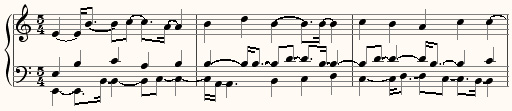
Since the piece is for amplified harpsichord, there are no dynamics indicated, though in every other respect the notation is meticulous. And before influencing your perception of the piece by reading how it works, you can hear the ten-minute piece here, performed by harpsichordist Joyce Lindorff.
This is a work of art as abstract as Mondrian’s Composition No. 2, as Milton Babbitt’s Three Compositions for Piano or Webern’s Op. 24 Concerto. It is music about the logic of music – but its logic is perhaps easier to process audibly than Babbitt’s or Webern’s, and more playful. His interest sparked decades ago by Steve Reich’s early music and the logical processes of Tom Johnson, Paul Epstein has long nurtured an interest in attractive surfaces generated by tight, self-replicating melodies. 57:4/5/7 is spun from a 57-note series structured in such as way as to replicate itself every 4, 5, and 7 notes, as can be seen in this breakdown whose lower three lines correspond to the opening measures above:

However, Paul’s music is never as mechanical as this correspondence suggests. Like many of his pieces, 57:4/5/7 is kind of a theme and variations on a logical concept. As you’ve heard or will hear, it changes key, it goes through a series of different textures, sprouts melodies, and its 16th-note momentum speeds up to various densities. Rarely does Paul simply set a process in motion and let it run. I sometimes call him “the postminimalist Babbitt†because of the ingenuity he expends twisting these logical constructs into an obvious-sounding but elusive series of processes. (And contrary to what you may assume, Babbitt is the composer of many pieces I have long been fond of.)
What I get from Paul’s music is a pleasurable but slightly exasperating feeling that I could figure out what the music’s doing if I could just listen a little harder. Motives repeat, tunes emerge, voices echo in canon, and I keep thinking that the piece will resolve into something obvious any minute now. This is a common experience for postminimalist music, which, more than totalism, has often become a strategy for setting up cognitive dissonances. In its most intricate form (of which Esptein is the extreme and William Duckworth another strong example), it tends to create structures that sound consistent and logical, but in such a way that the ear can’t quite tease out where the logic comes from.
It seems to me that postminimalism, and to a lesser extent totalism, have suffered in the public ear from having flourished at a time when formalism had acquired a sour reputation, following the long-awaited demise of 12-tone music. After I wrote the article “Downtown Beats for the 1990s†that sparked recognition of totalism, one of my Midtownish composer friends (Scott Wheeler) remarked with surprise, edged with disapproval, that “the Downtowners seemed to pick up where the Darmstadt composers had left off.†It’s true that postminimalism and totalism were united by the exploration of technical devices, as a way of creating a new musical language. Outsiders to the style have not had much patience for this particular aesthetic goal over the last 25 years. Even though serialism’s strictly formalist period was the 1950s, and it had evolved into something else by the 1970s, it created an understandable public perception that to “merely†play with formal structures was an intellectual self-indulgence, an elitist retreat into professional concerns. Minimalism was sometimes formalist too, of course, but its processes were so perceptually obvious as to be self-effacing – so exaggeratedly foregrounded, one might say, that you forgot about them. Postminimalism certainly attracted some composers – Janice Giteck, Elodie Lauten, Daniel Lentz – whose music dealt with political issues and diverse cultural influences. But the emphasis of the music, and its most original features, were on aspects of musical material, process, and syntax.
The 1980s – decade of performance art and world music – were all about teasing out music’s political significance, under a deconstructionist-driven assumption that one could read a person’s politics, conscious and unconscious, in the structure of a work. Abstraction seemed exposed as the irrelevant mind-game of privileged white males. It has certainly been that, at times. But one of the pendulums that swings back and forth in the history of art is that between society’s claim on artistic meaning and art’s own need to define its inner principles. Perhaps postminimalism picked an inauspicious cultural moment to develop a new musical language of auditory illusions based on minimalism. But at some point people will once again become fascinated by music’s inner workings, and when this happens, I hope there will be some recognition of all the wonderful territory postminimalism has explored.