
Totalist Orchestration

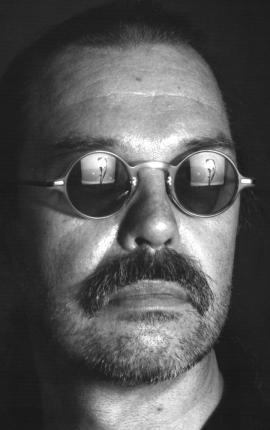
jarvinen.jpg Composer Art Jarvinen, known as “the West-Coast totalist” (poor guy, he never got to come to any of the parties), writes to remind me, in detailing qualities of totalist music, that there was a characteristic totalist instrumentation as well as rhythmic style:

For totalist music to really work requires an edge. A lot of totalist composers have guitar or saxophone or electric keyboards (Rhodes, Hammond, Mini-Moog), or drum set, as their main instrument. I wrote for chromatic harmonica and baritone sax. I don't want to hear a totalist piece for the Berlin Philharmonic, I want to hear Icebreaker, or the Berlin Phil-Harmonica Band! That's why the Bang on a Can All Stars have an electric guitar. And Evan Ziporyn plays bass clarinet as if it were a Stratocaster! My totalist rhythmic/contrapuntal ideas and techniques might work with a string quartet, more or less. But my "totalist" pieces, if we are to call them that, work best with more vernacular (less standard/classical) instrumental combinations, that provide a certain edge not available in the standard instrumental groupings that are all about blend and balance. Balance? That's why we have a guy at the mixing board!

When we recorded [Art’s piece] Clean Your Gun, I could hardly get the engineer to do what I wanted, which was, run the harmonica, cello, violin, and baritone sax through guitar amps, crank 'em up, and mic the amps. He didn't want to do it, even though I was paying him to. I had to tell him, it's my piece, we're going to take a bit of paint off the walls, and you just get it on tape! There is a clarity in amplification, vernacular instrumentation, and players who play like rock musicians - i.e. with a soloistic attitude and stage presence - that I would consider a vital and indispensable factor in the development and successful delivery of the totalist style. I would probably not have written any of my totalist pieces if I didn't have access to the instrumental doublings of the E.A.R. Unit. They just wouldn't sound right.

It’s true, there was generally a kind of mixed, all-or-partly amplified ensemble sound that made those pieces come off. Just as Nancarrow had to harden his piano hammers to keep his counterpoint masses from softening into mush, totalist music needed amplification and instruments with percussive attacks to bring off the gear-shifting tempo contrasts.

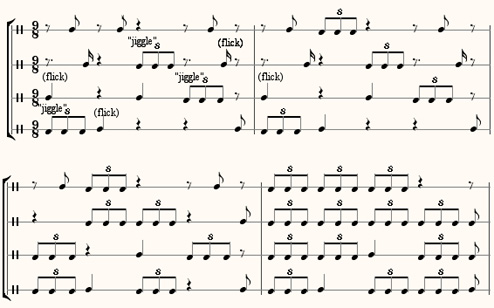
Although I might also mention that one of Art’s most rhythmically inventive works, The Paces of Yu (1990), was scored for solo berimbau (a simple Brazilian stringed instrument) accompanied by pencil sharpeners, window shutters, plucked wooden rulers, wooden boxes, mousetraps, and fishing reels. Here’s a small excerpt from the score, showing a section for flicked and jiggled window shutters. It employs a fairly common totalist or metametric rhythm, triplets in odd-numbered meters, so that downbeats contradict the momentum set up by the triplets, and also a gradual rhythmic process, showing the inheritance from minimalism:
Paces.jpg

And here’s a recording, courtesy of the California Ear Unit and O.O. Discs. (Warning, the opening is very soft for a few minutes.) It's hardly a sonically typical totalist example, but a suitably whacky bit of pure Jarvinen.

January 7, 2006 10:07 PM | | Comments (2)

Categories:

2 Comments

Marvellous piece! These examples also illustrate a concomitant trend in postclassical music, parallel to the change from simpler duple/triple rhythms to simultaneous higher prime (7 against 11, say) or relatively prime (9 against 8, say) meters. Namely, a change in the orchestration of western music from sustained harmonic series timbres with relatively slow or moderate attack times (strings, voices, woodwinds) to percussive instruments with inharmonic timbres and extremely rapid attack times: in this case, pencil sharpeners, window shutters, plucked wooden rulers, wooden boxes, mousetraps, and fishing reels.

Indeed, much totalist (metametric) music tends to employ a wealth of percussive timbres not found in the typical Euro/North American classical orchestral ensemble. A glance at the music of Michael Gordon or Louis Andriessen suffices to show the trend. One obvious reason for using percussive timbres? To acid-etch metametric rhythms into the listener's ear. But inharmonic percussive timbres also serves the secondary function of bending western rules of harmony, since inharmonic percussive timbres fail to generate the euphony we expect from major or minor triads.

As the instrumentation of post-classical music moves from harmonic-series sustained timbres to inharmonic percussive sound-colours, we exit the demesne of Euro/North American art music and enter the realm of non-Western music. This has melodic and harmonic as well as rhythmic implications, for outside of India and Europe/North America, no other indigenous musical culture on earth uses tertian triadic harmonic progressions or 12 roughly equal pitch divisions of the octave. (For convenience let us lump Iceland in with Europe/North America, whilst recognizing that Icelandic pitch-systems characteristically employ distinctly non-western neutral seconds of roughly 150 cents http://shoko.calarts.edu/KVAEDASKAPUS/.main.html just as Chinese music characteristically uses non-western neutral thirds of roughly 350 cents as well as non-Western 150-cent neutral seconds http://www.shayda.net/barbad.html ) And the use of non-western pitch systems likely relates to the prevalence of inharmonic timbres in non-western music, as William Sethares has noted in Timbre, Tuning, Spectrum, Scale, Springer-Verlag, 1994.

Thus, metametric (totalist) music represents not only a gateway to non-western rhythms but also to non-western musical timbres and non-western tunings. Parenthetically, "Non-Western" is shorthand here for "outside traditional common practice period European/North American pitch and rhythmic paradigms from roughly 1490 with the introduction of meantone to roughly 1929-1931 with the advent of Varese's Ionisation, the first Western composition orchestrated entirely for percussion instruments."

This may also help explain why the uptown New York Lincoln Center crowd continues its futile effort to deny the legitimacy of totalist/metametric music. Once the Pandora's box of non-Western pitch systems gets yanked open by contemporary western composers, the entire classical European art music scene starts to look like some soccer hoolies all jammed into one very crowded council housing flat in the midst of a vastly larger city named "World Music."

Great commentary, Jean! Your thoughts definitely make me want to know more about you and your music - any links or direction you'd care to share?

And thanks, Kyle, for shining your light on all these otherwise neglected areas of art that has actually occurred.

Cheers,
Jon

Leave a comment

Sites To See

Postclassic Radio! - Kyle Gann's internet radio station that accompanies the blog; see the playlist at kylegann.com

American Mavericks - the Minnesota Public radio program about American music (scripted by Kyle Gann with Tom Voegeli)

Kalvos & Damian's New Music Bazaar - a cornucopia of music, interviews, information by, with, and on hundreds of intriguing composers who are not the Usual Suspects

Iridian Radio - an intelligently mellow new-music station

New Music Box - the premiere site for keeping up with what American composers are doing and thinking

The Rest Is Noise - The fine blog of critic Alex Ross

William Duckworth's Cathedral - the first interactive web composition and home page of a great postminimalist composer

Mikel Rouse's Home Page - the greatest opera composer of my generation

Eve Beglarian's Home Page - great Downtown composer

Just Intonation Network - a meeting place for people interested in alternative tunings

Erling Wold's Web Site - a fine San Francisco composer of deceptively simple-seeming music, and a model web site

The Dane Rudhyar Archive - the complete site for the music, poetry, painting, and ideas of a greatly underrated composer who became America's greatest astrologer

Utopian Turtletop, John Shaw's thoughtful blog about new music and other issues

About this Entry

This page contains a single entry by PostClassic published on January 7, 2006 10:07 PM.

Metametric Mysteries Cleared Up was the previous entry in this blog.

More Evidence, If Evidence Were Needed is the next entry in this blog.

Find recent content on the main index or look in the archives to find all content.

AJ Ads

Introducing
AJ Arts Blog Ads

Now you can reach the most discerning arts blog readers on the internet. Target individual blogs or topics in the ArtsJournal ad network.

Advertise Here

AJ Blogs

AJBlogCentral | rss

culture
About Last Night
Terry Teachout on the arts in New York City
Artful Manager
Andrew Taylor on the business of arts & culture
blog riley
rock culture approximately
CultureGulf
Rebuilding Gulf Culture after Katrina
Dewey21C
Richard Kessler on arts education
diacritical
Douglas McLennan's blog
Flyover
Art from the American Outback
Life's a Pitch
For immediate release: the arts are marketable
Mind the Gap
No genre is the new genre
Rockwell Matters
John Rockwell on the arts
Straight Up |
Jan Herman - arts, media & culture with 'tude

dance
Foot in Mouth
Apollinaire Scherr talks about dance
Seeing Things
Tobi Tobias on dance et al...

jazz
Jazz Beyond Jazz
Howard Mandel's freelance Urban Improvisation
ListenGood
Focus on New Orleans. Jazz and Other Sounds
Rifftides
Doug Ramsey on Jazz and other matters...

media
Out There
Jeff Weinstein's Cultural Mixology
Serious Popcorn
Martha Bayles on Film...

classical music
The Future of Classical Music?
Greg Sandow performs a book-in-progress
On the Record
Exploring Orchestras w/ Henry Fogel
Overflow
Harvey Sachs on music, and various digressions
PostClassic
Kyle Gann on music after the fact
Sandow
Greg Sandow on the future of Classical Music
Slipped Disc
Norman Lebrecht on Shifting Sound Worlds

publishing
book/daddy
Jerome Weeks on Books
Quick Study
Scott McLemee on books, ideas & trash-culture ephemera

theatre
Drama Queen
Wendy Rosenfield: covering drama, onstage and off
lies like truth
Chloe Veltman on how culture will save the world
Stage Write
Elizabeth Zimmer on time-based art forms

visual
Aesthetic Grounds
Public Art, Public Space
Artopia
John Perreault's art diary
CultureGrrl
Lee Rosenbaum's Cultural Commentary
Modern Art Notes
Tyler Green's modern & contemporary art blog
Creative Commons License
This weblog is licensed under a Creative Commons License.