
Nested 3:2 Addendum
For whatever reason, I was never much drawn to the type of nested 3:2 and 4:3 crossrhythms that I described in my last metametrics post, but I did use it once, and could have mentioned it. In 1985, on the verge of turning 30, I was under some psychological pressure to write something ambitous. I decided on a big set of variations for two pianos, somewhat inspired by the two-piano tradition of Busoni’s Fantasia Contrappuntistica, Wallingford Riegger’s Variations, The Art of Fugue, and such huge solo piano variations as the Diabelli and Brahms’s Handel. (This was before Larry Polansky wrote his Lonesome Road Variations, which dwarfed mine.) My I’itoi Variations was a set of eleven variations on the “Black Mountain” song from the I’itoi cycle of the Papago Indians. I was very involved in collecting, transcribing, and analyzing American Indian music in those days, because I was attracted to its, um, proto-totalist rhythmic character - specifically the way it shifted back and forth among tempos.
Another influence on I’itoi Variations (and on much of my music) was Beethoven’s Op. 111 Sonata - variations 1 through 6 were stormy and tense like Beethoven’s first movement, variations 7 through 10 were impersonal and calm like the second movement, and no. 11, in an attempted tour de force, went back through the first ten variations in reverse order. Variation 8 was based on a nested 3:2. The idea was simple. (I try to make all my ideas simple). There were two foreground lines, the bass line in piano 2 and the right-hand melody of piano 1, plus a line of quarter-note chords shared by both pianos. The bass was in dotted quarters, the treble in triplet quarters, for a 4:6:9 tempo resultant. I hoped the treble and bass would float in seeming unrelatedness to each other, though subtly mediated by the chords in between. Here’s a passage from the beginning of the variation:
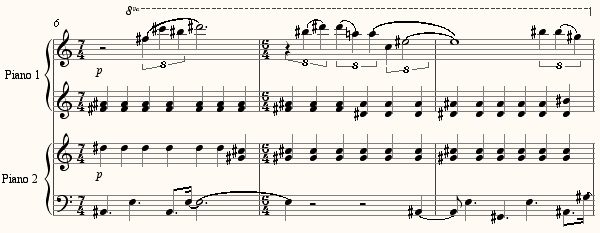
and another from the end, where the treble and bass lines have doubled in tempo:
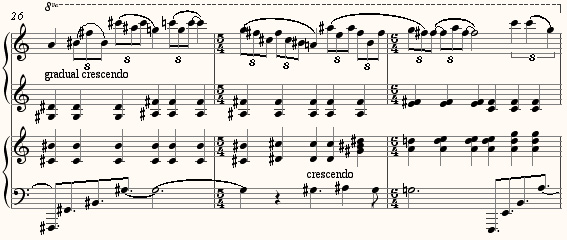
The bass line is the inversion of the theme, with the intervals doubled in size (a trick I picked up from Messiaen’s bird song music). I suppose it won’t much harm my reputation to admit that the changes of key are timed according to a descending sequence of Fibonacci numbers. Everyone who studied Bartok’s music had to try them once. This was back in 1985 when I had not yet heard of Mikel Rouse, Michael Gordon, or Art Jarvinen, and was blissfully unaware that they were using the same ideas.
Here’s the recording of Variation 8 from I’itoi Variations, played by the Double Edge duo - Nurit Tilles and Edmund Niemann, who premiered it at Cooper Union in New York circa 1990.
Categories:
Sites To See
American Mavericks - the Minnesota Public radio program about American music (scripted by Kyle Gann with Tom Voegeli)
Kalvos & Damian's New Music Bazaar - a cornucopia of music, interviews, information by, with, and on hundreds of intriguing composers who are not the Usual Suspects
Iridian Radio - an intelligently mellow new-music station
New Music Box - the premiere site for keeping up with what American composers are doing and thinking
The Rest Is Noise - The fine blog of critic Alex Ross
William Duckworth's Cathedral - the first interactive web composition and home page of a great postminimalist composer
Mikel Rouse's Home Page - the greatest opera composer of my generation
Eve Beglarian's Home Page - great Downtown composer
Just Intonation Network - a meeting place for people interested in alternative tunings
Erling Wold's Web Site - a fine San Francisco composer of deceptively simple-seeming music, and a model web site
The Dane Rudhyar Archive - the complete site for the music, poetry, painting, and ideas of a greatly underrated composer who became America's greatest astrologer
Utopian Turtletop, John Shaw's thoughtful blog about new music and other issues
AJ Ads
AJ Arts Blog Ads
Now you can reach the most discerning arts blog readers on the internet. Target individual blogs or topics in the ArtsJournal ad network.
Advertise Here
AJ Blogs
AJBlogCentral | rssculture
Terry Teachout on the arts in New York City
Andrew Taylor on the business of arts & culture
rock culture approximately
Rebuilding Gulf Culture after Katrina
Richard Kessler on arts education
Douglas McLennan's blog
Art from the American Outback
For immediate release: the arts are marketable
No genre is the new genre
John Rockwell on the arts
Jan Herman - arts, media & culture with 'tude
dance
Apollinaire Scherr talks about dance
Tobi Tobias on dance et al...
jazz
Howard Mandel's freelance Urban Improvisation
Focus on New Orleans. Jazz and Other Sounds
Doug Ramsey on Jazz and other matters...
media
Jeff Weinstein's Cultural Mixology
Martha Bayles on Film...
classical music
Greg Sandow performs a book-in-progress
Exploring Orchestras w/ Henry Fogel
Harvey Sachs on music, and various digressions
Kyle Gann on music after the fact
Greg Sandow on the future of Classical Music
Norman Lebrecht on Shifting Sound Worlds
publishing
Jerome Weeks on Books
Scott McLemee on books, ideas & trash-culture ephemera
theatre
Wendy Rosenfield: covering drama, onstage and off
Chloe Veltman on how culture will save the world
Elizabeth Zimmer on time-based art forms
visual
Public Art, Public Space
John Perreault's art diary
Lee Rosenbaum's Cultural Commentary
Tyler Green's modern & contemporary art blog

1 Comments
Leave a comment