
Meter: the Postclassical Paradigm

During Bard's Janacek festival a couple of years ago, I became rather impressed with that composer's textural and tonal originality, especially upon realizing that I had always thought of him as a 20th-century composer and he was actually born in 1854. So awhile later, browsing at Patelson's in New York, I ran across the sheet music to Janacek's On an Overgrown Path - the piece that the well-known eponymous blog is named for, I suppose - and picked it up. It sat on my piano for months, but since I moved to a new house, my Steinway has developed a terrible case of sticking notes, rendering it unsatisfying to play, and piano tuner time is at a dear premium up here. So at an odd moment I finally decided to listen to the new ECM recording of the piece with AndrĂ¡s Schiff while following the score. It's a lovely recording - except that Schiff can't handle the 5/8 meters that come up in a couple of movements. He plays this passage:
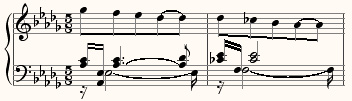
Janacek.jpg

by speeding up the first three 8th-notes notes and prolonging the last two (even extending the left-hand D-flat into a quarter-note), turning the meter into a more conventional 6/8, as you can hear here, and disappointingly taking the edge off of Janacek's rhythmic originality. (In fact, when the music reverts to 2/4 in the 5th measure, Schiff's 8th-note suddenly slows down by 50 percent, making it clear that he was feeling the 5/8 as 2/4 with triplets all along.)

This wouldn't merit mentioning if it weren't so common. Classical musicians are taught early in life that a measure is a rhythmic unit, divided into two or three parts, and if divided into more, then divded according to a symmetrical heirarchy: 2 groups of 2, 2 groups of 3, 3 groups of 3, and so on - or not and so on, because that's about it. Of course, quite early in the 20th century - On an Overgrown Path is a hundred years old - composers opened up a new conception of meter, as a quantity of equal or even unequal units. Musicians accustomed to playing composers as long-dead as Stravinsky and Copland are used to negotiating 5/8 and 7/8 meter, but it's surprising how many professional musicians have never added the new paradigm to their repertoire. They recognize it and think they know how to do it, but when they start to play, their body-need for a regular beat, like Schiff's, overrules their visual cognition. I have to warn my students, some of whom gravitate to 13/16 and similar meters under the influence of notation-software-induced ease, that some classical players will have to be taught how to play the rhythm, and that they might not be teachable. Recently a student wrote a passage in 10/8 meter, with the following quite elegant rhythm that required four beats per measure, quarter-notes on 1 and 3 and dotted quarters on 2 and 4:

10-8.jpg

It seemed perfectly simple to him and me, but the performance, by professional players steeped in 19th-century music, was a disaster. They ended up speeding the non-triplet 8th-notes into triplets, and making it a kind of bumpy 4/4. No amount of pleading could get them to feel successive beats as unequal.

I face the same mentality when I show people my Desert Sonata for piano, which has a long moto perpetuo passage in 41/16 meter. Certain people look at it and exclaim, incredulously, "How do you COUNT that?!" Well, of course, you don't count it, but if you will play the 16th-notes evenly and in the order indicated, I promise it will come out all right. What they want, of course, is some heirarchical division of 41 that they can funnel all those 16th-notes into, and there just isn't one. (Please don't be tiresome and advise me to renotate it in 4/4 - the 41/16 clarifies the underlying isorhythm, and mangling it into 4/4 would turn it into an unmemorizable mishmash.) By now this new metric paradigm is very common among young composers - Sibelius notation software will handle meters up to 99/32 just as easily as 4/4 - and so it's astonishing to still find it so missing in classical music pedagogy. In 1947 Nancarrow turned to the player piano because the musicians he met couldn't play the comparatively simple cross-rhythms he was writing. Were he to come back today, there are circles in which he would find that things haven't improved much.

November 27, 2005 9:17 AM | | Comments (7) |

Categories:

7 Comments

Just to play devil's advocate here. When you notate your compositions, do you notate for the performer's ease, or the composer/musicologist's ease? I always opt for the performer's, since I'd rather make it easier for the them and have a good performance, than a score that makes it easier for analysis. Of course, since most of my pieces have staggered entrances, the meter doesn't make all that much difference anyway. I also find that using phrase markings over a number of measures works better for most musicians than tricky meters, with the side benefit that beat duration isn't altered so readily that way.

Making the meaning of the music clear to the performer is the absolute top criterion, without exception.

It's an interesting problem, and I suppose one we all struggle with to one degree or another. Personally, if I have to choose between making the meaning clear to the performer and making the music sight-readable, I will opt for the latter, figuring that meaning will make itself apparent if the notes are played correctly.

But the example you give of Schiff's distortions -- that's inexcusable. In fact, all three examples you give here (janacek, your student, Desert Sonata) should be easily graspable by experienced performers.

This reminds me of an incident from high school band days. We were rehearsing a piece that was in 7/8 and to "help" us, the director called out the counts "one-two-three-four-five-six-sev-en" (ie 8/8) and got quite upset that many of us were'nt following him. With regards to Schiff, I think that it help prove my theory that most western Europeans are rhythmically challenged. I think a class in Bulgarian dance should be a requirement for all performance majors, so they can get a feel for "Aksak" rhythms!

To add to the Schiff example, I recently got a CD with Stokowski's c.1948 recording of "Sensemaya" by Silvestre Revueltas. If my ear is correct, Revueltas' 7/8 meter is turned into 4/4 for much of the piece with the addition of an extra eighth note per measure. Stokowski then tries to cover this up by taking the piece at the speed of light so that the difference between 7/8 and 4/4 (8/8) is only a fraction of a second. (His solution to the "problem" of the alternating 7/8 and 7/16 meters in the second section of the piece is also pretty funny.)

Just getting around to reading the far back issues of your blog but this was such a pleasant and familiar topic and so inspiring to me that I had to write something. I used to write a lot of meters with fractional bits - you know, 4 1/2 beats of 4 for example - which seemed to be the correct notation for the music. It was supposed to sound like a little bit was dropped off the end - of a normal 5/4 measure in the above case - but I couldn't get conductors to beat it that way, even though it seemed really straightforward to me. They all wanted to make it 2/8 + 2/8 + 2/8 + 3/8, which is of course the same length but hardly the same feel. I think the hiccuping rhythms in the Concord Sonata may have been the first place that made me think about using such things, but didn't Led Zeppelin take these kind of rhythms to the masses in the 70s? In what universe did these people all grow up? And why have I allowed them to browbeat me into their way of thinking? On this day, I take a solemn vow to subjugate myself no longer!

I ran into this trying to notate the unbelievable song "Storise Khoro Goliamo" as recorded by Mita Stoycheva in the 20's. Technically it's 7/8, but the last unplayed beat is more of an airborne skip, and you don't know when you're going to land. It's the opposite of a rest.

luckily we do have a variant of the oral tradition & I can't recommend this disc highly enough: http://www.amazon.com/Song-Crooked-Dance-Bulgarian-Traditional/dp/B000005ZC8

Leave a comment

Sites To See

Postclassic Radio! - Kyle Gann's internet radio station that accompanies the blog; see the playlist at kylegann.com

American Mavericks - the Minnesota Public radio program about American music (scripted by Kyle Gann with Tom Voegeli)

Kalvos & Damian's New Music Bazaar - a cornucopia of music, interviews, information by, with, and on hundreds of intriguing composers who are not the Usual Suspects

Iridian Radio - an intelligently mellow new-music station

New Music Box - the premiere site for keeping up with what American composers are doing and thinking

The Rest Is Noise - The fine blog of critic Alex Ross

William Duckworth's Cathedral - the first interactive web composition and home page of a great postminimalist composer

Mikel Rouse's Home Page - the greatest opera composer of my generation

Eve Beglarian's Home Page - great Downtown composer

Just Intonation Network - a meeting place for people interested in alternative tunings

Erling Wold's Web Site - a fine San Francisco composer of deceptively simple-seeming music, and a model web site

The Dane Rudhyar Archive - the complete site for the music, poetry, painting, and ideas of a greatly underrated composer who became America's greatest astrologer

Utopian Turtletop, John Shaw's thoughtful blog about new music and other issues

About this Entry

This page contains a single entry by PostClassic published on November 27, 2005 9:17 AM.

What They Get Away With in Lit'ratyoor was the previous entry in this blog.

Warning: Bloggers Blogging Bloggers is the next entry in this blog.

Find recent content on the main index or look in the archives to find all content.

AJ Ads

Introducing
AJ Arts Blog Ads

Now you can reach the most discerning arts blog readers on the internet. Target individual blogs or topics in the ArtsJournal ad network.

Advertise Here

AJ Blogs

AJBlogCentral | rss

culture
About Last Night
Terry Teachout on the arts in New York City
Artful Manager
Andrew Taylor on the business of arts & culture
blog riley
rock culture approximately
critical difference
Laura Collins-Hughes on arts, culture and coverage
Dewey21C
Richard Kessler on arts education
diacritical
Douglas McLennan's blog
Dog Days
Dalouge Smith advocates for the Arts
Flyover
Art from the American Outback
Life's a Pitch
For immediate release: the arts are marketable
Mind the Gap
No genre is the new genre
Performance Monkey
David Jays on theatre and dance
Plain English
Paul Levy measures the Angles
Real Clear Arts
Judith H. Dobrzynski on Culture
Rockwell Matters
John Rockwell on the arts
Straight Up |
Jan Herman - arts, media & culture with 'tude

dance
Foot in Mouth
Apollinaire Scherr talks about dance
Seeing Things
Tobi Tobias on dance et al...

jazz
Jazz Beyond Jazz
Howard Mandel's freelance Urban Improvisation
ListenGood
Focus on New Orleans. Jazz and Other Sounds
Rifftides
Doug Ramsey on Jazz and other matters...

media
Out There
Jeff Weinstein's Cultural Mixology
Serious Popcorn
Martha Bayles on Film...

classical music
The Future of Classical Music?
Greg Sandow performs a book-in-progress
On the Record
Exploring Orchestras w/ Henry Fogel
Overflow
Harvey Sachs on music, and various digressions
PianoMorphosis
Bruce Brubaker on all things Piano
PostClassic
Kyle Gann on music after the fact
Sandow
Greg Sandow on the future of Classical Music
Slipped Disc
Norman Lebrecht on Shifting Sound Worlds

publishing
book/daddy
Jerome Weeks on Books
Quick Study
Scott McLemee on books, ideas & trash-culture ephemera

theatre
Drama Queen
Wendy Rosenfield: covering drama, onstage and off
lies like truth
Chloe Veltman on how culture will save the world

visual
Aesthetic Grounds
Public Art, Public Space
Another Bouncing Ball
Regina Hackett takes her Art To Go
Artopia
John Perreault's art diary
CultureGrrl
Lee Rosenbaum's Cultural Commentary
Modern Art Notes
Tyler Green's modern & contemporary art blog
Creative Commons License
This weblog is licensed under a Creative Commons License.