
Near the beginning of T. S. Eliot’s “Portrait of a Lady” there are these lines:
“We have been, let us say, to hear the latest Pole
Transmit the Preludes, through his hair and fingertips.”
Were those the celebrated red locks of Paderewski? Like many Poles playing the piano, he specialized in Chopin. There were so many Chopinists in the 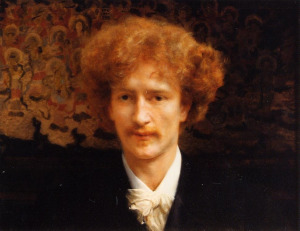 early years of the twentieth century — just as sound recording really got going — that, although we don’t know how the players of the 1840s sounded when they played Chopin’s music, we do have a lot of recorded evidence of the playing of the 1920s and 1930s. This forms a (somewhat anachronistic) performance-practice reference-collection for this repertory.
It can be intimidating. Before we play the Nocturne, opus 55, number 2, we might be thinking of Ignaz Friedman’s 1936 recording. (And some players imitate it.) There are pianists who avoid the Fourth Ballade because of Josef Hofmann’s overwhelming 1938 account.
Several years ago, in my essay “Exorcising Volodya,” I described my efforts to remove, from my performances of Chopin’s Polonaise-fantaisie, details from Vladimir Horowitz’s 1966 recording — details I imitated even though I didn’t like them. Recently, as I have studied the Polonaise-fantaisie again, I’ve been thankful there are no early twentieth-century recordings of it. We can wonder how Friedman, Hofmann, or Alfred Cortot, may have played the piece. But, either because of technology — it would have required several recorded “sides,” like a concerto — or perhaps because of this piece’s reputation as discursive, none of the old players put it onto shellac.
Our sense of music is colored by when and how it entered the recorded repertoire — even if we are not specifically aware of the first recordings. Do we have a more “modernist” view of the Polonaise-fantaisie than we might have of Chopin’s First Ballade — because the Polonaise-fantaisie was not recorded until after World War Two?
I always enjoy references to old perfomances from great artists.
I wonder what the Polonaise-Fantasie sounded like when composed, to ears of the time. Those were the days: when Liszt called it pathological! You might find this 1974 “pirate” of Horowitz playing it, on my Youtube: http://www.youtube.com/watch?v=2PSjmsrSSQk
I imagine the opinion of the Polonaise-fantaisie written in Liszt’s book about Chopin might be the thinking (or even the words) of the Princess…
I imagine that the disparity of approaches in the playing of pianists before the first sounds were captured by wax cylinders must have been extraordinary: if the only points of reference were public performances (unless there was a direct affiliation with a composer), the only way to reproduce a musical idea experienced directly was through memory – the memory of a public performance, for instance (which may have been radically different from any other one, even by the same performer, I suppose). But today the idea of relying on recordings to form an opinion about what a piece sounds like entails the possibility of repeating that listening experience over and over – we just push a button.
Learning a piece 150 years ago in most cases may have just been about buying a score and reading it for the first time with an open mind, devoid of any preconceived notion. Today, most of us choose repertoire because we are already in love with certain pieces, which we have come to know through recordings. For comparison purposes, we even own many recordings of the same pieces. Inevitably, these listening experiences affect us in the way we conceive our interpretations. Sometimes we emulate certain details that we find appealing; sometimes we simply end up sounding like the recording; sometimes we even copy misreadings!
I grew up with several recordings by Friedman – especially the Nocturne Op. 55. no. 2, possibly the most extraordinary recording of the piece, which I simply adored. I never learned this Nocturne, but I know that much of my conception, even after two decades, would be affected by the strong memories associated with this recording. Should I learn it, I’m quite sure I would probably go back to the recording to confirm that, indeed, that’s how I remembered it.
On a completely different note, I’m aware that Rubinstein recorded the Polonaise Fantaisie in 1934 – slightly more athletic than the two other versions, recorded in 1954 and 1964 respectively. It is, I believe, the first recording ever made of the piece.
Thank you Roberto for pointing out the existence of the 1934 Rubinstein recording! I believe this changes my sense of the reception of this music.
Negativity, that’s all it is about. Eliot looks at the negative side of life but through his use of language techniques, the colourless visions, which he brings across, are so vividly clear.
completely agree with Shan