
Because Alvin Ailey American Dance Theater has tended to extrapolate badly from its founder’s aesthetic and ethos, I forget every year what a strong craftsman Ailey was. Even when he was tired, the work had merit. Revelations is always my first reminder of his craft–and, no, he wasn’t tired for that–followed this year by Cry, Night Creatures, and the final section of Three Black Kings. In fact, Ailey produced relatively little dreck. (I’d put Memoria on that list and maybe Flowers and most of The River.)
In the three reviews I wrote for the Financial Times on the current season (through January 2), I found myself wanting mainly to write about the Ailey contribution even when there was a premiere on the program.
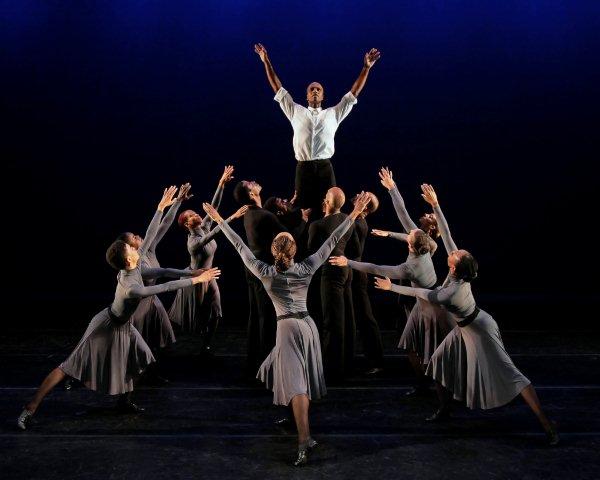
Here is my review of the best premiere of the season, Christopher Huggins’ Anointed. I situate it in terms of the Revelations legacy as I see it:
At Revelations on Friday, the gloriously craggy singer Ella Mitchell belted out the gospels while Judith Jamison in conductor mode coaxed a low, spooky sound from the chorus and students from the Ailey school dashed into the auditorium to mirror the drama onstage.
When the dancers slapped the air with their fans and threw back their heads to “Rocka My Soul”, the audience jumped up, ecstatic. Though they always rise for Revelations – it has become part of the ritual – this time the packed house was possessed.
Whether Revelations cracks the fourth wall or not, its mix of blood memory, pilgrim’s progress, popular music and populist faith has served as lodestar for the company repertory, though most works isolate a single strand from those that Revelations miraculously entwines.
The five-week City Center engagement includes snapshots of the Harlem Renaissance (Matthew Rushing’s Uptown) and spontaneous subway dramas (Camille Brown’s Groove to Nobody’s Business); glorified dance parties (George Faison’s Suite Otis and the team effort Love Stories); works to Ellington and Gillespie, played live by Wynton Marsalis and company; and spiritual journeys, the most recent of which surely contributed to the glowing mood on Friday.
Ailey alumnus Christopher Huggins’s Anointed creates its fervour via the swift, seamless partnering, stretched limbs and curving torso, and constant motion of contemporary ballet. The idiom risks soporific sameness and relentless emotionality, and Anointed‘s Moby soundtrack – like light at the end of the tunnel minus the tunnel – certainly pushes in that direction.
From left, the gorgeous women of Ailey: Rosalyn Deshauteurs, Olivia Bowman-Jackson, Ghrai DeVore, and
Demetia Hopkins in Christopher Huggins’s Anointed. Photo by Paul Kolnik.
But the choreography is so enlivened by flight – the women gathered into the men’s arms like flower buds or suspended overhead like birds- and so awake to human dignity that it escapes a banal end….
Click here for the whole Anointed review.
And here is a review of the season’s opening night, with the company premiere of artistic director in waiting (as my esteemed and witty colleague Roslyn Sulcas has put it) Robert Battle’s manly Hunt. But again Revelations distracted me, getting me thinking about what could possibly have been so misunderstood about Ailey’s aim to justify such awful contributions from his peers and progeny (with the big exception of Ronald K. Brown).
The company is in the mood for self-love. Last season it celebrated artistic director Judith Jamison’s 20th anniversary with a premiere dedicated to her “spirit” and a greatest hits compilation of works commissioned during her reign. Now it is throwing a year-long 50th birthday party for the dance to which it owes its reputation: the founding choreographer’s Revelations. There will be live accompaniment on several occasions, a version for a cast of 50, and a documentary by Judy Kinberg of Dance in America renown that prefaces each performance.It is hard to have an experience that has already been memorialised. By the time the curtain rose on the dancers on the glittery opening night, I only wanted to compare them with their screen versions. But I realised why Ailey dancers can reach outspread hands to heaven, while contestants on So You Think You Can Dance cannot. Even Ailey’s most overused gestures come with an aura of modernist faith. His belief in the distillation of emotion and story into spare lines imposes a restraint on his choreography – a sensual interiority – that saves it from kitsch.
But this saving grace depends on the dancers’ delivery. Too often…..
Here is the whole opening night review, for your delectation.
Finally, with Three Black Kings, revived in full for the first time in three decades, I am fully justified in going on about Ailey.
Three Black Kings has lain dormant almost since Alvin Ailey created it for a massive Duke Ellington celebration that he organised in 1976. The choreographer had made dances to the Duke from the beginning – Blues Suite, Reflections in D and a suite of works Ellington commissioned to accompany My People for the Emancipation Proclamation’s centenary in 1963. But when the composer died in 1974, Ailey outdid himself, creating eight pieces to his music in two years.
Saluting the King (Martin Luther, danced by Glenn Allen Sims). Photo by Paul Kolnik.
Three Black Kings is the genius jazzman’s last composition, completed by his son Mercer after his death. It is not his best work, nor Ailey’s. But both are good enough to justify this belated revival, especially when Wynton Marsalis’s Jazz at Lincoln Center Orchestra is in the house, as it was last week. In fact, the dance dwarfed everything else on Wednesday night: Billy Wilson’s Winter in Lisbon, a paean to 1940s nightlife that drowned Marsalis’s smoky, then bleating trumpet in a din of razzmatazz moves; Ulysses Dove’s Episodes, a portrait of mean-spirited anonymous sex; and artistic director-designate Robert Battle’s solo In/Side, its appealingly gawky vulnerability undermined by a repetitive structure.
For the first black king, the Nativity wise man Balthazar, Ellington alternates propulsive conga drum with piercing clarinet. To the drums Ailey sets bare-chested men whirling like dervishes. To the reed, the dancers bow luxuriously before their demigod king (Jamar Roberts, perfectly typecast). But the music’s lyrical solos do not merely announce the presence of royalty; they are a clarion call to a new order. Why else would the Magi “traverse afar”? Ailey sticks to Balthazar before he leaves home.
For Solomon, king number two, Ellington focuses not on the sage judge but on the lover of 700 wives and 300 concubines. So Clifton Brown comes out in a loincloth….
For the whole Black Kings review, click here.
Leave a Reply