
Hmmmm…. It must be something in the air–or in me–that the experimental works this month seemed too much between one thing and another, without ever wresting their own potent identity. They felt insufficiently steeped, like a stew that hasn’t sat and simmered long enough for the flavors to blend.
With Neil Greenberg’s (like a vase), the steps were precise yet coded, private, partial:
Neil Greenberg’s (like a vase)
begins with Ruth Draper – the mid-century monologist who set Lily
Tomlin on her course – impersonating a neoclassical PE teacher. She is
instructing her stout young female charges in the virtues of “Greek
poise”. The hour-long dance both shares this high-minded exerciser’s
aspirations and makes even more of a hash of them than her Isadorable
pupils probably did. I have never seen such well-wrought
inharmoniousness.
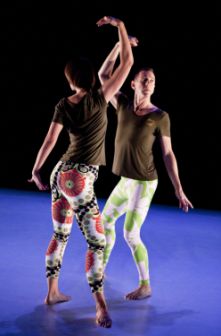
Johnni Durango and Greenberg. Photo by Yi Chun Wu
As soon as Johnni Durango shows up in garishly
patterned tights, which turn out to clash with the other five dancers’
equally garish ensembles, it is clear that the Greek columns
demarcating the space are a red herring. The choreography will offer
only momentary hallucinations of pattern and sense. As for the steps,
they abound in legs half straightened (or are they half bent?), feet
that would pound if they weren’t stuck on half point – in short, the
relentlessly incomplete. I glimpse snatches of flamenco, yoga, aerobics
and club dancing, executed as if stoned.Of
course, the bleariness is deliberate. The choreographer can do sharply
evocative when he wants. At hour’s end, for example, the dancers move
downstage to face every which way. For once, I know what their
formation is not: a line. Its absence hovers gorgeously over the
moment. More typical, though, is an episode in which two dancers blow
the dust off standing mikes as if preparing to sing; they do not. Most
of (like a vase) is a prelude or epilogue to an unrealised main event…..
For the rest of my Financial Times review on Greenberg, click here.
For Sasha Waltz, the problem was the lurch between factuality and storytelling, without metaphor in either:
Berliner Sasha Waltz’s influences are like her city used to be: divided. On one side is 1930s German expressionism, which also shaped Pina Bausch. On the other is the “just the facts, ma’am” structuralism of such Americans as Trisha Brown and Yvonne Rainer. Waltz, 47, has not tried to reconcile these polarities. She began her career making political dance theatre, then shifted to more architectural concerns, with the body the columns and posts, and Germany’s guilt-laden history in the shadows. For the first time with the nearly two-hour Gezeiten (Tides), for an international cast of 16, she brings the forms together.
Tides is about what happens when the things we take for granted – that the ground will remain firm, the ocean not overflow – no longer hold.
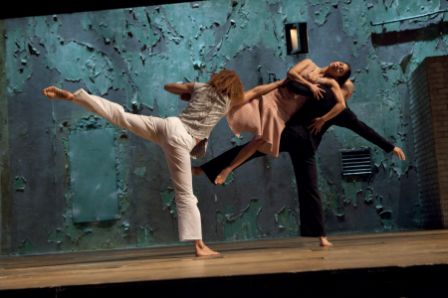
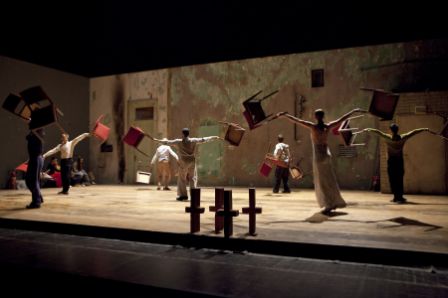
The dance begins serenely, with the dancers embodying the balance and order that will soon disintegrate. In twos and threes, they slink into the room of longtime Waltz set designer Thomas Schenk, the paint peeling and wood floors soft with wear. As the light passes through each time of day and Bach cello suites alternate with the whistling of the tide, the dancers pair up to form asymmetrical mobiles so carefully balanced that no clutching or clinging is necessary. Eventually the whole troupe arrays itself like a slant of dominoes.
Balancing. Photo by Richard TermineWhen the room goes black, we hear the sound of buckling, breaking and burning. When the lights come on again, the dancers are falling across the space and the doors are shut to keep disaster out.
No such luck. In the disproportionately long second act, Waltz subjects her crew to contamination, fire and earthquake…..
For the rest of my Financial Times review on Waltz, click here.
Jonah Bokaer’s Anchises fell in and out of theatrical time:
This rich collaboration between choreographer Jonah Bokaer and designers Ariane and Seth Harrison takes its name from the ailing father whom loyal Aeneas carries on his back from burning Troy. But the creators seem more interested in the ruins left behind and the Rome to come. Imagining the dancers as living structures as much as people, Anchises straddles architecture and dance, awkwardness and intrigue.
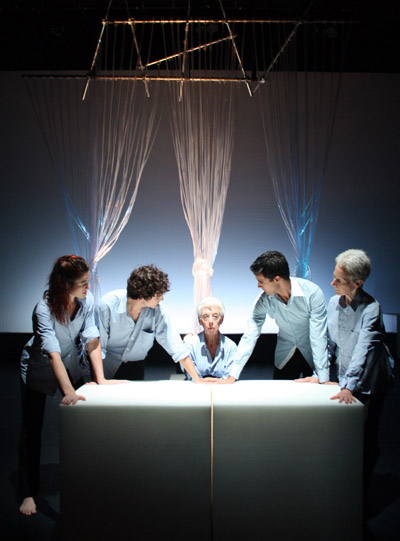
The most obvious allusion to Virgil’s cherished patriarch are Valda Setterfield, 76 and as arresting as ever, and a regal Meg Harper, 65 – both with Merce Cunningham in the 1960s and 1970s. The three much younger cast members occasionally lift the women on to their backs or shoulders or suspend them overhead.
More frequent, though, are tableaux not of dependence but of connection – a chain of dancers hand in hand, for example, with one sitting on the floor, the next kneeling, the third lunging, the fourth standing. Sometimes the dancers cluster like a family. Sometimes they face each other like a ballroom couple, with a few bodies sandwiched between. Sometimes large cubes take the place of people in these deliberative arrangements.
The effect is lovely yet static.
You do not feel the movement between generations or even the passage of time. In contrast, the swooping, arcing, twisting solos and duets for James McGinn and a stunning Catherine Miller sweep us into the moment. Off-kilter gravity and voluptuous force are not only unusual dynamics for the choreographer, they also bring into relief the older dancers’ circumscribed possibilities.Still, the mix of the dancey with the architectural risks inducing torpor in the viewer….
Click here for the rest of the Anchises review for the Financial Times.
With The AWARD Show!, the trouble was between artistic vision and expedience (We need a winner!):
Imagine So You Think You Can Dance without the flashing lights, screaming fans and millions of TV viewers, and voilà: The A.W.A.R.D. (Artists With Audiences Responding to Dance) Show!, where not the dancer but modern dance is the star.
The show’s aim is true: the top vote-getter of the 12 finalists
gleaned from some 200 entries wins $10,000, a fortune in this
cash-starved field. And since it began in 2005, the contest has caught
on, with editions in Chicago, Philadelphia, Los Angeles, San Francisco
and Seattle.So I wish this self-described “experiment in democratic ideals” did
not suffer from democratic realities as well, such as the sound-bite
mentality. The three dances voted on to the final night existed in a
vacuum, where world and dance history have no place. The popular vote
dredged up that hoary notion of modern dance as purveyor of timeless
psychological truths, decked out in allegory.Choreographer-dancer Yin Yue’s Torn combined in a single figure martial arts heroine and swamp princess. Satoshi Haga’s Thread, in
which two dancers kept their fingertips touching, veered from movement
exercise to arid symbol, with urgency and rich suggestion blessedly
intervening between those poles. Only choreographer Helen Simoneau’s
robotic solo was consistently layered. Playing with the history of
dolls in dance – The Nutcracker, Coppélia – she moved with a strangely sensual stiffness.
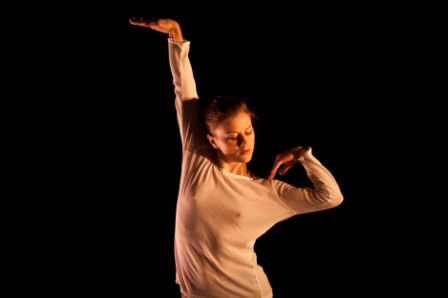 Helene Simoneau. Photo by Matthew Murphy.
And, reader, she won – though if it had been up to the hoi polloi
rather than the four expert panellists brought in for the last night,
who knows?Maybe the problem isn’t democracy but the balance of powers. The executive branch – the artist – needs beefing up…….
Click here for the rest of the AWARD review for the Financial Times.
Only with Keely Garfield, whose show is already a month old, was the betweenness gloriously to the point:
The International Ladies Garment Workers Union met in this East Village establishment (long before it was called the Duo). Yiddish-theatre idols clomped across its stage, with its gold-painted proscenium and murals of plump 18th-century ladies. Francis Ford Coppola shot a scene for The Godfather II here, and Andy Warhol organised porn movie nights. So why not London émigré Keely Garfield, whose MO is precisely the unlikely connection?
I will not hazard a summary of the choreographer’s latest tragicomic concoction, commissioned by Duo in its inaugural year as dance producer. Twin Pines has nothing so straightforward as a plot. If it is about anything, it is about painful, hopeful approximation – about making use of the materials at hand, however rudimentary or plasticky, to dream oneself out of despair.
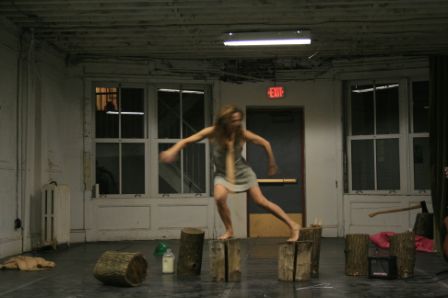
Twin Pines is organised around trees – or rather, this being Garfield, stumps. The stump symbolises the soul, the programme says – stunted, with the possibility of later growth.
The characters for the first act, in the studio above the theatre proper, include Brandin Steffensen’s stiff woodman, later enrobed like a king at a coronation in a fluffy pink sleeping bag; Anthony Phillips’s Zen master, coming to a bad end; dulcet-voiced folk singer and straight man Matthew Brookshire; and the indispensable Garfield.
Garfield between the stumps. Photo by Cyrus RaThese people attempt various metamorphoses. With coat hanger for crown and dangling shoelace as tinsel, Garfield becomes a queen, for example. The beige tool apron trailing between her legs serves as royal train. Later, a different kind of hanger (plastic and white) figures as leaves and she as a tree, rustling then wrestled to the ground and stripped by axe man and Zen master.
The performers enact these scenarios with the hilarious sombreness of a child in a skit she has learnt by heart. But the scenes do not cloy. Expert pacing and deadpan delivery guarantee that the players do not seem to be impersonating children so much as heading down the same rabbit hole of iconoclastic imagination.
The show becomes more dancey when it descends to the main theatre for “Flesh”, the second act. The introduction of gorgeous dancer Omagbitse Omagbemi invites this transition. Twin Pines’ fascination, however, depends on awkward inhabitation, the gap between the stiff little dances and the soul they are meant to invoke – and sometimes, miraculously, do.
Voila: my month of Mondays, with a Sunday thrown in for good measure.
what a wonderfully poetic critique. the analysis and imagery dance about the post in time with the artists and leave me feeling as if i had witnessed the performances in person. beautiful and scholarly.
[apollinaire responds]
Well, thank you, birthday girl.
~)a sagittarius too