
Where have all the animals gone? That’s what the wild horses in Christopher Wheeldon’s recent Estancia (Spanish for “ranch”) made me wonder. The generation of choreographers who would have come into contact with more than cats, dogs and whatever happens to be declining at the zoo–these people rode horses (or ate them, in Balanchine’s case), caught butterflies, listened to bluebirds, spied on swans–is dead. But animals imagined by dancers will always be wondrous, so I’m grateful that Wheeldon puts them in his ballets.
Even he, though–even now–doesn’t go so far as to let a heroine who begins tough stay that way. I guess ballet only grants her that privilege when she is crazy (cf. the repressed fury of Antony Tudor’s Pillar of Fire), wicked (the siren of Prodigal Son), or both (Lizzie Borden in de Mille’s Fall River Legend).
On a brighter note, I admire Wheeldon for riffling through the American-ballet back catalogue to discover Argentine Alberto Ginastera’s fantastic 1941 score: lively, rhythmically complex, and structured as a ballet, with, for example, a moony adagio in the middle. Lincoln Kirstein discovered the composer when American Ballet Caravan toured Latin America in the late thirties, and he commissioned it for Balanchine, but by the time the piece was ready, the choreographer didn’t have a company anymore.
Dude Dudamel, the Los Angeles Philharmonic’s hot young Venezuelan conductor, has played chunks of Estancia for 20,000 Berliners, but I’m not sure I would have known how good it was if at City Ballet Clotilde Otranto hadn’t been doing the conducting. Not only is the Brazilian the best conductor on the New York ballet stage, she is actually good: makes the music sound great without accelerating or decelerating it to the point of undanceability.
I know there are fans of NYCB musical director Faycal Karoui, and he is fine at maintaining a reliable tempo, which matters for ballet the way it doesn’t for opera or the concert hall. But he also takes the music down to a lower, muddier register, with dulcet flute or the high notes of the violin lost. Another way to put it: Karoui tends to sacrifice individual instruments for overall cohesion, so you don’t hear space between layers or individual instruments maintaining highly distinct lines (as they ought, say, in Thomas Ades’s violin concerto for Wayne McGregor’s Outlier this season). Karoui’s sound is more earth than air. Otranto, on the other hand, can elicit a brightness and briskness that never succumbs to the ABT problem–brassiness. She can conjure a wild happy sound from the orchestra that is also pure. In Estancia, soloist Kurt Nikkanen’s playing was more vivacious and beautiful than I’d ever heard it at the State Theater. New York City Ballet should use Otranto as often as possible. Audiences will be grateful.
Here is my Financial Times review of the Wheeldon ballet, published Tuesday:
In Agnes de Mille’s 1942 Rodeo, a cowgirl is determined to wrest a husband by wrangling a horse, but for a long time the beasts defeat her. In Christopher Wheeldon’s Estancia (“Ranch”) for the New York City Ballet, it is a city boy who gets bucked.
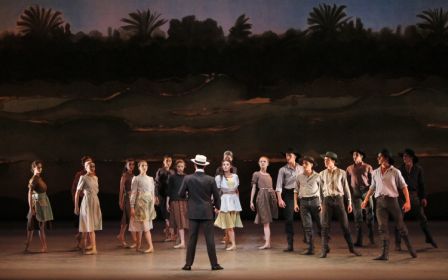
The standoff: Tyler Angle in boat hat, suit and tie confronts the country mob before the jungle plains of the Pampas. Backdrop by architect Santiago Calatrava. Photo by Paul Kolnik for the New York City Ballet.
If only Wheeldon had carried his metrosexual plot to its logical conclusion and had the butch woman fall for the urbane man’s effete ways, while he loved her for galloping free. But ballet habits – and plots – die hard. So the young man learns to handle wild horses and the tomboy turns shy, maidenly and adoring.
Still, this is Wheeldon. If his librettos cling to source and precedent, his means can be exhilarating and revelatory. Here that happens in the characters’ moments of ambivalence, struggle and, on the other hand, routine. Estancia begins with Tyler Angle, in suit and tie, hovering over the ground, his arms spanned like a hawk. His barrel leaps end where they began, in this earth-drawn stance. Yearning lunges face first one direction and then another: from where he came to where he is going. When he and girl gaucho Tiler Peck first rendezvous alone, before he has proven himself with the horse, their mirroring steps have a beautiful exploratory air. They are discovering what exists between them.
For soothing whirr of custom, Wheeldon gives us women planting…
For the whole review, click here.
For another take on the ballet, here is my esteemed colleague Roslyn Sulcas, of the New York Times, at a new, excellent online daily magazine Artsdesk, established by dance critic Ismene Brown, formerly of the UK Telegraph.
Leave a Reply