
I have always admired choreographer Stephen Petronio, but also have had certain reticences here and there: that the sophisticated bad-boy tone held the choreography back or that Petronio didn’t take sufficient advantage of his strong musical propensities. This past Tuesday, however, I was awed: one of those happy experiences where you come out of the theater recognizing with alarm how absorbed you were.
It wasn’t just that the dances were particularly strong, it was how they worked together, so that with each new work you understood the last one and the present one better: a burrowing deeper. “Smartly curated” is my shorthand for that more-than-the-sum-of-its-parts experience.
The day after I filed my review, the esteemed New York Times critic Roslyn Sulcas’s review came out; I think she had a similar experience. Choreographers are often disappointed that writers don’t much praise a work that moves them while they are sure to apply every pejorative in the book when it doesn’t. But these are not symmetrical experiences–not for the writer. When you are moved, you don’t simply want to say it is great, mesmerizing, wondrous, marvelous, etc., etc., you are on a mission to figure out why. When you aren’t moved, you are far enough outside the experience to resort to potted negatives.
Anyway, here’s my review, published Thursday, for the Financial Times:
For the 11-member ensemble’s 1990 signature piece MiddleSexGorge, the men don corsets over bare bottoms. This unlikely coupling of restraint and outrageousness typifies the choreography as well. Dagger-like limbs punctuate roiling torsos and rolling hips. Plunging pliés fraternise with stork-like balances. Strident awkwardness makes peace with ribbony grace. Formalism works in the service of chaos.
The five dances on this year’s smartly curated programme – two premieres and three repertory works from the 25-year-old company’s first decade – include solos as short as a pop song and ensemble works five times as long, pieces in an ironic romantic mode and pieces as impersonally theatrical as the weather. Over the course of this prismatic evening, the choreography grows more beautiful – and mysterious.
The evening begins with Petronio spotlit and alone on stage. In the 1986 solo #3, his arms seem to be squeezing his torso into place, as if without the contortions of his creaturely arms it would ooze on to the floor. In this rare cameo, the 54-year-old dancer is both luscious in body and precise in tortured limbs.
At one point he impersonates Balanchine in that famous photograph of him demonstrating the proper way to do a tendu, an essential ballet step. Petronio is preparing us for his deformations of classical pieties. In the group pieces MiddleSexGorge and the not yet fully realised Ghostown, legs don’t point skyward, they slash sideways like a sword. Instead of pas de deux, we get trios, with one dancer suspended crucifixion-style between the other two, restrained as much as supported. And the spatial harmonies in the several clusters of dancers doing different things at the same time, as in Cunningham, are only clear enough to make the threat of anarchy more tangible and thrilling.
More than classicism, however, Petronio rebels against the anti-pop orthodoxy of much postmodern dance…..
For the whole review, click here.
The Petronio company performs at the Joyce through Sunday, May 2.
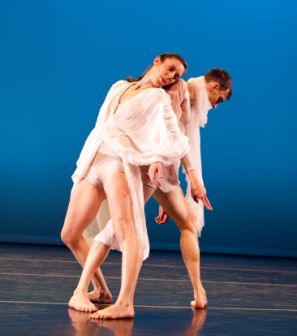
Mandy Kirschner and Australian guest artist Reed Luplau. Kirschner, a former Cunningham dancer who brings to the Petronio work that Merceian clarity, joins a few other incredible women in the current troupe: Shila Tirabassi, Amanda Wells, and Tara Lorenzen. The men and other women are promising, but they haven’t quite figured out the drama in Petronio’s style; they tend to efface themselves more than necessary. Photo by Yi-Chun Wu.
Leave a Reply