
Maybe I will connect the subjects, in the heading above, later in the week. For now, only have time to post the reviews.
Last day to see the new Ratmansky is Wednesday. Be forewarned: it has a shape all its own, which revealed itself, to me, anyway, only on a second viewing. But if you know from the start that the hour-long work–in itself an odd length for a ballet, neither the usual full-length nor the usual 20 minute plotless–races through its outline in the first half hour, then dallies in divertissements before returning in the last 10 minutes to its story, you will be better off than I was.
First time around I felt both befuddled and enchanted. The second time–which I reviewed, because the first was an exclusive gala–the fog had lifted and only delight, awe, etc remained.
The audience that second time didn’t seem to have any trouble loving it from the get-go. I think my experience with 19th century ballet actually hindered me from seeing the whole shape right off, as the Ratmansky is brimming with witty allusions and you can get lost in them.
Here’s some of the review, for the Financial Times this past Friday:
Though his subtitle suggests otherwise, Alexei Ratmansky’s Namouna, A Grand Divertissement does have a plot: basically the same one as Le Corsaire, The Sleeping Beauty, Raymonda, Sylvia and nearly every other 19th-century ballet. Boy meets girl; boy loses girl; boy finds girl. The difference with Namouna is that boy meets dozens of girls – and can hardly decide between them.
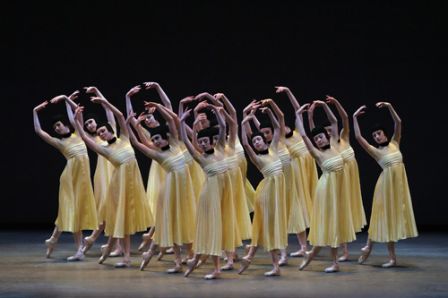
Some of those dozens in their first outfits of the night: Louise Brooks flapper caps and Empire waist sand-yellow accordion-pleated shoulderless gowns. The bathing beauty-ocean sprite get up comes later. Photo by Paul Kolnik for the New York City Ballet.
Despite a shimmering score by Edouard Lalo that Debussy singled out as “a masterpiece among too many stupid ballets”, Namouna hasn’t been heard from much since it flopped at the Paris Opera in 1882. Ratmansky sets his version for the New York City Ballet on a beach in the Mediterranean in the 1920s. Film director Rustam Khamdamov and NYCB costume director Marc Happel’s inspired costumes evoke sand, sea and midnight sky. Our hero, Robert Fairchild in a little boy’s sailor suit, resembles Lewis Carroll’s Alice – plopped down in a world that goes about its strange business with outrageous self-assurance. Ratmansky’s wonderland is the spectacle of imperial ballet itself.
Our docile hero’s quest is a bit vague. He is just looking. Two dozen bathing beauties in jellyfish tutus and conch-shell bathing caps look right back. Together with two Carmens – Jenifer Ringer smoking while dancing as Sara Mearns devours space and men’s affections – the corps wants him. And yet they only know each other, bickering and making up dances out of what they glimpse from the sidelines. The poignancy of their position – one boy and all these girls – leaps off the stage and into your heart. It’s as if Hamlet co-starred the gravediggers…..
For the whole review, click here.
The All-Balanchine program this year was a great triad, presented chronologically so you could feel the evolution of the choreographer’s thinking–or one thread of it, anyway: Concerto Barocco, The Four Temperaments, and Symphony in Three Movements. I’m not sure the last, the 1972 Stravinsky ballet, benefits from comparison to The Four Ts.
At this point, the ballets are appearing individually, on mixed programs. Through May 22. Here’s some of my review from last week:
People like to say great art is timeless. But the three plotless pieces by Balanchine that opened New York City Ballet’s spring season on Sunday not only transcend their moment, they reflect on it.
Concerto Barocco, which premiered in 1941, began as an exercise for Balanchine’s students. He must have been instructing them in the ballet ethos of graciousness. The dance begins with an ancient step: the bow with which a courtier greeted the king, inclining toward his outstretched leg as if to offer his exposed calf as a gift.
Concerto Barocco rings variations on this theme of reverence, with a small female corps lunging deeply – heads lowered – before the reigning dancers, or interlacing their arms as if to provide a net for the queen ballerina’s landings from scalloping leaps. At one point, the women twirl slowly upstage, arms in a V. They seem to be floating not in space but in the imagination.
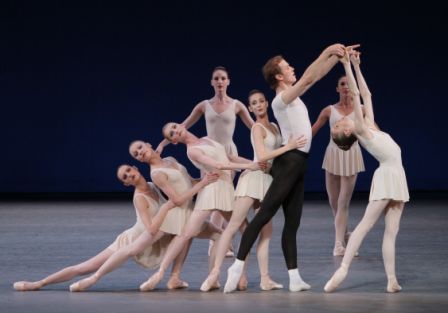
Concert Barocco. Photo by Paul Kolnik for New York City Ballet.
Balanchine always honoured the ballet virtues of grace and graciousness, but he never again paid such obsessive tribute. Five years on, he is diving flexed-foot first into the dislocations of modernism. In place of action and deferential response, The Four Temperaments offers action and retraction, push and pull, entanglement and entrapment. A ship’s figurehead replaces the courtly bow, with the woman’s pelvis the prow that plows through troubled waters. To the leisurely menace of Paul Hindemith’s score, the ballet conjures the psychological mood of a Hitchcock thriller even as the dancers perform their contortions with cool impassivity.
By 1972, when he created Symphony in Three Movements, Balanchine had given his modernism a mannerist twist, making sport of….
For the whole review, click here. (If they ask you to register, you only have to do so once and then you get 30 articles a month. And it’s free.)
Leave a Reply