
Faye Driscoll’s 837 Venice Boulevard, which premiered at Here in the South Village in late 2008, amazed me so thoroughly that it’s no surprise her latest, at Dance Theater Workshop a couple of weeks ago, amazed me somewhat less. It hardly had a chance. Still, I remain impressed by how Driscoll harnesses dance and the best experimental theater’s story rhythms to expose the seams between social behavior and antisocial behavior (the libidinal rising up and causing public havoc). Here, belatedly, is some of my Financial Times review:
You probably haven’t heard of Faye Driscoll, but if experimental dance theatre ever emerges from oblivion, you will. Since the birth of the Greek chorus and the Dionysian rite, dance has been linked with ecstatic states. The 34-year-old LA transplant unites them again, but not for the usual reason of delivering a sexy number. Instead, her giddily gruesome comedy There is so much mad in me reveals what communal forms of extreme feeling leave in the dust – mauled and pummelled – as they ruthlessly pursue their ends.
Amanda Ringger’s lighting veers from glowing puddles in the dark to blinding brightness. Brandon Wolcott’s soundscape slips from thundery rumbles to hollow New Wave beats to silence. Meanwhile, a ménage à trois re-forms as a twosome plus taskmaster, or the anarchic play of all nine dancers turns vicious and mob-like before it mutates into an oddly askew aerobics routine.
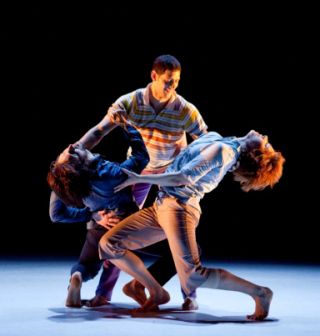
Sometimes an impulse towards harmony distracts the crueller drives. Contestants on a daytime talk show vie for the title of Biggest Sufferer of Outrageous Fortune. (I vote for the lady with two vaginas whose cheating husband has knocked up a male stripper.) But before the winner is declared, people have forgotten their troubles and descended into a telegenic orgy.
Half the fun of There is so much mad in me lies….
For the whole review, click here.
I am the odd woman out re the Trisha Brown miniprogram at the Baryshnikov Arts Center last week. My esteemed Artsjournal colleague Tobi Tobias loved it, as did Roslyn Sulcas at New York Times, Eva Yaa Asantewaa at Infinite Body and Kathleen O’Connell at Danceviewtimes (whom you should look out for if you haven’t yet: much insight). In their enthusiasms, they wrote more eloquently than I did, being grumpy.
So what’s my problem? I offer a few things in the review, but to frame it somewhat differently, Brown has enough ambivalences about theater that she can make me uncomfortable watching, without that discomfort leading anywhere fruitful. It’s fine to be ambivalent about a given of theater, but unless the choreographer can take that private neuroses and turn it into a matter of theater (to tweak Freud’s salvo about the goal of psychoanalysis: to convert “neurotic misery into common unhappiness”), the un-ease gets transferred to us.
With the two BAC dances, Brown’s qualms by no means overwhelm the experience. The accoutrements of theater–the rolling fog in Opal Loop, the back turned in If you couldn’t see me–are so well integrated into the dancing that they almost seem necessary to it. And she is unequivocally in love with dancing: that much is abundantly and deliciously clear.
Anyway, here’s some of my Financial Times review (though you have to click to get to the complaining):
The most consistent pleasures that Trisha Brown offers are not dramatic, musical or visual but kinetic. She reveals the muscle and momentum that drives a step so that we sense what it might feel like to execute the move. The 73-year-old choreographer makes dancers of us.
The company’s year-long 40th anniversary celebration, which extends from the US to Europe, began on Wednesday with Leah Morrison turning her back on us.
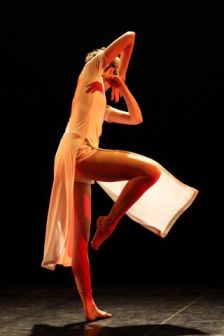
Photo by Julieta Cervantes.
In If you couldn’t see me the dancer never does show her face, but we can see her – or at least the part of her that matters to Brown. Morrison complements a swing of her leg with an undulating shoulder. She descends suddenly into a deep plié. She lets an animal stillness overtake her as she extends an arm upward at a slant as if signaling a thought. Last year Morrison won a Bessie – New York dance’s Oscars – for her performance of this 1994 solo, and it is clear why. She brings out the delicacy and fullness of Brown’s approach, in which everything counts as a detail and nothing does.
The 1980 Opal Loop/Cloud Installation #72503, the only other piece on this appetiser of a programme, begins with prancy feet – imagine reined-in horses – and anxious, air-massaging hands. As sculptor Fujiko Nakaya’s fog waterfall rolls down the theatre’s back and gradually floods the stage, the four dancers iron out their limbs and move with full-bodied clarity among the clouds.
Even with all their bodily fullness, however, these works do not let me forget what they omit. Of the two pieces….
For the whole review, click here.
Leave a Reply