
A good deal of experimental dance today–as in the Judson Church days–is closer to performance art. It examines its own parameters; the movement may be minimal. And yet choreographers exist in a nearly invisible parallel universe to visual artists. While choreographers and their audiences know what’s happening in gallery and museum, the reverse isn’t usually true–not on this side of the Atlantic, anyway.
I’d say, Fine, we don’t need them, if it weren’t that performance art in the art world is accorded value–bought and sold so it funds the artists and their work–and dance could use that kind of support. Plus, dancers’ understanding of gesture often makes the dance species of performance art less sophomoric in its conceptual moves. Choreographers understand better than artists, who aren’t always practiced in using time, that the moment will always trump the idea. They work with that fact, which gives the piece greater density.
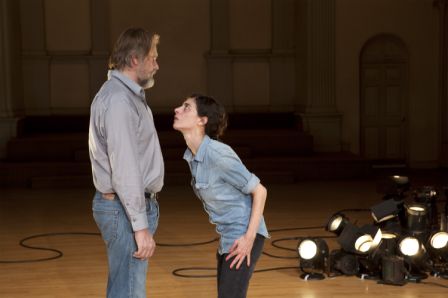
This brings me to Maria Hassabi and Robert Steijn’s Robert and Maria, which took over Danspace Project at St. Mark’s Church for three days recently, and will emerge again at a few performance festivals in Europe this spring before disappearing for good.
Here’s a part of last week’s review of Robert and Maria for the Financial Times. Then on to Marina.
Robert and Maria covers about 6 sq ft of ground – and lifetimes of feeling. In the final offering in curator Ralph Lemon’s event series “I Get Lost”, itinerant European performance artist Robert Steijn and
New York-based dancer-choreographer Maria Hassabi begin with their
backs to us and an arm wrapped around the other’s waist. They end in
the same amicable position, but facing front.
In
the hour that separates these mirror images, the large craggy man and
the beautiful diminutive woman stand facing each other, their profiles
to us; they face each other kneeling; they lie on their sides, face to
face. If Eadweard Muybridge had photographed not a horse’s gallop but
feelings growing, shrinking and wavering across body, face and the
space between two people, it might have looked like this.The piece progresses
via small adjustments in the performers’ stances – a hand grazing a
cheek or slid into a pocket – executed so slowly that Hassabi shakes
and Steijn sways. The dancers are not merely maintaining their
emotional equilibrium, they are invoking their feelings through their
gestures, like Proust’s narrator with his memory inducing madeleine.Sometimes Steijn
becomes Hassabi’s inverse, hollowing out his chest so she can draw
closer. Sometimes they suddenly draw apart. But they always look into
each other’s eyes, which often well with tears.
Robert
and Maria, beside a bouquet of footlights, all utility and decorative
beauty in a dance that has its own approach to both. Photo
by Antoine Tempe.
New York has lately become a hotbed of intimate, highly public
performance art. To enter the Marina Abramovic retrospective at the
Museum of Modern Art, for example, you must pass through a gauntlet of
nude bodies. At Tino Sehgal’s Guggenheim show earlier this spring, the
first piece you came upon was a couple rolling around on the atrium
floor. More exhibitionist than self-exposed, these works convert
viewers into hapless voyeurs. They throw us back on ourselves when we
are at our rubbernecking, vacant worst.Steijn and Hassabi keep their clothes on and their hands largely to themselves; what they do reveal is…
For the whole story, click here.
Now onto MOMA and the thousands of visitors further enshrining art world diva Marina Abramovic. I am baffled that even the art critics who had problems with the show made so little of their problems. They said Abramovic was vain–and sure she is. (Check out the New York Times Magazine story on her stoical self-grooming practices: a vanity converted into something else by its sheer extremity.) Or they said that the work could not survive its moment, which is also true, or could not survive being transferred to other performers– true as well. But it would be worth asking what kind of art depends so heavily on the merging of body, artist, and the present that it can survive so little translation: neither of person nor of decade. And what is it about this moment in particular that the art cannot survive? The show’s title is “The Artist is Present,” so it invites these questions.
The myth of the suffering artist that Abramovic exploits by sitting on a hard chair or a bicycle seat half-way up the wall for a gabillion hours was tiresome enough when she first recycled it in the est-y ’70s, with self-realization via non-denominational exploration and humiliation all the rage. Now that reality TV offers all sorts of different paths to fame via abjection and overexposure, it is worthless. A redundancy.
In one of the latest TV endurance shows, Hoarders, on A&E, the homebound packrats don’t do anything either to earn their claims on our attention, beyond peeing and sitting in one spot–and, oh yeah, not throwing anything away. Abramovic does not have stacks of unrecycled newspapers cluttering her space; she is an Artist, after all. In place of contestant-as sufferer she presents artist-as-sufferer. But otherwise she’s working from the same premise: her presence suffices. She should get herself a gig on TV.
Seriously. Critics who complained that MOMA’s grandeur and institutional weight deprived the work of its intimate immediacy might have considered that the culture deprived it of immediacy long before MOMA got around to the task. We are too used to spectacles that make claims on the real to grant Abramovic any special status. (The long train of admirers queing up to sit in the chair opposite her would disagree.) But put her on TV–with a live audience cheering and laughing each time she blinked, there in her chair– and maybe the work would gain traction. Or at least a sense of humor.
Leave a Reply