
I found Reggie Wilson and Andreya Ouamba’s dance, at BAM last week, maddening and, perhaps unwittingly, kinda rude. Its nonsensical combination of casualness and overweaning symbolism put pressure on the audience to get the work to cohere while also making us feeling silly for trying. Putting the audience in a bind is always a bad idea, I think, unless it’s done with such wit that you have to forgive it for making a fool of you. By now, it’s also become a postmodern commonplace. Time to try something else.
Here’s the bulk of my review (and please click for the rest). Then I will complain some more!
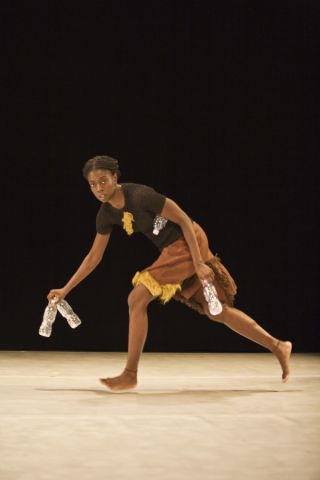
Some dances are so airtight that they give you no room to think or feel. Other dances – usually on the postmodern and pedestrian end of the spectrum – are so loose-knit that whatever floats into your mind is soon replaced by something else equally random. The Good Dance – a much-anticipated choreographic collaboration between Reggie Wilson, from Brooklyn by way of Milwaukee and, once upon a time, the Mississippi Delta, and the Congolese Andréya Ouamba, now based in Dakar, Senegal – suffers from the second, spacey problem.The Good Dance – dakar/brooklyn begins promisingly. Six of the work’s nine captivating dancers line up – unsmiling, gazes level – as if for a mandatory class photo. Then they take turns introducing themselves in jagged solos that, with the help of Naoko Nagata’s intriguingly patchwork outfits, bring out their individual idiosyncrasies. Tiny, pale Anna Schön’s winging arms gather so much force that they nearly knock her on her back. Impish Fatou Cisse lands from her jumps as if stamping footprints in the mud.
Fatou Cisse. Photo: Antoine Tempe
But just as pattern and drama start to build – the ensemble skittering sideways with limbs sharply angled and brightening their flexed-footed jumps with an air of surprise – the lights come up, the afrobeat disco music dies, and Wilson walks on to lay down the show’s concerns: the relationship between the choreographers’ working methods; between the Congo and the Mississippi Delta, sites of both unimaginable suffering and immense cultural fruit; and between the Good Book of the western tradition and “the Good Dance” of African culture. Wilson delivers these enticing themes while clownishly balancing a water bottle on his head.
The water bottle shenanigans aren’t, however, what convince me that The Good Dance will never get around to its subject. It’s….
To find out what did convince me, click here.
So, about that overweaning symbolism combined with a casualness that resists symbol altogether, let’s take those water bottles–hundreds of them, half-empty or half-full–in a dance that “investigates” the connection between the Congo river region and the Mississippi Delta. (God, I hate that academic investigate, which means not to look at the evidence and come to a conclusion, as in common usage, but to circle around and around the issues without feeling that arrival might be desirable). I think I get what the bottles are about: in place of free water (to wade in–as the gospel tune says– or swim in or drink), we have contained water, paltry water, but also this shimmery, translucent object, which is an art object like this dance. You can see through it and it may leak out, but it isn’t, doesn’t want to be, the river itself. Okay, got it. And yet the dance needs to do more than present the bottles, play catch with them, rearrange them, and then forget about them. The piece needs to keep reinforcing what they might mean–perhaps our divorce from even the most essential aspects of life, one of which is our histories, and
Lately, people have wanted to make dances about what it’s like to be haunted by something too tenuous for the body or even memory to hold onto. The topic favors writing, especially in a philosophical or theoretical vein. Dance has difficulty showing absence without either turning it into substance or making the dance itself seem not quite there. Which doesn’t mean it isn’t worth trying. Sometimes the best dances arise out of the most improbable prompts. You just need to address the difficulties without simply apologizing for them or passing them off on the audience.
About the other claim Wilson makes for the dance, that it is positing a Good Dance in place of the Good Book: it’s a fine idea (as my father liked to say), that the logic or system of a dance or dance culture might have a moral base, but to invoke that moral edge by such puny means as one dancer knocking a bottle off another’s head is to misunderstand poetic transference. When you use a part for the whole, the part has to feel momentous, or you diminish that whole–in this case, the Good Dance and by extension the Good Book.
Shall I complain some more? The music was a herky-jerky mix of traditional African drumming, gospel, blues, etc. The Good Dance doesn’t dig in to the musical genres’ likenesses and differences; it doesn’t even pick tunes that would lend themselves to our doing so. It wouldn’t have been so hard to take a tune and play out what happens to its beat as it crosses the Atlantic. For example, the heavy anchor that the blues, and much gospel, provides for its bass line the Congolese percussion either leaves out altogether or treats as a two-step, a dance step. It’s so interesting, the solid downward slide of the blues versus the swift stream of African beats. And when there’s guitar in African pop, its melody hovers above the bass line very sweetly like a cloud.
My favorite moment in the dance was co-choreographer Andreya Ouamba moving in his beautiful, rangey way in between the beats of–I think it was Aretha Franklin’s “Precious Memories.” And there, what all the talk couldn’t tell us: one time signature moving inside another; Ouamba’s light, swift, complexly accented beats inside the heavier, more staccato gospel.
I could have watched him all night. (I feel terrible that this is our introduction to him. Wilson has a track record here and will have other big chances, but Ouamba and his Dakar company, Premier Temps? Who knows.)
Okay, if you want to read the rest of the review now, you may.
The Good Dance is touring the West Coast, Arizona, Vermont and Connecticut in April; the choreographers have their work cut out for them.
Here, for your listening pleasure, a bit of Malian blues, which does in itself what Ouamba and the gospel he was dancing inside did together. Vieux Farka Toure’s father, Ali Farka Toure, whose tune this is, was a big proponent of Pan-Africanism generally and specifically of the ongoing interplay between traditional African music and the American blues.
Leave a Reply