
I ask on the occasion of Wally Cardona’s Really Real at BAM through tonight, which does what you’re always hoping for in a work–develop its ideas via its structure. Here, he’s exploring individuation, isolation, or “falling free,” as Kierkegaard, Really Real’s reigning philosopher, puts it. Cardona divides each thing from each thing, including us from an emotional investment in the work.
I didn’t mind my own diffidence–it seemed just fine–but I did wonder whether it was really necessary that the words and dance theater remain at such a remove, like two parallel universes. (Same question for Bill T. Jones’s Serenade/The Proposition, review excerpted below, where the distance it’s crossing is time.) That stance is as old as postmodernism–and I think we need an alternative. (Annie-B Parson and Paul Lazar’s Big Dance Theater offer an excellent if elusive one. Will elaborate some day.)
Here’s a chunk of my Financial Times review of the Cardona:
Choreographers are mostly too naive or too knowing to be strange. They either mistake their commonplaces for the unusual or flaunt their originality until it feels like a pose. Weirdo Wally Cardona, however, is fierce enough in his preoccupations not to care whether anyone shares them and yet aware enough of dance history not to repeat it. Juxtaposing Kierkegaard, compellingly disjointed dancing and the sweet voice of youth in his second BAM commission, the New York choreographer baffles and endears.
Dance may be a synthetic art – steps, music and lighting blending together for a single effect – but Really Real puts a premium on autonomy. The 80-minute piece begins with a teenager on tape stumbling through passages from a Kierkegaard biography. She is what she is, and the philosopher is something else: an obstacle to be overcome. Meanwhile, civilians in street clothes wander on to the beautifully dilapidated stage to sit or stand as Cardona moves among them, never touching a soul, his arms like the Tin Woodman’s, his hips like a snake.
If anything had the power to override the boundaries here, it would be the oratorio by Phil Kline (composer of the Unsilent Night boom-box symphony) for the Brooklyn Youth Chorus. Beginning low and sweet, the harmonies slowly accumulate into an oceanic wave of innocence . But the angelic voices, emanating from the balcony behind us, are too far away to wash over the stage. In lyrics adapted from Kierkegaard, the children sing: “To transform all this distance into one normal step into life is the single miracle.” Indeed.
In further divisions, Cardona separates the dances into…..
For the whole shabang, click here.
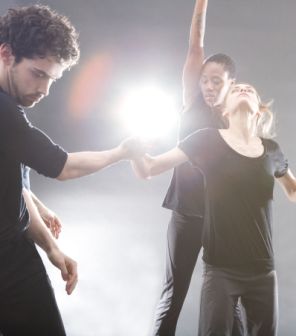
Photo above by Julieta Cervantes. Pictured: Stuart Singer, Omagbitse Omagbeni and Joanna Kotze.
And here is a chunk of the Bill T. Jones review for the Financial Times of one of his two Lincoln works presently touring the country:
“Four score and seven years ago,” Abraham Lincoln famously reminded an audience faced with a vast number of soldiers to bury, “our fathers brought forth on this continent a new nation conceived in liberty and dedicated to the proposition that all men are created equal.” Bill T. Jones’s Serenade/The Proposition is almost as dedicated to the notion that all texts are created equal. The otherwise glorious piece – one of his two works touring the US that take up Lincoln’s legacy – nearly sinks under this article of postmodern faith.
Photo by Paul B. Goode
The choreographer has set himself an arduous task: how to turn an influence into theatre. He opts for a maximalist, egalitarian approach. Along with images and a mishmash of music, a collage of recited and sung texts, live and on tape, juxtaposes history and the present, the battlefield and the podium, while 10 dancers perform strictly non-illustrative moves.
But the texts won’t co-operate. The identity issues that the dancers air at a company blab session sound fatuous beside a blazing Lincoln and Oliver Wendell Holmes. “The Battle Hymn of the Republic” knocks flat Jones’s own homilies on history.
Meanwhile, though, there is the dancing. Not so special solo, in ensemble the handsome dancers give expression to the twin principles Lincoln laboured under: a slave’s freedom depends on his being admitted to humanity and to a republic that, Lincoln explained, throws off “the arguments that kings have made: you work and I eat, you toil and I will enjoy the fruits of it”.
Jones combines a loose, ribbony style with inventive, all-over partnering, and the result is…
For the rest, click here.
Leave a Reply