
Karole Armitage is a choreographer who misses more than she hits, but even that bumpy track record didn’t prepare me for Itutu, playing BAM for a mercifully short run this week.
Here are the first few paragraphs of my Financial Times review, out tomorrow:
If cultural appropriation didn’t already have a bad name, Karole Armitage’s Itutu (until Saturday) would give it one. That the choreographer doesn’t notice that her troupe mixes with the charming and engrossing experimental Afropop band Burkina Electric like oil with water would be dumb enough. But to use the Burkinabè band members as props for her preening dancers is something else again. Has the lady not heard of colonialism?
At the start, Itutu diminishes the Africans only a little. Electric guitarist Wende K. Blass and singer-enchantress Maï Lingani flirt with a couple of dancers while strumming and singing, as if these antics and their music were on a par. The sound’s overamplification buries the guitar’s lilting melodies, but Armitage has a point to make: this isn’t your average ballet.
Soon her slick crew is copying the moves of the band’s own dancers, Vicky and Zoko Zoko, and depriving the steps of sense. When Zoko Zoko undulates from side to side, it’s as if an electric wire were running through him. Burkina Electric includes dancers in its mix not to prove its choreographic mettle but to show us musical possession in the flesh. Armitage doesn’t care. When she borrows, she takes without transforming or honouring.
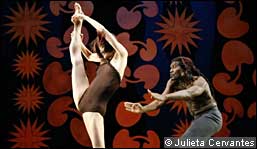
Megumi Eda and Zoko Zoko
The disrespect culminates in a duet between Megumi Eda, the choreographer’s favourite and most self-regarding performer, and the burly Zoko Zoko in which he serves as ballet barre, providing Eda with the leverage to power her leg overhead (for the millionth time). That Lingani can bring some gravity and humanity to Itutu, looking upon the dancers buzzing around her with the magnanimity and delight of a strict vegetarian towards flies, is a testament to the singer’s star power.
Without the band….
For the whole thing, click here.
Your time would be much better spent at the Joyce this weekend, watching and listening to a Taiwanese troupe that specializes in bringing ancient dance and music forms to life. Here, some of the Financial Times review published today:
About a millennium ago in China, as the Song Dynasty was swallowing up the Tang, the statesman Han Xizai realised his political career was over and retreated to his mansion for a life of debauchery. When word spread of nights where “guests mixed with ladies, shouting in wild excitement”, as one chronicler put it, Emperor Li Yu sent the court painter Gu Hongzhong to gather intelligence. Voilà “The Feast of Han Xizai”, a painting with enough intrigue and side plots to make Gu Imperial China’s demimondaine answer to Bruegel. Now hanging in the Beijing Palace Museum, the delectable 11-foot scroll has spawned imitations and tributes down the centuries.
The latest is a dreamily slow, meticulously constructed dramatisation by the Taiwanese music and dance troupe Han Tang Yuefu (at the Joyce until Sunday as part of Carnegie Hall’s bicoastal festival Ancient Paths, Modern Voices). Like the painting, the dance forgoes the “shouting” for ladies singing, dancing, fluting and plucking the lute, and men drumming, flirting and, mainly, watching. Unlike the painting, no beds with rumpled sheets frame the circumspect action to hint at where it all is leading or has led. Nor do several mini-dramas transpire at once, in that loose, improvisatory rhythm of a promiscuous night that will inevitably bleed into morning. Rather, Han Tang turns “The Feast” into an extended ritual, with one part discretely following another.
The stagey approach damps the mood of possibility but doesn’t destroy it. And it has little impact on what would always have been formal, such as the musical numbers. Mix the stir-and-beat rhythms of an ancient raga with the dissonance of Beijing opera, and you come close to the captivating idiom of the ancient Nanguan music that the lady flautists and lutenists play, each with her own kind, and the singers sing. Music is the show’s star.
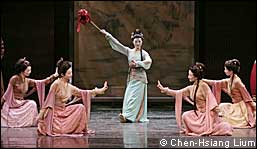
But Han Xizai’s consorts – particularly the head concubine (Ho-wen Hsiao, pictured above) – aren’t far behind. Above tiny, gliding steps, their heads bob like a marionette’s: they seem always to be yielding…..
Leave a Reply