
Emio Greco | PC’s [purgatorio] POPOPERA is kind of a mess, but if you love movement –watching it created with the breath, thought about unusually–you should head over to the Joyce this week (through Sunday). And you could probably get in for $10. (The Joyce has “updated their pricing structure”–i.e. succumbed to recession specials. On Tuesday, there were a lot of empty seats and gleeful 20somethings, who must have just wandered in.)
It’s so rare that European “contemporary dance” choreographers–you know, blessed with those well-funded regional centers–actually do anything interesting with the movement. It’s almost always the same liquid thrashing.
Anyway, this is what I said in the Financial Times today:
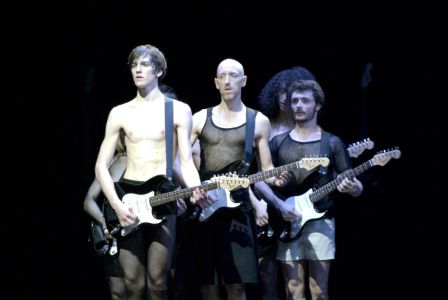 Photo by Igor Mendizibal
No, [purgatorio] POPOPERA, despite its title, is not one of those impudent European stagings of a canonical work, high on concept and low on everything else. You know, Nijinsky’s lethal Rite of Spring played out in undies on Astroturf, or the Faun in The Afternoon of a Faun pleasuring himself atop an enormous tissue box. Neither idea nor setting defines the purgatory fomented by Amsterdam’s Emio Greco and Pieter C. Scholten, collaborators since 1995. Dance does, and eventually five dancers wielding electric guitars. This work – at the Joyce until Sunday after touring Italy and France last year – unfolds organically from the inside out.
The movement is eloquent. The arms and hands, especially, tend to complete a flung phrase as if catching fireflies in a jar: energy made visible. The dancers cup their hands like lotus flowers to crown arms thrust overhead. They swing their arms wide to say, “Here I am, for what it’s worth”. They narrow those arms to dive into space as if it were water.
Purgatorio‘s tremendous dancers seem to be capturing and releasing air – an apt metaphor for the effort and slipperiness of liberating oneself from tiny sinful thoughts. And by delineating negative space – the space between them – they become a tribe. Every jangly chord crashing down on them from some guitar god in the sky (the erratic score is by Michael Gordon of Bang on a Can) propels these hapless habitués of limboland, by turns goofy, innocent, and mysterious, into another fit of steps.
About two-thirds through the hour-long work, the dancers each gain a limb – a shiny black electric guitar – and….
For the whole review, click here.
Upcoming (next week): Foot contributor Paul Parish on an impending threat to our online dance library, aka YouTube.
Hi. I must admit that I haven’t seen the piece, but just happened upon your review. I found it evocative and pretty clear until the appearance of this line: “Randomness – the creeping suspicion that the choreographer doesn’t care what he’s communicating – is the bane of postmodern dance right now.”
I doubt that any choreographer doesn’t care what he or she is communicating. As viewers experiencing a performance we may find it difficult to ascertain exactly what that is, but it might be due to any number of things: the choreographer isn’t wielding her/his tools concisely enough or is confused about his/her intention; the choreographer is purposely tossing their chosen materials onstage–with or without any indication of their direction–and leaving us to pick our way through it; we are unhappy because we’re not being given a sufficient number of or clear enough road signs to follow; and so on.
One view of the choreographer’s primary responsibility could be said to be the engaging of certain materials in the context of a creative vision. The task at hand has to be finding a way to make that mix communicate something…otherwise why share it with anyone else in the first place?
When choreographers are fortunate enough, their vision and how they choose to inhabit it is an evolving process. Which means that it’s not static. Some audiences want their dance to be comfortable and predictable; others are enthralled by not knowing what to expect, and are willing to meet the choreographer halfway as he/she struggles toward the light. Either way, there certainly seems to be something for everyone these days.
Goodness knows we’ve all seen our share of pieces that leave us less than satisfied, even angry at times. And yes, I do wonder more often than not what one “postmodern” choreographer or another is thinking [choreographers in other realms too!], as they putter, flutter, or scramble about without any apparent rhyme or reason. But as much as things can leave me cold, and even not so inclined to continue to follow that person’s work, I must still believe that choreography–like everything else, “postmodern” or not–is all about figuring out the equation(s) that connect. And that communication is always a two-way street.
[Apollinaire responds]
Dear David,
Thanks for your thoughts and feedback. A few thoughts back to you: by “creeping sense that the choreographer doesn’t care what they’re communicating,” creeping sense means I don’t know that they don’t care, I just feel that they don’t. I feel a lack of commitment to create something that coheres–and of course I understand that one person’s coherence is another person’s mess. I was saying what mine was.
I think you’re assuming that I wasn’t willing to meet the choreographer half-way, that i was just waiting to be fed, like a big baby. It’s as if the very fact that I find much work random means I’m not watching it with an open mind, hope, etc. Why assume that? You say “communication is a two-way street” but then assume that between me and the choreographer, I’m the one not meeting my responsibility. That’s part of the problem I was describing.
Thanks for writing,
Apollinaire