
So I debated whether to link to my latest review for The Financial Times–on the Emanuel Gat company, at the Lincoln Center Festival–because I may have bungled it (not for lack of trying, believe me). But perhaps you could click on the link and NOT read the review (dance never gets enough clicks)–and maybe, once explained, the bungles will make an instructive story–you know, for all of you hoping to make your fortunes as dance writers.
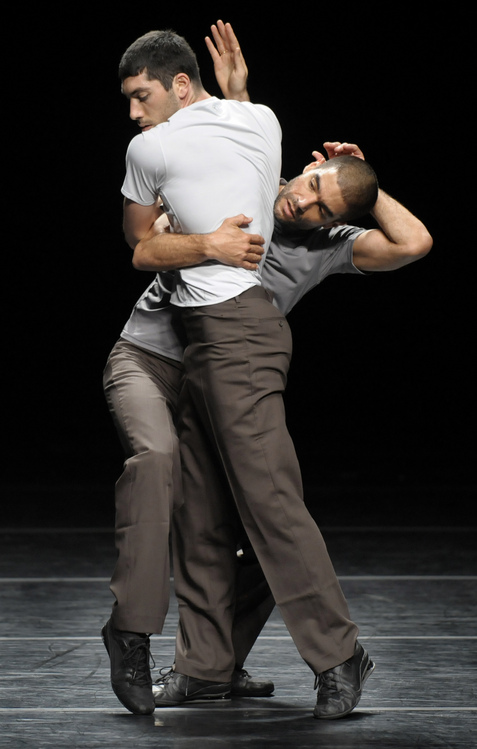
The glorious Assaf (in white T-shirt) and Gat. Photo by Sara D. Davis courtesy of ADF/2009
The piece was hard to write because I had a big idea and couldn’t decide how much of it to get into in a 400-word review. A review is not exegesis–not what we did in college–except insofar as the dance’s “about” reveals the experience of watching it. And yet so often it does. In fact, I’m not sure how you can decide what a work of art is worth if you don’t have in mind what it’s doing and meaning. In this case, though, it was only by a series of analogies that I understood what it (the first dance on the program, at least: Winter Variations) stirred in me. Gat presents something invisible–two people thinking together–in visible form in order to mirror the difficulty and magic of that mental communion. I’m not sure I gestured toward that chain of equivalencies, which made the dance feel deep and far away, without getting entangled in it.
Next time…
I write about dance in Durham, NC, and reviewed the new Gat piece when it premiered recently at the American Dance Festival. Here is the link to Classical Voice of North Carolina.
http://www.cvnc.org/reviews/2009/062009/ADF2.html
It sounds as if I would have written differently had I sat through the “Silent Ballet.”
[Apollinaire responds] Kate, thanks for the link. I’ll check it out.
Nice and thoughtful piece, Apollinaire. It can be tricky to define the feeling we have about a particular choreographer, especially when we have to quote physicality and atmosphere rather than text. I saw Gat’s work for the first time last September, on his British debut (with the same works you discuss here). Although it seemed a little lost on a wide stage, I felt all those deft and feathery gestures invited some kind of narrative explanation. The pieces were full of questions (not just the irritated ones you found yourself plagued by) – but until I see his work again, I’m not sure I’d know which questions were the useful ones.
[Apollinaire responds]
David, wonderful comment–and thank you. Yes, Gat seems to me, too, to operate by way of question and experiment; the success of the piece depends, though, on him getting us engaged enough in the questions that we can sort through them and know “which questions were the useful ones,” as you so aptly put it.
I liked the vast stage for so small an ensemble, particularly in “Winter Variations,” where he so pointedly used only half of it for the first 20 minutes. I felt the idea of there being all this unused space, off to the side where it’s so easy to forget about–reinforced, circuitously the space between the men, the unseen space as much as the seen.
But why is it narrative explanation–as opposed to emotional or psychological–that the “deft and feathery gestures” (how beautifully put!) made you think of? Write again!
Say, I saw Gat in Durham with the Fabulous Kate (above). I think you captured something important when you say: “His head seems to be watching his body move. Assaf’s head, by contrast, follows the spine; if his body were a mind, it would be absorbed in thought.” I’m not sure what it means but it TOTALLY felt that to me!
We got a chance to find out about that airplane drone you mention. I found it fascinating. It’s Beatle’s “A Day in the Life,” but it’s hard to tell, since Gat has manipulated that song’s famous passage, the one where all the orchestra instruments play through their full range, simultaneously, crescendo-ing as they go. He has stretched this 20-second passage to fill 20-minutes.
Seems like you’re doing just fine…but perhaps you might be interested in the NEA Arts Journalism Institute for Dance. It’s 3 weeks of dance and reviewing and discussion at ADF in Durham. We (the writers) were all different levels and I think we all learned. We had great models and wonderful feedback on our writing from guests and colleagues.
Looking forward to reading more dance reviews – keep it up –
Rosie
[Apollinaire responds]: About the 20 minute drone–yes, of course it’s the opening of the Beatles’ song: it’s a very droll way to begin the dance to extend that jet-hitting-the-sound-barrier of the song so the dance is its prologue almost. I loved that, but with 4oo words, I had to pick what to get into.
And thanks for the career advice: I’m sure a post like this seems to beg for it. I was really only trying to present what I thought was an interesting problem (with, yes, some requisite moaning, beating of chest, and tearing of hair). ~Apollinaire