
I review her debut as Sylvia for the Financial Times.
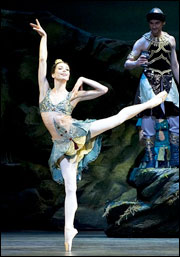
In the cave with ogre Jared Matthews. (He might have bit into the part with more appetite: would have helped Vishneva’s comic turn.) Photo by Gene Schiavone for ABT.
It’s really a delightful ballet–the delicious Delibes score as mercurial as the deus ex machina plot, sliding from trumpeting horns for huntress Sylvia and her cadre to lyric love passages to sensuous harem music to the buzzy sound of the villagers to the plucky violins for the ultimately princesslike Sylvia at her nuptials. It clearly influenced Tchaikovsky’s Sleeping Beauty (and some of the Candyland divertissements in the Nutcracker). In 1877, shortly after completing Swan Lake, Tchaikovsky wrote a friend,
Listened to the Leo Delibes’ ballet Sylvia. In fact, I actually listened, because it is the first ballet where the music constitutes not only the main but the only interest. What charm, what elegance, what richness of melody, rhythm, harmony. I was ashamed. If I had known this music early then, of course, I would not have written Swan Lake.
Good thing he didn’t. Anyway, Ashton responds acutely to Delibes, and his steps are so interesting in their back and forth balances (thinking of love perhaps, he treats the body as a pendulum: the dancer stays on balance by way of counterbalances), which Vishneva brings out.
I know Ashton felt burdened by all the ensemble choreography he had to foment, but what he came up with is ingenious and exhilarating: for example, the staglike movements for the huntresses (resembling the creatures they hunt); the pinwheel arms and stalwart feet for the columns of villagers and gods (all mixed up together) in the final act; and the odd “marking” entrechats of the villagers’ circle and line dances–it’s such a peculiar and ingenious way to suggest folk dance, which is often marked so that old and young can keep it up for a long time.
I don’t talk about all this in the review because the news this year was that Vishneva was taking on the role. I do mention that the steps are less visible–less well articulated–than in past years. But they’re still good enough to make the ballet worthwhile, particularly if you’ve never seen it.
Vishneva does it again tonight, then Paloma Herrera tomorrow matinee, and that’s it for Sylvia this year. People have liked Herrera in this role, though the one time I saw her she seemed only intermittently engaged–flickering in and out of focus. But that’s the thing about Herrera: you never know when she’s going to be thoroughly involved. (Actually, you kinda know: generally, it’s Balanchine and contemporary works.)
My friend, playwright Andy Podell went to see the ballet for the first time and writes with enviable insight [my interpolations in brackets like this]:
Great review. I basically agree, but it’s the first time I saw Sylvia and I was pretty much in heaven. The first act and the entrance of Vishneva and the Delibes music made me shiver. Also the ending of the first act is beautiful… lovely… I loved the way Eros points the direction to Aminta after returning his life.
It’s a very pagan ballet. The opening sequence is the erotic play of the elements of water and trees or wind [and fauns, swinging each other around and then settling in a little love bundle with the naiads (or perhaps it was the dryads)]. Later the two sheep are kind of intruding into the Classical world to keep us reminded that love has its animal level (even though they’re a pretty cutsey-poo duo) [in case the bronze sculpture of Eros, carried overhead with great comic solemnity, doesn’t!] So the ballet has a coherence to me, but it’s a kind of masque drama–The Triumph of Eros–and Sylvia and Aminta are really just another duo like Pluto and Persephone. There’s no arc of character, as you said.
I really liked the two slaves in the harem sequence. I don’t know what their names were [Arron Scott and Grant DeLong] but they were fantastic clowns–really subtle and sexy clowns. It tickled me how the heavy was this Muslim/Turk/terrorist who kidnaps the girl from the Western civilization.
d
Leave a Reply