
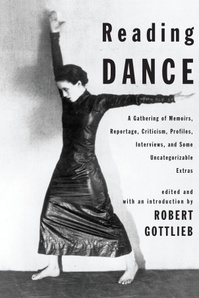
It was a labor of love: there would be no other reason to spend a decade sifting through thousands of pages of previously published work for this massive “gathering of memoirs, reportage, criticism, profiles, interviews, and some uncategorizable extras,” as the subtitle puts it, in charming 18th century fashion. I was excited to discover the 1360-page tome in the slush pile at the women’s magazine where I copyedit, and drag it back to my lair for a good look. But it only took the table of contents to change happy anticipation into despondency.
Gottlieb is one of the few people associated with dance who have the credentials to get such a primer into print–not because of his dance writing (dance never carries that much weight), though he did write a lovely biography of Balanchine, but because he has been the editor of Knopf and The New Yorker, so people in the publishing industry trust him.
Maybe they shouldn’t have.
You can offer an anthology mainly looking to the past, but the whole project becomes an exercise in nostalgia, a mausoleum, if you don’t create some bridge to the future. “Reading Dance” doesn’t. There is Astaire but no Savion Glover–and nothing about the Astaire to get you to Glover. There’s Tudor but no Forsythe, not to mention Wheeldon (though there is Boris Eifman–why? Just because it’s fun to hate?). The ballet dancers basically stop with the generation of Gelsey Kirkland and Baryshnikov–there’s no one with the contemporary sensibility of Wendy Whelan, Diana Vishneva, or Gillian Murphy. The modern dance is focused on Graham, Taylor, Cunningham, with a smattering of Judson-era noodlers, and ends with Morris. It’s as if the last few decades never happened.
Gottlieb may feel that indeed nothing noteworthy has happened since Reagan, but then he should have taken the advice of unlike-minded friends (if he has any: from the looks of the acknowledgements and contributors, perhaps not). He should have been leery of a generation’s narcissism.
And he should have been braver: there’s not one risky subject in the book.
I
wouldn’t have been so disappointed had the title prepared me–if instead of “Reading Dance,” the book had been called something more modest and more accurate, like, “Reading Dances I Have Loved and Looked to,” with the subtitle modified to “A gathering of memoirs, reportage, criticism, profiles, interviews, and some uncategorizable extras by the Boomers, the dead, and a few in between.”
But see for yourself–“Reading Dance” is now in bookstores.
And let me know what you think.
UPDATE: If you disregard the title and the ambition of the book, and reorganize the contents, you will find a valuable history inside. I explain here.
I think maybe the Eifman article in “Critical Voices” is in there because it has a strong opinion, rather wickedly couched, about a cultural phemonenon. But then I would think that: I wrote it. About the book: there is some delicious stuff in it that not only did I not write, but that I had never seen. However, this would be a biased, if not narcissistic take. At least I am not dead yet. xoxox to you, Nancy
Hey, you, I remember reading your piece on Eifman’s “Anna Karenina” when it first came out–in Danceviewtimes, wasn’t it?–and giggling. But given all the cultural phenomena that *aren’t* in the book, I don’t think it justifies inclusion. (See? I can be a hard-ass even to my friends.) As for delicious, yes, of course. But the book wouldn’t have had to give up delicious to gain other values.
xoxox to you too, Nancy!
~)) Apollinaire
Similar problem to Gottlieb’s previous anthology, “Reading Jazz.” The point of view almost immediately dates the publication, however compendious it is.
Hello, Artsjournal neighbor! Useful perspective. Thanks for writing. ~Apollinaire
Yes, this incredible book deals with a certain time and sensibility. But that certain time, as dated as it may seem now, was a time of extraordinary dance creation and performance. Bob G is of that time and place and as such, has created an elegant and fascinating book–a history, if you will, of a golden era. I only hope that the post-“Reagan” writers and scholars treat their age as well.
Apollinaire responds:
Thank you for your response.
Yes, the book is consistent in its concerns. But it’s not as if the time Gottlieb celebrates hasn’t been celebrated already. I, for example, know it’s a golden era precisely because Gottlieb et. al have been saying so for years now. And if things continue as they have, with many of the writers who are in a position to look forward looking backwards instead (witness Alastair Macaulay’s essay in yesterday’s Times, about NYCB no longer being at the helm of the Balanchine revolution: we’ve been hearing this very lament for 20 years now! In fact, Macaulay himself has offered it up a few times since he took the post, in early 2007. Even if you agree with it, it’s tiresome), there won’t be enough writing, not to mention an editor who commands enough respect to convince a major publisher, for an anthology on dance from Reagan forward, which, if it were to exist, would have no choice but to be called “Post-Reading Dance”–an apt title, it turns out, for the Bronze Age, when we have forgotten, we’ve been told, not only how to make dances, but how to read too.
So, Mr. Yesselman, you don’t have to waste your time “only hoping.”
I’m glad to read your comments regarding “Reading Dancing.” Thank you for exposing its tremendous inadequacies. I stumbled upon the giant book the other day and upon breezing through the table of contents was dismayed to see nothing about Alwin Nikolais, Murray Louis, or any from their legacy. There was, thankfully, one piece about the great Wigman, and I did not see anything about Holm either, but I might have missed that. [Yes, there’s a piece on Hanya Holm.] This wouldn’t be so bad if the tome was billed, as you suggest, as a reflection on only SELECT parts of dance in this country. I am baffled how so little continues to be written about the dance lineage that developed after Wigman’s historic tours here, after Holm’s impact, after Nikolais’ inventions, multi-media spectacles, and teaching advancements, and after Louis’s remarkable performances and pioneering forays into the ballet world. Of course, as a part of this artistic “family” myself I am surely biased, but would love to see someone publish a volume that is dedicated to the colorful legacy of Nikolais and his “offspring”, especially since we’ll be celebrating his centenary year soon, in 2010. Or at the very least, a book that is billed as comprehensive, that actually IS comprehensive.
Apollinaire responds:
Thank you for your perspective, however biased. My perspective is biased, too–to what has happened during my lifetime as an audience member (from the mid-’70s through now, and on the West Coast for the first part of that). So, bias is inevitable. A different title would have done the trick, I think.
Hi, Apollinaire.
Could you say if you were able to read every entry in this book before you wrote about it, or, like the Times reviewer, did you scan the table of contents and then skip around to selected entries? That would, of course–given the massive size of the thing–be quite understandable. But this is simply a question. I’m curious how reviewers are actually reading dance.
Regards on the New Year,
Mindy (author of the obit on Honi Coles)
Hi, Mindy,
I read the Times review, too, and I never got the impression that she didn’t read the whole thing–but I think you’re right, she might not have read it in order.
As for me, I skipped the entries I had read before in their original form and I read a good deal of the others. I did start at the front and work my way to the back, though I also skipped around. If I had been reviewing it officially, I might have made myself read it front to back.
I think what the Times reviewer was trying to reflect was how she thought non-reviewers–plain old readers–might most fruitfully read it. I don’t think the anthology helps at all in that respect, because, as I discuss in my second post on the book (http://www.artsjournal.com/foot/2008/11/readingdancerevisited.html), it’s not laid out either chronologically or by subject matter, but by writing genre–and there’s no index! (I understand: the expense, the expense)
Happy New Year,
Apollinaire
At 1330 pages how could it matter if this book became even longer with the addition of an index? In this age of computers, an index is no longer the expensive and time-consuming chore it once was, and this book desperately needs one. I am not a dance “insider,” but a sometime ballet goer, so almost all of the names in the book are familiar, but making connections and filling out profiles would be a lot richer if I didn’t have to keep plowing back through hundreds pages trying to find a reference. Gottlieb has been an editor far too long to have failed to see this. If the book is meant to be read only by the dance world, then it probably doesn’t matter, but what a waste.
Dear Shirley,
I’m with you. Anthologists should always think whom they’re anthologizing *for*. It’s a double whammy– no index and such an idiosyncratic arrangement.
Thank you for writing,
Apollinaire