
In dance, and even moreso in the subset of ballet, we don’t possess such a supply of geniuses that we can afford to demote any of them to the merely good, or even to era-specific genius. So between the video testimonies that Baryshnikov, Agnes de Mille, and director Kevin McKenzie proffered to the soothsaying powers of Antony Tudor at American Ballet Theatre’s celebration in his honor a couple of Fridays ago, I felt a dread coming on.
The centennial commemoration at City Center began with “Continuo,” which Tudor made in 1977 for his students at Juilliard, where he taught for decades. The piece is unusually cheery and plotless for him–in its standout moment, women dive like dolphins (rather than the usual fish) into men’s arms, who take their momentum, and their bodies, and run with them. Still, it reminded me of what an inarticulate oddity of steps Tudor can conjure: arms and legs bent as if made of wood, deliberately modest turnout, a paucity of plié–in short, a stubborn refusal to embrace the elasticity, expansiveness, and uplift of ballet.
Tudor siphoned steps through dramatic
imperative. The legs are quasi turned out because the story is inward–about
hearts that can’t be exposed without being lost (along with heads). Joints are
stiff because the force of the characters’ romantic and libidinous feeling
catches in their crooks. Plus, there’s the lure of symbolism: Tudor wanted
steps to read symbolically; he wanted gesture to inch toward archetype. Along
with mid-century dramatists Martha Graham, Eugene O’Neill, and Tennessee
Williams, the British émigré brought epic proportion to the particular.
as in Jerome Robbins’ ballets, the stylized gesture never loses touch with its
pedestrian roots. In archival footage of Tudor’s “Romeo and Juliet”
and “Pillar of Fire,” the dramatic ballerina and early Tudor muse
Nora Kaye and the choreographer’s lifelong partner, Hugh Laing, seem almost to
be in a silent movie, they so underplay the steps as steps.
Tudor’s rhythms,
however, are dancey: a rush and suspend, rush and suspend, like waves that
reach a peak without ever cresting. The artfulness of Tudor’s musicality has
the paradoxical effect of reinforcing rather than undercutting the ballets’
psychological realism. The rhythm is perfect for the conundrum that the
choreographer regularly returns to: feeling so bottled up, it’s like a pillar
of fire.
Now that the
dances have outlived him, though, the rush-and-suspend rhythm has evened out
and the unwieldiness of the steps threatens to overwhelm their sense. That’s
what happened at the centennial, anyway, with “Continuo” and Xiomara
Reyes and Gennadi Saveliev’s dully dutiful bedroom scene from “Romeo and
Juliet.” It’s what prompted my dread. Once the physical awkwardness seeps
into our sense of the drama, Tudor’s ballets come to seem quaint.
The most
frequent nominee for the musty-dusty award is “Pillar of Fire,” about
three Edwardian-age sisters–a coltish flirt, all flyaway ribbons and waltzes;
Hagar, a starkly miserable virgin intent on self-immolation; and the stern,
washed-out eldest–and what happens when the middle sister “lets herself
go.” Since repression no longer exists, not even among those who advocate
it (see: Bristol and the evangelical Right), it’s not surprising that
“Pillar” would sink to period-piece status.
That it hasn’t–that
it certainly didn’t on this occasion–redeems Tudor for me, more even than
ABT’s admirable performances of “Lilac Garden.” (Generally touted as
his greatest ballet, “Lilac Garden” traffics in sentiments more
wedded to its outdated plot than “Pillar’s” are, it seems to me.)
Specifically, Gillian Murphy as the protagonist, Hagar, did the rescuing –with Marcelo Gomes as the impassive sex-serpent who brings her down and David Hallberg as the stoic Friend who lifts her up. After Murphy had done with it, “Pillar of Fire” was as unlikely a choice for the dustbin as Balanchine’s “La Somnambula” or “Liebeslieder Walzer.”
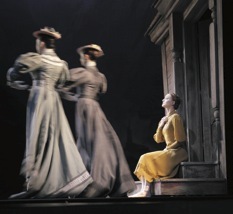
Powell for The New Yorker)
Murphy has cornered the market on repressed heroines. Last year, she brought out the comico-tragic gruesomeness of Lizzy Borden in Agnes de Mille’s “Fall River Legend” (another ballet that critics regularly designate for storage). And she’s been a persuasive Hagar for several seasons now. But on Halloween, she topped herself.
Because ballerinas are rewarded for their
vanity, they often get stuck at pretty. That’s never been a problem for the
very lovely Murphy. She gives herself over to a role even to the point of
spiritual ugliness, or obtuseness, at least. (Earlier in her career, it was
more often comic ridiculousness: one of the few reasons to attend ABT’s
“Raymonda” was to watch Murphy play a girl who’s being courted right
and left, by good prince and bad, when all she really wants is to frolic with
her girlfriends.)
Her Hagar isn’t someone we know better
than Hagar herself does. We are not thinking, If only she could see how
pretty and likeable she is. We suffer her cramped, explosive self along
with her. She doesn’t let us pity ourselves in the guise of her. (“I too
am good enough, and smart enough, and people would like me–if they
weren’t such fools!“) She is not “a girl with a bad self-image
and a longing for acceptance,” as Danceviewtimes’ Gay Morris has
asserted. (With a ballet like that, who needs self-help books?) This Hagar
has given up on acceptance before the story even begins.
She is obstinate in her suffering. She
wears it like a crown of thorns, with the blood pouring down her face all day
and dripping onto the carpet. We’ve all encountered the type–in jobs, usually,
because if you could avoid this kind of person, you would. She is the most
visible of invisibles–glowing with the knowledge that she will have been
abandoned.
That’s her tense: will have been.
She skips over the dubious present to live in a future perfect she knows will
be wretched. It’s as good as done already. You feel bad that you don’t like her, then resent her for that, too. Soon you have descended into a mise en abime of guilt and self-loathing. (Some feelings are contagious.) You wish she’d do something vile finally so you could off-load some of this evil feeling back onto her.
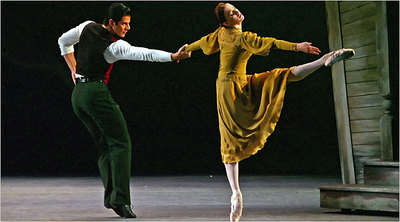
Marcelo Gomes as the Young Man from the House Opposite and Gillian Murphy as Hagar. (Photo by Andrea Mohin for the New York Times)
Hagar does, of course: she sleeps with the Young Man from the [Whore]House Opposite (no question, Tudor’s names are quaint), and she gets pregnant, which is where the drama would lose us if Murphy hadn’t so powerfully established the nature of the person we’re embroiled in. The act’s shamefulness may be outdated, but not the character of the shame. When Murphy’s Hagar turns to the questionable young man, she is wanting nothing so humanizing as acceptance or love. Rather, her desire is made of the same elemental force as her shame. In that regard, she is like her deflowerer. It doesn’t matter who does the deed, it only matters that he do it: liberate her.
He doesn’t, really–because she already knows he won’t. Murphy causes us to ache at both Hagar’s restraint and the stiff force of her abandon. Critics often talk about Murphy’s technique as if it had nothing to do with her dramatic power. But here, for example, she gives the steps the precision and force they need and simultaneously lets you feel what she has withheld–that there is a pillar of fire burning her up from within. The equilibrium Murphy establishes is wrenching–and true to Tudor.
What my colleague Christopher Caines says about “Lilac Garden” in Robert Gottlieb’s new anthology, “Reading Dance,” applies, with some modification, to “Pillar of Fire” too:
[The dance is] about things that don’t happen…. It is a sign of Tudor’s peculiar genius, his originality, and his wild courage that the ballet is built around a void.
In “Pillar of Fire” a lot does happen–our heroine gets knocked up, humiliated, then betrothed–but the characters’ stillness, not their movement, defines them. Gomes’s amoral Young Man maintains an oily equanimity without a single extraneous move: he takes whomever he wants without any resistance, in himself or them. Hallberg’s Friend is like a cool stream jetting into a churned up river. He belongs in this town among these people–he is made of the same stuff–but what he has made of that stuff is unlike them. Whenever he appears, there’s a suddenness and surprise to his arrival. And when he holds Hagar, he doesn’t waver–Tudor distinguishes his steadfastness from her stiffness or the Young Man’s easy brutality, though all are species of containment. And finally, Hagar is a maelstrom of the unrealized and the already realized. Until the Friend demands that she accept his help and solace, there is for her no present in which to rest.
I’ve seen “Pillar of Fire”
several times, but on Halloween I forgot the ending–that the Friend would come
to Hagar’s rescue. When the lights lowered for a set change, I thought the
ballet was over, and I felt relieved. If Hagar had been smaller in her inchoate
desire and more likeable–less dumbly mute and stalwart in her terror, less
epically doomed–it would have been easier to feel bad over her abandonment by
the bordello man and the town. And I would have felt less. As it was, my
feelings for her weren’t at first so different from the townspeople’s. I didn’t
entirely want to be drawn in to her struggle. So when I was, it was akin to the
sex Hagar has: it involved too much force. When the lights came back on and the
ballet resumed, I thought, Please end. Hagar’s self-consuming strength
is the particular provenance of women–even now, when we can sleep with whomever
we want whenever we want.
The “Pillar of Fire” that Murphy ignited is less about an innocent early-20th-century woman being condemned and redeemed than about a life as heavy as stone rolling inexorably downward. Unless there’s an obstacle in its way–a tree, a Friend–it will keep rolling until it hits bottom.
That story has no sell-by date.
Leave a Reply