
La Mama is a casual
kind of place. I’ve shown up to review a dance version of “Medusa” without anyone
mentioning that there would be lots of talking–in Japanese. Or, a couple of Sundays
ago, only half the advertised performers actually performed. The other half had
gone the day before.
This easy spirit is
perfect for the La Mama Moves festival, which just finished up (sorry!) its
glorious three weeks. The festival was experimental in the root sense: artists
goofing around.
On the Mavericks in
Motion program on May 18, the pieces made especially for the occasion–and probably
in short time–were dopey, gross, brawling, oozy, highly allusive, and very much
of the moment. (Heather Olson’s solo, excerpted from her Dance Theater Workshop
premiere in March, “Curious Awake Not Possible,” was naturally more polished. I
don’t know what I would have thought of the drama as a whole, but this part,
with the always-splendid Olson doing the dancing, possessed a compelling oddness
and clarity.)
Aaron Draper’s
“Fruitshake Polaroid” calls to mind food commercials–all of them–where food fills
in for some other appetite. A man and woman dance, romance, and stuff their
faces with Ho-Hos.
You may say, okay,
I get how that’s gross, oozy, and allusive, but new? The references in the other dances aren’t of recent vintage, either: not the psychedelic
light shows or the grunge spirit that cinematographer Ray Roy’s “Red Light
Special” brings to mind, nor the cassette tapes featured prominently in Julian Barnett’s “Sound
Memory.” But what does feel current is the very plenitude of retro allusions–the ease with which the choreographers borrow from the past.
“Red Light Special”
sets the scene with a video screen behind the dancers multiplying them
tenfold in red and green as they move sluggishly in the flesh. It comes into its own when pasty-faced
Roy, in boxer shorts, and his two lady companions, in hoodies and
underpants, plunk down in a row of institutional metal folding chairs and spread
their legs, subway style.
Roy is getting off in a clammy, crackhead way on the
nearness of them, while they, looking slovenly and hung over, are maintaining a
heavy-lidded glumness, like he found them that day at the Laundromat after
someone had stolen their clothes. If the American Apparel models let some natural
light into their fluorescent cubes, it might look like this.
As I’ve complained on Foot more than once about the lack of movement invention among
youngish choreographers, I should say that they are keen on the social realm. My favorite example on Sunday–the whole
year, even–was Julian Barnett’s “Sound Memory (work in progress).”
The piece gives off
such light in its unfinished state that you worry it might lose more than it
gains by being completed. (Then–nature abhorring a vacuum–you figure out what
might be gained and stop worrying.)
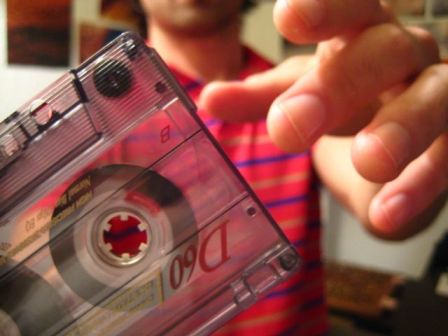
The dance begins in the pitch black. Someone empties a box of cassette tapes onto the floor and scoots them
one by one across the space. It turns out that cassettes dropped and scattered make
a sound so distinct that you can identify it in the dark. “Sound Memory” calls up many things that have
lain in the dark.
You may only remember
a song’s words and tune after it begins, but you usually know in advance how it will
make you feel. It’s as if the song were unwinding from you as much as from the
tape: a reverse déjà vu, the song on tape imagined while the song in
you is real. Sometimes the experience is inverted: you realize you’ve forgotten how
much pleasure a song has given, over and over again. For weeks or months or
years while you were thinking of other things, it held that pleasure, like someone
holding a place for you in line.
That mix of certainty
and anticipation–everything will proceed in order, and you will have to, you
will get to, take it bit by bit–is
specific to tape-playing. With an iPod or even with a record player (God
forbid!), no one ever has to wait. And with an iPod, you can choose not only a
particular tune but even randomness. (What kind of randomness is it, anyway, if
you get to choose it?) Tape-playing has us wait for what we can’t quite
remember until it arrives.
“Sound Memory” gets
at this boredom and relief, private memory and collective ritual, by very simple
means. Three dancers (Barnett, Patrick Ferreri, and Hanna Kivioja) take turns
picking cassettes off the floor, stuffing them into their individual boom boxes,
and dancing alone to the song.
Years ago, these songs spent months in heavy rotation. Most of them are like the Counting
Crows’ “Mister Jones”: dumb lyrics (“…and I felt so symbolic yesterday”) and a dumb yet
catchy beat. The dancer occasionally seems to be responding to the lyrics. More
often, the song is only a point of departure–departed from so long ago,
no one could possibly follow the path back.
Whenever someone says
a dance is left open to our imaginations, I’m pretty sure I won’t like it. Doesn’t
all dance do that? So what does it mean to announce it? “Sound Memory” doesn’t
leave the dance open to our imagination, it explores what an imagination does
with what gets handed to it. The encodedness of this dancing is funny and to
the point.
The dances to the individual
songs could have been more distinct from person to person and song to song. My
friend Elaine hoped Barnett would deploy a quasi-Cunninghamesque method as he
proceeded: make a bunch of short dances, some of them to specific songs and
some of them randomly assigned a song. The dancers then have this enormous
repertory of dances in their heads–as we have song memories in ours–which they
call up on the instant when a tape is picked off the floor.
What was amazing and rare was the texture–the
way the dance fell in and out of formality. Sometimes it was antitheatrical: the
dancer picking up a tape and plunking it in the player in a thoroughly
pedestrian way, or losing the thread of his improvisation midway and just diddling around. And
sometimes it was tightly rehearsed–the dancers tumbling over each as they progressed along a diagonal late in the piece. Usually when dances alternate back and
forth like this, it means the choreographer doesn’t know what he’s doing. Here,
it felt like listening to tapes: sometimes you’re just listening and sometimes
you’re remembering. Sometimes it’s in real time and sometimes it has the smooth patina of dream-memory. “Sound Memory (work in
progress)” is the raw and the cooked together.
Look for Julian Barnett’s “Sound Memory” at Danspace Project at St. Mark’s Church in March.
“Sound Memory” made me think of all sorts of mental habits that current technology has made
obsolete.
When you called someone
before there were answering machines, you imagined the person
walking to the phone, which was grafted to the wall or planted on a surface. If it kept ringing–and you could let it ring for as long as you wanted–you imagined the
empty house and no one hearing the ring except maybe the dog, if he was home. And
what did it mean to him?
Then there was
being called–the mystery of it. You had no idea who it might be, and you had time to
think about it. Nothing was going to happen if you didn’t answer on the fourth
ring except maybe the person would hang up. There was no answering machine to make
you feel like a cheat. If you didn’t want to answer, you could count the rings
and extrapolate how much this person really wanted to talk to you (or maybe your sister, mother, father, or brother.)
In the second house
I grew up in, people didn’t call much, though they did come by–my mother’s
friends and the enticing friends of the artist who lived in our basement.
The basement arrangement
was supposed to be temporary–the artist moved in because his girlfriend, who lived
next door, had dumped him. But he was there for years, until another girlfriend
took him in.
The basement, which
mainly consisted of a carport, had no windows. When he wanted outside light, he’d
open the carport door–his front door–and hang out in the driveway, him and his
paint-speckled friends. The subject of
his paintings, were, appropriately, cars. Big cars, little cars, red cars, blue
cars.
When he got drunk,
he would call–and call and call and call and call. It was like having the troll who usually stays under the bridge move in. You could practically hear him
dialing before the ringing began.
My father didn’t
live with us, so he was the person I most looked forward to hearing from. For a
year after he died, when the phone would ring I’d be halfway through anticipating
it was him before I remembered it couldn’t be.
Then I moved away to
college, and there was nowhere to anchor that tense, achy hope to.
The phone and the
home and the hope were of a piece for me, but I wonder whether in this evermore
portable world the imagination binds itself more and more loosely to places and things.
Leave a Reply