

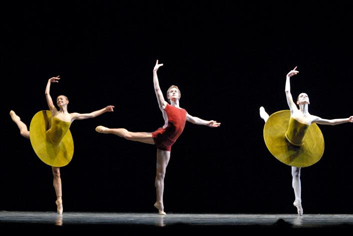
Forsythe’s style looks different here than on his own company–not so in your face but also implacable, whiplash yet static–and maybe that’s why I liked it so much.
The Kirov dancers are exceptional at switching styles, probably because they’ve been trained so solidly in a single school that they know what a style is. Still, they bring to Forsythe a softness and slipperiness–as if we’ve entered a world where the sound has been turned off–that probably returns the work too solidly to ballet for his own taste. It expresses a tenderness and curiosity toward this old idiom that I haven’t seen much from him (and certainly not from all the Forsythe spin-offs). Maybe the difference is that these are earlier works, from 1985 to 1996, while the stuff that he’s brought to BAM in the last several years has been more up-to-date. In any case, I was thoroughly engaged–delivered to the dances’ world. It helps that we get a whole night devoted to Forsythe and that, unlike the classical ballets, these fit on the City Center stage.
Dancers I especially couldn’t take my eyes off:
–Diana Vishneva in “Steptext,” one woman among three men making a real– uncontrived–story out of her outlandish figures.
–Olesia Novikova (black hair, very white, open face) bringing out the Balanchinean rhythm in Forsythe’s homage to the master, “The Vertiginous Thrill of Exactitude.” Novikova moves like a pebbled stream, with small but startling bumps in a constant flow. I think this is what people mean by Russian cantilena: however much rhythmic counterpoint the steps involve, you feel the rush of the whole passage rather than just the push and pull of discrete moments. It’s like being inside a dream.
–Henna-haired Ektarina Kondaurova had that power too in the central inside-out adagio of “In the Middle, Somewhat Elevated.”
Anyway, the Forsythe program only continues through tomorrow (Thursday). Then the company is on to Balanchine for its final three days at City Center, which should also not be missed.
UPDATE (4:30 pm, Wednesday): A friend writes,
Thank you. This is great. Can you
explain why he kept the house lights up so long, with the doors open at the
beginning? I found it so distracting (I was sitting in the back).
No, I don’t know, but, yes! it was distracting–I think the lights and the doors were probably deliberate, but I wonder about all the usher and late-patron talk.
You remind me of something major I forgot to mention: Forsythe’s propensity to cut up the stage space and sink the suspension of disbelief. He likes to pull down the shades, as it were, either by lowering the pitch black scrim at the front lip of the stage or by having the dancers fall out of performance mode. (They walk into the wings like they’re headed to the drinking fountain on the margins of a rehearsal room, or they stand in a loose first position, pressing their toes into the floor, before they begin the dancing, which, by contrast, never looks improvised.)
I think the point is less to break down the fourth wall, Brecht-style, though it has that effect too, than to do the live-performance equivalent of a handheld camera or a jump cut, which reminds you that someone is choosing these angles, this cut. Forsythe is showing that the edge of the performance isn’t the edge of the stage but sometimes more and sometimes less: a permeable, malleable boundary. And that’s how he thinks of ballet, too: the code isn’t fixed but breakable and remakeable. Sometimes his stage maneuvers really work theatrically–as in the ending of “Approximate Sonata,” when the scrim lowered, so only Elena Sheshina’s calves were visible, before the lights blacked out, and you could imagine her dancing all night–working out the approximations of this sonata. And sometimes the maneuvers feel gimmicky. That’s when I’m thinking, “But I’ve seen this already.”
Many thanks for the question.
Eva writes: From what I’ve read, I believe the funny business with the houselights
and the open doors (allowing ambient noise to enter the hallowed
hall) are a deliberate part of the scheme. I found that–and more–to be
a bit too contrived for my taste. And besides, if you trouble to warn
people that they are going to be facing some unorthodox theatrical
approaches, and they read that and settle back, thinking, “Okay, so
this will be weird,” don’t you kind of undercut the effectiveness of
the weirdness? Very, very few people seated near me appeared to be
distracted or disturbed in any way by the lights and the intruding
conversation. The strategy seems pointless to me and nearly childish
and definitely tedious after a very short while.
That said, the whole evening became, for me, an opportunity to savor
the coltish dancing of Vishneva, who is a marvel.
Apollinaire responds: Eva, I love your irritation–it makes me want to cheer, especially after I gave such a sober (very likely pretentious!) explanation. And I definitely know what you mean about “nearly childish.” Forsythe can be so charmlessly impudent. “Kammer/Kammer,” at BAM a few years ago, started with one of his dancers heckling the audience, telling us all off for being bougie hipsters. It was like an EST session, where you pay to be abused; I was very tempted to heckle him back. Anyway, maybe because this was mild by comparison or because there was more to it than postmodern self-reflexive cleverness or because the Kirov dancers softened the attitudinizing and also were clearly happy to be dancing this stuff (especially Vishneva!), I felt willing to believe he was up to something beyond a taunt. I definitely know what you mean, though!
I’m so glad you liked Vishneva! Yeah, a marvel.
Leave a Reply