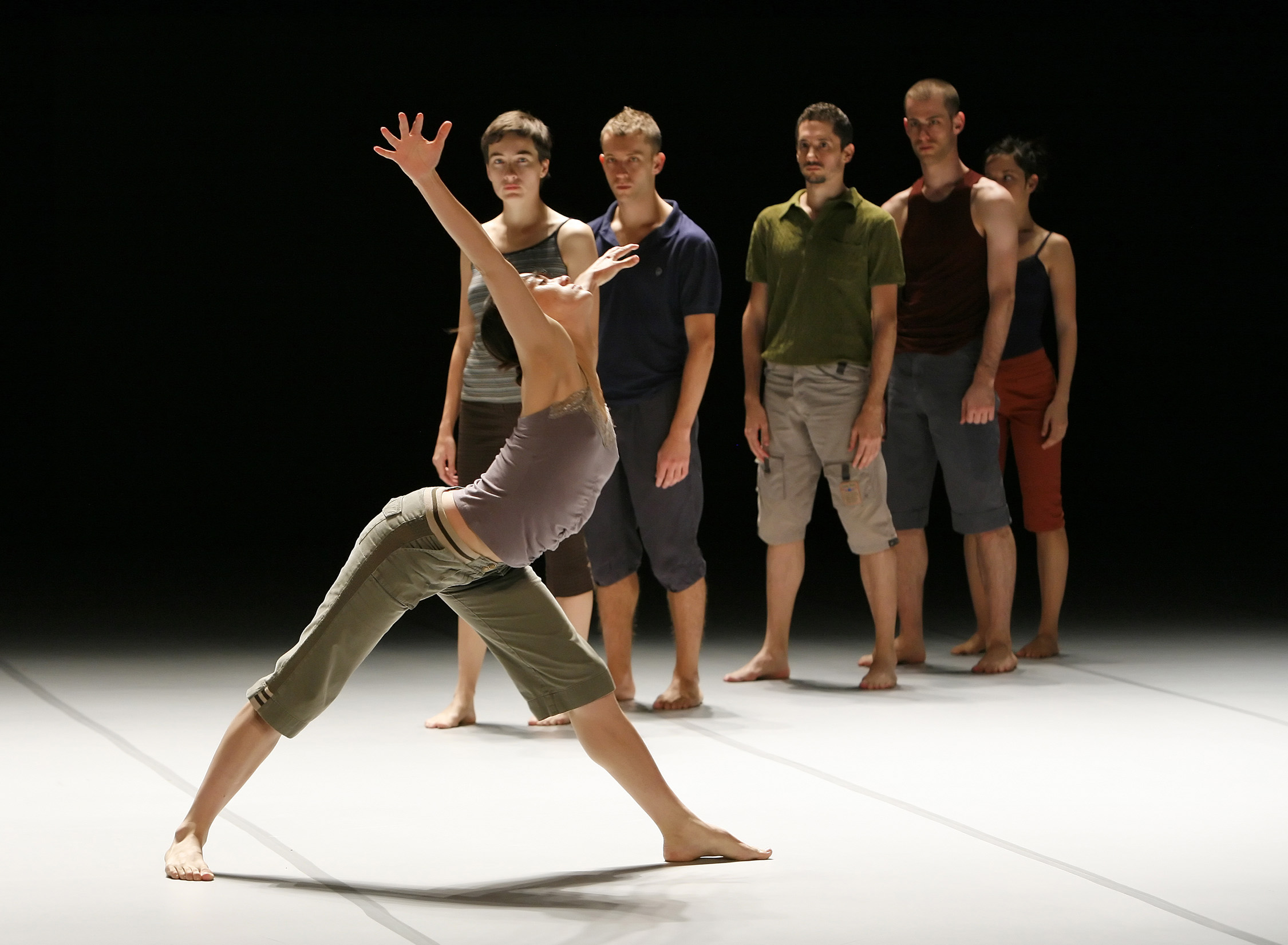
Ohad Naharin’s “Three,” performed by the Batsheva Dance Company at the BAM Opera House through Saturday, is what people like to call a “pure movement piece.” It’s an annoying expression in any case, as movement can never be wiped clean of history and metaphor (and why would you want it to be?), but it’s especially off when applied to Naharin’s gestural idiom.
Still, other pieces by Israel’s preeminent choreographer, artistic director of Batsheva, have felt more issue-oriented. The barriers to Palestinian-Israeli peace dog every step in “Naharin’s Virus,” with its score by Arab-Israelis and a high black wall against which the dancers batter themselves and on top of which they shout useless invective. (BAM presented this dance in 2002.) And other pieces have been more dramatic. “Mamootot,” presented by BAM at the Mark Morris studios a couple of years ago, bound us to the performers by a fragile umbilical cord of responsibility. The dance took place in the square, as it were, with the dancers repeating the sequences to each side. First you watched them without them seeing you and then you watched them come right at you. Enclosing them, our job was to absorb their ungainly beauty and their inwardness. At the end, they walked single file along the perimeter where we were seated and held a few of our hands too long while looking into our eyes. Would you return the gaze or look away? And how would you look at someone who brought you so close to the dance, to herself, maybe even to yourself?
With “Three,” we are in our usual place–seated in an auditorium, where the performers can’t see us. Our task is straightforward. As a talking head–literally– on a video monitor during the first comic entre’acte puts it, we’re to “Pay. Atten. Tion.” For two sections out of three, you don’t need to be told.
The movement is typical of Naharin lately. The limbs are crooked, the stomach isn’t drawn up (as in ballet), the butt sticks out behind, and the hands gnarl into claws. The gestures veer toward the obscene, as if someone seemed to be scratching his balls when he was only picking lint off his trousers.
With gestures shooting out at earthy angles, the body is not a coordinated unit but made up of parts, each having its own say. What a lively, protuberant creature it is! (The 17 members of Naharin’s Tel Aviv tribe are mesmerizing individuals without for the most part being showoffs.)
What’s unusual for Naharin is the unison. It’s as if he set up an experiment to test his language’s limits: What happens if I confine movement so obviously individual to unison? And what happens to the unison when such freaky movement inhabits it?
The movement in the unison sections doesn’t feel any less idiosyncratic, but it does seem more instinctive than willed. The dancers resemble a herd, a school of fish, a flock–animals moving from a collective and silent knowledge. And yet, the individual in the group doesn’t seem to have to contain herself to move in sync with others. Unison becomes a lovely, miraculous feat here, one of those rare cases of having one’s cake and eating it, too.
Glen Gould’s rendition of Bach’s Goldberg Variations proves a funny, apt choice for “Three’s” first part, “Bellus” (or “Beautiful”). The eccentric pianist’s emphasis on the knobbly moments in Bach’s mathematical sublime brings out the uncouth angularity of Naharin’s steps and even “Bellus’s” structure, in which dancers walk on flatfootedly to dance together or alone.
Burbly, quiet Brian Eno works just as well for section two, “Humus” (Soil), for nine women. “Humus” is almost entirely in unison. Given the subdued character the mode possesses here, this section is the most quiet and serene, without ever being faceless or mystical or whatever association the hopeful fantasy of silent women carries.
The third section resorts to a musical collage of electronica, the Beach Boys, etc., plus tried-and-true Naharin choreographic formulas. For example, the dancers line up for some vogueing, each person presenting his “own thing.”
Often with modern dance, I’m irritated that choreographers who have the opportunity to invent a whole movement palette (yippee!) make such pallid, shopworn choices. But Naharin takes avidly to his freedom. When the dancers are left to their own devices, though–or seem to be, anyway–they look less individual, not more. Unedited, “your own thing” turns out to be mainly someone else’s: the unconscious both collective and spongelike, and a bit dull. Perhaps Naharin was exhausted by the time he got to part three. And no wonder: he has made a dance unlike any he’s done before, and mesmerized us to boot.
Here is a 40-second video collage of the 70-minute “Three.”
Photo credit: Richard Termine for the Brooklyn Academy of Music
Apollinaire Scherr talks about dance

this is the best descrip of ohad’s choreography i have read.
[Apollinaire responds]: Thank you so much for your kind words Don’t know your website: will look it up.