
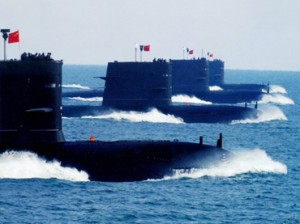
When the Communist Party of China held its annual plenum in the fall of 2011, it released a communiqué in which it announced its intention to become a major cultural power. This autumn, it held its five-yearly congress – the 18th since it was founded in 1921 – and pledged to become a maritime power. So, to ring in the New Year at the Great Hall of the People – the same august venue in which these annual political gatherings were held – the Party combined both goals and held “The First Annual ‘Ocean China’ New Year’s Concert.”
The New Year’s concert is by now an established tradition in China. State television started broadcasting the Vienna New Year’s Concert back in the 1980s and it was immensely popular for years. Shimmering images of the golden box that is the Musikavern and the gaiety of Strauss’ waltzes are thus as much a part of solar New Year celebrations as the boom and bang of firecrackers are of lunar New Year revelries. As the years passed, orchestras in China gradually started holding their own Christmas and New Year concerts. Then, as astonishing new concert halls sprang up like mushrooms, presenters began inviting foreign orchestras and ballets to tour during this period, especially from Russia.
Today, there are hundreds of New Year concerts, held over a roughly two week period from mid-December to January 1, with the biggest events closest to New Year’s Eve. Chinese artists from around the world fly back to do multi-city concert tours –Lang Lang is a regular, holding recitals in 10,000 seat stadiums around the country. Orchestras nationwide earn their bread and butter by playing at corporate parties, which sometimes directly imitate an imagined version of 19th century Vienna. Concert tickets have also become popular New Year’s gifts – the more expensive the ticket, the better. Prosperous companies and banks in interior cities that lack their own symphonies hire orchestras from coastal cities and fly them out to perform at private concerts.
The Great Hall of the People, which stands on Tiananmen Square, is a massive marble monolith that was built to impress. Its main hall seats 10,000 people and has a red and gold star for a chandelier. Security is airport style and there is no fooling around – the ushers are soldiers in suits, their erect bearing, tall height, cropped hair, and unsmiling faces a dead give-away. To get from the front door into the hall requires traversing a red carpet the length of several football fields. Our seats were at wooden desks where Party and government delegates listen to speeches. The desks have little cubbies for papers and books, and in years gone by had red and green buttons that you could flip up and down while pretending to vote; after a renovation a few years ago these were replaced with an electronic system. Like pretty much everything in China, the Great Hall is available for rent, but this particular concert had official sponsorship from the Bureau of the Oceans.
The Decemner 27 concert began with two well-known TV presenters reading from the 18th Party Congress pronouncement regarding China’s determination to become a maritime power. The female presenter wore a blue gown, to emphasize the point, as did all female soloists. To underscore the size and global nature of China’s ambition, the orchestra was doubled to 160 people, with half the musicians from the China National Orchestra and half from the Russian National Orchestra, which is currently touring China. The program stuck to the theme – indeed, only ocean-themed pieces were permitted, with the exception of the encores (“Pleasant News from Beijing” and Strauss “Radetzky March”): Debussy’s “La Mer;” “Xisha – My Beloved Homeland,” a song from a late 1970s or early 1980s movie; “Making Nets By the Sea,” another movie song; Tchaikovsky’s “The Tempest:” an ocean-themed selection from Rimsky-Korsakoff’s “Scheherazade;” and Wagner’s “The Flying Dutchman” overture.
At the end of the concert, the announcers returned to assure the audience that the ocean was nothing more than “China’s blue-colored territory” and that becoming a maritime power was part of the nation’s “renaissance.”
“We will go straight to the sea,” they declared, “and never look back! Happy New Year!”
Leave a Reply