Horton Foote: An Appreciation
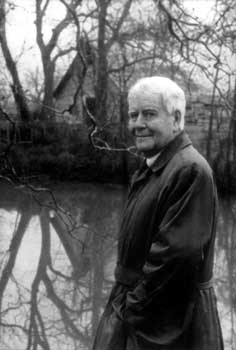
Obituaries described Horton Foote, who died Wednesday, as a great storyteller, a writer of ordinary Americans. To me, these sound just a little condescending. For them, Foote is not a great dramatist on par with an Albee or Mamet. He's a great storyteller - as if he were some folksy character on a front porch just spinning yarns about his kin.
It's easy to get this impression. I confess I held it at first. Foote never went to college (although he and his wife did end up running a school in Washington, D.C.) Some of Foote's earliest works - like The Trip to Bountiful - were written for television, and they remain some of his most popular. They're also his most sentimental. The characters here express what they feel and act on those feelings. End of story. The small town settings, the countryfied language, the homey qualities: Nothing much will surprise you.
The New York Times obituary claimed, unsurprisingly, that the Times' theater critic Frank Rich was partly responsible for rediscovering and reviving Foote's career. Actually, for anyone who was paying attention, the change was apparent with the 1983 film, Tender Mercies, in which Robert Duvall plays a washed-up, drunken country singer. And won an Oscar.
In Tender Mercies - and in plays from the same period - Foote's characters often don't know what they want. Or can't express it. So how the plot works out sometimes doesn't reflect what they're telling us.
It's why Foote's later plays can take unexpected turns. And it's why they suggest these great depths of dammed up, unexpressed feelings. (Mac Sledge, the Duvall character, can sing a plaintive song, but most of the rest of his dialogue comes in two- or three-word sentences.) Foote's mother and father died in 1974-'75 -- his father died in the same room in the same house where Foote's brothers were born. And the loss seemed to open him up as a writer. Soon afterwards, he started writing a cycle of nine plays called Orphans' Home. His writing here is extremely pared away, yet he gives his hometown of Wharton, outside of Houston, the full Faulkner treatment. He chronicles the place from convict laborers to local aristocrats in all its complex social and moral interactions.
What I'm saying is that Foote was a much more sophisticated
writer than he's often given credit for. Orphans' Home: Even the title
seems quaint. But it's actually taken from a poem by Marianne Moore, and it describes all of our sorry lives on this planet ("The world's an orphans' home"). One of the cycle's plays is called Roots in a Parched Ground. That's a line from William Carlos Williams.
Whenever I met Foote, he was always the courtly, friendly gentleman the obituaries describe. But he was also a tougher, more determined character than that. He won the Pultizer Prize in 1995 - and he hadn't had a play on Broadway for more than 40 years. And he wouldn't have a full-out Broadway success until this past year. When he died in Hartford on Wednesday, Foote was working on a stage production for this fall. He was adapting Orphans' Home. He was 92 and he'd started writing it 35 years ago.
Whenever I met him, Foote was dressed the same way, even standing out in the heat of a Houston street. Navy-blue, double-breasted blazer, grey slacks, velvet slippers. Simple, dapper but comfortable. Foote was the son of a haberdasher, so he knew what he was doing.
And once he found it, he stuck with it.
You can hear an audio version of this post or watch a video interview of Foote at my day job.
Categories:
Blogroll
Critical Mass (National Book Critics Circle blog)
Acephalous
Again With the Comics
Bookbitch
Bookdwarf
Bookforum
BookFox
Booklust
Bookninja
Books, Inq.
Bookslut
Booktrade
Book World
Brit Lit Blogs
Buzz, Balls & Hype
Conversational Reading
Critical Compendium
Crooked Timber
The Elegant Variation
Flyover
GalleyCat
Grumpy Old Bookman
Hermenautic Circle
The High Hat
Intellectual Affairs
Jon Swift
Laila Lalami
Lenin's Tomb
Light Reading
The Litblog Co-op
The Literary Saloon
LitMinds
MetaxuCafe
The Millions
Old Hag
The Phil Nugent Experience
Pinakothek
Powell's
Publishing Insider
The Quarterly Conversation
Quick Study (Scott McLemee)
Reading
Experience
Sentences
The Valve
Thrillers:
Confessions of an Idiosyncratic Mind
Crime Fiction Dossier
Detectives Beyond Borders
Mystery Ink
The Rap Sheet
Print Media:
Boston Globe Books
Chicago Tribune Books
The Chronicle Review
The Dallas Morning News
The Literary Review/UK
London Review of Books
Times Literary Supplement
San Francisco Chronicle Books
Voice Literary Supplement
Washington Post Book World

2 Comments