Review: Mudbound, by Hillary Jordan
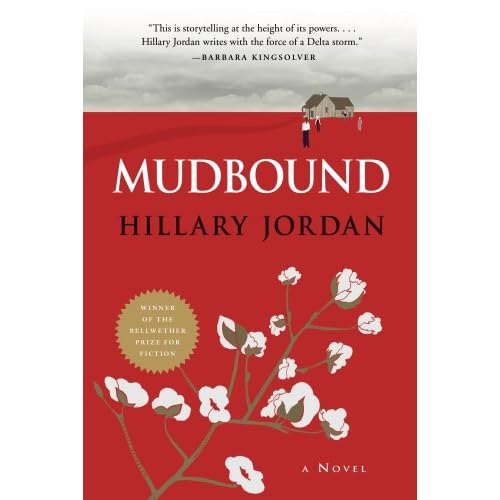 Author Hillary Jordan spent her childhood in Dallas and Oklahoma, but her debut novel, called Mudbound, is set on a Mississippi cotton farm in 1946. This actually isn't all that big a jump. Dallas may play up its cowboy myths, but not so long ago, the city was surrounded by cotton fields. Cotton farming built Dallas, it built the Cotton Bowl.
Given its time and place, Mudbound is inevitably about Jim Crow. A Memphis schoolteacher, Laura moves to Mississippi because her husband Henry loves the land and wants to raise cotton. They're cheated out of the nice house he bought, so they're stuck living on the farm with no electricity, no running water. Before this, Laura must have lived a sheltered life.In 1946, America was a much more rural and segregated country, yet Laura is shocked by how primitive and racially ugly the Delta can be.
Needless to say, family tensions and racial tensions mount.
Henry's father, Pappy, a thoroughly unpleasant old coot, comes to share their tiny farmhouse. And the end of World War II brings Jaimie back home -- Henry's charming, ne'er-do-well brother. Laura has been secretly infatuated with Jaimie.
The end of the war also brings back Ronsel Jackson, the strong, likable son of the black sharecroppers who work Henry's land. Ronsel was a sergeant under General Patton, and with thousands of other African-American vets, he comes home having seen Europe, having proved himself a soldier and having decided he'll no longer accept the insults and violence of segregation. Either Mississippi is going to change, or Ronsel will have to leave.
While it was still in draft form, Mudbound won the Bellwether Prize, founded by novelist Barbara Kingsolver, author of The Poisonwood Bible. The Bellwether is awarded to unpublished first novels that support social change.
Not surprisingly, Mudbound echoes the strengths and weaknesses of some of Ms. Kingsolver's own writing. Ms. Jordan has a vivid way with description, for instance. "When I think of the farm," Laura writes, "I think of mud ... There was no defeating it. The mud coated everything. I dreamed in brown."
And she can work up some powerful scenes. Initially, Mudbound seems as though it might be something like "Emily Bronte on the Bayou" - about an illicit passion in a godforsaken backwoods. But the novel begins with a bleak burial in a violent storm and continues with different characters taking over the story as it heads toward the inevitable lynch mob. It's really kind of William Faulkner Lite - Faulkner without the gothic poetry or the dense stream-of-consciousness.
The novel's chief weakness - a weakness it shares with some of Ms. Kingsolver's writing - is its moral simplicity. The good characters - Laura, Ronsel, Ronsel's tough mother Florence - have their failings. And there are ambiguous characters like Henry. But the bad guys - and they are all guys - they're just hateful scum. Pappy is racist, bad-tempered, stingy, bullying, abusive, lazy, sexist. True, he represents the old white patriarchal South, but he might as well kick dogs and spit on babies. Actually, late in the novel, we learn Pappy does hate animals, he forbids his grandchildren from having pets. You just want to pinch the guy.
It's unfortunate because Ms. Jordan actually works out a multi-layered resolution for her novel. But Mudbound is too bound up with its obvious lessons about the evils of racism to shake free into something truly different, something real.
Categories:
Blogroll
Critical Mass (National Book Critics Circle blog)
Acephalous
Again With the Comics
Bookbitch
Bookdwarf
Bookforum
BookFox
Booklust
Bookninja
Books, Inq.
Bookslut
Booktrade
Book World
Brit Lit Blogs
Buzz, Balls & Hype
Conversational Reading
Critical Compendium
Crooked Timber
The Elegant Variation
Flyover
GalleyCat
Grumpy Old Bookman
Hermenautic Circle
The High Hat
Intellectual Affairs
Jon Swift
Laila Lalami
Lenin's Tomb
Light Reading
The Litblog Co-op
The Literary Saloon
LitMinds
MetaxuCafe
The Millions
Old Hag
The Phil Nugent Experience
Pinakothek
Powell's
Publishing Insider
The Quarterly Conversation
Quick Study (Scott McLemee)
Reading
Experience
Sentences
The Valve
Thrillers:
Confessions of an Idiosyncratic Mind
Crime Fiction Dossier
Detectives Beyond Borders
Mystery Ink
The Rap Sheet
Print Media:
Boston Globe Books
Chicago Tribune Books
The Chronicle Review
The Dallas Morning News
The Literary Review/UK
London Review of Books
Times Literary Supplement
San Francisco Chronicle Books
Voice Literary Supplement
Washington Post Book World
