The Exception: a philosophical thriller
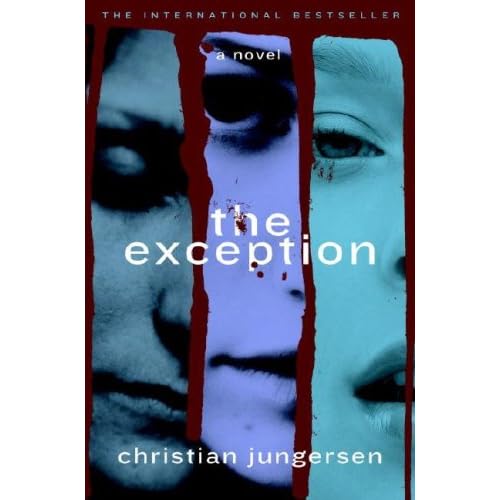 Thousands of thrillers have used genocide as the big threat -- like the Holocaust that hovers in the background of so many World War II yarns. But in his novel The Exception -- his first to be published in English -- Danish author Christian Jungersen puts mass murder front and center as a trigger for suspense but also as the chief topic of debate for his characters. A philosophical thriller, The Exception considers the question who among us could commit atrocities, and sets it not among soldiers or sadists but the staff in a Copenhagen think tank devoted to studying genocide. In other words, take the most humanitarian, high-minded Westerners around -- people like us, you know, the best people -- and given the right circumstances, circumstances that needn't even be that extreme, we will still savage each other.
In this case, it's ordinary, petty office politics that turn terrifying. In The Exception, the female researchers and librarians at the tiny Danish Center for Information on Genocide receive death threats, anonymous e-mails that possibly came from one of the Serbian war criminals they've written about. What's more, the center itself is in danger of a takeover by a larger nonprofit.
The tense atmosphere causes staff alliances to turn poisonous. One researcher was kidnapped on an earlier mission to Kenya, and her flashbacks make her panic. Another was bullied growing up and turns resentful and paranoid. Their boss is up to his own bureaucratic tactics to save the institute, and while he's out of the office, staff members are soon breaking into files for evidence against each other or ostracizing one member in an effort to drive her away.
In between these efforts, the Center's staff write about Darfur or Cambodia, allowing Mr. Jungerson to load in fascinating historical and psychological data on torture -- like the infamous Stanley Milgram experiment which found that the great majority of people are willing to deliver supposedly fatal shocks to our fellow test subjects. Or the Stanford Prison experiment which saw ordinary people who played at being guards or inmates fulfilling their roles with a vengeance.
In effect, The Exception is one of these experiments, with Mr. Jungerson setting out to demonstrate what these studies have shown: It's not just mad racists who torture and kill. No matter our country or background, 60 to 80 percent of us would be willing lynchers or death camp guards.
And that's one of the novel's weaknesses -- the feeling that the office workers are just lab rats in Mr. Jungerson's maze. We get his point long before the staff members do. Another weakness is the novel's flat-footed prose, whether that's the fault of Mr. Jungerson or his translator, Anna Paterson, I can't say. But when he's reporting grim ethnic cleansings, it works chillingly to the book's advantage. For pages of everyday dialogue, it can plod.
Despite its disturbing subject, Mr. Jungerson's 500-page novel has been a bestseller in Europe. And if it were about 100 pages shorter, The Exception truly would be exceptional. As it is, it's a thought-provoking thriller, part PhD thesis, part cliffhanger.
A version of this review was broadcast on KERA-FM, public radio for North Texas.
Categories:
Blogroll
Critical Mass (National Book Critics Circle blog)
Acephalous
Again With the Comics
Bookbitch
Bookdwarf
Bookforum
BookFox
Booklust
Bookninja
Books, Inq.
Bookslut
Booktrade
Book World
Brit Lit Blogs
Buzz, Balls & Hype
Conversational Reading
Critical Compendium
Crooked Timber
The Elegant Variation
Flyover
GalleyCat
Grumpy Old Bookman
Hermenautic Circle
The High Hat
Intellectual Affairs
Jon Swift
Laila Lalami
Lenin's Tomb
Light Reading
The Litblog Co-op
The Literary Saloon
LitMinds
MetaxuCafe
The Millions
Old Hag
The Phil Nugent Experience
Pinakothek
Powell's
Publishing Insider
The Quarterly Conversation
Quick Study (Scott McLemee)
Reading
Experience
Sentences
The Valve
Thrillers:
Confessions of an Idiosyncratic Mind
Crime Fiction Dossier
Detectives Beyond Borders
Mystery Ink
The Rap Sheet
Print Media:
Boston Globe Books
Chicago Tribune Books
The Chronicle Review
The Dallas Morning News
The Literary Review/UK
London Review of Books
Times Literary Supplement
San Francisco Chronicle Books
Voice Literary Supplement
Washington Post Book World

2 Comments