On The Road, again
In The New York Review of Books, Michael Chabon's essay on Cormac McCarthy's novel, The Road, is extremely interesting and insightful in that he argues against the book being taken as a sci-fi novel, even though "all the elements of a science fiction novel of the post-apocalypse are present or at least hinted at ...: the urgent naturalism of McCarthy's description of torched woodland, desiccated human remains, decaying structures, human and natural violence; the ambivalence toward technology embodied in the destructive-redemptive role of fire; the faint inventive echoes of works like Roger Zelazny's Damnation Alley and the Mad Max movies...."
Mr. Chabon takes this stand because he believes that rather than a break into a new genre or a departure from McCarthy's previous work, The Road represents a return to it -- that is, a return to his work from before The Border Trilogy (All the Pretty Horses, The Crossing, Cities of the Plain), specifically, a return to the Gothic horror and adventure stories most fully embodied in Blood Meridian.
This echoes something of the judgment in my September 24 review for The Dallas Morning News: "His novels have headed toward this unforgiving Judgment Day since at least Blood Meridian, which marked his move from Tennessee to Texas with a savage, revisionary Western filled with murderous humans akin to the beasts from Alien."
An aside: I've always felt that the over-the-top brutality of Blood Meridian was a significant influence on Larry McMurtry's own, increasingly gruesome, post-Lonesome Dove Westerns. Lonesome Dove and Blood Meridian both came out the same year, 1985, and despite the popular affection for the Pulitzer Prize-winning McMurtry novel, it was actually intended, in its own way, to debunk the myths of the cowboy hero, depicting pointless deaths, pointless sex, the natural horrors of 19th century life in Texas, etc.
To his complete surprise, McMurtry has said, the saga was received instead as an Epic Romance of the Cattle Drive, something of a "Gone With the Wind of the West." America's love for the mythic West, he concluded, was stronger than any defilement he could come up with. Depressed and disoriented by his quadruple bypass operation -- and as I said, influenced by the example of McCarthy's novel -- his Westerns became increasingly harsh and almost nihilistic, beginning with 1993's sequel, Streets of Laredo.
A chief difference between McMurtry and McCarthy, I would argue, is that McCarthy's worldview is actually harsher but never nihilistic. Much like Samuel Beckett's poetry-and-humor-in-the-face-of-the-void, McCarthy's writing is often so beautiful, it conjures its own spell against despair, a point Chabon makes. (McMurtry's prose style, in comparison, isn't in the same league as McCarthy's.) But also, McCarthy really does hold to an Old Testament sense of punishment and purgation: He acts like an angry Jehovah toward his puny little human characters, rarely but occasionally taking pity on them.
Or rather, everything I've said about McCarthy's work holds true before and after The Border Trilogy. Those three novels now seem like "a detour," as my review noted. "Mr McCarthy's flinty wrath was muted, but only softened into heartbreak and tragedy." With The Road, his vengeful god of justice has returned full force.
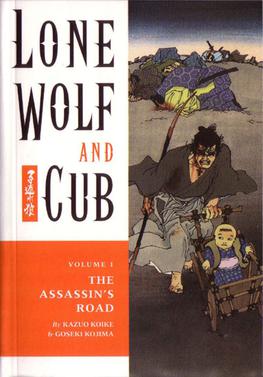 Chabon makes much the same argument but in terms of genre, and given McCarthy's penchant for barbecuing babies (as his vicious marauders do in The Road), Chabon's points about McCarthy's strong tendency toward Gothic horror are well taken. I have one addition to make to Chabon's genre analysis, one that my review originally made but which no one seems to have picked up on: The central image in The Road of a father and son against the world, of a solitary warrior-father -- a sad, beleagured but noble figure -- pushing his young son around in a cart in a bleak, lawless countryside while fighting off wandering gangs and cutthroats lying in wait owes a great deal, it seems to me, to the samauri manga series, Lone Wolf and Cub by Kazuo Koike and Goseki Kojima. To many Americans, this may seem like an improbable and most likely forced connection on my part, but Lone Wolf and Cub is a landmark in graphic fiction and one of the longest-running, most popular works in Japan, with something like 27 volumes in print, six film adaptations, four stage plays and a television series. And in this light, the mixture in The Road of astonishing lyricism, natural beauty (if charred and broken), lonely male heroism and barbaric violence can seem almost Japanese at times, like something out of a black-and-white Kurosawa.
Categories:
Blogroll
Critical Mass (National Book Critics Circle blog)
Acephalous
Again With the Comics
Bookbitch
Bookdwarf
Bookforum
BookFox
Booklust
Bookninja
Books, Inq.
Bookslut
Booktrade
Book World
Brit Lit Blogs
Buzz, Balls & Hype
Conversational Reading
Critical Compendium
Crooked Timber
The Elegant Variation
Flyover
GalleyCat
Grumpy Old Bookman
Hermenautic Circle
The High Hat
Intellectual Affairs
Jon Swift
Laila Lalami
Lenin's Tomb
Light Reading
The Litblog Co-op
The Literary Saloon
LitMinds
MetaxuCafe
The Millions
Old Hag
The Phil Nugent Experience
Pinakothek
Powell's
Publishing Insider
The Quarterly Conversation
Quick Study (Scott McLemee)
Reading
Experience
Sentences
The Valve
Thrillers:
Confessions of an Idiosyncratic Mind
Crime Fiction Dossier
Detectives Beyond Borders
Mystery Ink
The Rap Sheet
Print Media:
Boston Globe Books
Chicago Tribune Books
The Chronicle Review
The Dallas Morning News
The Literary Review/UK
London Review of Books
Times Literary Supplement
San Francisco Chronicle Books
Voice Literary Supplement
Washington Post Book World

1 Comments