Second thoughts on Alan Furst
This is one of the things that makes Alan Furst such a remarkable writer of historical thrillers. His specialty is wartime or pre-war Europe, and this is from Blood of Victory:
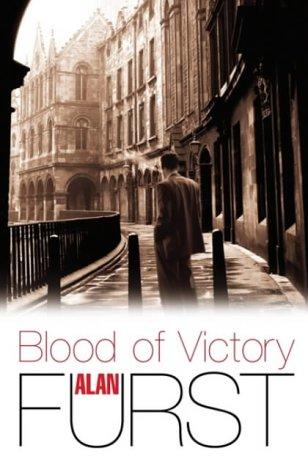 Belgrade -- or so the British cartographers called it. To the local residents, it was Beograd, the White City, the capital of Serbia, as it had always been, and not a place called Yugoslavia, a country which, in 1918, some diplomats made up for them to live in. Still, when that was done, the Serbs were in no shape to object. They'd lost a million and a half people, siding with Britain and France in the Great War, and the Austro-Hungarian army had looted the city. Real, old-fashioned looting -- none of this prissy filching of the national art and gold. They took everything. Everything that wasn't hidden and much that was. Local residents were seen in the street wearing curtains, and carpets. And ten years later, some of them, going up to see friends in Budapest, were served dinner on their own plates.
Admittedly, Blood of Victory shifts
locations a lot -
But Furst does it so smoothly and enjoyably. He treats the reader well. As much as the story or the characters, he seems to say, this is what a historical thriller is about, this kind of texture. It's not just data nor is it a bit of war-is-hell, tough-guy posturing on the narrator's part. It's evocative, graceful, even humane in the way the author, in that last line, clearly understands the anger and surprise of the Serbs while also relishing the humor of the situation, appreciating the good "old-fashioned" looting. It's all very much part of Furst's oft-noted "urbane" or "European" touch - that sympathy with a smile and a Gallic shrug.
In fact, for comparison's sake, let's look at another American thriller writer's use of exposition and scene-setting, a thriller writer I've chosen perfectly at random - oh, let's say - Tom Clancy. This is from Clancy's TheTeeth of the Tiger:
"The cabs in
"Some," Jack agreed. "Nice city. Nice people."
That sparkling little exchange gets to the
heart of
That's so much simpler than "'Some,' Jack partly agreed."
So let's not dismiss scene-setting and
exposition as minor affairs for a thriller writer. I recently picked up Blood of Victory because I'm reading a study of thrillers, and it reminded me that I still had some titles of Furst's to read. I came to him late because he didn't always write with such seemingly effortless style. Initially, his writing felt like a patently movie-ish attempt to evoke atmosphere, not create it but borrow it, remind us of it from other places. His first novel, Night Soldiers got generally excellent reviews when it came out in 1988. I was turned off by this sort of passage, though:
But nothing here was what it seemed. Even the gray stone of the buildings hid within itself a score of secret tints, to be revealed only by one momentary strand of light. At first, the tide of secrecy that rippled through the streets had made him tense and watchful, but in time he realized that in a city of clandestine passions, everyone was a spy. Amours. Fleeting or eternally renewed, tender or cruel, a single sip or an endless bacchanal.....
Did you catch that? It's not just the gray stone that has its secrets, it's the gray stone's hidden tints. Now, that's a secretive town. And that's a writer who's piling on too many metaphors, straining too much after atmosphere. He's either showing off his 'fancy' writing or he's insecure and he's forcing things.
<But Furst calmed down, gained confidence, his writing became smoky yet lean. And he began using dry, throwaway humor. In the midst of the suspense and violence, it lends a cosmopolitan feel that aids immensely in making his main characters appealing. These are sadly experienced men, often with conflicted loyalties, or they're the perennial losers in the big European wars. In Blood of Victory, Serebin's a Russian who escaped Stalin, ends up in Paris and now must elude the Gestapo. Why him? he asks. Why not? "That was, Serebin thought, glib and ingenuous, but until a better two-word history of the USSR came along, it would do."
So Serebin is another reluctant hero. He's enlisted in a plot to disrupt the flow of Romanian oil by sinking barges at a crucial point along the Danube. Like Furst's other protagonists, he's not a natural warrior or idealist, but a man who would be much happier eating good food and staying in bed with a lover (in fact, it's a lover, a French diplomat's wife, who gets Serebin involved in all this).
 Even the espionage operations Furst's characters get caught up in are not the grand master plans like Overlord or Barbarossa. They're more the nuts-and-bolts clandestine efforts: smuggling weapons or people, sabotaging the enemy's materiel, trying to sway a political situation. Yet we learn from each novel - as earth-changing events overtake our protagonists - that when everything's at stake, every little thing counts. Rather than an easy nostalgia for some time of supposed moral clarity, Furst's novels give us a feel for the murk and undertow and backwash of warfare and espionage -- the "kingdom of shadows" -- and it's often the murk and backwash that are as dangerous as any army.
All of this leads to that very Furstian effect, perfectly on display in Blood of Victory: His novels are at once elegant and earthy. Somehow, magically, they're sardonic and anti-heroic -- yet also touchingly heroic.
I can't get enough of them.
Categories:
Blogroll
Critical Mass (National Book Critics Circle blog)
Acephalous
Again With the Comics
Bookbitch
Bookdwarf
Bookforum
BookFox
Booklust
Bookninja
Books, Inq.
Bookslut
Booktrade
Book World
Brit Lit Blogs
Buzz, Balls & Hype
Conversational Reading
Critical Compendium
Crooked Timber
The Elegant Variation
Flyover
GalleyCat
Grumpy Old Bookman
Hermenautic Circle
The High Hat
Intellectual Affairs
Jon Swift
Laila Lalami
Lenin's Tomb
Light Reading
The Litblog Co-op
The Literary Saloon
LitMinds
MetaxuCafe
The Millions
Old Hag
The Phil Nugent Experience
Pinakothek
Powell's
Publishing Insider
The Quarterly Conversation
Quick Study (Scott McLemee)
Reading
Experience
Sentences
The Valve
Thrillers:
Confessions of an Idiosyncratic Mind
Crime Fiction Dossier
Detectives Beyond Borders
Mystery Ink
The Rap Sheet
Print Media:
Boston Globe Books
Chicago Tribune Books
The Chronicle Review
The Dallas Morning News
The Literary Review/UK
London Review of Books
Times Literary Supplement
San Francisco Chronicle Books
Voice Literary Supplement
Washington Post Book World

1 Comments