Failing to cross the Alps, again
Thomas Harris will be coming out with a new Hannibal Lecter novel next week -- Hannibal Rising.
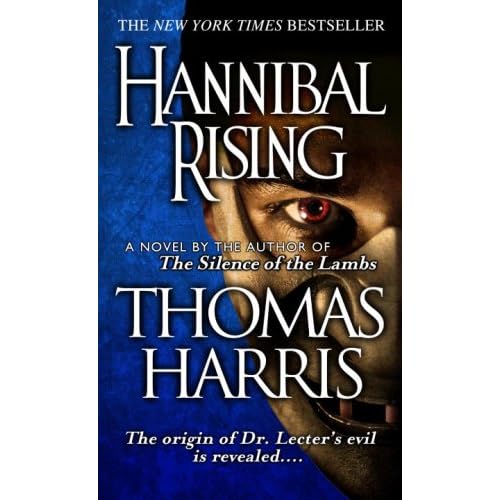 Here's my prediction: It will get ecstatic reviews from major media outlets in America, just as Hannibal did, and it will be, just as Hannibal was, absolutely dreadful. A letdown, a botch.
That's because Mr. Harris did not understand what made The Silence of the Lambs the special piece of popcorn entertainment it was. Most people didn't. It wasn't just Hannibal Lecter that made the story. Sorry, but a mastermind killer with the pretensions of an aristocratic aesthete is as old as Professor Moriarty -- although Hannibal does have a joie de vivre that most twisted, sexual predators just seem to lack somehow.
No, what made Silence succeed so well, what director Jonathan Demme and screenwriter Ted Tally understood and Mr. Harris didn't, is that the story is really Clarice Starling's. It's her small-town woman's embarrassment and anguish we feel, it's her character that doesn't just survive despite the odds (as is typical of most conventional thriller heroines). She changes; she triumphs in the all-male law enforcement world; she faces down the lonely, impoverished family past that haunts her. After all, the title of the book is about her, not Lecter.
That's what made Silence superior to Red Dragon, and it helps explain Jody Foster's fine performance. Anthony Hopkins had the delightfully (chillingly) show-offy role; Foster submerged herself into this troubled but determined young woman. It's an inspiring piece of acting.
The evidence that Mr. Harris didn't realize this is the particularly ugly, belittling way he handled Starling in the sequel, Hannibal, and the baroque, gross-out nature of that book's violence.
When one reads the three Lecter novels in a row, it's plain that, much like Darth Vader's character in Star Wars, Lecter is something of a sideshow who took over the main event. Mr. Harris discovers his potential as he goes along; at first, he seems the logical next step in the gimmicky 'profiler vs. serial killer' sweepstakes that took over thrillers in the '80s and '90s: The FBI profilers actually use one serial killer to find another. But this serial killer proved much more interesting than the by-now-typical "sympathetic" mass murderer, the Red Dragon. That's because this serial killer is a psychiatrist, he's brilliantly self-conscious -- not only can he play the usual cat-and-mouse games with the cops, he can actually explain what's going on, what motivates the police, what drives his fellow killers. And all this comes full flower in Silence.
But with Hannibal, not only did Mr. Harris add nothing new, he seemed to think, as so many others did, that his books' appeal lay in their gruesome inventions and in Lecter's artsy disdain and gourmet snobbery. So all of these were taken to laughably ridiculous lengths in the third book.
One final reason for the predicted failure of Hannibal Rising: A real key to Lecter's allure is the way he seems to spring immediately into view, already confident of his own genius and artistry (although not yet in full control of his destiny -- that comes in Silence). We get to learn all the sad, sordid, grubby details that lead to a Red Dragon or to a Buffalo Bill, the details that make them pathetically human even as they are monstrous. But Hannibal? He's above it all, a superhuman mystery. To explain him would be like explaining Michelangelo. Art critics and historians can certainly do that, but they don't do it in a thriller. It will only diminish a fictional creation by trying to make him "real." Or we'll get one of those silly Hollywood moments when the great composer sits at the piano, lost in thought, hits a few random notes -- and that's it! It's Rhapsody in Blue!
In other words, it's no explanation at all. But that's precisely what Mr. Harris is setting out to do: Explain Lecter. Explain the explainer. His title for the third novel, Hannibal, seemed thuddingly pedestrian as it was. Now, the uninventive title for the fourth book, Hannibal Rising, betrays what I believe will be a sadly flat-footed approach to what once was a sparklingly sinister creation.
Of course, I'm hoping I'm wrong. But I'm not betting on it.
Categories:
Blogroll
Critical Mass (National Book Critics Circle blog)
Acephalous
Again With the Comics
Bookbitch
Bookdwarf
Bookforum
BookFox
Booklust
Bookninja
Books, Inq.
Bookslut
Booktrade
Book World
Brit Lit Blogs
Buzz, Balls & Hype
Conversational Reading
Critical Compendium
Crooked Timber
The Elegant Variation
Flyover
GalleyCat
Grumpy Old Bookman
Hermenautic Circle
The High Hat
Intellectual Affairs
Jon Swift
Laila Lalami
Lenin's Tomb
Light Reading
The Litblog Co-op
The Literary Saloon
LitMinds
MetaxuCafe
The Millions
Old Hag
The Phil Nugent Experience
Pinakothek
Powell's
Publishing Insider
The Quarterly Conversation
Quick Study (Scott McLemee)
Reading
Experience
Sentences
The Valve
Thrillers:
Confessions of an Idiosyncratic Mind
Crime Fiction Dossier
Detectives Beyond Borders
Mystery Ink
The Rap Sheet
Print Media:
Boston Globe Books
Chicago Tribune Books
The Chronicle Review
The Dallas Morning News
The Literary Review/UK
London Review of Books
Times Literary Supplement
San Francisco Chronicle Books
Voice Literary Supplement
Washington Post Book World

1 Comments