« June 2010 | Main | August 2010 »
July 30, 2010
CD
Erroll Garner, The Most Happy Piano: The 1956 Studio Sessions (American Jazz Classics, two CDs). If, like me, you adore Garner's unselfconsciously joyous art, make haste to order this imported double album containing all twenty-nine of the long-unavailable trio sides that he cut for Columbia in 1956, including a show-stopping eight-minute-long version of "The Man I Love." The title is on the nose: no jazz musician, not even Louis Armstrong or Fats Waller, has ever made more purely happy music (TT).Posted July 30, 3:44 PM
TT: Love among the redwoods
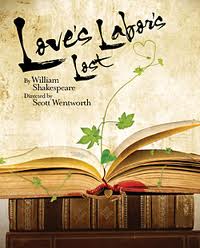
In the last of three reports from my recent drama-related travels in California, I review two shows currently being performed at Shakespeare Santa Cruz, Love's Labour's Lost and The Lion in Winter. Both are superior. Here's an excerpt.
* * *
While some of Shakespeare's plays border on being performer-proof, others need tender loving care to flourish onstage. "Love's Labour's Lost" is one of the latter, a relentlessly artificial farce whose comedy is almost entirely verbal and whose hectically bawdy wordplay leaves little room for the richness of characterization that modern audiences expect from a Shakespeare production. Small wonder that "Love's Labour's Lost" is mounted so infrequently in America that I've reviewed it in this space only once before now. The good news--very, very good news--is that Shakespeare Santa Cruz's outdoor production of "Love's Labour's Lost," directed by Scott Wentworth, is a complete success...
Rarely do I get to see a production of a Shakespeare comedy in which each member of a large cast stands out in such high relief. Fold in a heaping helping of zany comic business and you get a show that is not just amusing but wildly, chokingly funny. Then, without warning, the last scene modulates into the shadowy key of doubt, and after the play's enigmatic closing line ("You that way: we this way") is spoken, you leave the theater marveling anew at Shakespeare's matchless ability to surprise....
Indoors on the company's adjoining main stage, Richard E.T. White has directed a vigorous revival of James Goldman's "The Lion in Winter," a play that is now best known in its handsomely cast 1968 film version, which teamed Peter O'Toole and Katharine Hepburn, but is even more rewarding when seen in live performance....
Goldman's play, in which the strife-ridden marriage of England's Henry II (Marco Barricelli) and Eleanor of Aquitaine (Kandis Chappell) is portrayed as a drawing-room comedy steeped in wormwood and gall, is a piece of theatrical prestidigitation that juxtaposes a 12th-century setting with 20th-century dialogue ("Is this an audience, a goodnight kiss with cookies or an ambush?"). The trick is to deliver the clever lines not archly but with ram-you-damn-you boldness, and Mr. Barricelli, the company's artistic director, has it down pat. He gives a leonine, space-filling performance that put me in mind of the young Orson Welles...
* * *
Read the whole thing here.
Posted July 30, 12:00 AM
TT: Almanac
"Life does not cease to be funny when people die any more than it ceases to be serious when people laugh."
George Bernard Shaw, The Doctor's Dilemma
Posted July 30, 12:00 AM
July 29, 2010
TT: So you want to see a show?
Here's my list of recommended Broadway, off-Broadway, and out-of-town shows, updated weekly. In all cases, I gave these shows favorable reviews (if sometimes qualifiedly so) in The Wall Street Journal when they opened. For more information, click on the title.
Warning: Broadway shows marked with an asterisk were sold out, or nearly so, last week.
BROADWAY:
• La Cage aux Folles (musical, PG-13, adult subject matter, reviewed here)
• Fela! * (musical, PG-13, adult subject matter, reviewed here)
• Million Dollar Quartet (jukebox musical, G, reviewed here)
OFF BROADWAY:
• Alfred Hitchcock's The 39 Steps (comedy, G, suitable for bright children, original Broadway production reviewed here)
• Avenue Q (musical, R, adult subject matter and one show-stopping scene of puppet-on-puppet sex, reviewed here)
• The Fantasticks (musical, G, suitable for children capable of enjoying a love story, reviewed here)
• Our Town (drama, G, suitable for mature children, closes Sept. 12, reviewed here)
IN ASHLAND, ORE.:
• Hamlet (Shakespeare, PG-13, closes Oct. 30, reviewed here)
• Ruined (drama, PG-13/R, violence and adult subject matter, closes Oct. 31, reviewed here)
• She Loves Me (musical, G, suitable for children capable of enjoying a love story, closes Oct. 30, reviewed here)
IN GARRISON, N.Y.:
• The Taming of the Shrew/Troilus and Cressida (Shakespeare, PG-13, playing in rotating repertory through Sept. 5, reviewed here)
IN SAN DIEGO:
• King Lear/The Madness of George III (drama, PG-13, playing in rotating repertory through Sept. 24, reviewed here)
CLOSING SOON ON BROADWAY:
• South Pacific * (musical, G/PG-13, some sexual content, brilliantly staged but unsuitable for viewers acutely allergic to preachiness, closes Aug. 22, reviewed here)
CLOSING SOON IN GLENCOE, ILL.:
• A Streetcar Named Desire (drama, PG-13, adult subject matter, extended through Aug. 15, reviewed here)
CLOSING SUNDAY IN ORINDA, CALIF.:
• Mrs. Warren's Profession (serious comedy, PG-13, adult subject matter, reviewed here)
CLOSING SUNDAY IN MADISON, N.J.:
• Arms and the Man (comedy, G, too complicated for children, reviewed here)
CLOSING SUNDAY OFF BROADWAY:
• The Grand Manner (drama, PG-13, adult subject matter, reviewed here)
• The Merchant of Venice (Shakespeare, PG-13, adult subject matter, reviewed here)
Posted July 29, 12:00 AM
TT: Almanac
"A perpetual holiday is a good working definition of Hell."
George Bernard Shaw, Misalliance
Posted July 29, 12:00 AM
July 28, 2010
TT: Snapshot
George S. Kaufman appears as a panelist on a 1953 episode of This Is Show Business, originally broadcast on CBS. This extremely rare kinescope is thought to be the only surviving sound film of Kaufman:
(This is the latest in a weekly series of arts-related videos that appear in this space each Wednesday.)
Posted July 28, 12:00 AM
TT: Almanac
"Satire is something that closes on Saturday night."
George S. Kaufman (quoted in Current Biography 1941)
Posted July 28, 12:00 AM
July 27, 2010
TT: Almanac
"Martyrdom, sir, is what these people like: it is the only way in which a man can become famous without ability."
George Bernard Shaw, The Devil's Disciple
Posted July 27, 12:00 AM
July 26, 2010
TT: Yon to hither
Mrs. T and I are returning to the East Coast today, which will keep us busy until the wee hours.
Till tomorrow--or the next day. Or whenever.
Posted July 26, 12:00 AM
TT: Almanac
"The great advantage of a hotel is that it's a refuge from home life."
George Bernard Shaw, You Never Can Tell
Posted July 26, 12:00 AM
July 23, 2010
TT: Shav vs. Shakes
In today's Wall Street Journal drama column, I pull a switch and report on two Shakespeare festivals at which I saw a pair of plays by George Bernard Shaw, Arms and the Man at the Shakespeare Theatre of New Jersey and Mrs. Warren's Profession at California Shakespeare Theater. Here's an excerpt.
* * *
"Arms and the Man," Shaw's first great box-office success, remains one of his most enduringly popular plays, but it's been some time since it received a New York production of any consequence, the last Broadway revival having been in 1985. Now Shakespeare Theatre of New Jersey, a company that has yet to let me down--I've seen five shows there since 2006, all of them memorable--is doing the old boy proud with an exceptionally stylish version that hits all the high notes.
The metaphor is an appropriate one, for "Arms and the Man" is an "anti-romantic comedy in three acts" (Shaw's phrase) in which he deploys the high-flying rhetoric of 19th-century opera to twit those benighted creatures of flesh and blood who behave as though the real world worked that way. It starts out as a love story in which the starry-eyed Raina (Nisi Sturgis) awaits the return of her gallant and heroic Sergius (Anthony Marble) from the Serbo-Bulgarian War. Then a cynical enemy soldier (Sean Mahan) who has been fighting too long to have any illusions about the nature of war upsets Raina's plans by hiding out in her starlit bedroom, and all at once a classic change-partners farce plot starts ticking away....
Revivals of "Mrs. Warren's Profession," in which Shaw satirized laissez-faire capitalism by purporting to show that prostitution was one of its natural consequences, used to be comparatively rare in this country. Times have changed, though, and what was once a hugely controversial play has received no less than two high-profile American stagings this summer, one by California Shakespeare Theater and one by the Shakespeare Theatre Company of Washington, D.C., with the Roundabout Theatre Company's upcoming Broadway revival set to open in October.
Never having seen Cal Shakes in action, I chose California over Washington, and was mightily impressed by their production, staged by Timothy Near in the company's 545-seat amphitheater, one of the most beautiful outdoor performing spaces in America, located not far from San Francisco. Performed on an open stage in a broadly comic style that is nicely suited to an outdoor venue, Ms. Near's version of "Mrs. Warren's Profession" is an arresting blend of Vicwardian décor and modern energy...
* * *
Read the whole thing here.
Posted July 23, 12:00 AM
TT: The smiling genius
In recent weeks I've been posting videos of performances of the music of Emmanuel Chabrier, a composer who is infrequently performed and insufficiently appreciated in this country, I suspect in part because his music is too pleasurable for prigs to take seriously. In the interests of heightening Chabrier consciousness in America, I've now written a "Sightings" column for Saturday's Wall Street Journal in which I argue that he was in fact an important composer--but one who is underrated because his genius was essentially comic.
If you share my passion for Chabrier's music, pick up a copy of Saturday's Journal and see what I have to say. If not, take a look at the video posted below. Should it fail to lift your heart, you might want to consider a transplant.
UPDATE: Read the whole thing here.
* * *
Georges Prêtre and the Vienna Philharmonic perform Chabrier's España:
* * *
A reader writes to tell me something I didn't know, which is that in 1956, the year of my birth, Perry Como recorded a novelty song called "Hot Diggity (Dog Ziggity Boom)" which is, amazingly enough, based on España. I must have heard the record as a child, but I'd completely forgotten it until today.
Here's a kinescope of one of Como's TV shows in which he performs "Hot Diggity":
Posted July 23, 12:00 AM
TT: Almanac
"There's a gigantic gray area between good moral behavior and outright felonious activities. I call that the Weasel Zone and it's where most of life happens."
Scott Adams, Dilbert and the Way of the Weasel
Posted July 23, 12:00 AM
July 22, 2010
TT: So you want to see a show?
Here's my list of recommended Broadway, off-Broadway, and out-of-town shows, updated weekly. In all cases, I gave these shows favorable reviews (if sometimes qualifiedly so) in The Wall Street Journal when they opened. For more information, click on the title.
Warning: Broadway shows marked with an asterisk were sold out, or nearly so, last week.
BROADWAY:
• La Cage aux Folles * (musical, PG-13, adult subject matter, reviewed here)
• Fela! (musical, PG-13, adult subject matter, reviewed here)
• Million Dollar Quartet (jukebox musical, G, reviewed here)
• South Pacific * (musical, G/PG-13, some sexual content, brilliantly staged but unsuitable for viewers acutely allergic to preachiness, closes Aug. 22, reviewed here)
OFF BROADWAY:
• Alfred Hitchcock's The 39 Steps (comedy, G, suitable for bright children, original Broadway production reviewed here)
• Avenue Q (musical, R, adult subject matter and one show-stopping scene of puppet-on-puppet sex, reviewed here)
• The Fantasticks (musical, G, suitable for children capable of enjoying a love story, reviewed here)
• Our Town (drama, G, suitable for mature children, closes Sept. 12, reviewed here)
IN ASHLAND, ORE.:
• Hamlet (Shakespeare, PG-13, closes Oct. 30, reviewed here)
• Ruined (drama, PG-13/R, violence and adult subject matter, closes Oct. 31, reviewed here)
• She Loves Me (musical, G, suitable for children capable of enjoying a love story, closes Oct. 30, reviewed here)
IN GARRISON, N.Y.:
• The Taming of the Shrew/Troilus and Cressida (Shakespeare, PG-13, playing in rotating repertory through Sept. 5, reviewed here)
IN GLENCOE, ILL.:
• A Streetcar Named Desire (drama, PG-13, adult subject matter, extended through Aug. 15, reviewed here)
IN SAN DIEGO:
• King Lear/The Madness of George III (drama, PG-13, playing in rotating repertory through Sept. 24, reviewed here)
CLOSING NEXT WEEK OFF BROADWAY:
• The Grand Manner (drama, PG-13, adult subject matter, closes Aug. 1, reviewed here)
• The Merchant of Venice (Shakespeare, PG-13, adult subject matter, closes Aug. 1, reviewed here)
CLOSING SATURDAY IN CHICAGO:
• The Farnsworth Invention (drama, G, too complicated for children, reviewed here)
CLOSING SATURDAY IN OGUNQUIT, ME.:
• The Sound of Music (musical, G, completely child-friendly, reviewed here)
Posted July 22, 12:00 AM
TT: Almanac
"I'll bet Shakespeare compromised himself a lot; anybody who's in the entertainment industry does to some extent."
Christopher Isherwood, Paris Review interview (1973)
Posted July 22, 12:00 AM
July 21, 2010
TT: Snapshot
Sir Edward Elgar conducts an excerpt from his Pomp and Circumstance, Op. 39/1, at the opening of EMI's Abbey Road recording studios in London on November 12, 1931:
(This is the latest in a weekly series of arts-related videos that appear in this space each Wednesday.)
Posted July 21, 12:00 AM
TT: Almanac
"Money costs too much."
Ross Macdonald, The Goodbye Look
Posted July 21, 12:00 AM
July 20, 2010
EXHIBITION
Charles Burchfield: Fifty Years as a Painter (DC Moore Gallery, 724 Fifth Ave., up through Sept. 25). If you've already paid a visit to the Whitney's idiosyncratic large-scale retrospective of the work of the visionary modern American watercolorist whose studies of small-town life have won the admiration of everyone from Edward Hopper to Jerry Saltz, then check out this small, tightly focused museum-quality show. It's more than a mere pendant (TT).Posted July 20, 10:49 AM
TT: O.K. for sound
Today's episode of Fresh Air is all about the history of songs in Hollywood, and the producers invited those who follow the series on Twitter to vote for their favorite movie song. My snap response was to nominate "The Shadow of Your Smile," but the more I thought about it, the less sure I was that I could pick a single song, or even five, to represent the richness of the field. So I thought a little bit more, and came up with this list of my fifteen favorite songs that were written for use in Hollywood films:
• "Have Yourself a Merry Little Christmas" (Blane-Martin, from Meet Me in St. Louis)
• "How About You?" (Lane-Freed, from Babes on Broadway)
• "I'm Old Fashioned" (Kern-Mercer, from You Were Never Lovelier)
• "Let's Face the Music and Dance" (Berlin, from Follow the Fleet)
• "The Man That Got Away" (Arlen-Gershwin, from A Star Is Born)
• "Moon River" (Mancini-Mercer, from Breakfast at Tiffany's)
• "One for My Baby" (Arlen-Mercer, from The Sky's the Limit)
• "The Shadow of Your Smile" (Mandel-Webster, from The Sandpiper)
• "Something's Gotta Give" (Mercer, from Daddy Long Legs)
• "Spring Will Be a Little Late This Year" (Loesser, from Christmas Holiday)
• "Swinging on a Star" (Van Heusen-Burke, from Going My Way)
• "That's Entertainment" (Schwartz-Dietz, from The Band Wagon)
• "They Can't Take That Away From Me" (Gershwin-Gershwin, from Shall We Dance)
• "The Way You Look Tonight" (Kern-Fields, from Swing Time)
• "You'd Be So Nice to Come Home To" (Porter, from Something to Shout About)
Two things struck me about this list. The first is that all of the songs on it are "classic" golden-age pop. I love rock, but the only post-classic song written specifically for a film that came to mind as a possible candidate was Aimee Mann's "Save Me" (from Magnolia).
The second is that seven of these songs were written for Fred Astaire to sing on screen, a statistic that speaks for itself.
And which one is the best of the lot? If you tied me down and tickled me, I might say "Moon River" to get you to stop. But tickle me again tomorrow and you could get a different answer....
* * *
Fred Astaire performs "One for My Baby" in The Sky's the Limit:
Posted July 20, 12:00 AM
TT: Almanac
"Nothing wrong with Southern California that a rise in the ocean wouldn't cure."
Ross Macdonald, The Moving Target
Posted July 20, 12:00 AM
July 19, 2010
TT: A masterpiece revisited
Thomas Eakins' "The Gross Clinic," his most famous painting, has just been restored by conservators at the Philadelphia Museum of Art, which became co-owner of the painting (together with the Pennsylvania Academy of the Fine Arts) two years ago. This news reminded me that I first saw "The Gross Clinic" in person when it was on display at the Met eight years ago, and that I wrote a piece about the experience for The Wall Street Journal. (It was the prototype for what later evolved into the Journal's "Masterpiece" column.)
To celebrate the restoration of "The Gross Clinic," here is my piece, reprinted for the first time since it was originally published in 2002.
* * *
Neville Cardus, the English music critic, spent World War II in Australia. Most Aussies then were well behind the cultural curve, and Cardus learned to his dismay that the centerpiece of the first concert he was to review for the Sydney Morning Herald was Beethoven's Fifth Symphony, the "Mona Lisa" of classical music. What could he possibly say about a warhorse he'd heard at least a hundred times?
That night, though, he glanced around the concert hall and realized that at least half ot the audience had never before heard a performance of Beethoven's Fifth. "To those Australians, in the Sydney Town Hall, the Fifth Symphony was a revelation," he later recalled. "I found this a tremendous inspiration....the concert was for me an illumination and living proof that there are no hackneyed masterpieces, only hackneyed critics."
I thought of Neville Cardus the other day when I went to an exhibition of the paintings of Thomas Eakins at New York City's Metropolitan Museum of Art. The centerpiece is "The Gross Clinic," Eakins' 1875 portrayal of an osteomyelitis operation. It's one of the best-known American paintings of the 19th century, so I wasn't expecting to be startled by it. "The Gross Clinic" is so well known, in fact, that I forgot I'd never really seen it in person, since it normally hangs not in a museum but at the Jefferson Medical College in Philadelphia, a bit off the beaten path of most critics.
The Met has hung "The Gross Clinic" by itself on a darkish-blue wall, and as you step through the entrance, everything else in the gallery disappears. All you see is a huge canvas, eight feet tall and six and a half feet wide, encased in a heavy gold frame. The sheer size of "The Gross Clinic" caught me off guard--in my mind, it was a medium-sized work suitable for display in the waiting rooms of the doctors' offices where it is still so often found--and I needed a few seconds to catch my breath and let the half-remembered details snap back into focus.
"The Gross Clinic" is set in the amphitheater of Jefferson Medical College. Four earnest-looking doctors in ties and jackets are clustered around a patient, their hands covered with blood as they probe his helpless body. Off to the left, a horrified woman shields her eyes. (She is thought to be the patient's mother.) Meanwhile, Dr. Samuel Gross, a tight-lipped, balding surgeon-teacher who towers over the operating table like a colossus, lectures to the students surrounding him in tiers of ascending seats, a scalpel clutched in his bloody right hand.
To run across "The Gross Clinic" in an art book is anything but startling--movies and TV long ago accustomed us to close-up carnage--but to see the real thing up close is to feel as though you've been slapped in the face. Just for a moment, you can understand why the critics of 1875 were so horrified by so unsparingly candid a portrayal of the surgeon's life. One squeamish critic called it "revolting to the last degree."
First the shock, then the beauty: Eakins has turned this violent vignette into a complex yet perfectly balanced composition, guiding you from point to point with supreme finesse. Your eye is drawn irresistibly to the garish red blood on the hands of the surgeons--and to the spotlit forehead of Dr. Gross, leaping forward out of a somber sea of brown and black. Then you see the heads of the four doctors, arranged in a tight semi-circle. Then the frightened woman and, right behind her, a mustached clerk, taking down Dr. Gross' words for posterity. Then the shadowy onlookers, among them Eakins himself, sketching the proceedings on a pad. (This Hitchcock-like cameo is hard to make out in many reproductions, but it's as plain as day when you're standing in front of the painting.)
As I gazed intently at "The Gross Clinic," I suddenly became aware of two elderly ladies standing next to me. "Boy, they've come a long way in medicine!" one said. I smiled, but I knew she had a point. "The Gross Clinic" is more than just a work of art--it's also a piece of social history. The radiant forehead of Dr. Gross is a potent symbol of the Victorian faith in the redemptive power of science, in which most 19th-century Americans were the truest of believers. Few of us have that kind of faith today: The horrors of the 20th century knocked it out of us. But Thomas Eakins had it, and he makes you feel it, too. That is part of the overwhelming effect of "The Gross Clinic," as much as its dramatic composition or Rembrandt-like palette.
I walked down the steps of the Met, a little dazed by my encounter with a painting whose greatness had been dulled by familiarity, and asked myself, "How on earth could I possibly have thought I 'knew' 'The Gross Clinic'? I didn't know it at all!" That's the way every critic should feel whenever he comes into the presence of an over-familiar masterpiece, be it Beethoven's Fifth or "Romeo and Juliet." For we can never fully "know" a great work of art. It is bigger than we are, bigger than life, which is why it offers the possibility of permanent renewal and refreshment. All we have to do is see it for the first time--every time.
Posted July 19, 12:00 AM
TT: Almanac
"I live in a house that was quite modern for its time, in a neighborhood that broke with the grid and tried to bring new ideas to the standard city model. I love most architecture that tried to do something different, right up until the point where the expression of one individual became the only thing that mattered. Architecture has always been a collaboration--even if there's one Genius designing the building, he or she collaborates with the developers, the occupants, and the street where the building exists. Now we have enormous mounds of narcissistic concrete and metal, housing the yawps and shouts of artists who cannot put the past into the shredder fast enough.
"I hate feeling this way."
James Lileks, The Bleat, July 7, 2010
Posted July 19, 12:00 AM
July 17, 2010
DANCE
Pilobolus Dance Theatre (Joyce Theater, 175 Eighth Ave., closes Aug. 7). These are hard times for the much-loved modern dance troupe, which is coming to grips with the recent death of Jonathan Wolken, one of its founding members. Yet there can be no better way to celebrate Wolken's life than to pay a visit to Pilobolus' annual summer season at the Joyce Theater. The company is performing three mixed bills, the first of which features the New York premiere of Hapless Hooligan in "Still Moving," a collaboration with Art Spiegelman. No matter which one you see, you'll be entranced (TT).Posted July 17, 6:23 AM
BOOK
Brooke Berman, No Place Like Home: A Memoir in 39 Apartments (Harmony, $23). The author of Hunting and Gathering came to Manhattan at the age of eighteen in the hopes of someday becoming a full-time professional playwright. Talented, inexperienced, naïve, and broke, she spent the next twenty years sharing microscopically small apartments, sleeping on futons, bouncing from roommate to roommate and gradually finding herself along the way. Now she's written a memoir of her formative years, and it's a lovely piece of work, at once charming and deeply felt. No Place Like Home is one of the best books I've read about how young artists make their way--or not--in an unforgiving world (TT).Posted July 17, 4:39 AM
July 16, 2010
TT: Two kings make a winning hand
I spent the week in San Diego seeing The Madness of George III and King Lear, two of the three shows currently being performed in rotating repertory as part of the Old Globe's 2010 Shakespeare Festival. They make a nifty pair. Here's an excerpt from my Wall Street Journal review.
* * *
Some plays, including most of the best ones, are all but impossible to film, but a handful of memorable stage shows have been filmed so well as to discourage subsequent revivals. Nicholas Hytner's 1994 film of Alan Bennett's "The Madness of George III" is a case in point, for it was so effective that productions of the play in this country have since been few and far between. That's what lured me to San Diego to see the Old Globe's outdoor version, directed by Adrian Noble as part of the company's 2010 Shakespeare Festival. It appears to be the play's first American staging of any consequence since the National Theater's production (on which Mr. Hytner's film was based) toured the U.S. in 1993. All praise to the Old Globe for mounting it so stylishly--and proving that fine though it was on screen, "The Madness of George III" is even better on stage.
If you haven't seen it in either form, here's a quick refresher course in 18th-century British history: King George III (played at the Old Globe by Miles Anderson) was stricken in 1788 with a mental disorder that left him incapacitated and triggered a political crisis. Seeing a chance to force William Pitt, the Tory prime minister, out of office, Charles James Fox, the leader of the Whig opposition, sought to ram a bill through Parliament authorizing the Prince of Wales to act as Prince Regent and replace Pitt with Fox. It was only when Dr. Francis Willis succeeded against all odds in restoring the king to his senses that the regency was forestalled and the crisis defused.
Out of these grim events, Mr. Bennett has spun a sparkling play whose sober subject is the corrupting effect of power on those who attain it--and, by extension, the corrupting effect of the British class system on those who profit from its privileges....
The Old Globe has fielded a cast of 26 for "The Madness of George III," which is another reason why the play has all but vanished from the stage: Few American companies can now afford to put on so labor-intensive a show. To perform it in rotating repertory with "King Lear," also directed by Mr. Noble, is a feat still further beyond the reach of most regional theater companies, but the Old Globe is bringing it off with seeming effortlessness--and throwing in "The Taming of the Shrew" for good measure! I've seen two other productions "Shrews" in recent weeks, so I passed this one up, but the Old Globe's "Lear" is a splendid piece of work that no one in or near southern California should miss.
What is most surprising about Mr. Noble's "Lear" is his unexpected avoidance of the grand manner. His program note, in which he speaks of presenting the play in a "language-based" style that embraces "the American accent and cadence of speech," gives the clue: This is a text-driven, eloquently plain-spoken "Lear" that strives at all times to be clear and comprehensible, leaving the heavy lifting to Shakespeare instead of trying to do it for him....
* * *
Read the whole thing here.
A scene from The Madness of King George, Nicholas Hytner's 1994 film version of The Madness of George III:
Posted July 16, 12:00 AM
TT: Almanac
"If forty million people say a foolish thing it does not become a wise one, but the wise man is foolish to give them the lie."
W. Somerset Maugham, A Writer's Notebook
Posted July 16, 12:00 AM
July 15, 2010
TT: Richard Harriman, R.I.P.
William Jewell College, my alma mater, is the home of one of the finest performing-arts series in America, the Harriman-Jewell Series. Among countless noteworthy things, the Harriman-Jewell Series presented Luciano Pavarotti in his professional recital debut in 1973. During my student days, I saw under its auspices performances by Pavarotti, Birgit Nilsson, Itzhak Perlman, Leontyne Price, Mstislav Rostropovich, Rudolf Serkin, Frederica von Stade, Twyla Tharp, and Beverly Sills--all of which I attended for free.
Richard Harriman, the man who co-founded and directed the series and after whom it would later be named, graduated from Jewell in 1953 and joined its English faculty in 1962. Three years later he decided that the college ought to be in the business of presenting great performances. He extracted three thousand dollars from the administration and proceeded to book Edward Villella, Patricia MacBride, and Jan Peerce. Not long after that, Liberty, Missouri, the suburb of Kansas City where William Jewell College is located, had become known throughout America as the place where world-famous musicians tried out the programs they would later perform in New York.
Mr. Harriman--I never got used to calling him Dick, not even after I grew up, moved to New York, and became a full-time critic of the arts--was the most genial of impresarios, a famously soft-spoken man who never had a bad word to say about anyone, at least not in my hearing. Nor did I ever hear anyone say a bad word about him. He was kind, sweet-natured, and impeccably tasteful in every aspect of his life and work. That he took an interest in me when I was an undergraduate was one of the luckiest breaks in a life that has been full of good fortune.
In addition to giving away free tickets to any student willing to line up and claim them, Mr. Harriman took a group of arts-conscious students to New York each winter and shepherded them to performances of every imaginable kind. I went on that trip in December of 1975, and wrote about it years later in a memoir of my youth:
Rummaging through my mother's cupboard the other day, I found a manila envelope full of souvenirs of my visit to New York. There was my program from Harold Prince's Broadway production of Candide; there were Lincoln Center and Radio City Music Hall and Mikhail Baryshnikov, fresh out of Rusia, soaring across the stage of the Uris Theater; there was a memorandum scrawled in an unformed hand on Waldorf-Astoria stationery (when you traveled with Mr. Harriman, you traveled first-class) telling where I had eaten dinner each night. The food I ate dazzled me as much as the sights I saw, for I had been raised on Kraft Dinner and Chef Boy-Ar-Dee pizza in a box, and the act of ordering vichyssoise from a haughty waiter at "21" very nearly made me swoon.
In later years I would occasionally run into Mr. Harriman in the lobby of a Manhattan theater or concert hall. We would swap snippets of performing-arts gossip, and I always tried to conduct myself not as a former student but as a colleague. It was, of course, an act, and a poor one. He had been present at the creation of my career, and it was impossible for me to talk to him without being intensely and inhibitingly aware of how very much I owed him.
It would have been no more possible for me to thank him to his face for what he had done for me, but I was able to do it from a safe distance when Achieve, William Jewell's alumni magazine, asked me to write a few words of tribute when his series celebrated its fortieth anniversary and was renamed the Harriman Arts Program. This is what I wrote:
Cézanne called the Louvre "the book in which we learn to read." The Harriman Arts Program was the book in which I learned to see, hear, and love the performing arts. It gave me a golden yardstick of taste--one I still use to this day.
Mr. Harriman died this afternoon at the age of seventy-seven. I bless and revere his memory.
UPDATE: A reader writes:
Your essay reminds me of something very important that is easy to forget: that a civilization's art and culture are preserved and kept alive when related to as a highly personal and carefully selected gift from one generation to the next, from an individual to a valued friend. This is exactly what Harriman gave to his students and general audiences.
So it was. Well said.
Posted July 15, 11:48 PM
TT: So you want to see a show?
Here's my list of recommended Broadway, off-Broadway, and out-of-town shows, updated weekly. In all cases, I gave these shows favorable reviews (if sometimes qualifiedly so) in The Wall Street Journal when they opened. For more information, click on the title.
Warning: Broadway shows marked with an asterisk were sold out, or nearly so, last week.
BROADWAY:
• La Cage aux Folles (musical, PG-13, adult subject matter, reviewed here)
• Fela! * (musical, PG-13, adult subject matter, reviewed here)
• Million Dollar Quartet (jukebox musical, G, reviewed here)
• South Pacific * (musical, G/PG-13, some sexual content, brilliantly staged but unsuitable for viewers acutely allergic to preachiness, closes Aug. 22, reviewed here)
OFF BROADWAY:
• Alfred Hitchcock's The 39 Steps (comedy, G, suitable for bright children, original Broadway production reviewed here)
• Avenue Q (musical, R, adult subject matter and one show-stopping scene of puppet-on-puppet sex, reviewed here)
• The Fantasticks (musical, G, suitable for children capable of enjoying a love story, reviewed here)
• Our Town (drama, G, suitable for mature children, reviewed here)
IN ASHLAND, ORE.:
• Hamlet (Shakespeare, PG-13, closes Oct. 30, reviewed here)
• Ruined (drama, PG-13/R, violence and adult subject matter, closes Oct. 31, reviewed here)
• She Loves Me (musical, G, suitable for children capable of enjoying a love story, closes Oct. 30, reviewed here)
IN GARRISON, N.Y.:
• The Taming of the Shrew/Troilus and Cressida (Shakespeare, PG-13, playing in rotating repertory through Sept. 5, reviewed here)
IN GLENCOE, ILL.:
• A Streetcar Named Desire (drama, PG-13, adult subject matter, extended through Aug. 15, reviewed here)
CLOSING SOON OFF BROADWAY:
• The Grand Manner (drama, PG-13, adult subject matter, closes Aug. 1, reviewed here)
• The Merchant of Venice (Shakespeare, PG-13, adult subject matter, closes Aug. 1, reviewed here)
CLOSING NEXT WEEK IN CHICAGO:
• The Farnsworth Invention (drama, G, too complicated for children, closes July 24, reviewed here)
CLOSING NEXT WEEK IN OGUNQUIT, ME.:
• The Sound of Music (musical, G, completely child-friendly, closes July 24, reviewed here)
CLOSING SUNDAY IN CHICAGO:
• Killer Joe (black comedy-drama, X, extreme violence and nudity, reviewed here)
Posted July 15, 12:00 AM
TT: Almanac
"Now the world in general doesn't know what to make of originality; it is startled out of its comfortable habits of thought, and its first reaction is one of anger."
W. Somerset Maugham, Great Novelists and Their Novels
Posted July 15, 12:00 AM
July 14, 2010
TT: Snapshot
Jean-Pierre Rampal plays the slow movement of Francis Poulenc's Flute Sonata, accompanied by the composer:
(This is the latest in a weekly series of arts-related videos that appear in this space each Wednesday.)
Posted July 14, 12:00 AM
TT: Almanac
"I do not believe they are right who say that the defects of famous men should be ignored. I think it is better that we should know them. Then, though we are conscious of having faults as glaring as theirs, we can believe that that is no hindrance to our achieving also something of their virtues."
W. Somerset Maugham, The Summing Up
Posted July 14, 12:00 AM
July 13, 2010
TT: Almanac
"Old age is ready to undertake tasks that youth shirked because they would take too long."
W. Somerset Maugham, The Summing Up
Posted July 13, 12:00 AM
July 12, 2010
TT: Harvey Pekar, R.I.P.
The creator of American Splendor has died at the age of seventy. I admired him, albeit with certain reservations that I summed up in this 2003 posting.
It will be interesting to see whether his work continues to be read--if "read" is the word....
P.S. Mrs. T's reaction: "Harvey Pekar? He was kind of a grumpy guy, wasn't he?"
Posted July 12, 11:44 AM
TT: Going our way
Today Mrs. T and I fly from New York to San Diego to embark on the latest installment of our summer playgoing travels. We'll be seeing two shows this week at the Old Globe, then driving up the coast to the California Shakespeare Theater and Shakespeare Santa Cruz. Along the way I'll be giving a speech to a private group about the biographer's art, and we also plan to make a side trip to San Simeon, the home of Citizen Kane.
I have to write and file three Wall Street Journal columns along the way, so I've built more down time into our itinerary than usual, which may or may not mean that I'll be able to blog with something not unlike my usual regularity. We'll see. In any case, I promise to report on our doings as often as possible!
See you on Highway 1.
Posted July 12, 12:00 AM
TT: Almanac
"I think there is in the heroic courage with which man confronts the irrationality of the world a beauty greater than the beauty of art."
W. Somerset Maugham, A Writer's Notebook
Posted July 12, 12:00 AM
July 9, 2010
TT: Boys will be boys
In today's Wall Street Journal drama column, I report enthusiastically on two productions that I saw last weekend at the Hudson Valley Shakespeare Festival, plus the Ogunquit Playhouse's revival of The Sound of Music. Here's an excerpt.
* * *
Of all Shakespeare's "problem" plays, "Troilus and Cressida" is the one in which the problem is plainest to see: The two halves of the play don't seem to fit together. It starts out as a bawdy comedy of love in the Trojan War, then modulates abruptly into a furious study of how "fools on both sides" of an ultimately meaningless dispute can suddenly start piling up corpses for no good reason. Yet the play can be highly effective when mounted by a director savvy enough to equalize its tone. When Barbara Gaines staged it for Chicago Shakespeare Theater in 2007, she emphasized the darkness and violence to monumentally compelling effect. Now Terrence O'Brien, the artistic director of the Hudson Valley Shakespeare Festival, has flipped the coin and given us a ribald "Troilus" mounted with the lightest possible touch, and it works just as well.
Mr. O'Brien, like Ms. Gaines, is a theatrical populist who never makes the fatal mistake of condescending to his audiences--or to Shakespeare. Rather than modernizing the setting of "Troilus," as most contemporary directors would do in order to make a difficult show more palatable, he plays it more or less straight, opting instead to infuse the production with an unequivocally modern energy. From the pop-culture references and pop-music score (at one point the women lip-sync a dance number set to Pomplamoose's cooler-than-the-original cover version of Beyoncé's "Single Ladies") to the lively acting of the conspicuously youthful players, this is a "Troilus" tailored to suit the needs of vacationers in a festive mood. Yet the boys-will-be-boys antics of the male members of the cast prove to be deadly serious, and when Thersites (Jason O'Connell) warns us that "war and lechery confound all," we know very well that these two things will soon be fatefully and devastatingly interwoven....
"Troilus" will be performed throughout the summer in rotating repertory with Kurt Rhoads' engaging production of "The Taming of the Shrew," which is set in the Swinging '60s and is graced--if that's the word--by the bra-burning, chainsaw-wielding Kate of Gabra Zackman, who is clearly having the time of her life and makes sure that you'll do the same....
Few musicals are more beloved--and get less respect--than "The Sound of Music," in which Richard Rodgers and Oscar Hammerstein turned the tale of how the Trapp Family Singers escaped from the Nazis into a child-friendly love story. Highbrows are understandably wont to dismiss "The Sound of Music" as vapid and saccharine, yet it was hugely successful on stage and screen and continues to be revived with fair frequency, though I suspect that most people now know it through Robert Wise's 1965 film version rather than from a staged production. It happens that I'd never seen the show performed live, so I drove up to Maine last week to take a look at the Ogunquit Playhouse's new production, and found it altogether charming. Sweet it most definitely is, but never cloyingly so, in large part because Gary John La Rosa's staging (unlike the over-opulent film) is modest and straightforward in both scale and tone....
* * *
Read the whole thing here.
The real-life Trapp Family Singers perform a Bach chorale in a recording made for RCA Victor shortly after they emigrated to the United States in 1938:
Posted July 09, 12:00 AM
TT: This must be the place
Not only did I see a play in Maine last week, but I made a point of paying a visit to the Portland Museum of Art. Though the museum's permanent collection is always worth a look, I went there specifically to look at two exhibitions, "American Moderns: Masterworks on Paper from the Wadsworth Atheneum Museum of Art" and "Winslow Homer and the Poetics of Place." Both are exceptionally fine, and the second show inspired me to write a "Sightings" column for Saturday's Journal.
It happens that many of America's finest artists, including Homer, Marsden Hartley, Edward Hopper, Alex Katz, John Marin, Fairfield Porter, and Neil Welliver, either lived in Maine or spent a considerable amount of time there. You can't spend five minutes driving down the road without seeing why. I suppose there might be more picturesque places in America, but I can't think of anywhere that offers more concentrated opportunities in a smaller geographical space to a representational artist.
What struck me about the Winslow Homer show was the way in which it dramatizes how profoundly affected Homer was by the Maine seascape. This is, of course, a commonplace--everybody who knows anything about Homer knows how frequently he painted the coast of Maine--but to actually see a painting like "Weatherbeaten" in Maine is to be reminded with freshly illuminating force of this well-known fact.
How did the experience of seeing "Weatherbeaten" and Marsden Hartley's "Surf on Reef" at the Portland Museum of Art affect an art lover who, like me, was raised on twentieth-century abstraction? To find out, pick up a copy of Saturday's paper and see what I have to say.
UPDATE: Read the whole thing here.
Posted July 09, 12:00 AM
TT: Almanac
"That which in England we call the middle class is in America virtually the nation."
Matthew Arnold, "A Word About America"
Posted July 09, 12:00 AM
July 8, 2010
TT: So you want to see a show?
Here's my list of recommended Broadway, off-Broadway, and out-of-town shows, updated weekly. In all cases, I gave these shows favorable reviews (if sometimes qualifiedly so) in The Wall Street Journal when they opened. For more information, click on the title.
Warning: Broadway shows marked with an asterisk were sold out, or nearly so, last week.
BROADWAY:
• La Cage aux Folles (musical, PG-13, adult subject matter, reviewed here)
• Fela! (musical, PG-13, adult subject matter, reviewed here)
• Million Dollar Quartet (jukebox musical, G, reviewed here)
• South Pacific (musical, G/PG-13, some sexual content, brilliantly staged but unsuitable for viewers acutely allergic to preachiness, closes Aug. 22, reviewed here)
OFF BROADWAY:
• Alfred Hitchcock's The 39 Steps (comedy, G, suitable for bright children, original Broadway production reviewed here)
• Avenue Q (musical, R, adult subject matter and one show-stopping scene of puppet-on-puppet sex, reviewed here)
• The Fantasticks (musical, G, suitable for children capable of enjoying a love story, reviewed here)
• The Grand Manner (drama, PG-13, adult subject matter, closes Aug. 1, reviewed here)
• The Merchant of Venice (Shakespeare, PG-13, adult subject matter, closes Aug. 1, reviewed here)
• Our Town (drama, G, suitable for mature children, reviewed here)
IN ASHLAND, ORE.:
• Hamlet (Shakespeare, PG-13, closes Oct. 30, reviewed here)
• Ruined (drama, PG-13/R, violence and adult subject matter, closes Oct. 31, reviewed here)
• She Loves Me (musical, G, suitable for children capable of enjoying a love story, closes Oct. 30, reviewed here)
IN GLENCOE, ILL.:
• A Streetcar Named Desire (drama, PG-13, adult subject matter, extended through Aug. 15, reviewed here)
CLOSING SOON IN CHICAGO:
• The Farnsworth Invention (drama, G, too complicated for children, closes July 24, reviewed here)
CLOSING NEXT WEEK IN CHICAGO:
• Killer Joe (black comedy-drama, X, extreme violence and nudity, closes July 18, reviewed here)
CLOSING SUNDAY ON BROADWAY:
• Fences * (drama, PG-13/R, adult subject matter, closes July 11, reviewed here)
Posted July 08, 12:00 AM
TT: Almanac
"Don't forget the Western is not only the history of this country, it is what the Saga of the Nibelungen is for the European."
Fritz Lang (quoted in Peter Bogdanovich, Fritz Lang in America)
Posted July 08, 12:00 AM
July 7, 2010
TT: Snapshot
A 1931 newsreel of George Gershwin playing "I Got Rhythm" at the old Manhattan Theater (now the Ed Sullivan Theater) in New York. This is the only surviving sound film of Gershwin at the piano:
(This is the latest in a weekly series of arts-related videos that appear in this space each Wednesday.)
Posted July 07, 12:00 AM
TT: Almanac
"Europe is the unfinished negative of which America is the proof."
Mary McCarthy, "America the Beautiful"
Posted July 07, 12:00 AM
July 6, 2010
CAAF: Werner Herzog's reading list
Reading list for those attending the filmmaker's Rogue Film School:
Required reading: Virgil's "Georgics" and Ernest Hemingway's "The Short Happy Life of Francis Macomber". Suggested reading: The Warren Commission Report, Rabelais' "Gargantua and Pantagruel", "The Poetic Edda", translated by Lee M. Hollander (in particular The Prophecy of the Seeress), Bernal Diaz del Castillo "True History of the Conquest of New Spain".
Re-watching a couple of his documentaries over the weekend began thinking how it was too bad Herzog wasn't tapped to create the Voyager's message to aliens. One imagines a future army of extraterrestrials arriving on Earth speaking in Herzog: "What is this planet we find ourselves upon? Everything is pointing to a new world but we need to articulate what that might be..."
Posted July 06, 2:49 PM
TT: Almanac
"America is a vast conspiracy to make you happy."
John Updike, Problems
Posted July 06, 12:00 AM
July 5, 2010
TT: Replenished
Mrs. T and I are traveling today, but there's lots of new stuff in the right-hand column, so take a gander. (Or a goose.)
Posted July 05, 12:00 AM
TT: Almanac
"Yesterday, the greatest question was decided which ever was debated in America, and a greater perhaps never was nor will be decided among men."
John Adams, letter to Abigail Adams, July 3, 1776
Posted July 05, 12:00 AM
July 4, 2010
BOOK
Selena Hastings, The Secret Lives of Somerset Maugham (Random House, $35). Actually, not much of the dirt in this tell-all biography of the author of Of Human Bondage (and, needless to say, The Letter) will come as a surprise to those familiar with Ted Morgan's Maugham, published in 1980. But Hastings is a much better writer who had unrestricted access to previously unknown primary source material, and the result is a smart book that portrays its subject with a welcome combination of candor and sympathy (TT).Posted July 04, 10:34 AM
CD
Punch Brothers, Antifogmatic (Nonesuch). The second album from mandolinist Chris Thile's post-Nickel Creek quintet is a collection of original songs about love and its discontents. Like its predecessor, Antifogmatic is tantalizingly hard to pigeonhole. To call it "progressive bluegrass" makes a fair amount of sense but fails to convey the group's rich yet coherent stylistic eclecticism. Why not settle for "incredibly hip acoustic music"? I'll stand on that (TT).Posted July 04, 10:27 AM
TT: The best of all possible marches
John Philip Sousa's "The Stars and Stripes Forever," performed by Leonard Bernstein and the New York Philharmonic:
Performed on the organ by Cameron Carpenter:
Performed (audio only) by Vladimir Horowitz:
Performed (audio only) by Sousa's Band in 1931, with a spoken introduction by the composer:
Posted July 04, 10:02 AM
PLAY
The Grand Manner (Lincoln Center Theater, closes Aug. 1). Superbly acted by Kate Burton and Boyd Gaines and staged with sensitivity and wit by Mark Lamos, A.R. Gurney's new play looks at first glance like a nostalgia-drenched valentine to Katharine Cornell and the lost world of old-fashioned theater. Don't be fooled, though. The Grand Manner is really a searching, unexpectedly tough-minded portrait of the "lavender marriage" of a man and a woman who love but don't desire one another. Smart, funny, poignant (TT).Posted July 04, 7:11 AM
THE CONVERSION OF DAVID MAMET
"The battles in which Mamet's characters are engaged, as one of them remarks in American Buffalo, the most archetypical (and artful) of his portraits of American life, are zero-sum games in which only one player can win: "It's kickass or kissass, Don, and I'd be lying if I told you any different." When these plays were new, this caused them to be read by liberal critics as indictments of the American dream in all its hideous falseness. But the plays themselves are not nearly so explicit..."Posted July 04, 7:04 AM
TT: Today and tomorrow
"About the Declaration there is a finality that is exceedingly restful. It is often asserted that the world has made a great deal of progress since 1776, that we have had new thoughts and new experiences which have given us a great advance over the people of that day, and that we may therefore very well discard their conclusions for something more modern. But that reasoning can not be applied to this great charter. If all men are created equal, that is final. If they are endowed with inalienable rights, that is final. If governments derive their just powers from the consent of the governed, that is final. No advance, no progress can be made beyond these propositions. If anyone wishes to deny their truth or their soundness, the only direction in which he can proceed historically is not forward, but backward toward the time when there was no equality, no rights of the individual, no rule of the people. Those who wish to proceed in that direction can not lay claim to progress. They are reactionary. Their ideas are not more modern, but more ancient, than those of the Revolutionary fathers."
Calvin Coolidge, address at the celebration of the 150th anniversary of the Declaration of Independence, Philadelphia, Pa., July 5, 1926
Posted July 04, 12:00 AM
TT: The first time
Calvin Coolidge speaking on the White House grounds in 1924. This is the first sound film ever taken of an American president:
Posted July 04, 12:00 AM
July 2, 2010
TT: Out of the park
After a string of variously unsatisfying Shakespeare in the Park productions presented by the Public Theater in recent years, I'm delighted to report in this morning's Wall Street Journal that Daniel Sullivan's Merchant of Venice is a major event. Here's an excerpt.
* * *
The distracting presence of a movie star, even one who knows (as most don't) what to do on a stage, can be a heavy burden for a classic play to bear. Thus it was with a fair amount of trepidation that I went to Central Park to watch Al Pacino, who was last seen on a New York stage in 2003, play Shylock in the Public Theater's outdoor version of "The Merchant of Venice." Mr. Pacino is, or can be, a formidable stage actor, which is one of the reasons why his film performances so often seem overblown. But he is also a celebrity, and I feared the distorting effects of his outsized personality on a play that has more than enough troubles of its own. So what happened? Mr. Pacino's performance was interesting but problematic--and the rest of the show was so good that it didn't matter. Not only is this the best "Merchant of Venices" I've ever reviewed, but it's one of the finest Shakespeare productions I've ever seen, period.
Daniel Sullivan, the director, was responsible for the hideous modern-dress "Julius Caesar" in which Denzel Washington embarrassed himself on Broadway five years ago. But everyone deserves a second chance, and I rejoice to say that Mr. Sullivan also deserves much credit for the illuminating force of this "Merchant," which is set in a brokerage house in Vicwardian London, a mercilessly genteel land of spats, cravats and don't-think-twice-it's-all-right anti-Semitism. Imposing high directorial concepts on Shakespeare's plays doesn't always serve them well, but it makes good dramatic sense to transplant the tale of Shylock and his Christian tormentors into a time and place in which Jews were treated with near-universal disdain. It therefore becomes unnecessary for the other characters to underline their contempt for Shylock: We take it for granted....
Mr. Pacino has opted to make Shylock a traditional "comic" stage Jew, an interpretation that will cause some viewers to wince but makes sense--up to a point--in the context of the evening. What I waited for in vain was the clinching moment when he unsheathes his sword and sets loose his rage. I never expected to see a soft-edged Shylock from Mr. Pacino, but that's pretty much what he's giving us, though he and Mr. Sullivan have cooked up between them a redemptive coup de théâtre about which I'll say only that it's worth the wait.
That said, I can't imagine a better ensemble cast than the one assembled for this production....
* * *
Read the whole thing here.
Posted July 02, 12:00 AM
TT: Almanac
"What object could Fate possibly have in enviously debarring love between Prudence and such an ordinary and colourless young man as this appeared to be? But of course, she remembered, that was why women were so wonderful; it was their love and imagination that transformed these unremarkable beings. For most men, when one came to think of it, were undistinguished to look at, if not positively ugly."
Barbara Pym, Jane and Prudence
Posted July 02, 12:00 AM
July 1, 2010
TT: So you want to see a show?
Here's my list of recommended Broadway, off-Broadway, and out-of-town shows, updated weekly. In all cases, I gave these shows favorable reviews (if sometimes qualifiedly so) in The Wall Street Journal when they opened. For more information, click on the title.
Warning: Broadway shows marked with an asterisk were sold out, or nearly so, last week.
BROADWAY:
• La Cage aux Folles (musical, PG-13, adult subject matter, reviewed here)
• Fela! (musical, PG-13, adult subject matter, reviewed here)
• Million Dollar Quartet (jukebox musical, G, reviewed here)
• South Pacific (musical, G/PG-13, some sexual content, brilliantly staged but unsuitable for viewers acutely allergic to preachiness, closes Aug. 22, reviewed here)
OFF BROADWAY:
• Alfred Hitchcock's The 39 Steps (comedy, G, suitable for bright children, original Broadway production reviewed here)
• Avenue Q (musical, R, adult subject matter and one show-stopping scene of puppet-on-puppet sex, reviewed here)
• The Fantasticks (musical, G, suitable for children capable of enjoying a love story, reviewed here)
• Our Town (drama, G, suitable for mature children, reviewed here)
IN ASHLAND, ORE.:
• Hamlet (Shakespeare, PG-13, closes Oct. 30, reviewed here)
• Ruined (drama, PG-13/R, violence and adult subject matter, closes Oct. 31, reviewed here)
• She Loves Me (musical, G, suitable for children capable of enjoying a love story, closes Oct. 30, reviewed here)
IN CHICAGO:
• The Farnsworth Invention (drama, G, too complicated for children, closes July 24, reviewed here)
IN GLENCOE, ILL.:
• A Streetcar Named Desire (drama, PG-13, adult subject matter, closes Aug. 8, reviewed here)
CLOSING SOON IN CHICAGO:
• Killer Joe (black comedy-drama, X, extreme violence and nudity, closes July 18, reviewed here)
CLOSING NEXT WEEK ON BROADWAY:
• Fences * (drama, PG-13/R, adult subject matter, closes July 11, reviewed here)
CLOSING SATURDAY IN EAST HADDAM, CONN.:
• Annie Get Your Gun (musical, G, child-friendly, reviewed here)
CLOSING SUNDAY IN PHILADELPHIA:
• Sunday in the Park with George (musical, PG-13, far too complex for children, reviewed here)
Posted July 01, 12:00 AM
TT: Almanac
"Things were said on both sides which might be regretted afterwards, and both felt the perverse satisfaction which is to be got from saying things of precisely that kind. It is very seldom that we can tell our friends exactly what we think of them; for some the occasion never presents itself, and they are perhaps the poorer for not having experienced the exultation of flinging the buried resentment and the usually irrelevant insult at a dear friend."
Barbara Pym, Less Than Angels
Posted July 01, 12:00 AM