AJ Logo an ARTSJOURNAL weblog | ArtsJournal Home | AJ Blog Central

« April 2009 | Main | June 2009 »

May 31, 2009

BROADWAY'S NO-HITTER

"Unlike some highbrow critics, I love musicals--and not just old ones, either. But the new shows that opened in the season just past illustrate my belief that the Broadway musical is suffering from four chronic problems that are growing increasingly pronounced..."

Posted May 31, 7:24 AM

EXHIBITION

The Collage Aesthetic of Louis Armstrong: "In the Cause of Happiness" (Peter Jay Sharp Arcade, Frederick P. Rose Hall, Broadway at 60th St., up through Sept. 26). Now that a book of Louis Armstrong's collages has been published, a growing number of music lovers are becoming aware that the greatest jazz musician of the twentieth century was also a gifted amateur artist who decorated the boxes that held his reel-to-reel tape collection and the walls of his New York home with colorful scissors-and-Scotch-tape assemblages of newspaper and magazine clippings whose freely associational quality recalls the "visionary art" of untrained painters. Jazz at Lincoln Center is currently mounting an exhibition of large-scale reproductions of Armstrong's collages, and a selection of the fragile one-of-a-kind originals will also be on view at the Louis Armstrong House Museum in Queens through July 12. Both shows offer a fascinating glimpse of a little-known aspect of Armstrong's proliferating creativity (TT).

Posted May 31, 7:20 AM

May 30, 2009

CD

The Complete Louis Armstrong Decca Sessions (1935-1946) (Mosaic, seven CDs). Most jazz critics regard the late Twenties and early Thirties as Satchmo's peak years, but a vocal and steadily growing minority begs to differ. This box set will give them plenty of ammunition. Armstrong had simplified and purified his flamboyant style by the time he signed with Decca in 1935, and no apologies of any kind need be made for the recordings he made with his big band and a delightfully wide variety of guest artists, including Sidney Bechet, Bing Crosby and the Mills Brothers. Put on "2:19 Blues," "Darling Nellie Gray," "Ev'ntide," "Jodie Man," "Jubilee," "Nobody Knows the Trouble I've Seen," "Struttin' with Some Barbecue," or "Wolverine Blues" and you'll get the point instantly. Many of these 78 sides are comparatively unfamiliar, and all have been digitally remastered to gorgeous effect. Dan Morgenstern's liner notes deserve a Grammy, or maybe a Nobel Prize. This one's a must, and then some (TT).

Posted May 30, 9:31 AM

BOOK

Judith Mackrell, Bloomsbury Ballerina: Lydia Lopokova, Imperial Dancer and Mrs. John Maynard Keynes (Phoenix, $14.95 paper). She was a star of the Ballets Russes whose long list of lovers included Igor Stravinsky and Heywood Broun. He was a world-famous economist, a member of the Bloomsbury circle, and a confirmed homosexual. They were, in short, the least likely of couples--but they fell in love, married, and lived happily ever after, much to the dismay of Keynes' viciously snobbish friends, Virginia Woolf foremost among them. Their story had previously been told in bits and pieces, but Judith Mackrell, the dance critic of the Guardian, has now given us an impeccably well-written book that pulls a half-forgotten ballerina out of the memory hole and restores her to her proper place among the key figures of twentieth-century ballet. Lopokova's marriage to Keynes turns out to have been a full-fledged romance on both sides, and Mackrell describes it with sympathy and candor. Rarely have I read a better dance biography--or a more touching love story (TT).

Posted May 30, 9:31 AM

TT: Broadway's no-hitter

I panned every musical that opened on Broadway in the 2008-09 season, revivals included. While this may well say more about me than it does about Broadway, I'm more inclined to think that my unfailing displeasure points to something amiss with contemporary musical comedy. In my "Sightings" column for Saturday's Wall Street Journal, I argue that the Broadway musical is suffering from four chronic problems that have grown increasingly pronounced in recent seasons. To find out what they are, pick up a copy of today's Journal and see what I have to say.

UPDATE: Read the whole thing here.

Posted May 30, 12:00 AM

May 29, 2009

TT: Cross-country run (VI)

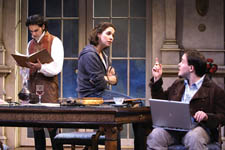
ps_the_cd15_229.jpgThe last few days of my cross-country reviewing trip were typically hectic. I traveled from Smalltown, U.S.A., to Washington, D.C., on Tuesday, a twelve-hour-long journey that seemed to last for at least a fortnight. That night I met a friend for dinner and a show, the Shakespeare Theatre Company's revival of Design for Living, one of Noël Coward's most interesting and, in my opinion, inadequately appreciated plays. On Thursday I returned to New York--this time, thank God, by train. I dragged two bags of snail mail home from the post office, took a suitcase full of dirty clothes to the laundry, went to the gym, and spent the evening on the couch, watching TV and doing as little as possible.

Today I'll be back at work with a vengeance. If you should happen to be in town for BookExpo America, you can catch me at the Javits Center: I'll be signing bound galleys of Pops: A Life of Louis Armstrong at Table 19 from 12:30 to one p.m., then appearing on the Uptown Stage at 2:30, where Ben Moser will be interviewing me about Pops. Tonight I'm seeing a press preview of Coraline at the Lucille Lortel Theatre, and tomorrow I'm catching Norman Corwin's The Rivalry, a play about the Lincoln-Douglas debates, at the Irish Repertory Theatre.

Sunday marks the start of a new theater-related adventure: Mrs. T and I will be flying north to Toronto to spend four days at the Stratford Shakespeare Festival, where we'll be seeing Three Sisters, The Importance of Being Earnest, and Macbeth. You can't get much eggheadier than that! Watch this space for details, though I don't expect to do a whole lot of blogging from Stratford.

And so ends my first theater-related marathon trip of the summer of 2009. It's been one hell of a sprint--I wouldn't care to know how many miles I traveled--but I enjoyed nearly every minute of it, not counting the time I spent sitting on planes or in departure lounges. I only wish I could take a week off to pull myself together, but The Letter and ten more summer festivals await my presence, and I have miles and miles and miles to go before I sleep.
(Last of six parts)

Posted May 29, 12:00 AM

TT: Shakespeare-style Stoppard

Today's Wall Street Journal drama column contains reviews of the Folger Theatre's revival of Arcadia in Washington, D.C., the American Shakespeare Center's revival of Rosencrantz and Guildenstern Are Dead in Staunton, Virginia, and the Kansas City Repertory Theatre's production of David Ives' new adaptation of Georges Feydeau's A Flea in Her Ear. Here's a excerpt.

* * *

Most of the half-dozen American drama companies that perform in more or less authentic replicas of Elizabethan-era theaters specialize, logically enough, in the works of Shakespeare. From time to time, though, contemporary plays are acted on these modern re-creations of 17th-century stages, and it happens that two such productions are currently being performed in the same part of the country. In Washington, the Folger Theatre is mounting Tom Stoppard's "Arcadia" on its indoor stage, while the American Shakespeare Center, located in Staunton, Va., is presenting Mr. Stoppard's "Rosencrantz and Guildenstern Are Dead" in the Blackfriars Playhouse, a copy of a 1596 London theater. It's a once-in-a-lifetime coincidence that these two shows are being performed within a three-hour drive of one another, and both are very much worth seeing.

2009-05-14_stage_4238_4711.jpgThe Folger's "Arcadia," directed by Aaron Posner, is the more conventional of the two stagings: Daniel Conway's solidly built proscenium-style set treats the surrounding theater as a shell rather than making use of its specifically Elizabethan features. But Mr. Posner and his fabulous cast need no scenic assistance in order to make magic out of Mr. Stoppard's best play....

Unlike Mr. Posner's "Arcadia," which would have looked as good and played as well in a modern theater, Jim Warren's knockabout staging of "Rosencrantz and Guildenstern Are Dead," Mr. Stoppard's topsy-turvy variation on "Hamlet," is a site-specific production that makes impeccably idiomatic use of the wide-open stage of the Blackfriars Playhouse. No curtain, no sets, no spotlights--just a bunch of actors who come and go through a pair of upstage doors, speaking their soliloquies directly to the audience and moving briskly from scene to scene. The title roles are played not by two men but by a man and a woman, Rick Blunt and Ginna Hoben, who act in the broad, unselfconsciously vulgar manner of Shakespearean clowns....

David Ives, who rewrote Mark Twain's "Is He Dead?" to extensive and brilliant effect a couple of seasons ago, has done a similar service on behalf of an infinitely better play. In Mr. Ives' new version of "A Flea in Her Ear," Georges Feydeau's 1907 comedy about an impotent husband (John Scherer) whose wife (Carol Halstead) suspects him of adulterous dalliance, Feydeau's fin-de-siècle French dialogue has been modernized (and Americanized) in a way that is fully faithful to the spirit of the greatest of all French farces. My guess is that this version, which is now making the regional rounds, will become the standard English-language version of "A Flea in Her Ear," and anyone who sees the Kansas City Repertory Theatre's immaculate production, directed by Gary Griffin, will come away certain that Mr. Ives has passed another theatrical miracle.

Mr. Griffin's staging of "A Flea in Her Ear" is direct, vigorous and gimmick-free, thus allowing Feydeau's meticulously engineered plot to work itself out with near-mathematical clarity....

* * *

Read the whole thing here.

Posted May 29, 12:00 AM

TT: Almanac

"Perfection is a trifle dull. It is not the least of life's ironies that this, which we all aim at, is better not quite achieved."

W. Somerset Maugham, The Summing Up

Posted May 29, 12:00 AM

May 28, 2009

TT: Joy in the evening

n652497192_5354.jpgI just opened an envelope containing three "advance reading copies" of Pops: A Life of Louis Armstrong. These are handsomely bound promotional paperbacks of the uncorrected galley proofs of Pops whose front cover and spine are essentially identical to the dust jacket of the finished book. I can now see for the first time what Pops will look like when it comes out on December 2.

Needless to say, I'm biased, but I think it's the most beautifully designed of all my books--and now it's real. I can hold it in my hand, turn the pages, and marvel at what Houghton Mifflin Harcourt and I have wrought.

I'm so proud I could burst.

Posted May 28, 6:36 PM

TT: So you want to see a show?

Here's my list of recommended Broadway, off-Broadway, and out-of-town shows, updated weekly. In all cases, I gave these shows favorable reviews (if sometimes qualifiedly so) in The Wall Street Journal when they opened. For more information, click on the title.

Warning: Broadway shows marked with an asterisk were sold out, or nearly so, last week.

BROADWAY:
Alfred Hitchcock's The 39 Steps (comedy, G, suitable for bright children, reviewed here)
August: Osage County (drama, R, adult subject matter, reviewed here)
Avenue Q (musical, R, adult subject matter and one show-stopping scene of puppet-on-puppet sex, reviewed here)
God of Carnage * (serious comedy, PG-13, adult subject matter, closes July 19, reviewed here)
Joe Turner's Come and Gone (drama, PG-13, some adult subject matter, accessible to adolescents with mature attention spans, closes June 14, reviewed here)
The Little Mermaid * (musical, G, entirely suitable for children, reviewed here)
Mary Stuart (drama, G, far too long and complicated for children, closes Aug. 16, reviewed here)
The Norman Conquests (three related comedies, PG-13, comprehensively unsuitable for children, playing in repertory through July 25, reviewed here)
South Pacific * (musical, G/PG-13, some sexual content, brilliantly staged but unsuitable for viewers acutely allergic to preachiness, reviewed here)
Waiting for Godot * (drama, PG-13, accessible to intelligent and open-minded adolescents, closes July 12, reviewed here)

OFF BROADWAY:
The Fantasticks (musical, G, suitable for children capable of enjoying a love story, reviewed here)
Our Town (drama, G, suitable for mature children, reviewed here)

IN CHICAGO:
The History Boys (drama, PG-13/R, adult subject matter, too intellectually complex for most adolescents, closes Aug. 2, reviewed here)

CLOSING SOON ON BROADWAY:
Exit the King * (disturbingly black comedy, PG-13, closes June 14, reviewed here)

CLOSING SOON OFF BROADWAY:
Ruined (drama, PG-13/R, sexual content and suggestions of extreme violence, closes June 28, reviewed here)

CLOSING SOON IN DALLAS:
Lost in the Stars (musical, PG-13, closes June 14, reviewed here)

CLOSING NEXT WEEK IN HOUSTON:
Awake and Sing! (drama, PG-13, closes June 7, reviewed here)

CLOSING SUNDAY IN CHICAGO:
Old Times (drama, PG-13, adult subject matter, reviewed here)

CLOSING SUNDAY IN ARLINGTON, VA.:
Giant (musical, PG-13, far too long for children, reviewed here)

Posted May 28, 12:00 AM

TT: Almanac

"Go for the pain, and the audience will laugh."

Matthew Warchus, director of The Norman Conquests and God of Carnage (quoted in The Wall Street Journal, May 22, 2009)

Posted May 28, 12:00 AM

May 27, 2009

TT: Snapshot

Excerpts from the only surviving film of Wanda Landowska playing harpsichord, shot in 1953:

(This is the latest in a weekly series of arts-related videos that appear in this space each Wednesday.)

Posted May 27, 12:00 AM

TT: Almanac

"It may take time to get over an obsession, even after the roots have been pulled out."

L.P. Hartley, Eustace and Hilda

Posted May 27, 12:00 AM

May 26, 2009

TT: Cross-country run (V)

You can get anywhere in America from anywhere else, but some trips are easier than others. Unless you own a private plane, the only sensible way to get from Kansas City to Smalltown is to drive east on I-70 to St. Louis for four hours, turn right, then drive south on I-55 for two hours. I've made that trip dozens of times, and it isn't very interesting, so instead of sticking to the program last Wednesday morning, I pulled off the interstate, fired up my GPS, and took the back roads all the way home.

It's been more than a quarter-century since I last saw the parts of Missouri through which I drove, and I enjoyed every minute of my impromptu journey to Smalltown via Sedalia, Cole Camp, Laurie, Sunrise Beach, Rolla, Dixon, Steelville, and Potosi. Somewhere along the way I stopped in the parking lot of a Burger King, downloaded my e-mail, and learned that Pops: A Life of Louis Armstrong has been sold to a Bulgarian publisher. Isn't technology wonderful?

3272428483_8304f2ee5c.jpgI hadn't been home since Christmas, so I hadn't seen the effects of the devastating ice storm that swept through southeast Missouri a few weeks after my last visit. My first sight of Smalltown was jolting: it looked as if my home town had caught a terrible disease. Many of the trees in town, including the ones in my mother's yard, had lost a considerable number of their branches, and more than a few, including some of the biggest and grandest ones, had been chopped down. Once I started getting used to the sight of the sickly trees, though, things in Smalltown seemed pretty much the way they've always been. I took my mother to the covered bridge north of town for a picnic one day, and a couple of days later my brother smoked a pork loin on his back porch and treated us to a feast.

lamberts1.jpgIn between I wrote a Wall Street Journal drama column and a book review and went to lunch at Lambert's Café, the home of "throwed rolls" (the waiters toss them to you) and Smalltown's sole claim to national fame, with Lee McMurray, a good friend from high school who now lives in St. Louis but was in town for a weekend visit. Lee and I hadn't seen one another for years, but we'd been keeping in sporadic touch via e-mail and Facebook, and we picked up the threads of our friendship effortlessly.

My visit was over before I knew it, and today I rose early to start the long trip from Smalltown to Washington, D.C., where I'll be seeing a Noël Coward play and dining with Thornton Wilder's nephew. Then I'll rush back to New York to appear at BookExpo America, do a couple of Pops-related interviews, and see an off-Broadway press preview. On Sunday I pack my passport and fly north to Toronto for my first visit to the Stratford Shakespeare Festival. I already miss Smalltown, where I got to hang up my clothes, sleep late every morning, and eat home cooking. I love my crowded life more than words can say, but sometimes it's nice to stay in one place for a few days and do next to nothing.

(To be continued)

Posted May 26, 12:00 AM

TT: Almanac

"But to those who are accustomed to listen for it, the voice of conscience is not easily silenced; it goes on mumbling even if it cannot find anything to say."

L.P. Hartley, Eustace and Hilda

Posted May 26, 12:00 AM

May 25, 2009

TT: Bonus almanac (special Memorial Day edition)

"In peace we can make many of them ignore good and evil entirely; in danger, the issue is forced upon them in a guise to which even we cannot blind them. There is here a cruel dilemma before us. If we promoted justice and charity among men, we should be playing directly into the Enemy's hands; but if we guide them to the opposite behaviour, this sooner or later produces (for He permits it to produce) a war or a revolution, and the undisguisable issue of cowardice or courage awakes thousands of men from moral stupor. This, indeed, is probably one of the Enemy's motives for creating a dangerous world--a world in which moral issues really come to the point. He sees as well as you do that courage is not simply one of the virtues, but the form of every virtue at the testing point, which means, at the point of highest reality."

C.S. Lewis, The Screwtape Letters

Posted May 25, 10:38 AM

TT: Almanac

"I associate chronic boredom with narcissism, ingratitude and poverty of imagination."

Patrick Kurp, Anecdotal Evidence, May 15, 2009

Posted May 25, 12:00 AM

May 22, 2009

TT: An American classic in Texas

In the latest of my Wall Street Journal reports from the road, I review Main Street Theater's revival of Awake and Sing! in Houston and Theatre Three's revival of Lost in the Stars in Dallas. Here's an excerpt.

* * *

Why is Clifford Odets's "Awake and Sing!" performed so rarely? It's one of the greatest of all American plays, a wrenching kitchen-sink drama of Depression-era family life, and by all rights it ought to be as popular as "Our Town" or "The Glass Menagerie." But revivals of "Awake and Sing!" are few and far between--Lincoln Center Theater's 2006 production was the first time the show had been done on Broadway since 1984--which is why I flew to Houston to see a new staging of an un­derappreciated masterpiece....

The special excellence of "Awake and Sing!" lies not in its standard-issue plot, whose climax is frankly melodramatic, but in Odets's golden ear for the tangy, Yiddish-flavored everyday speech of the Russian-Jewish immigrant community into which he, like the Bergers, was born. It's as though he'd spent his childhood with a notebook in his hand, scribbling down homely phrases that he would later use with the lapidary exactitude of a poet ("Never mind laughing. It's time you already had in your head a serious thought"). Not until August Wilson came along a half-century later would an American playwright make such effective use of the language of the streets on which he grew up.

I confess to not having expected a stageful of Houston-based actors to speak Odets's dialogue with the idiomatic snap that you'd take for granted from a New York cast. Was I wrong! Not only is Main Street Theater's ensemble cast at home with every line, but they put across the play's angry warmth so believably that you'd think you were sitting at the table with them....

Today Kurt Weill is mainly remembered for "The Threepenny Opera," but in his lifetime he was best known for the musicals that he wrote after he immigrated to America in 1935 and retrofitted himself as a Broadway songsmith. Yet none of them has been successfully revived in New York, and Theatre Three's production of "Lost in the Stars," Weill's 1949 musical version of Alan Paton's novel "Cry, the Beloved Country," appears to be the first full-scale staging of that show to be seen anywhere in the past two decades. I wondered whether a 60-year-old musical about life under apartheid would make sense in the 21st century, but "Lost in the Stars" proves to be a fresh and compelling piece of work that is long overdue for a second chance on Broadway.

* * *

Read the whole thing here.

Posted May 22, 10:30 AM

TT: Almanac

"We cross our bridges when we come to them and burn them behind us, with nothing to show for our progress except a memory of the smell of smoke, and a presumption that once our eyes watered."

Tom Stoppard, Rosencrantz and Guildenstern Are Dead

Posted May 22, 12:00 AM

May 21, 2009

TT: Cross-country run (IV)

I know my limits, and I reached them on Monday and acted accordingly. Instead of driving around Dallas in search of cultural experiences and/or barbecue, I spent the day in my hotel room, emerging only to eat breakfast, visit the fitness center, and go to Theatre Three that evening to see the rare revival of Lost in the Stars, Kurt Weill's musical version of Alan Paton's Cry, the Beloved Country, that had brought me to town. The fact that it was Monday, meaning that the museums were closed, prevented me from zooming off to the Kimbell Art Museum in Fort Worth, which I would doubtless have felt obliged to do on any other day of the week.

AMPaper.jpgOn Tuesday I behaved only slightly less prudently, flying to Kansas City in the morning and going straight from the airport to the Nelson-Atkins Museum of Art, which is in the same neighborhood as my hotel and the theater where the Kansas City Repertory Theatre is performing David Ives' new version of Georges Feydeau's A Flea in Her Ear. My plan was to visit the museum just long enough to get a look at the exhibition of American art on paper that went up last month. Alas, nobody told me that the Nelson-Atkins is closed on Mondays and Tuesdays! Fortuitously stymied, I drove to the hotel and spent the rest of the afternoon on my back, giving myself just enough time to dine at Winstead's before reporting to the theater at six-forty-five.

Yesterday was...well, let's just say it was long. Or maybe looong would be a better way to put it. I got up in the morning, wrote and filed my Friday drama column for The Wall Street Journal, then drove three hundred and seventy-nine miles to Smalltown, U.S.A., where my mother was standing in the doorway, beaming like a searchlight.

Yes, I have a couple of reviews to write while I'm here, but insofar as it's possible for me to drop the reins, I plan to do so between now and next Tuesday, when I fly back to Washington, D.C., to see Design for Living. Pops is finished and The Letter out of my hands, both of which should make it easier for me to relax. I promised my mother that I'd take her on a picnic, and I promised Mrs. T that I'd sleep late every day. Never let it be said that I'm not a man of my word!

(To be continued)

Posted May 21, 12:00 AM

TT: So you want to see a show?

Here's my list of recommended Broadway, off-Broadway, and out-of-town shows, updated weekly. In all cases, I gave these shows favorable reviews (if sometimes qualifiedly so) in The Wall Street Journal when they opened. For more information, click on the title.

Warning: Broadway shows marked with an asterisk were sold out, or nearly so, last week.

BROADWAY:
Alfred Hitchcock's The 39 Steps (comedy, G, suitable for bright children, reviewed here)
August: Osage County (drama, R, adult subject matter, reviewed here)
Avenue Q (musical, R, adult subject matter and one show-stopping scene of puppet-on-puppet sex, reviewed here)
Exit the King (disturbingly black comedy, PG-13, closes June 14, reviewed here)
God of Carnage * (serious comedy, PG-13, adult subject matter, closes July 19, reviewed here)
Joe Turner's Come and Gone (drama, PG-13, some adult subject matter, accessible to adolescents with mature attention spans, closes June 14, reviewed here)
The Little Mermaid * (musical, G, entirely suitable for children, reviewed here)
Mary Stuart (drama, G, far too long and complicated for children, closes Aug. 16, reviewed here)
The Norman Conquests * (three related comedies, PG-13, comprehensively unsuitable for children, playing in repertory through July 25, reviewed here)
South Pacific * (musical, G/PG-13, some sexual content, brilliantly staged but unsuitable for viewers acutely allergic to preachiness, reviewed here)
Waiting for Godot * (drama, PG-13, accessible to intelligent and open-minded adolescents, closes July 12, reviewed here)

OFF BROADWAY:
The Fantasticks (musical, G, suitable for children capable of enjoying a love story, reviewed here)
Our Town (drama, G, suitable for mature children, reviewed here)
Ruined (drama, PG-13/R, sexual content and suggestions of extreme violence, closes June 28, reviewed here)

IN CHICAGO:
The History Boys (drama, PG-13/R, adult subject matter, too intellectually complex for most adolescents, closes Aug. 2, reviewed here)

CLOSING SOON IN CHICAGO
Old Times (drama, PG-13, adult subject matter, closes May 31, reviewed here)

CLOSING SOON IN ARLINGTON, VA.:
Giant (musical, PG-13, far too long for children, closes May 31, reviewed here)

Posted May 21, 12:00 AM

TT: Almanac (apropos of The Letter, III)

GUILDENSTERN: You!--What do you know about death?

PLAYER KING: It's what the actors do best. They have to exploit whatever talent is given to them, and their talent is dying. They can die heroically, comically, ironically, slowly, suddenly, disgustingly, charmingly, or from a great height. My own talent is more general. I extract significance from melodrama, a significance which it does not in fact contain; but occasionally, from out of this matter, there escapes a thin beam of light that, seen at the right angle, can crack the shell of mortality.

Tom Stoppard, Rosencrantz and Guildenstern Are Dead

Posted May 21, 12:00 AM

May 20, 2009

TT: Cross-country run (III)

It's been a decade since I last set foot in any part of Texas other than an airport. I've been wanting to review theater there for the past few years, but until this week I was never able to find a sufficiently compact stretch of time when I could catch more than one worthy-looking show.

Even this trip, short as it was, took some doing. I had to fly from Washington, D.C., to Houston on Saturday, see Main Street Theater's revival of Clifford Odets' Awake and Sing! on Sunday afternoon, drive from Houston to Dallas that same night so that I could attend the opening of Theatre Three's production of Kurt Weill's Lost in the Stars on Monday, then fly to Kansas City on Tuesday morning for a preview of A Flea in Her Ear. I hate cramming so many shows into so brief a span of time, but there was no way to get around it--the schedules of the three companies that I wanted to see locked together in only one way that fit into the rest of my itinerary--so I made my plans and resigned myself to scurrying.

I spent twenty-one hours in Houston, not nearly long enough to get more than the flimsiest of impressions of a city that I remember only vaguely from my previous trip. It felt sprawling and sleepy on Saturday night, but I have no doubt that appearances were deceiving (especially given the fact that I was sleepy, too). Brazos Bookstore, an independently owned shop to which I made a happy pilgrimage the next morning, is an unmistakable sign of intellectual life, an egghead's paradise of well-stocked shelves and comfy chairs that left nothing to be desired save for being located in Houston instead of on the Upper West Side of New York.

Rothko%20Chapel.jpegSince I only had time to visit one other cultural landmark before heading for the theater on Sunday, I decided to return to the Rothko Chapel, which I saw for the first time when I went to Houston in 1998 to interview Francesca Zambello for Time. It struck me then as bleak and forbidding, a monochrome monument to everything that is least inviting about modernism, and I can't say I felt all that different the second time around.

g051_rothko_vbkoy-wr.jpgMisleading though it can be to read an artist's life into his work, I'm not greatly surprised that the Rothko Chapel was created by a man who committed suicide a year before it opened. I say this as one who loves Mark Rothko's paintings of the late Forties and early Fifties passionately. In those days he was full of life, spilling over with the bold, high-key colors that he first saw in the work of Pierre Bonnard. But something seems to have gone badly wrong by the time he got around to painting the Rothko Chapel murals (though there are plenty of critics and scholars who beg to differ).

To be sure, the chapel bills itself as "a place alive with religious ceremonies of all faiths," and countless religious and quasi-religious groups use it for their various purposes. A delegation from Yoga for Peace was setting up shop when I arrived on Sunday morning. But the black-on-black panels in whose fathomless darkness they labored seemed to mock their smiling certitude, and I could all but hear Matthew Arnold's "melancholy, long, withdrawing roar" in the middle distance as I watched them make ready to glorify Krishna.

It was a relief to escape from the spiritual chill of the chapel to the furious warmth of the quarreling Jewish family that Clifford Odets portrayed in Awake and Sing! As I wrote in The Wall Street Journal apropos of the 2006 Broadway revival of Odets' greatest play:

"Awake and Sing!" is the original Jewish-mom kitchen-sink family drama, complete with stock characters, a creaky plot and a happy ending that reeks of socialist realism--none of which matters in the least. The point of the play is the dialogue, which crackles with the near-stenographic exactitude of an artist who had an exquisitely precise ear for the speech of the lost world into which he was born: "I can't take a bite in my mouth no more." "You'll excuse my expression, you're bughouse." "Don't yell in my ears. I hear." In Odets' hands everyday talk becomes musical, and you hang breathlessly on each line. It's as if Anton Chekhov had paid a visit to the Lower East Side.

Front.jpgFrom the Lower East Side to the wastelands of Texas: the highway between Houston and Dallas is flat and tedious, and no one drives it who doesn't have to. I suppose I could have flown, but it was somewhat more convenient to rent a car at the Houston airport and drop it off in Dallas, so I hit the road again as soon as Awake and Sing! was over, driving for the better part of five hours and pausing only to dine on chicken-fried steak and sweet tea at Sam's Restaurant, a no-nonsense oasis just past the middle of nowhere.

It should have been a painfully boring trip, but I ended up enjoying most of it. Barreling down a long, straight stretch of road at eighty miles an hour is one of the most mentally restful activities I know, especially when you've been spending too much time juggling too many responsibilities. I only wish I'd thought to bring along some suitable music: Bob Wills and Ray Price would have been ideal, but the car radio offered only Christian rock and hip-hop, so I opted for incongruity and popped The John Kirby Sextet: Complete Columbia and RCA Victor Recordings into the CD player as I made my way to Dallas.

(To be continued)

Posted May 20, 12:00 AM

TT: Snapshot

Lester Young plays "Pennies from Heaven" in 1950:

(This is the latest in a weekly series of arts-related videos that appear in this space each Wednesday.)

Posted May 20, 12:00 AM

TT: Almanac (apropos of The Letter, II)

GUILDENSTERN: You're familiar with the tragedies of antiquity, are you? The great homicidal classics? Matri, patri, fratri, sorrori, uxori and it goes without saying--

ROSENCRANTZ: Saucy--

GUILDENSTERN: --Suicidal--hm? Maidens aspiring to godheads--

ROSENCRANTZ: And vice versa--

GUILDENSTERN: Your kind of thing, is it?

PLAYER KING: Well, no, I can't say it is, really. We're more of the blood, love and rhetoric school.

GUILDENSTERN: Well, I'll leave the choice to you, if there is anything to choose between them.

PLAYER KING: They're hardly divisible, sir--well, I can do you blood and love without the rhetoric, and I can do you blood and rhetoric without the love, and I can do you all three concurrent or consecutive, but I can't do you love and rhetoric without the blood. Blood is compulsory--they're all blood, you see.

Tom Stoppard, Rosencrantz and Guildenstern Are Dead

Posted May 20, 12:00 AM

May 19, 2009

TT: Cross-country run (II)

47702.jpgOn Friday Mrs. T and I drove down to Staunton, Virginia, where we lunched on Superburgers at Wright's Dairy-Rite, a drive-in that has been doing business in the same building since 1952, and saw another Tom Stoppard play, Rosencrantz and Guildenstern Are Dead, in another Elizabethan-style theater, the Blackfriars Playhouse, which I visited for the first time in 2006:

In theater, seeing is believing, and the best way to learn about 17th-century theatrical performance practices is to watch a Shakespeare play acted on a modern re-creation of an Elizabethan-style stage....The U.S. is home to a half-dozen such houses, including the indoor theater at the Folger Shakespeare Library in Washington, D.C., and the open-air theaters that I saw earlier this year at the Oregon Shakespeare and Utah Shakespearean Festivals. Most of the American replicas, however, are variously modernized structures that incorporate such anachronistic devices as theatrical lighting. If you want to see the real thing--and to see it used in a convincing way--the place to go is Staunton, home of the American Shakespeare Center, whose performances are given in a dazzlingly exact re-creation of the Blackfriars Playhouse, originally built in London in 1596....

To pass through the lobby doors into the 300-seat auditorium is like jumping into Mr. Peabody's Wayback Machine and setting the controls for 1600, with some allowances made for fire safety. Actors and audience are lit by the same electric chandeliers--there are no spotlights--and if you're fortunate enough to hold a ticket for one of the 12 "Lord's Chairs" placed on either side of the stage, you'll be close enough to the players to reach out and touch them.

The opportunity to review two Stoppard plays performed on consecutive nights in two different Elizabethan-style theaters was, of course, irresistible, and I didn't even consider resisting it, even though I knew it would involve a fair-sized chunk of long-distance driving, there being no practical way to get from Washington to Staunton other than in a car. The next morning I took Mrs. T back to Union Station, from whence she departed for Connecticut. I then drove to Dulles International Airport and flew to Houston, Texas, by way of Charlotte, North Carolina, to begin the second leg of my cross-country regional-theater pilgrimage.

Too much travel in one day makes my head spin--I woke up an hour ahead of my wake-up call in Staunton--and it wasn't until I landed in Houston that I started to calm down. All told, I spent thirteen hours on the move last Saturday, including a twenty-minute jog from one end of the Charlotte airport to the other (for once, the word literally is applicable). As soon as I picked up my rental car in Houston, I drove straight to La Mexicana, a neighborhood joint recommended by Michael Stern, and dined on fish tacos laced with fresh cilantro and lime. Then I found my hotel, ascended to the twenty-third floor, called Mrs. T and my mother, and fell into bed.

(To be continued)

Posted May 19, 12:00 AM

TT: Try, try again

I asked about this without effect back in January, so allow me to repeat myself: I'm curious about the current whereabouts of two people whom I knew in college three decades ago, a violinist named Laura Gutsch and an oboe player named Michelle Rock. Both lived in the Kansas City area. Laura married and moved away, but I know nothing more about Michelle, who may or may not still be in Kansas City.

If anyone out there knows either of these women, would you be so kind as to send them a link to this posting?

Posted May 19, 12:00 AM

TT: Almanac (apropos of The Letter, I)

"I always think of melodrama as the thing we are all capable of that's swept under the rug."

Sidney Lumet (quoted on imdb.com)

Posted May 19, 12:00 AM

May 18, 2009

TT: Cross-country run (I)

On Wednesday Mrs. T and I took the Acela Express to Washington, D.C., picked up a rental car at the train station, and drove to Arlington, Virginia, to see Signature Theatre's production of Giant, the new Michael John LaChiusa-Sybille Pearson musical version of Edna Ferber's 1952 novel. My Wall Street Journal review, unlike most of the others that I've seen to date, was strongly positive. I think Giant is a show of the first importance, and I wish I'd had time to see it twice, something I almost never get to do.

MORANDI%20PHILLIPS.jpgThe next day we strolled from our hotel to the Phillips Collection to see Morandi: Master of Modern Still Life, an exhibition of sixty paintings and etchings to which I've been looking forward ever since it was announced last year. (The Phillips, not incidentally, happens to own one of my favorite Morandis, a 1953 still life that is one of the finest pieces in the show, which is up through May 24.) I've written a fair amount about Morandi in this space, most recently in connection with the Metropolitan Museum's 2008 retrospective, a once-in-a-lifetime event that nonetheless disappointed me, not because the paintings weren't beautiful but because they were presented in a way that I found problematic. Not so the Phillips show, which gets everything right. The size of the show is ideal--large enough to suggest Morandi's range without blunting your perception of the individual pieces--and though the galleries were fairly full of spectators, everyone was properly quiet and attentive.

Afterward we had dinner at the home of Megan McArdle, who bills herself as "the world's tallest female econoblogger," and her boyfriend Peter Suderman, a comparably classy writer. I love to eat out on the road, but it's always nicer to dine in a friend's backyard garden, and Megan, in addition to being very tall and very smart, is also a terrific cook, so a good time was had by all.

003569W2.jpgThe four of us then went to the Folger Theatre to see Aaron Posner's revival of Tom Stoppard's Arcadia, a play that is close to my heart. My review hasn't run yet, so you'll have to wait to find out what I thought of the production (Peter Marks of the Washington Post gave it a hat-in-the-air rave). Instead, I'll reprint part of what I wrote about Arcadia when I last saw it performed by Chicago's Court Theatre two seasons ago:

In theory Arcadia, a highbrow whodunit whose plot charges back and forth between 1809 and the present, ought to be hard to unravel. On stage it plays like a high-speed boulevard comedy heavily salted with wicked punchlines. Yet for all its fizzing fun, Arcadia is also a deeply serious meditation on what it means to live in the shadow of modernity, and the climactic scene, in which a fey child prodigy and her tutor reflect on man's fate, is hauntingly hopeful: "When we have found all the mysteries and lost all the meaning, we will be alone, on an empty shore." "Then we will dance. Is this a waltz?"

I wish I'd written that.

(To be continued)

* * *

Here's a video about "Morandi: Master of Modern Still Life":

Posted May 18, 12:00 AM

TT: Almanac

"The bad end unhappily, the good unluckily. That is what tragedy means."

Tom Stoppard, Rosencrantz and Guildenstern Are Dead

Posted May 18, 12:00 AM

May 15, 2009

CAAF: Breathless

I've read a couple reviews of Angels & Demons but thus far have not had my most burning question about the movie answered: Will Robert Langdon, Harvard symbologist, once again be forced to face down his old nemesis, claustrophobia, in his scholarly pursuit of truth?

Because I'm pretty much done in by the very idea of Robert Langdon, Harvard symbologist, whenever he appears on the scene in his khakis and his black turtleneck, but once you add in the gripping fear of enclosed spaces -- gamely portrayed by Tom Hanks in The Da Vinci Code with gritted teeth and tiny, earnest beads of sweat -- it takes it to a whole other level of adventure.

Posted May 15, 1:06 PM

TT: A really, really big show

In today's Wall Street Journal drama column I report on two first-rate out-of-town shows, Giant at Arlington's Signature Theatre and Old Times at Chicago's Remy Bumppo Theatre Company. Here's an excerpt.

* * *

For some playgoers, the most noteworthy piece of information about "Giant," Michael John LaChiusa's musical version of Edna Ferber's mammoth 1952 novel, will be that it runs for three hours and 45 minutes. Even for an opera, that's on the long side, and in the knock-'em-dead world of musical comedy, it's endless. Yet Signature Theatre, which just won a well-deserved regional-theater Tony Award, has thrown caution to the winds and dared to put Mr. LaChiusa's new show on its smallish stage--with immensely impressive results. This is a long show that doesn't feel long, with a score so rich and varied that you'll relish every bar.

smGIANT_123.jpgFerber's multigenerational middlebrow epic about a family of Texas cattle ranchers is best known nowadays from George Stevens' star-studded 1956 film version. Sybille Pearson, however, has gone back to the source in writing the book for "Giant," and her three-act adaptation conveys the essence of the 416-page novel without getting bogged down in Ferber's flat-textured, tin-eared prose. The story comes through clearly, and it's a good one, an event-packed tale of a wealthy rancher (Lewis Cleale) whose young Virginia bride (Betsy Morgan), stunned by the size and strangeness of her new home, spends the rest of her life trying to come to terms with Texas.

The pull of the plot is obviously an important part of what makes "Giant" work on stage, but it's the marvelous songs that are the heart of the matter. From the spacious, unhurried lyricism of "Lost in Her Woods" to the sock-hop rock of "Jump," the score of "Giant" cuts a wide swath of stylistic terrain. Yet Mr. LaChiusa isn't just trying on idioms for size--he is at home in all the musical languages to which he turns his hand--and his plain-spoken lyrics propel the action so decisively that "Giant" seems far shorter than it is....

Time was when Harold Pinter's shorthand dialogue struck most people as impenetrably mysterious--and times, truth to tell, haven't changed all that much. Yet his best plays continue to make a powerful impression, and "Old Times," first seen on Broadway in 1971, has even become something of a regional-theater staple in recent years, partly because it can be produced so cheaply (three actors, one simple set) and partly because it's so theatrically effective. Pinter never wrote anything more potent than the enigmatic story of Deeley and Kate, an uneasily married couple whose life is disrupted by a visit from Anna, who knew Kate 20 years ago and appears (or maybe not) to have been romantically involved with her. Remy Bumppo Theatre, one of my favorite Chicago companies, is presenting this icy sparring match in an exceptionally satisfying production that has been staged with surgical skill by James Bohnen, the company's artistic director...

* * *

Read the whole thing here.

Posted May 15, 12:00 AM

TT: The world according to Bucky

1101640110_400.jpgI recently visited a retrospective at Chicago's Museum of Contemporary Art that was devoted to the life, work, and thought of Buckminster Fuller, the man who invented the geodesic dome and was--once upon a time--famous enough to have made the cover of Time and been profiled in The New Yorker. Fuller isn't nearly so well known today, but he has his fair share of passionate devotees, and in my "Sightings" column in tomorrow's Wall Street Journal I take a skeptical look at the sources of their undiminished passion.

Exactly what was it about this self-styled "comprehensive anticipatory design scientist" that made so many people so sure that he knew the secret of peace, love, and understanding? For the answer, pick up a copy of Saturday's Journal and see what I have to say.

UPDATE: Read the whole thing here.

Posted May 15, 12:00 AM

TT: Almanac

"The critic lives at second hand. He writes about. The poem, the novel, or the play must be given to him; criticism exists by the grace of other men's genius. By virtue of style, criticism can itself become literature. But usually this occurs only when the writer is acting as critic of his own work or as outrider to his own poetics, when the criticism of Coleridge is work in progress or that of T.S. Eliot propaganda."

George Steiner, Language and Silence

Posted May 15, 12:00 AM

May 14, 2009

TT: So you want to see a show?

Here's my list of recommended Broadway, off-Broadway, and out-of-town shows, updated weekly. In all cases, I gave these shows favorable reviews (if sometimes qualifiedly so) in The Wall Street Journal when they opened. For more information, click on the title.

Warning: Broadway shows marked with an asterisk were sold out, or nearly so, last week.

BROADWAY:
Alfred Hitchcock's The 39 Steps (comedy, G, suitable for bright children, reviewed here)
August: Osage County (drama, R, adult subject matter, reviewed here)
Avenue Q (musical, R, adult subject matter and one show-stopping scene of puppet-on-puppet sex, reviewed here)
Exit the King (disturbingly black comedy, PG-13, closes June 14, reviewed here)
God of Carnage * (serious comedy, PG-13, adult subject matter, closes July 19, reviewed here)
Joe Turner's Come and Gone (drama, PG-13, some adult subject matter, accessible to adolescents with mature attention spans, closes June 14, reviewed here)
The Little Mermaid (musical, G, entirely suitable for children, reviewed here)
Mary Stuart (drama, G, far too long and complicated for children, closes Aug. 16, reviewed here)
The Norman Conquests (three related comedies, PG-13, comprehensively unsuitable for children, playing in repertory through July 25, reviewed here)
South Pacific * (musical, G/PG-13, some sexual content, brilliantly staged but unsuitable for viewers acutely allergic to preachiness, reviewed here)
Waiting for Godot * (drama, PG-13, accessible to intelligent and open-minded adolescents, closes July 12, reviewed here)

OFF BROADWAY:
The Fantasticks (musical, G, suitable for children capable of enjoying a love story, reviewed here)
Our Town (drama, G, suitable for mature children, reviewed here)
Ruined (drama, PG-13/R, sexual content and suggestions of extreme violence, closes June 28, reviewed here)

IN CHICAGO:
The History Boys (drama, PG-13/R, adult subject matter, too intellectually complex for most adolescents, closes Aug. 2, reviewed here)

CLOSING SUNDAY IN BROOKLYN:
The Merchant of Venice (Shakespearian drama, PG-13, reviewed here)

CLOSING SUNDAY OFF BROADWAY:
Distracted (serious comedy, PG-13, reviewed here)

Posted May 14, 12:00 AM

TT: Almanac

"You can hone a speech to a point where it's actually better, but in the end you don't believe it--it's too clever, sort of joke-planted all the time; it's always possible to make things funnier. But you can see the truth running out of the door."

Alan Ayckbourn (quoted in Paul Allen, Alan Ayckbourn: Grinning at the Edge)

Posted May 14, 12:00 AM

May 13, 2009

TT: Eat my smoke

I depart New York this morning for the first leg of a long theater-related trip that will take me to Washington, D.C., followed by points south and west. I'll be describing my adventures in this space, though not necessarily as they happen, since I'll also be filing Wall Street Journal columns from the road in between shows. Work comes first!

I'm going to be on the move for much of the next couple of months, after which I settle down in Santa Fe for rehearsals of The Letter. I arrive in New Mexico on July 12, and the opera opens thirteen days later. Needless to say, you'll be hearing all about it in this space.

Now, though, I've got to catch a train....

Posted May 13, 12:00 AM

TT: Snapshot

Sir Thomas Beecham rehearses the London Philharmonic in a 1932 newsreel:

(This is the latest in a weekly series of arts-related videos that appear in this space each Wednesday.)

Posted May 13, 12:00 AM

TT: Almanac

"I don't believe anything that happens in films. But on stage there are no tricks except the tricks you see. The tricks are the actors and actresses persuading you of what they are."

Alan Ayckbourn (quoted in Paul Allen, Alan Ayckbourn: Grinning at the Edge)

Posted May 13, 12:00 AM

May 12, 2009

TT: That's all he wrote

armstrongcornet.jpgOn Sunday I read the page proofs of Pops: A Life of Louis Armstrong for the last time and made my final corrections. (For the record, I added some commas and cut a half-dozen repeated words and phrases.) Today I'll be sending the proofs back to the Boston office of Houghton Mifflin Harcourt. I'll double-check the index as soon as it's ready, but otherwise the tinkering is over. I'm through with Pops.

How do I feel? Very good--though not, I trust, unreasonably so. I made a point of setting the proofs aside for a couple of weeks in order to let them cool down. Then I read them in a single day-long sitting, hoping to recapture my sense of the book as a whole. I liked what I saw this time around. The narrative is fast-moving, the facts as straight as I could make them, the prose style formal (I don't like chummy biographers) but not stiff. The design of the book is gorgeous--I love how the photos are integrated into the text. I think that Armstrong's personality comes through clearly. So, of course, does my own view of the man and his work, but while I took great pains to correct the record whenever necessary, I also went out of my way not to be argumentative. No scores are settled in Pops. This book is about him, not me.

As I mentioned the other day, I'm already planning my next book--perhaps even my next three books--and I also have The Letter on my mind. Tomorrow I'll hit the road again, and I won't be back in New York (save for a couple of quick touchdowns) until well after the curtain goes up in Santa Fe. All this means that I won't have much time to brood about Pops, which is just as it should be. What's done is done. I hope the reading public is pleased with the results, but even if they're not, I can't do anything about it now. The cord is cut. It's time to move on to the next part of my life.

Posted May 12, 12:00 AM

TT: Almanac

"Instinct.--When our house burns down, we even forget our lunch.--Yes, but we go back to it later in the ashes."

Friedrich Nietzsche, Beyond Good and Evil

Posted May 12, 12:00 AM

May 11, 2009

CAAF: In response; David Copperfield's paradise lost

I like the Graham Greene letter that Terry quoted this morning as I know what Greene means, and I feel like the opening chapters of David Copperfield are something that regularly should be exclaimed about. They must be among the most beautiful and sustained performances of music-making ever to happen in a novel; so rapturous and psalm-like, never a word out of place. A sample from Chapter 2., the "I Observe" chapter: "There is nothing half so green that I know anywhere, as the grass of that churchyard; nothing half so shady as its trees; nothing half so quiet as its tomb-stones. The sheep are feeding there, when I kneel up, early in the morning in my little bed in a closet within my mother's room, to look out at it; and I see the red light shining on the sun-dial, and think within myself, 'Is the sun-dial glad, I wonder, that it can tell the time again?'" As Greene says, they're "perfect."

I'd argue that contrary to Greene's expectations, Dickens never mis-steps once for the novel's first ten chapters. But at Chapter 11 the tone shifts to something more ordinary. It clearly is a deliberate choice by Dickens, and one appropriate to the plot: It occurs at the point that the young Copperfield, having lost his mother, is being sent by the dreadful Murdstones out into the world to work; and it's only fitting that as he's ejected from childhood, the language of childhood would end. You couldn't call it "a mistake" but I never reach it without experiencing a feeling of deflation.

Here is the close of Chapter 10, which sounds in the same magical key as the novel's beginning:

Behold me, on the morrow, in a much-worn little white hat, with a black crape round it for my mother, a black jacket, and a pair of hard stiff corduroy trousers--which Miss Murdstone considered the best armor for the legs in that fight with the world which was now to come off--behold me so attired, and with my little worldly all before me in a small trunk, sitting, a lone lorn child (as Mrs. Gummidge might have said), in the post-chaise that was carrying Mr. Quinion to the London coach at Yarmouth! See how our house and church are lessening in the distance; how the grave beneath the tree is blotted out by intervening objects; how the spire points upward from my old playground no more, and the sky is empty!

And then Chapter 11 opens and the music is over:

I know enough of the world now, to have almost lost the capacity of being much surprised by anything; but it is a matter of some surprise to me, even now, that I can have been so easily thrown away at such an age. A child of excellent abilities, and with strong powers of observation, quick, eager, delicate, and soon hurt bodily or mentally, it seems wonderful to me that nobody should have made any sign in my behalf. But none was made; and I became at ten years old, a little laboring hind in the service of Murdstone and Grinby.

Posted May 11, 1:54 PM

TT: All blessings are mixed

When I told Paul Moravec three years ago that I'd love to collaborate with him on an opera, it didn't occur to me that The Letter would open in the same year that Pops: A Life of Louis Armstrong would be published. I'm sure I would have said yes anyway--it was an offer I couldn't refuse--but I might have thought twice, and maybe even thrice, if I'd known exactly what I was getting into.

modern-times.jpgThe good news is that Pops won't be coming out until four months after The Letter opens. That doesn't mean I can simply put Satchmo aside for now and concentrate solely on Santa Fe, of course, though The Letter is rarely far from my mind these days. Paul and I popped up in the annual list of summer-festival highlights published in Sunday's New York Times, and I also ran across an Associated Press story the other day in which Charles MacKay, the general director of the Santa Fe Opera, announced that the company has been "doing pretty well" despite the current economic difficulties. That tallies with everything I've been hearing so far. Ticket sales for The Letter are looking good, and though we've encountered a few bumps in the road to opening night, we haven't hit any potholes.

On the other hand, I've had to juggle Pops and The Letter more or less simultaneously in recent weeks, and while I have yet to drop any balls on my head, it's been a near-run thing. Last Tuesday, for instance, Paul and I auditioned a pair of singers, then went straight to a club in midtown Manhattan to give an hour-long presentation on The Letter. The next day I was interviewed twice about Pops, once via e-mail and once on the phone, in preparation for my May 29 appearance at BookExpo America (Benjamin Moser, the alarmingly smart new-books columnist of Harper's, will be interviewing me on stage that afternoon). I also finished writing an essay about the making of The Letter for the July issue of Commentary. In between these varied activities, I chipped away at the page proofs of Pops, knocked out a Wall Street Journal drama column, went to Brooklyn to see a performance by Propeller of The Merchant of Venice, and started drafting proposals--strictly preliminary, at least for the moment--for three books that I'm giving serious thought to writing.

If you think I'm working too hard, you're right, and it's only going to get worse. The only thing that's keeping me on a fairly even keel is that both The Letter and Pops are basically finished: I still have a certain amount of this-and-that left to do, but the really heavy lifting is now in the hands of the Santa Fe Opera and Houghton Mifflin Harcourt. Nevertheless, I'm going to be unremittingly busy between now and January, and I find the prospect unnerving, sometimes even scary.

How do I cope? By going to the gym each day, going to bed as early as I can each night, and seizing every opportunity, however brief, to put down the reins and read, watch, or listen to something unrelated to Pops or The Letter. It's helping, too, that so many of the shows I'm seeing these days are turning out to be exceptionally good. Great art is, among other things, a powerful distraction from the problems of the moment, and it has been a blessed relief to be able to escape into such enveloping theatrical experiences as The History Boys, Joe Turner's Come and Gone, and The Norman Conquests.

What I can't do--at least not very often--is lie fallow. That's something I need to do, but it won't be possible any time soon. In order to make it all the way from here to January without falling over, I have to pedal as fast as I can. Moreover, I feel guilty every time I complain about being too busy, because I know that the world is full of anxious artists who aren't nearly busy enough. As I've previously had occasion to mention in this space. George Balanchine was once asked why the members of New York City Ballet's pit orchestra were paid less than New York City's garbagemen. His answer? "Because garbage stinks." Nobody has to tell me that my life smells like roses.

The fact that I have an opera opening in July and a book coming out in December is by any reasonable standard a wholly unmixed blessing, and few days pass without my remembering to rejoice at my good fortune. But as Raskolnikov reminds us, "Man grows used to everything--the beast!" I'll try to remind myself at regular intervals not to be too beastly about being too busy.

Posted May 11, 12:00 AM

TT: Dream a little dream

ladykillers.gifMrs. T and I watched a documentary about Rita Hayworth on Saturday night. Afterward I went to bed and slept deeply. I got up the next morning, went straight to my iBook, and tweeted as follows: "I dreamed last night that I saw Alec Guinness in Pal Joey. Can't remember what part he played, but I hope it was Nicely-Nicely Johnson."

It seemed perfectly plausible: not only did Rita Hayworth star in the 1957 film version of Pal Joey, but I had "The Oldest Established Permanent Floating Crap Game in New York" running through my head all morning long as a result of the dream. As for Guinness, I just wrote an essay about him for Commentary. Q.E.D., right? Wrong. Both Nicely-Nicely Johnson and the song that was playing in my head are from Guys and Dolls, not Pal Joey, a fact that several of my fellow tweeters hastened to point out to me.

Moral: don't tweet about a dream while you're still half asleep.

Posted May 11, 12:00 AM

TT: Almanac

"Started reading David Copperfield. My goodness, the first two chapters are perfect. I don't believe there's ever been anything better in the novel--& that includes Proust & Tolstoy. One dreads the moment of failure, for Dickens always sooner or later fails."

Graham Greene, letter to Catherine Walston, Feb. 15-24, 1959

Posted May 11, 12:00 AM

May 9, 2009

DVD

Van Cliburn in Moscow, Vol. 1 (VAI). The long, barren years of Van Cliburn's retirement from the concert hall have largely blotted out the memory of the young virtuoso who stunned the world by winning the 1958 Tchaikovsky Competition at the height of the Cold War. Few people under the age of fifty know that he was--for a time--one of the finest pianists of the twentieth century. This disc, the first of five drawn from Russian videotapes of concerts given by Cliburn in his prime years, contains 1962 performances of Tchaikovsky's First Concerto and Beethoven's "Emperor" Concerto accompanied by Kiril Kondrashin and the Moscow Philharmonic, plus two encores, Chopin's F Minor Fantasie and the Liszt Twelfth Hungarian Rhapsody, a Cliburn warhorse that the pianist never got around to recording commercially. All are played with the expansive yet firmly disciplined romanticism that can also be heard on his best studio recordings. An unforgettable document of a great artist who lost his way in mid-career and spent the rest of his life wandering in the wilderness of celebrity (TT).

Posted May 09, 1:12 AM

May 8, 2009

CAAF: Fun with vampires

• Description of the complexion of Edward Cullen (the Robert Pattinson character) in Twlight: "literally sparkles"; "like thousands of diamonds" are "embedded in the surface."

• Description of livestock in the West Country, as written by Dorothy Wordsworth in her journal in 1798: "the sheep glittering in the sunshine."

Conclusion: English sheep are vampires.

Quotes from Twilight were lifted from Jenny Turner's terrific essay about the series and movie for the London Review of Books. While I was looking it up, I came across this Twilight-inspired WikiAnswer exchange (presented here with spelling, grammar corrected):
Q. Does vampire skin really sparkle in the sunlight?

A. Unfortunately, vampires don't really exist.

That is unfortunate -- and, according to this news item on i09, also correct: "Two physicists have published an academic paper where they demonstrate, by virtue of geometric progression, that vampires could not exist, since they would almost immediately deplete their entire food supply (a.k.a, all of us)." (Last link via Rebecca Skloot.)

Posted May 08, 12:05 PM

CAAF: Morning coffee

It is still raining. And I just realized that thanks to a fifth-grade production of "Rip Van Winkle" my class put on during elementary school I never hear thunder without thinking "God is bowling." Or excuse me, "playing nine-pins."

• A couple things to listen to: Mary Gaitskill reads Vladimir Nabokov's short story, "Symbols and Signs." You may think, as I did, that listening to this will be a spinach-y experience -- it won't be. Also amazing, albeit in an entirely different way: Christopher Walken reads "The Raven." (Second link via Maud.)

• Speaking of Nabokov, scholar and author Alfred Appel, Jr.'s obituary in the New York Times ends with this anecdote:

Speaking at a memorial service for Nabokov in Manhattan in 1977, Mr. Appel recalled telling him about an antiwar protest at Northwestern during which a student had called Mr. Appel a eunuch. Nabokov said quickly, "Oh no, Alfred, you misunderstood him. He called you a unique."

Sam Jones reminded me that Nabokov also praised Appel's work in his eccentric "Anniversary Notes" -- one of those pieces which ideally would be presented in a fan of index cards.

• Ammon Shea picks his 26 favorite words from Reading The OED. Relatedly, I'm now holding auditions for my new glam rock band, Wonderclout.

Posted May 08, 10:22 AM

TT: The boys are back

I went to Chicago last weekend and returned with a rave in my pocket: TimeLine Theatre Company's production of The History Boys is a not-to-be-missed event. It's reviewed in today's Wall Street Journal drama column, along with Propeller's all-male staging of The Merchant of Venice in Brooklyn. Here's an excerpt.

* * *

It's rare for me to have such sharply mixed feelings about a play as I had about Alan Bennett's "The History Boys" when I first saw it on Broadway in 2006--so mixed, in fact, that I came away not knowing whether I really liked what I'd seen, impressed though I was by Nicholas Hytner's direction and the performances of Richard Griffiths and the ensemble cast. Ever since then I've been wanting to see "The History Boys" done by an American company (Mr. Hytner's film version was made with the same all-British cast that I saw in New York). Would Mr. Bennett's knowing tale of a class of self-consciously bright schoolboys and the teacher who loves them too well seem less slick the second time around?

HistoryBoys_image.jpgThe answer has come with the Chicago premiere of "The History Boys," which is currently being performed by TimeLine Theatre Company, a highly regarded Windy City troupe that specializes in--logically enough--history plays. To say that TimeLine makes "The History Boys" work is to understate the case by a mile-wide margin. Nick Bowling's staging is actually more effective in certain key ways than the original National Theatre production, and to my mind more moving as well. While I still have a few lingering doubts about "The History Boys," I have none whatsoever about TimeLine's production, which is one of the smartest shows I've seen all season long....

No small part of the potent effect of this production derives from Brian Sidney Bembridge's ingenious environmental set, which envelops the audience (you enter the theater through the boys' dorm rooms) and heightens the impression that you're in the middle of the fray. Still, it's Mr. Bowling and his top-drawer cast who are mainly responsible for changing my mind about "The History Boys." While I still find Mr. Bennett's here's-what-happened-to-everybody ending to be neat to the point of outright patness, I bought into the rest of the play this time around and cared about its characters. So will you....

One of the surest pleasures of the season is the annual visit to Brooklyn's BAM Harvey Theater of Propeller, Edward Hall's all-male Shakespeare troupe. This is true even when, as in the case of "The Merchant of Venice," I question the underlying premise of the production. Mr. Hall has a weakness for rigidly schematic directorial concepts, and this "Merchant," which is set in a present-day cell block full of shivs and punks, is a case in point. I get the symbolism--it'd be hard not to--but the interpretation rests atop the play like oil on water, and the one-dimensional results seem to be less a full-fledged performance of Shakespeare's play than a clever commentary on it. On the other hand, Mr. Hall's staging crackles with testosterone-charged life...

* * *

Read the whole thing here.

To watch a scene from TimeLine Theatre Company's production of The History Boys, go here.

Posted May 08, 12:00 AM

TT: Almanac

"The rhythm of the weekend, with its birth, its planned gaieties, and its announced end, followed the rhythm of life and was a substitute for it."

F. Scott Fitzgerald, The Crack-Up

Posted May 08, 12:00 AM

May 7, 2009

CAAF: Fragile states

I'm also reading Sarah Waters's new novel, The Little Stranger, this week. I'm about midway through, and so far I'm in agreement with Laura Miller's praise for the book. On the surface, the book is a creepy, highly readable Gothic ghost story set in post-WW II England. But of course, ghost stories are never just ghost stories, or at least the good ones aren't, and Miller makes a great argument for what Waters has achieved with the novel, writing: "Ghosts are not supposed to exist, which is one reason why ghost stories are often about things that people try to deny. The rage and sexual longings of lonely, well-bred women, for example, infuse the two great classics of the form: Henry James' 'Turn of the Screw' and Shirley Jackson's 'The Haunting of Hill House.' ... [With this novel] Waters has boldly reassigned all these gothic motifs from their usual Freudian duties to another detail entirely: "The Little Stranger" is about class, and the unavoidable yet lamentable price paid when venerable social hierarchies begin to erode."

The novel's beautifully written too. Last night while reading, I came across this passage, which reminded me of Elizabeth Bowen in the acuteness of the psychological description. It takes place as the male narrator is leaving a dance with a younger female friend:

The gesture jarred with me. She had had that brandy early in the evening, and, after that, a glass or two of wine, and I'd been glad to see her--as I'd thought of it then--letting off steam. But where, for those first few dances, she'd been genuinely loose and tipsy in my arms, it seemed to me now that her giddiness had something just slightly forced about it. She said again, "Oh, isn't it a shame we have to leave!"--but she said it too brightly. It was as if she wanted more from the night than the night had so far given her, and was broadening and hardening her strokes against it in an effort to make it pay up.

The last sentence is the one I think is so good; it seems like the perfect description of when the end of the night turns you brassy.

Posted May 07, 2:25 PM

CAAF: In the drinking garden

It has been raining in Asheville for the past couple weeks. All varieties: Light rain, heavy rain, rain accompanied by thunder, rain accompanied by tornadoes, dribbling rain, rain rain rain. Somewhere in there Lowell became convinced that the Weather Service knew that the rain was never going to stop but was only forecasting one to two days at a time so as to not "completely destroy the spirits of the people." We're lucky to work at home but this kind of weather can make you feel extra confined, as if the circumference of the world has been reduced to the computer and the window with the rain streaking down it. So on Tuesday we played hooky -- went to 12 Bones for beef brisket, cornbread and grits, and then downtown to visit Malaprop's and Captain's Bookshelf . It was a really lovely outing, which of course I would say because I clearly got to commandeer the itinerary.

At Malaprop's, I picked up the new Geoff Dyer, Jeff in Venice, Death in Varanasi, which looks marvelous. At Captain's, I got two books I've had my eye on for a while, The Collected Poems of Roethke (I've had the library's copy since December and they'd probably like it back) and the collected stories of Elizabeth Bowen. The latter is a very pleasing hardcover edition by Jonathan Cape; beautiful typesetting, pretty engravings by Joan Hassall. I've been visiting it for over a year -- always looking it over, feeling desire, then returning it to the shelf and acting excessively virtuous about it. But Tuesday, the book fell open to one particular story and I knew I had to bring it home.

It's the opening of "The Confidante," one of Bowen's early stories. The odd thing that day was I'd just spend the entire morning trying to describe a character in my book's "secret preoccupation" and had finally given up on the paragraph before going out. And then there was Bowen, describing the same emotion so vividly yet economically:

"You are losing your imagination," cried Maurice.

It was a bitter reproach. He stood over her, rumpling up his hair, and the wiry tufts sprang upright, quivering from his scalp.

Penelope gulped, then sat for a moment in a silence full of the consciousness of her brutality. She had never dreamed that her secret preoccupation would be so perceptible to Maurice. Unconsciously she had been drawing her imaginations in upon herself like the petals of a flower, and her emotions buzzed and throbbed within them like a pent-up bee.

The room was dark with rain, and they heard the rip and rustle of leaves in the drinking garden.

See? It had to come home.

Posted May 07, 2:20 PM

TT: So you want to see a show?

Here's my list of recommended Broadway, off-Broadway, and out-of-town shows, updated weekly. In all cases, I gave these shows favorable reviews (if sometimes qualifiedly so) in The Wall Street Journal when they opened. For more information, click on the title.

Warning: Broadway shows marked with an asterisk were sold out, or nearly so, last week.

BROADWAY:
Alfred Hitchcock's The 39 Steps (comedy, G, suitable for bright children, reviewed here)
August: Osage County (drama, R, adult subject matter, reviewed here)
Avenue Q (musical, R, adult subject matter and one show-stopping scene of puppet-on-puppet sex, reviewed here)
Exit the King (disturbingly black comedy, PG-13, closes June 14, reviewed here)
God of Carnage * (serious comedy, PG-13, adult subject matter, closes July 19, reviewed here)
Joe Turner's Come and Gone (drama, PG-13, some adult subject matter, accessible to adolescents with mature attention spans, closes June 14, reviewed here)
The Little Mermaid (musical, G, entirely suitable for children, reviewed here)
Mary Stuart (drama, G, far too long and complicated for children, closes Aug. 16, reviewed here)
The Norman Conquests (three related comedies, PG-13, comprehensively unsuitable for children, playing in repertory through July 25, reviewed here)
South Pacific * (musical, G/PG-13, some sexual content, brilliantly staged but unsuitable for viewers acutely allergic to preachiness, reviewed here)
Waiting for Godot (drama, PG-13, accessible to intelligent and open-minded adolescents, extended through July 12, reviewed here)

OFF BROADWAY:
The Fantasticks (musical, G, suitable for children capable of enjoying a love story, reviewed here)
Our Town (drama, G, suitable for mature children, reviewed here)
Ruined (drama, PG-13/R, sexual content and suggestions of extreme violence, closes June 28, reviewed here)

CLOSING NEXT WEEK OFF BROADWAY:
Distracted (serious comedy, PG-13, closes May 17, reviewed here)

Posted May 07, 12:00 AM

TT: Almanac

"To have his path made clear for him is the aspiration of every human being in our beclouded and tempestuous existence."

Joseph Conrad, The Mirror of the Sea

Posted May 07, 12:00 AM

May 6, 2009

TT: Snapshot

John King plays the prelude from Bach's G Major Cello Suite on ukulele:

(This is the latest in a weekly series of arts-related videos that appear in this space each Wednesday.)

Posted May 06, 12:00 AM

TT: Almanac

"Music is the effort we make to explain to ourselves how our brains work. We listen to Bach transfixed because this is listening to a human mind."

Lewis Thomas, The Medusa and the Snail

Posted May 06, 12:00 AM

May 5, 2009

TT: Pretty good grief

CharlieBrownLucyFootball.gifI read "Peanuts" every day when I was a boy. In college, though, I stopped reading newspapers other than sporadically, and by the time I got back into the habit years later, I'd lost interest in comic strips. Watching the American Masters TV documentary on Charles Schulz made me curious as to what impression "Peanuts" would make on me now, so I rooted around on the Web and found a site on which it is possible to read the entire 17,897-strip run of "Peanuts," day by day. I rolled up my sleeves and started clicking my way through 1961, and for a few minutes I responded happily to the rueful charm with which Charlie Brown and his friends grappled with life's little problems--but soon I lost interest and moved on to other things.

The problem I had with "Peanuts" is the same problem I have with virtually all serial art: it isn't meant to be consumed in bulk. A daily comic strip whose installments are free-standing rather than connected by strands of plot is an endless series of moments. To read it once a day is a fleeting pleasure. To read dozens of installments in a single sitting is to realize just how ephemeral that pleasure was.

I've tried on other occasions to revisit other works of serial art that gave me pleasure in the past. In 2007, for instance, I tried watching Hill Street Blues reruns once or twice a week. At first I enjoyed the experiment, but before long the same thing happened: even though I saw what I'd seen in the show when it was new, I simply couldn't make myself watch it on a regular basis. For my generation, part of the point of watching a TV series was its regularity. It was a social event, a communal activity. You structured your week around it, and so did your family and friends. The introduction of the VCR eliminated this iron necessity, and for me it also eliminated much of the attraction of series TV, which I no longer watch.

427345_The-World-According-to-Peanuts-Charles-Schulz.jpgAs for "Peanuts," the documentary reminded me, among other things, of how seriously Schulz's work was taken in the Sixties. In 1965 Time went so far as to run a portentous cover story declaring "Peanuts" to be something more than a daily treat:

The wry and wistful characters created by Cartoonist Charles M. Schulz have all but come to life for readers in the U.S. and abroad as they demonstrate daily and Sunday an engaging wisdom beyond their years, a simplistic yet somehow impressive understanding of the assorted problems that perplex their elders....Love, hate, togetherness, solitude, the alienation in an age of anxiety--such topics are so deftly explored by Charlie Brown and the rest of the "Peanuts" crew that readers who would not sit still for a sermon readily devour the sermon-like cartoons.

True enough, I suppose, at least in the early years of "Peanuts," though the strip is widely thought to have grown less interesting as Schulz devoted more and more of his time to the TV specials and marketing ventures that made him unimaginably rich. But even at its best, how good can a four-frame comic strip be? Just for the sake of argument, let's suppose that Charles Schulz was the modern equivalent of...oh, a French aphorist. This isn't as absurd a comparison as you might think: the very best "Peanuts" strips have a concentration and simplicity not unlike that of a good aphorism. But how many times can the trick be turned? Even La Rochefoucauld came up short on occasion, and he only left behind seven hundred-odd maxims. It would never have occurred to him to try to be wise once a day for half a century.

I come not to bury good old Charlie Brown, but to note the tendency of a popular culture to overpraise its own passing fancies. We want the things we like to also be good, and if you've never seen Hamlet, you're likely to think that cable TV is better than it really is--which isn't to say that you should run right out and sell your TV. As I've remarked on more than one occasion, man cannot live by masterpieces alone. I spend a fair amount of time watching pretty good movies on TV, time that would doubtless be better spent reading Proust or listening to the St. Matthew Passion were it not for the fact that I find that I can't grapple with the eternal verities twenty-four hours a day. I like well-made B movies, the same way that I like diner food. The difference is that I'd never write a monograph on corned-beef hash.

We have it on the best of authority that a thing of beauty is a joy forever. But some pleasures are meant to be enjoyed once, set aside, and remembered fondly--and occasionally.

UPDATE: A friend writes:

What was wonderful about "Peanuts" was that it reflected a deep truth about childhood for children that was unavailable anywhere else: that it is a time not of high adventure but often of confusion and anxiety. That's what made Charlie Brown indelible, but once you recognize this about life in general, it no longer offers the shock of recognition.

I think that's exactly right. One of the best shots in the PBS documentary was a slow pan down a newspaper comic page circa 1960, showing "Peanuts" in the context of the other strips of the day--a vivid illustration of how different Schulz's work was from that of his contemporaries, both in subject matter and in visual style. This makes it easier to see why "Peanuts" made so strong an impression at the time.

Posted May 05, 12:00 AM

TT: And the winners are...

The New York Drama Critics' Circle met yesterday afternoon to vote on its annual awards. (I was unable to attend the meeting and cast my ballot by proxy.) Lynn Nottage's Ruined received our prize for best play of the year, a judgment in which I happily concurred. I abstained from voting for the best musical and best foreign play of the year, feeling that none of the shows that opened in New York this season was sufficiently deserving. My colleagues, not surprisingly, disagreed, and gave prizes to Billy Elliot and Black Watch, both of which I panned. Go figure.

You can read the full results here, along with information on how the individual members of the NYDCC voted.

Posted May 05, 12:00 AM

TT: Almanac

"Most young writers and artists roll around in description like honeymooners on a bed."

James Agee, Let Us Now Praise Famous Men (courtesy of erasing.org)

Posted May 05, 12:00 AM

May 4, 2009

TT: Never such innocence

An old schoolmate who found me on Facebook passed on this 1962 photo of my first-grade class:

FIRST%20GRADE%20CLASS%20PHOTO.jpg

I can't think my way back into the lost world that is preserved in this photograph--I can only see it in flashes--but I had no trouble spotting the child I was in 1962, shapeless and unformed yet well on the way to becoming recognizable. I already liked to read, and I was clumsy and hated sports. I recall myself as being shy, too, though the woman who sent me the picture says that she remembers me arguing fiercely with our teacher, a tough old bird by the name of Clura Hall. Mrs. Hall, it seems, disapproved of the fact that I wrote with my left hand and was determined to make me change my errant ways. I didn't.

mat.jpgOther things remain unchanged as well. The school that I attended in 1962, Matthews Elementary, is still open for business. It's one block north of 713 Hickory Drive, the house where I grew up and where my 79-year-old mother still lives. Most of the people in the photo are alive, and some of them can still be found in or near Smalltown, U.S.A., though I haven't seen any of them for years.

Are they changed utterly? Am I? What do I have in common with the boy on the front row? I'm still left-handed, brown-eyed, and clumsy. I still love to read--and I'm still shy, though I've learned to behave otherwise. But I moved away from Smalltown well over half a lifetime ago, and I left behind much of what I thought I was. First I wanted to be a fireman, then a concert violinist, then a schoolteacher. Never did I imagine myself living in New York, writing books, or becoming a drama critic. Nor would the boy in the picture have been able to grasp what it would mean to do any of those things.

If I could talk to him, what would I say--and would there be anything I could say that would make sense to him? Listen, Terry, your friends are going to start thinking that you're strange, but don't worry--you'll grow up and move away from Smalltown and spend your life among people who think you're perfectly normal. Somehow I doubt that would register. A few months ago I posted an excerpt from "Walking Distance," a 1959 episode of The Twilight Zone in which Gig Young trips over a crack in time, finds himself in the small town where he grew up, and runs into a little boy who turns out to be his younger self. He tries to do what I just imagined doing--and, needless to say, it doesn't work. Small children know nothing of the future: they barely know the difference between today and tomorrow. What they see is what there is.

340205.jpgDo I know better now? I wonder. Samuel Beckett said it: "We have time to grow old. The air is full of our cries. But habit is a great deadener. At me too someone is looking, of me too someone is saying, He is sleeping, he knows nothing, let him sleep on." Have I awakened at last from my youthful dream of the eternal present, forty-seven years after my first class photo was taken, the one at which I now look with bemusement? Am I seizing the day? Or is someone else looking at me and shaking his head at my continuing obliviousness to the speed with which the hands race round the clock?

* * *

You can watch "Walking Distance" by going here.

Posted May 04, 12:00 AM

TT: Almanac

"Droll thing life is--that mysterious arrangement of merciless logic for a futile purpose. The most you can hope from it is some knowledge of yourself--that comes too late--a crop of unextinguishable regrets."

Joseph Conrad, Heart of Darkness

Posted May 04, 12:00 AM

May 3, 2009

HEARD, BUT NOT SEEN

"To orchestrate a Broadway show is a backbreaking job, one that requires special training of a kind that most songwriters don't have--and that many would be incapable of completing in any case. The ability to write a good showtune is unrelated to the ability to score it..."

Posted May 03, 5:57 PM

May 2, 2009

TT: Heard but not seen

Broadway orchestrators make a huge difference in the way that a musical comes across to the audience--yet few theatergoers even know who they are, much less understand what they do. So it was with enormous pleasure that I recently read The Sound of Broadway Music, Steven Suskin's new book about the men who created the orchestral language of American musical comedy. No sooner did I finish The Sound of Broadway Music than I knew that I wanted to write a "Sightings" column about it. You'll find the results in today's Wall Street Journal.

If the names of Sid Ramin, Don Walker, and Ralph Burns ring no bells in your head, pick up a copy of the Journal and learn how much you owe them.

UPDATE: Read the whole thing here.

Posted May 02, 12:00 AM

May 1, 2009

TT: Time was...

Time has just published its annual list of the one hundred "world's most influential people." I don't know which says more about the state of print-media journalism: the people on the list, or the people whom Time picked to write about the people on the list. (Four words: Michael Bloomberg on The View.) Either way, you can sift through the 2009 Time 100 here. I commend it to your attention.

Posted May 01, 10:35 AM

ALEC GUINNESS, THE GREAT LITTLE BRITON

"It was the self-evident uneasiness in his own skin that helped to make Guinness more than just an uncommonly gifted actor. The characters he played came over time to be seen as symbols of England's own postwar uncertainties, sharply drawn parodies of a fearful middle class that continued to cling to the empty shell of manners in order to ward off its final demise..."

Posted May 01, 10:21 AM

PLAY

The Norman Conquests (Circle in the Square, 235 W. 50, closes July 25). Alan Ayckbourn's 1973 comic triptych--three farces about adultery and its discontents, set on the same weekend in different rooms of the same house--is a jolting combination of laugh-till-you-choke lunacy and deep melancholy. This long-awaited Broadway revival by London's Old Vic does it full justice. The three plays can be seen individually and in any order, but the best way to see them is in a single day-long sitting. Specially priced marathon performances of "Table Manners," "Living Together," and "Round and Round the Garden" take place each Saturday and on May 17 and June 28. Break the piggy bank and go while you can (TT).

Posted May 01, 9:39 AM

TT: The end of a long road

The Broadway season is over at last, and in today's Wall Street Journal I review the last two shows to open in 2008-09, Waiting for Godot and 9 to 5: The Musical. One is better than the other. Guess which? Here's an excerpt.

* * *

godot_1.jpgIt says much about modernity that the most admired play of the 20th century should be a baggy-pants comedy about the meaninglessness of life. "Waiting for Godot," Samuel Beckett's dark parable of two bowler-hatted tramps who await a long-deferred rendezvous with a man who may or may not be God, is one of those works of art that is not diminished but enhanced by familiarity. The more you see it, the better it looks, though I doubt that it's ever looked much better than it does on Broadway right now. The Roundabout Theatre Company's revival, which stars Nathan Lane, Bill Irwin, John Goodman and John Glover, is beautifully simple and straightforward--and very, very funny, as "Godot" should be. Every aspect of the production, directed by Anthony Page, serves the script faithfully, and none of the performances gets between you and what Beckett wrote....

Not having been at the rehearsals, I can't tell you what Mr. Page did to coax such magnificent performances out of his cast. I can only report that his staging, like David Cromer's Off-Broadway production of "Our Town," seems to show you the play itself, plain and true....

"9 to 5" is a Big Mac musical, a surprise-free entertainment machine based on a hit movie. Buy a ticket and you don't have to guess what you'll be getting: You already know, right down to the number of pickles on the sesame-seed bun that is Joe Mantello's ultra-efficient staging. From start to finish, it does what it's supposed to do--and no more....

The one good reason to see "9 to 5" is Allison Janney, who plays the role created in 1980 by Lily Tomlin. Not only is her comic acting mouth-puckeringly tart and her stage presence strong and sexy, but she can sing--not just well enough, either, but very well indeed. Might she be the next big musical-comedy star? I wouldn't be at all surprised....

* * *

Read the whole thing here.

Posted May 01, 12:00 AM

TT: Almanac

"For the artist, who does not deal in surfaces, the rejection of friendship is not only reasonable, but a necessity. For the only possible spiritual development is in the sense of depth. The artistic tendency is not expansive, but a contraction. And art is the apotheosis of solitude."

Samuel Beckett, Proust

Posted May 01, 12:00 AM

e="application/atom+xml" title="Atom" href="http://www.artsjournal.com/aboutlastnight/atom.xml" /> About Last Night: May 2009 Archives

« April 2009 | Main | June 2009 »

May 2009 Archives

May 1, 2009

TT: Almanac

"For the artist, who does not deal in surfaces, the rejection of friendship is not only reasonable, but a necessity. For the only possible spiritual development is in the sense of depth. The artistic tendency is not expansive, but a contraction. And art is the apotheosis of solitude."

Samuel Beckett, Proust

TT: The end of a long road

The Broadway season is over at last, and in today's Wall Street Journal I review the last two shows to open in 2008-09, Waiting for Godot and 9 to 5: The Musical. One is better than the other. Guess which? Here's an excerpt.

* * *

godot_1.jpgIt says much about modernity that the most admired play of the 20th century should be a baggy-pants comedy about the meaninglessness of life. "Waiting for Godot," Samuel Beckett's dark parable of two bowler-hatted tramps who await a long-deferred rendezvous with a man who may or may not be God, is one of those works of art that is not diminished but enhanced by familiarity. The more you see it, the better it looks, though I doubt that it's ever looked much better than it does on Broadway right now. The Roundabout Theatre Company's revival, which stars Nathan Lane, Bill Irwin, John Goodman and John Glover, is beautifully simple and straightforward--and very, very funny, as "Godot" should be. Every aspect of the production, directed by Anthony Page, serves the script faithfully, and none of the performances gets between you and what Beckett wrote....

Not having been at the rehearsals, I can't tell you what Mr. Page did to coax such magnificent performances out of his cast. I can only report that his staging, like David Cromer's Off-Broadway production of "Our Town," seems to show you the play itself, plain and true....

"9 to 5" is a Big Mac musical, a surprise-free entertainment machine based on a hit movie. Buy a ticket and you don't have to guess what you'll be getting: You already know, right down to the number of pickles on the sesame-seed bun that is Joe Mantello's ultra-efficient staging. From start to finish, it does what it's supposed to do--and no more....

The one good reason to see "9 to 5" is Allison Janney, who plays the role created in 1980 by Lily Tomlin. Not only is her comic acting mouth-puckeringly tart and her stage presence strong and sexy, but she can sing--not just well enough, either, but very well indeed. Might she be the next big musical-comedy star? I wouldn't be at all surprised....

* * *

Read the whole thing here.

PLAY

The Norman Conquests (Circle in the Square, 235 W. 50, closes July 25). Alan Ayckbourn's 1973 comic triptych--three farces about adultery and its discontents, set on the same weekend in different rooms of the same house--is a jolting combination of laugh-till-you-choke lunacy and deep melancholy. This long-awaited Broadway revival by London's Old Vic does it full justice. The three plays can be seen individually and in any order, but the best way to see them is in a single day-long sitting. Specially priced marathon performances of "Table Manners," "Living Together," and "Round and Round the Garden" take place each Saturday and on May 17 and June 28. Break the piggy bank and go while you can (TT).

ALEC GUINNESS, THE GREAT LITTLE BRITON

"It was the self-evident uneasiness in his own skin that helped to make Guinness more than just an uncommonly gifted actor. The characters he played came over time to be seen as symbols of England's own postwar uncertainties, sharply drawn parodies of a fearful middle class that continued to cling to the empty shell of manners in order to ward off its final demise..."

TT: Time was...

Time has just published its annual list of the one hundred "world's most influential people." I don't know which says more about the state of print-media journalism: the people on the list, or the people whom Time picked to write about the people on the list. (Four words: Michael Bloomberg on The View.) Either way, you can sift through the 2009 Time 100 here. I commend it to your attention.

May 2, 2009

TT: Heard but not seen

Broadway orchestrators make a huge difference in the way that a musical comes across to the audience--yet few theatergoers even know who they are, much less understand what they do. So it was with enormous pleasure that I recently read The Sound of Broadway Music, Steven Suskin's new book about the men who created the orchestral language of American musical comedy. No sooner did I finish The Sound of Broadway Music than I knew that I wanted to write a "Sightings" column about it. You'll find the results in today's Wall Street Journal.

If the names of Sid Ramin, Don Walker, and Ralph Burns ring no bells in your head, pick up a copy of the Journal and learn how much you owe them.

UPDATE: Read the whole thing here.

May 3, 2009

HEARD, BUT NOT SEEN

"To orchestrate a Broadway show is a backbreaking job, one that requires special training of a kind that most songwriters don't have--and that many would be incapable of completing in any case. The ability to write a good showtune is unrelated to the ability to score it..."

May 4, 2009

TT: Almanac

"Droll thing life is--that mysterious arrangement of merciless logic for a futile purpose. The most you can hope from it is some knowledge of yourself--that comes too late--a crop of unextinguishable regrets."

Joseph Conrad, Heart of Darkness

TT: Never such innocence

An old schoolmate who found me on Facebook passed on this 1962 photo of my first-grade class:

FIRST%20GRADE%20CLASS%20PHOTO.jpg

I can't think my way back into the lost world that is preserved in this photograph--I can only see it in flashes--but I had no trouble spotting the child I was in 1962, shapeless and unformed yet well on the way to becoming recognizable. I already liked to read, and I was clumsy and hated sports. I recall myself as being shy, too, though the woman who sent me the picture says that she remembers me arguing fiercely with our teacher, a tough old bird by the name of Clura Hall. Mrs. Hall, it seems, disapproved of the fact that I wrote with my left hand and was determined to make me change my errant ways. I didn't.

mat.jpgOther things remain unchanged as well. The school that I attended in 1962, Matthews Elementary, is still open for business. It's one block north of 713 Hickory Drive, the house where I grew up and where my 79-year-old mother still lives. Most of the people in the photo are alive, and some of them can still be found in or near Smalltown, U.S.A., though I haven't seen any of them for years.

Are they changed utterly? Am I? What do I have in common with the boy on the front row? I'm still left-handed, brown-eyed, and clumsy. I still love to read--and I'm still shy, though I've learned to behave otherwise. But I moved away from Smalltown well over half a lifetime ago, and I left behind much of what I thought I was. First I wanted to be a fireman, then a concert violinist, then a schoolteacher. Never did I imagine myself living in New York, writing books, or becoming a drama critic. Nor would the boy in the picture have been able to grasp what it would mean to do any of those things.

If I could talk to him, what would I say--and would there be anything I could say that would make sense to him? Listen, Terry, your friends are going to start thinking that you're strange, but don't worry--you'll grow up and move away from Smalltown and spend your life among people who think you're perfectly normal. Somehow I doubt that would register. A few months ago I posted an excerpt from "Walking Distance," a 1959 episode of The Twilight Zone in which Gig Young trips over a crack in time, finds himself in the small town where he grew up, and runs into a little boy who turns out to be his younger self. He tries to do what I just imagined doing--and, needless to say, it doesn't work. Small children know nothing of the future: they barely know the difference between today and tomorrow. What they see is what there is.

340205.jpgDo I know better now? I wonder. Samuel Beckett said it: "We have time to grow old. The air is full of our cries. But habit is a great deadener. At me too someone is looking, of me too someone is saying, He is sleeping, he knows nothing, let him sleep on." Have I awakened at last from my youthful dream of the eternal present, forty-seven years after my first class photo was taken, the one at which I now look with bemusement? Am I seizing the day? Or is someone else looking at me and shaking his head at my continuing obliviousness to the speed with which the hands race round the clock?

* * *

You can watch "Walking Distance" by going here.

May 5, 2009

TT: Almanac

"Most young writers and artists roll around in description like honeymooners on a bed."

James Agee, Let Us Now Praise Famous Men (courtesy of erasing.org)

TT: And the winners are...

The New York Drama Critics' Circle met yesterday afternoon to vote on its annual awards. (I was unable to attend the meeting and cast my ballot by proxy.) Lynn Nottage's Ruined received our prize for best play of the year, a judgment in which I happily concurred. I abstained from voting for the best musical and best foreign play of the year, feeling that none of the shows that opened in New York this season was sufficiently deserving. My colleagues, not surprisingly, disagreed, and gave prizes to Billy Elliot and Black Watch, both of which I panned. Go figure.

You can read the full results here, along with information on how the individual members of the NYDCC voted.

TT: Pretty good grief

CharlieBrownLucyFootball.gifI read "Peanuts" every day when I was a boy. In college, though, I stopped reading newspapers other than sporadically, and by the time I got back into the habit years later, I'd lost interest in comic strips. Watching the American Masters TV documentary on Charles Schulz made me curious as to what impression "Peanuts" would make on me now, so I rooted around on the Web and found a site on which it is possible to read the entire 17,897-strip run of "Peanuts," day by day. I rolled up my sleeves and started clicking my way through 1961, and for a few minutes I responded happily to the rueful charm with which Charlie Brown and his friends grappled with life's little problems--but soon I lost interest and moved on to other things.

The problem I had with "Peanuts" is the same problem I have with virtually all serial art: it isn't meant to be consumed in bulk. A daily comic strip whose installments are free-standing rather than connected by strands of plot is an endless series of moments. To read it once a day is a fleeting pleasure. To read dozens of installments in a single sitting is to realize just how ephemeral that pleasure was.

I've tried on other occasions to revisit other works of serial art that gave me pleasure in the past. In 2007, for instance, I tried watching Hill Street Blues reruns once or twice a week. At first I enjoyed the experiment, but before long the same thing happened: even though I saw what I'd seen in the show when it was new, I simply couldn't make myself watch it on a regular basis. For my generation, part of the point of watching a TV series was its regularity. It was a social event, a communal activity. You structured your week around it, and so did your family and friends. The introduction of the VCR eliminated this iron necessity, and for me it also eliminated much of the attraction of series TV, which I no longer watch.

427345_The-World-According-to-Peanuts-Charles-Schulz.jpgAs for "Peanuts," the documentary reminded me, among other things, of how seriously Schulz's work was taken in the Sixties. In 1965 Time went so far as to run a portentous cover story declaring "Peanuts" to be something more than a daily treat:

The wry and wistful characters created by Cartoonist Charles M. Schulz have all but come to life for readers in the U.S. and abroad as they demonstrate daily and Sunday an engaging wisdom beyond their years, a simplistic yet somehow impressive understanding of the assorted problems that perplex their elders....Love, hate, togetherness, solitude, the alienation in an age of anxiety--such topics are so deftly explored by Charlie Brown and the rest of the "Peanuts" crew that readers who would not sit still for a sermon readily devour the sermon-like cartoons.

True enough, I suppose, at least in the early years of "Peanuts," though the strip is widely thought to have grown less interesting as Schulz devoted more and more of his time to the TV specials and marketing ventures that made him unimaginably rich. But even at its best, how good can a four-frame comic strip be? Just for the sake of argument, let's suppose that Charles Schulz was the modern equivalent of...oh, a French aphorist. This isn't as absurd a comparison as you might think: the very best "Peanuts" strips have a concentration and simplicity not unlike that of a good aphorism. But how many times can the trick be turned? Even La Rochefoucauld came up short on occasion, and he only left behind seven hundred-odd maxims. It would never have occurred to him to try to be wise once a day for half a century.

I come not to bury good old Charlie Brown, but to note the tendency of a popular culture to overpraise its own passing fancies. We want the things we like to also be good, and if you've never seen Hamlet, you're likely to think that cable TV is better than it really is--which isn't to say that you should run right out and sell your TV. As I've remarked on more than one occasion, man cannot live by masterpieces alone. I spend a fair amount of time watching pretty good movies on TV, time that would doubtless be better spent reading Proust or listening to the St. Matthew Passion were it not for the fact that I find that I can't grapple with the eternal verities twenty-four hours a day. I like well-made B movies, the same way that I like diner food. The difference is that I'd never write a monograph on corned-beef hash.

We have it on the best of authority that a thing of beauty is a joy forever. But some pleasures are meant to be enjoyed once, set aside, and remembered fondly--and occasionally.

UPDATE: A friend writes:

What was wonderful about "Peanuts" was that it reflected a deep truth about childhood for children that was unavailable anywhere else: that it is a time not of high adventure but often of confusion and anxiety. That's what made Charlie Brown indelible, but once you recognize this about life in general, it no longer offers the shock of recognition.

I think that's exactly right. One of the best shots in the PBS documentary was a slow pan down a newspaper comic page circa 1960, showing "Peanuts" in the context of the other strips of the day--a vivid illustration of how different Schulz's work was from that of his contemporaries, both in subject matter and in visual style. This makes it easier to see why "Peanuts" made so strong an impression at the time.

May 6, 2009

TT: Almanac

"Music is the effort we make to explain to ourselves how our brains work. We listen to Bach transfixed because this is listening to a human mind."

Lewis Thomas, The Medusa and the Snail

TT: Snapshot

John King plays the prelude from Bach's G Major Cello Suite on ukulele:

(This is the latest in a weekly series of arts-related videos that appear in this space each Wednesday.)

May 7, 2009

TT: Almanac

"To have his path made clear for him is the aspiration of every human being in our beclouded and tempestuous existence."

Joseph Conrad, The Mirror of the Sea

TT: So you want to see a show?

Here's my list of recommended Broadway, off-Broadway, and out-of-town shows, updated weekly. In all cases, I gave these shows favorable reviews (if sometimes qualifiedly so) in The Wall Street Journal when they opened. For more information, click on the title.

Warning: Broadway shows marked with an asterisk were sold out, or nearly so, last week.

BROADWAY:
Alfred Hitchcock's The 39 Steps (comedy, G, suitable for bright children, reviewed here)
August: Osage County (drama, R, adult subject matter, reviewed here)
Avenue Q (musical, R, adult subject matter and one show-stopping scene of puppet-on-puppet sex, reviewed here)
Exit the King (disturbingly black comedy, PG-13, closes June 14, reviewed here)
God of Carnage * (serious comedy, PG-13, adult subject matter, closes July 19, reviewed here)
Joe Turner's Come and Gone (drama, PG-13, some adult subject matter, accessible to adolescents with mature attention spans, closes June 14, reviewed here)
The Little Mermaid (musical, G, entirely suitable for children, reviewed here)
Mary Stuart (drama, G, far too long and complicated for children, closes Aug. 16, reviewed here)
The Norman Conquests (three related comedies, PG-13, comprehensively unsuitable for children, playing in repertory through July 25, reviewed here)
South Pacific * (musical, G/PG-13, some sexual content, brilliantly staged but unsuitable for viewers acutely allergic to preachiness, reviewed here)
Waiting for Godot (drama, PG-13, accessible to intelligent and open-minded adolescents, extended through July 12, reviewed here)

OFF BROADWAY:
The Fantasticks (musical, G, suitable for children capable of enjoying a love story, reviewed here)
Our Town (drama, G, suitable for mature children, reviewed here)
Ruined (drama, PG-13/R, sexual content and suggestions of extreme violence, closes June 28, reviewed here)

CLOSING NEXT WEEK OFF BROADWAY:
Distracted (serious comedy, PG-13, closes May 17, reviewed here)

CAAF: In the drinking garden

It has been raining in Asheville for the past couple weeks. All varieties: Light rain, heavy rain, rain accompanied by thunder, rain accompanied by tornadoes, dribbling rain, rain rain rain. Somewhere in there Lowell became convinced that the Weather Service knew that the rain was never going to stop but was only forecasting one to two days at a time so as to not "completely destroy the spirits of the people." We're lucky to work at home but this kind of weather can make you feel extra confined, as if the circumference of the world has been reduced to the computer and the window with the rain streaking down it. So on Tuesday we played hooky -- went to 12 Bones for beef brisket, cornbread and grits, and then downtown to visit Malaprop's and Captain's Bookshelf . It was a really lovely outing, which of course I would say because I clearly got to commandeer the itinerary.

At Malaprop's, I picked up the new Geoff Dyer, Jeff in Venice, Death in Varanasi, which looks marvelous. At Captain's, I got two books I've had my eye on for a while, The Collected Poems of Roethke (I've had the library's copy since December and they'd probably like it back) and the collected stories of Elizabeth Bowen. The latter is a very pleasing hardcover edition by Jonathan Cape; beautiful typesetting, pretty engravings by Joan Hassall. I've been visiting it for over a year -- always looking it over, feeling desire, then returning it to the shelf and acting excessively virtuous about it. But Tuesday, the book fell open to one particular story and I knew I had to bring it home.

It's the opening of "The Confidante," one of Bowen's early stories. The odd thing that day was I'd just spend the entire morning trying to describe a character in my book's "secret preoccupation" and had finally given up on the paragraph before going out. And then there was Bowen, describing the same emotion so vividly yet economically:

"You are losing your imagination," cried Maurice.

It was a bitter reproach. He stood over her, rumpling up his hair, and the wiry tufts sprang upright, quivering from his scalp.

Penelope gulped, then sat for a moment in a silence full of the consciousness of her brutality. She had never dreamed that her secret preoccupation would be so perceptible to Maurice. Unconsciously she had been drawing her imaginations in upon herself like the petals of a flower, and her emotions buzzed and throbbed within them like a pent-up bee.

The room was dark with rain, and they heard the rip and rustle of leaves in the drinking garden.

See? It had to come home.

CAAF: Fragile states

I'm also reading Sarah Waters's new novel, The Little Stranger, this week. I'm about midway through, and so far I'm in agreement with Laura Miller's praise for the book. On the surface, the book is a creepy, highly readable Gothic ghost story set in post-WW II England. But of course, ghost stories are never just ghost stories, or at least the good ones aren't, and Miller makes a great argument for what Waters has achieved with the novel, writing: "Ghosts are not supposed to exist, which is one reason why ghost stories are often about things that people try to deny. The rage and sexual longings of lonely, well-bred women, for example, infuse the two great classics of the form: Henry James' 'Turn of the Screw' and Shirley Jackson's 'The Haunting of Hill House.' ... [With this novel] Waters has boldly reassigned all these gothic motifs from their usual Freudian duties to another detail entirely: "The Little Stranger" is about class, and the unavoidable yet lamentable price paid when venerable social hierarchies begin to erode."

The novel's beautifully written too. Last night while reading, I came across this passage, which reminded me of Elizabeth Bowen in the acuteness of the psychological description. It takes place as the male narrator is leaving a dance with a younger female friend:

The gesture jarred with me. She had had that brandy early in the evening, and, after that, a glass or two of wine, and I'd been glad to see her--as I'd thought of it then--letting off steam. But where, for those first few dances, she'd been genuinely loose and tipsy in my arms, it seemed to me now that her giddiness had something just slightly forced about it. She said again, "Oh, isn't it a shame we have to leave!"--but she said it too brightly. It was as if she wanted more from the night than the night had so far given her, and was broadening and hardening her strokes against it in an effort to make it pay up.

The last sentence is the one I think is so good; it seems like the perfect description of when the end of the night turns you brassy.

May 8, 2009

TT: Almanac

"The rhythm of the weekend, with its birth, its planned gaieties, and its announced end, followed the rhythm of life and was a substitute for it."

F. Scott Fitzgerald, The Crack-Up

TT: The boys are back

I went to Chicago last weekend and returned with a rave in my pocket: TimeLine Theatre Company's production of The History Boys is a not-to-be-missed event. It's reviewed in today's Wall Street Journal drama column, along with Propeller's all-male staging of The Merchant of Venice in Brooklyn. Here's an excerpt.

* * *

It's rare for me to have such sharply mixed feelings about a play as I had about Alan Bennett's "The History Boys" when I first saw it on Broadway in 2006--so mixed, in fact, that I came away not knowing whether I really liked what I'd seen, impressed though I was by Nicholas Hytner's direction and the performances of Richard Griffiths and the ensemble cast. Ever since then I've been wanting to see "The History Boys" done by an American company (Mr. Hytner's film version was made with the same all-British cast that I saw in New York). Would Mr. Bennett's knowing tale of a class of self-consciously bright schoolboys and the teacher who loves them too well seem less slick the second time around?

HistoryBoys_image.jpgThe answer has come with the Chicago premiere of "The History Boys," which is currently being performed by TimeLine Theatre Company, a highly regarded Windy City troupe that specializes in--logically enough--history plays. To say that TimeLine makes "The History Boys" work is to understate the case by a mile-wide margin. Nick Bowling's staging is actually more effective in certain key ways than the original National Theatre production, and to my mind more moving as well. While I still have a few lingering doubts about "The History Boys," I have none whatsoever about TimeLine's production, which is one of the smartest shows I've seen all season long....

No small part of the potent effect of this production derives from Brian Sidney Bembridge's ingenious environmental set, which envelops the audience (you enter the theater through the boys' dorm rooms) and heightens the impression that you're in the middle of the fray. Still, it's Mr. Bowling and his top-drawer cast who are mainly responsible for changing my mind about "The History Boys." While I still find Mr. Bennett's here's-what-happened-to-everybody ending to be neat to the point of outright patness, I bought into the rest of the play this time around and cared about its characters. So will you....

One of the surest pleasures of the season is the annual visit to Brooklyn's BAM Harvey Theater of Propeller, Edward Hall's all-male Shakespeare troupe. This is true even when, as in the case of "The Merchant of Venice," I question the underlying premise of the production. Mr. Hall has a weakness for rigidly schematic directorial concepts, and this "Merchant," which is set in a present-day cell block full of shivs and punks, is a case in point. I get the symbolism--it'd be hard not to--but the interpretation rests atop the play like oil on water, and the one-dimensional results seem to be less a full-fledged performance of Shakespeare's play than a clever commentary on it. On the other hand, Mr. Hall's staging crackles with testosterone-charged life...

* * *

Read the whole thing here.

To watch a scene from TimeLine Theatre Company's production of The History Boys, go here.

CAAF: Morning coffee

It is still raining. And I just realized that thanks to a fifth-grade production of "Rip Van Winkle" my class put on during elementary school I never hear thunder without thinking "God is bowling." Or excuse me, "playing nine-pins."

• A couple things to listen to: Mary Gaitskill reads Vladimir Nabokov's short story, "Symbols and Signs." You may think, as I did, that listening to this will be a spinach-y experience -- it won't be. Also amazing, albeit in an entirely different way: Christopher Walken reads "The Raven." (Second link via Maud.)

• Speaking of Nabokov, scholar and author Alfred Appel, Jr.'s obituary in the New York Times ends with this anecdote:

Speaking at a memorial service for Nabokov in Manhattan in 1977, Mr. Appel recalled telling him about an antiwar protest at Northwestern during which a student had called Mr. Appel a eunuch. Nabokov said quickly, "Oh no, Alfred, you misunderstood him. He called you a unique."

Sam Jones reminded me that Nabokov also praised Appel's work in his eccentric "Anniversary Notes" -- one of those pieces which ideally would be presented in a fan of index cards.

• Ammon Shea picks his 26 favorite words from Reading The OED. Relatedly, I'm now holding auditions for my new glam rock band, Wonderclout.

CAAF: Fun with vampires

• Description of the complexion of Edward Cullen (the Robert Pattinson character) in Twlight: "literally sparkles"; "like thousands of diamonds" are "embedded in the surface."

• Description of livestock in the West Country, as written by Dorothy Wordsworth in her journal in 1798: "the sheep glittering in the sunshine."

Conclusion: English sheep are vampires.

Quotes from Twilight were lifted from Jenny Turner's terrific essay about the series and movie for the London Review of Books. While I was looking it up, I came across this Twilight-inspired WikiAnswer exchange (presented here with spelling, grammar corrected):
Q. Does vampire skin really sparkle in the sunlight?

A. Unfortunately, vampires don't really exist.

That is unfortunate -- and, according to this news item on i09, also correct: "Two physicists have published an academic paper where they demonstrate, by virtue of geometric progression, that vampires could not exist, since they would almost immediately deplete their entire food supply (a.k.a, all of us)." (Last link via Rebecca Skloot.)

May 9, 2009

DVD

Van Cliburn in Moscow, Vol. 1 (VAI). The long, barren years of Van Cliburn's retirement from the concert hall have largely blotted out the memory of the young virtuoso who stunned the world by winning the 1958 Tchaikovsky Competition at the height of the Cold War. Few people under the age of fifty know that he was--for a time--one of the finest pianists of the twentieth century. This disc, the first of five drawn from Russian videotapes of concerts given by Cliburn in his prime years, contains 1962 performances of Tchaikovsky's First Concerto and Beethoven's "Emperor" Concerto accompanied by Kiril Kondrashin and the Moscow Philharmonic, plus two encores, Chopin's F Minor Fantasie and the Liszt Twelfth Hungarian Rhapsody, a Cliburn warhorse that the pianist never got around to recording commercially. All are played with the expansive yet firmly disciplined romanticism that can also be heard on his best studio recordings. An unforgettable document of a great artist who lost his way in mid-career and spent the rest of his life wandering in the wilderness of celebrity (TT).

May 11, 2009

TT: Almanac

"Started reading David Copperfield. My goodness, the first two chapters are perfect. I don't believe there's ever been anything better in the novel--& that includes Proust & Tolstoy. One dreads the moment of failure, for Dickens always sooner or later fails."

Graham Greene, letter to Catherine Walston, Feb. 15-24, 1959

TT: Dream a little dream

ladykillers.gifMrs. T and I watched a documentary about Rita Hayworth on Saturday night. Afterward I went to bed and slept deeply. I got up the next morning, went straight to my iBook, and tweeted as follows: "I dreamed last night that I saw Alec Guinness in Pal Joey. Can't remember what part he played, but I hope it was Nicely-Nicely Johnson."

It seemed perfectly plausible: not only did Rita Hayworth star in the 1957 film version of Pal Joey, but I had "The Oldest Established Permanent Floating Crap Game in New York" running through my head all morning long as a result of the dream. As for Guinness, I just wrote an essay about him for Commentary. Q.E.D., right? Wrong. Both Nicely-Nicely Johnson and the song that was playing in my head are from Guys and Dolls, not Pal Joey, a fact that several of my fellow tweeters hastened to point out to me.

Moral: don't tweet about a dream while you're still half asleep.

TT: All blessings are mixed

When I told Paul Moravec three years ago that I'd love to collaborate with him on an opera, it didn't occur to me that The Letter would open in the same year that Pops: A Life of Louis Armstrong would be published. I'm sure I would have said yes anyway--it was an offer I couldn't refuse--but I might have thought twice, and maybe even thrice, if I'd known exactly what I was getting into.

modern-times.jpgThe good news is that Pops won't be coming out until four months after The Letter opens. That doesn't mean I can simply put Satchmo aside for now and concentrate solely on Santa Fe, of course, though The Letter is rarely far from my mind these days. Paul and I popped up in the annual list of summer-festival highlights published in Sunday's New York Times, and I also ran across an Associated Press story the other day in which Charles MacKay, the general director of the Santa Fe Opera, announced that the company has been "doing pretty well" despite the current economic difficulties. That tallies with everything I've been hearing so far. Ticket sales for The Letter are looking good, and though we've encountered a few bumps in the road to opening night, we haven't hit any potholes.

On the other hand, I've had to juggle Pops and The Letter more or less simultaneously in recent weeks, and while I have yet to drop any balls on my head, it's been a near-run thing. Last Tuesday, for instance, Paul and I auditioned a pair of singers, then went straight to a club in midtown Manhattan to give an hour-long presentation on The Letter. The next day I was interviewed twice about Pops, once via e-mail and once on the phone, in preparation for my May 29 appearance at BookExpo America (Benjamin Moser, the alarmingly smart new-books columnist of Harper's, will be interviewing me on stage that afternoon). I also finished writing an essay about the making of The Letter for the July issue of Commentary. In between these varied activities, I chipped away at the page proofs of Pops, knocked out a Wall Street Journal drama column, went to Brooklyn to see a performance by Propeller of The Merchant of Venice, and started drafting proposals--strictly preliminary, at least for the moment--for three books that I'm giving serious thought to writing.

If you think I'm working too hard, you're right, and it's only going to get worse. The only thing that's keeping me on a fairly even keel is that both The Letter and Pops are basically finished: I still have a certain amount of this-and-that left to do, but the really heavy lifting is now in the hands of the Santa Fe Opera and Houghton Mifflin Harcourt. Nevertheless, I'm going to be unremittingly busy between now and January, and I find the prospect unnerving, sometimes even scary.

How do I cope? By going to the gym each day, going to bed as early as I can each night, and seizing every opportunity, however brief, to put down the reins and read, watch, or listen to something unrelated to Pops or The Letter. It's helping, too, that so many of the shows I'm seeing these days are turning out to be exceptionally good. Great art is, among other things, a powerful distraction from the problems of the moment, and it has been a blessed relief to be able to escape into such enveloping theatrical experiences as The History Boys, Joe Turner's Come and Gone, and The Norman Conquests.

What I can't do--at least not very often--is lie fallow. That's something I need to do, but it won't be possible any time soon. In order to make it all the way from here to January without falling over, I have to pedal as fast as I can. Moreover, I feel guilty every time I complain about being too busy, because I know that the world is full of anxious artists who aren't nearly busy enough. As I've previously had occasion to mention in this space. George Balanchine was once asked why the members of New York City Ballet's pit orchestra were paid less than New York City's garbagemen. His answer? "Because garbage stinks." Nobody has to tell me that my life smells like roses.

The fact that I have an opera opening in July and a book coming out in December is by any reasonable standard a wholly unmixed blessing, and few days pass without my remembering to rejoice at my good fortune. But as Raskolnikov reminds us, "Man grows used to everything--the beast!" I'll try to remind myself at regular intervals not to be too beastly about being too busy.

CAAF: In response; David Copperfield's paradise lost

I like the Graham Greene letter that Terry quoted this morning as I know what Greene means, and I feel like the opening chapters of David Copperfield are something that regularly should be exclaimed about. They must be among the most beautiful and sustained performances of music-making ever to happen in a novel; so rapturous and psalm-like, never a word out of place. A sample from Chapter 2., the "I Observe" chapter: "There is nothing half so green that I know anywhere, as the grass of that churchyard; nothing half so shady as its trees; nothing half so quiet as its tomb-stones. The sheep are feeding there, when I kneel up, early in the morning in my little bed in a closet within my mother's room, to look out at it; and I see the red light shining on the sun-dial, and think within myself, 'Is the sun-dial glad, I wonder, that it can tell the time again?'" As Greene says, they're "perfect."

I'd argue that contrary to Greene's expectations, Dickens never mis-steps once for the novel's first ten chapters. But at Chapter 11 the tone shifts to something more ordinary. It clearly is a deliberate choice by Dickens, and one appropriate to the plot: It occurs at the point that the young Copperfield, having lost his mother, is being sent by the dreadful Murdstones out into the world to work; and it's only fitting that as he's ejected from childhood, the language of childhood would end. You couldn't call it "a mistake" but I never reach it without experiencing a feeling of deflation.

Here is the close of Chapter 10, which sounds in the same magical key as the novel's beginning:

Behold me, on the morrow, in a much-worn little white hat, with a black crape round it for my mother, a black jacket, and a pair of hard stiff corduroy trousers--which Miss Murdstone considered the best armor for the legs in that fight with the world which was now to come off--behold me so attired, and with my little worldly all before me in a small trunk, sitting, a lone lorn child (as Mrs. Gummidge might have said), in the post-chaise that was carrying Mr. Quinion to the London coach at Yarmouth! See how our house and church are lessening in the distance; how the grave beneath the tree is blotted out by intervening objects; how the spire points upward from my old playground no more, and the sky is empty!

And then Chapter 11 opens and the music is over:

I know enough of the world now, to have almost lost the capacity of being much surprised by anything; but it is a matter of some surprise to me, even now, that I can have been so easily thrown away at such an age. A child of excellent abilities, and with strong powers of observation, quick, eager, delicate, and soon hurt bodily or mentally, it seems wonderful to me that nobody should have made any sign in my behalf. But none was made; and I became at ten years old, a little laboring hind in the service of Murdstone and Grinby.

May 12, 2009

TT: Almanac

"Instinct.--When our house burns down, we even forget our lunch.--Yes, but we go back to it later in the ashes."

Friedrich Nietzsche, Beyond Good and Evil

TT: That's all he wrote

armstrongcornet.jpgOn Sunday I read the page proofs of Pops: A Life of Louis Armstrong for the last time and made my final corrections. (For the record, I added some commas and cut a half-dozen repeated words and phrases.) Today I'll be sending the proofs back to the Boston office of Houghton Mifflin Harcourt. I'll double-check the index as soon as it's ready, but otherwise the tinkering is over. I'm through with Pops.

How do I feel? Very good--though not, I trust, unreasonably so. I made a point of setting the proofs aside for a couple of weeks in order to let them cool down. Then I read them in a single day-long sitting, hoping to recapture my sense of the book as a whole. I liked what I saw this time around. The narrative is fast-moving, the facts as straight as I could make them, the prose style formal (I don't like chummy biographers) but not stiff. The design of the book is gorgeous--I love how the photos are integrated into the text. I think that Armstrong's personality comes through clearly. So, of course, does my own view of the man and his work, but while I took great pains to correct the record whenever necessary, I also went out of my way not to be argumentative. No scores are settled in Pops. This book is about him, not me.

As I mentioned the other day, I'm already planning my next book--perhaps even my next three books--and I also have The Letter on my mind. Tomorrow I'll hit the road again, and I won't be back in New York (save for a couple of quick touchdowns) until well after the curtain goes up in Santa Fe. All this means that I won't have much time to brood about Pops, which is just as it should be. What's done is done. I hope the reading public is pleased with the results, but even if they're not, I can't do anything about it now. The cord is cut. It's time to move on to the next part of my life.

May 13, 2009

TT: Almanac

"I don't believe anything that happens in films. But on stage there are no tricks except the tricks you see. The tricks are the actors and actresses persuading you of what they are."

Alan Ayckbourn (quoted in Paul Allen, Alan Ayckbourn: Grinning at the Edge)

TT: Snapshot

Sir Thomas Beecham rehearses the London Philharmonic in a 1932 newsreel:

(This is the latest in a weekly series of arts-related videos that appear in this space each Wednesday.)

TT: Eat my smoke

I depart New York this morning for the first leg of a long theater-related trip that will take me to Washington, D.C., followed by points south and west. I'll be describing my adventures in this space, though not necessarily as they happen, since I'll also be filing Wall Street Journal columns from the road in between shows. Work comes first!

I'm going to be on the move for much of the next couple of months, after which I settle down in Santa Fe for rehearsals of The Letter. I arrive in New Mexico on July 12, and the opera opens thirteen days later. Needless to say, you'll be hearing all about it in this space.

Now, though, I've got to catch a train....

May 14, 2009

TT: Almanac

"You can hone a speech to a point where it's actually better, but in the end you don't believe it--it's too clever, sort of joke-planted all the time; it's always possible to make things funnier. But you can see the truth running out of the door."

Alan Ayckbourn (quoted in Paul Allen, Alan Ayckbourn: Grinning at the Edge)

TT: So you want to see a show?

Here's my list of recommended Broadway, off-Broadway, and out-of-town shows, updated weekly. In all cases, I gave these shows favorable reviews (if sometimes qualifiedly so) in The Wall Street Journal when they opened. For more information, click on the title.

Warning: Broadway shows marked with an asterisk were sold out, or nearly so, last week.

BROADWAY:
Alfred Hitchcock's The 39 Steps (comedy, G, suitable for bright children, reviewed here)
August: Osage County (drama, R, adult subject matter, reviewed here)
Avenue Q (musical, R, adult subject matter and one show-stopping scene of puppet-on-puppet sex, reviewed here)
Exit the King (disturbingly black comedy, PG-13, closes June 14, reviewed here)
God of Carnage * (serious comedy, PG-13, adult subject matter, closes July 19, reviewed here)
Joe Turner's Come and Gone (drama, PG-13, some adult subject matter, accessible to adolescents with mature attention spans, closes June 14, reviewed here)
The Little Mermaid (musical, G, entirely suitable for children, reviewed here)
Mary Stuart (drama, G, far too long and complicated for children, closes Aug. 16, reviewed here)
The Norman Conquests (three related comedies, PG-13, comprehensively unsuitable for children, playing in repertory through July 25, reviewed here)
South Pacific * (musical, G/PG-13, some sexual content, brilliantly staged but unsuitable for viewers acutely allergic to preachiness, reviewed here)
Waiting for Godot * (drama, PG-13, accessible to intelligent and open-minded adolescents, closes July 12, reviewed here)

OFF BROADWAY:
The Fantasticks (musical, G, suitable for children capable of enjoying a love story, reviewed here)
Our Town (drama, G, suitable for mature children, reviewed here)
Ruined (drama, PG-13/R, sexual content and suggestions of extreme violence, closes June 28, reviewed here)

IN CHICAGO:
The History Boys (drama, PG-13/R, adult subject matter, too intellectually complex for most adolescents, closes Aug. 2, reviewed here)

CLOSING SUNDAY IN BROOKLYN:
The Merchant of Venice (Shakespearian drama, PG-13, reviewed here)

CLOSING SUNDAY OFF BROADWAY:
Distracted (serious comedy, PG-13, reviewed here)

May 15, 2009

TT: Almanac

"The critic lives at second hand. He writes about. The poem, the novel, or the play must be given to him; criticism exists by the grace of other men's genius. By virtue of style, criticism can itself become literature. But usually this occurs only when the writer is acting as critic of his own work or as outrider to his own poetics, when the criticism of Coleridge is work in progress or that of T.S. Eliot propaganda."

George Steiner, Language and Silence

TT: The world according to Bucky

1101640110_400.jpgI recently visited a retrospective at Chicago's Museum of Contemporary Art that was devoted to the life, work, and thought of Buckminster Fuller, the man who invented the geodesic dome and was--once upon a time--famous enough to have made the cover of Time and been profiled in The New Yorker. Fuller isn't nearly so well known today, but he has his fair share of passionate devotees, and in my "Sightings" column in tomorrow's Wall Street Journal I take a skeptical look at the sources of their undiminished passion.

Exactly what was it about this self-styled "comprehensive anticipatory design scientist" that made so many people so sure that he knew the secret of peace, love, and understanding? For the answer, pick up a copy of Saturday's Journal and see what I have to say.

UPDATE: Read the whole thing here.

TT: A really, really big show

In today's Wall Street Journal drama column I report on two first-rate out-of-town shows, Giant at Arlington's Signature Theatre and Old Times at Chicago's Remy Bumppo Theatre Company. Here's an excerpt.

* * *

For some playgoers, the most noteworthy piece of information about "Giant," Michael John LaChiusa's musical version of Edna Ferber's mammoth 1952 novel, will be that it runs for three hours and 45 minutes. Even for an opera, that's on the long side, and in the knock-'em-dead world of musical comedy, it's endless. Yet Signature Theatre, which just won a well-deserved regional-theater Tony Award, has thrown caution to the winds and dared to put Mr. LaChiusa's new show on its smallish stage--with immensely impressive results. This is a long show that doesn't feel long, with a score so rich and varied that you'll relish every bar.

smGIANT_123.jpgFerber's multigenerational middlebrow epic about a family of Texas cattle ranchers is best known nowadays from George Stevens' star-studded 1956 film version. Sybille Pearson, however, has gone back to the source in writing the book for "Giant," and her three-act adaptation conveys the essence of the 416-page novel without getting bogged down in Ferber's flat-textured, tin-eared prose. The story comes through clearly, and it's a good one, an event-packed tale of a wealthy rancher (Lewis Cleale) whose young Virginia bride (Betsy Morgan), stunned by the size and strangeness of her new home, spends the rest of her life trying to come to terms with Texas.

The pull of the plot is obviously an important part of what makes "Giant" work on stage, but it's the marvelous songs that are the heart of the matter. From the spacious, unhurried lyricism of "Lost in Her Woods" to the sock-hop rock of "Jump," the score of "Giant" cuts a wide swath of stylistic terrain. Yet Mr. LaChiusa isn't just trying on idioms for size--he is at home in all the musical languages to which he turns his hand--and his plain-spoken lyrics propel the action so decisively that "Giant" seems far shorter than it is....

Time was when Harold Pinter's shorthand dialogue struck most people as impenetrably mysterious--and times, truth to tell, haven't changed all that much. Yet his best plays continue to make a powerful impression, and "Old Times," first seen on Broadway in 1971, has even become something of a regional-theater staple in recent years, partly because it can be produced so cheaply (three actors, one simple set) and partly because it's so theatrically effective. Pinter never wrote anything more potent than the enigmatic story of Deeley and Kate, an uneasily married couple whose life is disrupted by a visit from Anna, who knew Kate 20 years ago and appears (or maybe not) to have been romantically involved with her. Remy Bumppo Theatre, one of my favorite Chicago companies, is presenting this icy sparring match in an exceptionally satisfying production that has been staged with surgical skill by James Bohnen, the company's artistic director...

* * *

Read the whole thing here.

CAAF: Breathless

I've read a couple reviews of Angels & Demons but thus far have not had my most burning question about the movie answered: Will Robert Langdon, Harvard symbologist, once again be forced to face down his old nemesis, claustrophobia, in his scholarly pursuit of truth?

Because I'm pretty much done in by the very idea of Robert Langdon, Harvard symbologist, whenever he appears on the scene in his khakis and his black turtleneck, but once you add in the gripping fear of enclosed spaces -- gamely portrayed by Tom Hanks in The Da Vinci Code with gritted teeth and tiny, earnest beads of sweat -- it takes it to a whole other level of adventure.

May 18, 2009

TT: Almanac

"The bad end unhappily, the good unluckily. That is what tragedy means."

Tom Stoppard, Rosencrantz and Guildenstern Are Dead

TT: Cross-country run (I)

On Wednesday Mrs. T and I took the Acela Express to Washington, D.C., picked up a rental car at the train station, and drove to Arlington, Virginia, to see Signature Theatre's production of Giant, the new Michael John LaChiusa-Sybille Pearson musical version of Edna Ferber's 1952 novel. My Wall Street Journal review, unlike most of the others that I've seen to date, was strongly positive. I think Giant is a show of the first importance, and I wish I'd had time to see it twice, something I almost never get to do.

MORANDI%20PHILLIPS.jpgThe next day we strolled from our hotel to the Phillips Collection to see Morandi: Master of Modern Still Life, an exhibition of sixty paintings and etchings to which I've been looking forward ever since it was announced last year. (The Phillips, not incidentally, happens to own one of my favorite Morandis, a 1953 still life that is one of the finest pieces in the show, which is up through May 24.) I've written a fair amount about Morandi in this space, most recently in connection with the Metropolitan Museum's 2008 retrospective, a once-in-a-lifetime event that nonetheless disappointed me, not because the paintings weren't beautiful but because they were presented in a way that I found problematic. Not so the Phillips show, which gets everything right. The size of the show is ideal--large enough to suggest Morandi's range without blunting your perception of the individual pieces--and though the galleries were fairly full of spectators, everyone was properly quiet and attentive.

Afterward we had dinner at the home of Megan McArdle, who bills herself as "the world's tallest female econoblogger," and her boyfriend Peter Suderman, a comparably classy writer. I love to eat out on the road, but it's always nicer to dine in a friend's backyard garden, and Megan, in addition to being very tall and very smart, is also a terrific cook, so a good time was had by all.

003569W2.jpgThe four of us then went to the Folger Theatre to see Aaron Posner's revival of Tom Stoppard's Arcadia, a play that is close to my heart. My review hasn't run yet, so you'll have to wait to find out what I thought of the production (Peter Marks of the Washington Post gave it a hat-in-the-air rave). Instead, I'll reprint part of what I wrote about Arcadia when I last saw it performed by Chicago's Court Theatre two seasons ago:

In theory Arcadia, a highbrow whodunit whose plot charges back and forth between 1809 and the present, ought to be hard to unravel. On stage it plays like a high-speed boulevard comedy heavily salted with wicked punchlines. Yet for all its fizzing fun, Arcadia is also a deeply serious meditation on what it means to live in the shadow of modernity, and the climactic scene, in which a fey child prodigy and her tutor reflect on man's fate, is hauntingly hopeful: "When we have found all the mysteries and lost all the meaning, we will be alone, on an empty shore." "Then we will dance. Is this a waltz?"

I wish I'd written that.

(To be continued)

* * *

Here's a video about "Morandi: Master of Modern Still Life":

May 19, 2009

TT: Almanac (apropos of The Letter, I)

"I always think of melodrama as the thing we are all capable of that's swept under the rug."

Sidney Lumet (quoted on imdb.com)

TT: Try, try again

I asked about this without effect back in January, so allow me to repeat myself: I'm curious about the current whereabouts of two people whom I knew in college three decades ago, a violinist named Laura Gutsch and an oboe player named Michelle Rock. Both lived in the Kansas City area. Laura married and moved away, but I know nothing more about Michelle, who may or may not still be in Kansas City.

If anyone out there knows either of these women, would you be so kind as to send them a link to this posting?

TT: Cross-country run (II)

47702.jpgOn Friday Mrs. T and I drove down to Staunton, Virginia, where we lunched on Superburgers at Wright's Dairy-Rite, a drive-in that has been doing business in the same building since 1952, and saw another Tom Stoppard play, Rosencrantz and Guildenstern Are Dead, in another Elizabethan-style theater, the Blackfriars Playhouse, which I visited for the first time in 2006:

In theater, seeing is believing, and the best way to learn about 17th-century theatrical performance practices is to watch a Shakespeare play acted on a modern re-creation of an Elizabethan-style stage....The U.S. is home to a half-dozen such houses, including the indoor theater at the Folger Shakespeare Library in Washington, D.C., and the open-air theaters that I saw earlier this year at the Oregon Shakespeare and Utah Shakespearean Festivals. Most of the American replicas, however, are variously modernized structures that incorporate such anachronistic devices as theatrical lighting. If you want to see the real thing--and to see it used in a convincing way--the place to go is Staunton, home of the American Shakespeare Center, whose performances are given in a dazzlingly exact re-creation of the Blackfriars Playhouse, originally built in London in 1596....

To pass through the lobby doors into the 300-seat auditorium is like jumping into Mr. Peabody's Wayback Machine and setting the controls for 1600, with some allowances made for fire safety. Actors and audience are lit by the same electric chandeliers--there are no spotlights--and if you're fortunate enough to hold a ticket for one of the 12 "Lord's Chairs" placed on either side of the stage, you'll be close enough to the players to reach out and touch them.

The opportunity to review two Stoppard plays performed on consecutive nights in two different Elizabethan-style theaters was, of course, irresistible, and I didn't even consider resisting it, even though I knew it would involve a fair-sized chunk of long-distance driving, there being no practical way to get from Washington to Staunton other than in a car. The next morning I took Mrs. T back to Union Station, from whence she departed for Connecticut. I then drove to Dulles International Airport and flew to Houston, Texas, by way of Charlotte, North Carolina, to begin the second leg of my cross-country regional-theater pilgrimage.

Too much travel in one day makes my head spin--I woke up an hour ahead of my wake-up call in Staunton--and it wasn't until I landed in Houston that I started to calm down. All told, I spent thirteen hours on the move last Saturday, including a twenty-minute jog from one end of the Charlotte airport to the other (for once, the word literally is applicable). As soon as I picked up my rental car in Houston, I drove straight to La Mexicana, a neighborhood joint recommended by Michael Stern, and dined on fish tacos laced with fresh cilantro and lime. Then I found my hotel, ascended to the twenty-third floor, called Mrs. T and my mother, and fell into bed.

(To be continued)

May 20, 2009

TT: Almanac (apropos of The Letter, II)

GUILDENSTERN: You're familiar with the tragedies of antiquity, are you? The great homicidal classics? Matri, patri, fratri, sorrori, uxori and it goes without saying--

ROSENCRANTZ: Saucy--

GUILDENSTERN: --Suicidal--hm? Maidens aspiring to godheads--

ROSENCRANTZ: And vice versa--

GUILDENSTERN: Your kind of thing, is it?

PLAYER KING: Well, no, I can't say it is, really. We're more of the blood, love and rhetoric school.

GUILDENSTERN: Well, I'll leave the choice to you, if there is anything to choose between them.

PLAYER KING: They're hardly divisible, sir--well, I can do you blood and love without the rhetoric, and I can do you blood and rhetoric without the love, and I can do you all three concurrent or consecutive, but I can't do you love and rhetoric without the blood. Blood is compulsory--they're all blood, you see.

Tom Stoppard, Rosencrantz and Guildenstern Are Dead

TT: Snapshot

Lester Young plays "Pennies from Heaven" in 1950:

(This is the latest in a weekly series of arts-related videos that appear in this space each Wednesday.)

TT: Cross-country run (III)

It's been a decade since I last set foot in any part of Texas other than an airport. I've been wanting to review theater there for the past few years, but until this week I was never able to find a sufficiently compact stretch of time when I could catch more than one worthy-looking show.

Even this trip, short as it was, took some doing. I had to fly from Washington, D.C., to Houston on Saturday, see Main Street Theater's revival of Clifford Odets' Awake and Sing! on Sunday afternoon, drive from Houston to Dallas that same night so that I could attend the opening of Theatre Three's production of Kurt Weill's Lost in the Stars on Monday, then fly to Kansas City on Tuesday morning for a preview of A Flea in Her Ear. I hate cramming so many shows into so brief a span of time, but there was no way to get around it--the schedules of the three companies that I wanted to see locked together in only one way that fit into the rest of my itinerary--so I made my plans and resigned myself to scurrying.

I spent twenty-one hours in Houston, not nearly long enough to get more than the flimsiest of impressions of a city that I remember only vaguely from my previous trip. It felt sprawling and sleepy on Saturday night, but I have no doubt that appearances were deceiving (especially given the fact that I was sleepy, too). Brazos Bookstore, an independently owned shop to which I made a happy pilgrimage the next morning, is an unmistakable sign of intellectual life, an egghead's paradise of well-stocked shelves and comfy chairs that left nothing to be desired save for being located in Houston instead of on the Upper West Side of New York.

Rothko%20Chapel.jpegSince I only had time to visit one other cultural landmark before heading for the theater on Sunday, I decided to return to the Rothko Chapel, which I saw for the first time when I went to Houston in 1998 to interview Francesca Zambello for Time. It struck me then as bleak and forbidding, a monochrome monument to everything that is least inviting about modernism, and I can't say I felt all that different the second time around.

g051_rothko_vbkoy-wr.jpgMisleading though it can be to read an artist's life into his work, I'm not greatly surprised that the Rothko Chapel was created by a man who committed suicide a year before it opened. I say this as one who loves Mark Rothko's paintings of the late Forties and early Fifties passionately. In those days he was full of life, spilling over with the bold, high-key colors that he first saw in the work of Pierre Bonnard. But something seems to have gone badly wrong by the time he got around to painting the Rothko Chapel murals (though there are plenty of critics and scholars who beg to differ).

To be sure, the chapel bills itself as "a place alive with religious ceremonies of all faiths," and countless religious and quasi-religious groups use it for their various purposes. A delegation from Yoga for Peace was setting up shop when I arrived on Sunday morning. But the black-on-black panels in whose fathomless darkness they labored seemed to mock their smiling certitude, and I could all but hear Matthew Arnold's "melancholy, long, withdrawing roar" in the middle distance as I watched them make ready to glorify Krishna.

It was a relief to escape from the spiritual chill of the chapel to the furious warmth of the quarreling Jewish family that Clifford Odets portrayed in Awake and Sing! As I wrote in The Wall Street Journal apropos of the 2006 Broadway revival of Odets' greatest play:

"Awake and Sing!" is the original Jewish-mom kitchen-sink family drama, complete with stock characters, a creaky plot and a happy ending that reeks of socialist realism--none of which matters in the least. The point of the play is the dialogue, which crackles with the near-stenographic exactitude of an artist who had an exquisitely precise ear for the speech of the lost world into which he was born: "I can't take a bite in my mouth no more." "You'll excuse my expression, you're bughouse." "Don't yell in my ears. I hear." In Odets' hands everyday talk becomes musical, and you hang breathlessly on each line. It's as if Anton Chekhov had paid a visit to the Lower East Side.

Front.jpgFrom the Lower East Side to the wastelands of Texas: the highway between Houston and Dallas is flat and tedious, and no one drives it who doesn't have to. I suppose I could have flown, but it was somewhat more convenient to rent a car at the Houston airport and drop it off in Dallas, so I hit the road again as soon as Awake and Sing! was over, driving for the better part of five hours and pausing only to dine on chicken-fried steak and sweet tea at Sam's Restaurant, a no-nonsense oasis just past the middle of nowhere.

It should have been a painfully boring trip, but I ended up enjoying most of it. Barreling down a long, straight stretch of road at eighty miles an hour is one of the most mentally restful activities I know, especially when you've been spending too much time juggling too many responsibilities. I only wish I'd thought to bring along some suitable music: Bob Wills and Ray Price would have been ideal, but the car radio offered only Christian rock and hip-hop, so I opted for incongruity and popped The John Kirby Sextet: Complete Columbia and RCA Victor Recordings into the CD player as I made my way to Dallas.

(To be continued)

May 21, 2009

TT: Almanac (apropos of The Letter, III)

GUILDENSTERN: You!--What do you know about death?

PLAYER KING: It's what the actors do best. They have to exploit whatever talent is given to them, and their talent is dying. They can die heroically, comically, ironically, slowly, suddenly, disgustingly, charmingly, or from a great height. My own talent is more general. I extract significance from melodrama, a significance which it does not in fact contain; but occasionally, from out of this matter, there escapes a thin beam of light that, seen at the right angle, can crack the shell of mortality.

Tom Stoppard, Rosencrantz and Guildenstern Are Dead

TT: So you want to see a show?

Here's my list of recommended Broadway, off-Broadway, and out-of-town shows, updated weekly. In all cases, I gave these shows favorable reviews (if sometimes qualifiedly so) in The Wall Street Journal when they opened. For more information, click on the title.

Warning: Broadway shows marked with an asterisk were sold out, or nearly so, last week.

BROADWAY:
Alfred Hitchcock's The 39 Steps (comedy, G, suitable for bright children, reviewed here)
August: Osage County (drama, R, adult subject matter, reviewed here)
Avenue Q (musical, R, adult subject matter and one show-stopping scene of puppet-on-puppet sex, reviewed here)
Exit the King (disturbingly black comedy, PG-13, closes June 14, reviewed here)
God of Carnage * (serious comedy, PG-13, adult subject matter, closes July 19, reviewed here)
Joe Turner's Come and Gone (drama, PG-13, some adult subject matter, accessible to adolescents with mature attention spans, closes June 14, reviewed here)
The Little Mermaid * (musical, G, entirely suitable for children, reviewed here)
Mary Stuart (drama, G, far too long and complicated for children, closes Aug. 16, reviewed here)
The Norman Conquests * (three related comedies, PG-13, comprehensively unsuitable for children, playing in repertory through July 25, reviewed here)
South Pacific * (musical, G/PG-13, some sexual content, brilliantly staged but unsuitable for viewers acutely allergic to preachiness, reviewed here)
Waiting for Godot * (drama, PG-13, accessible to intelligent and open-minded adolescents, closes July 12, reviewed here)

OFF BROADWAY:
The Fantasticks (musical, G, suitable for children capable of enjoying a love story, reviewed here)
Our Town (drama, G, suitable for mature children, reviewed here)
Ruined (drama, PG-13/R, sexual content and suggestions of extreme violence, closes June 28, reviewed here)

IN CHICAGO:
The History Boys (drama, PG-13/R, adult subject matter, too intellectually complex for most adolescents, closes Aug. 2, reviewed here)

CLOSING SOON IN CHICAGO
Old Times (drama, PG-13, adult subject matter, closes May 31, reviewed here)

CLOSING SOON IN ARLINGTON, VA.:
Giant (musical, PG-13, far too long for children, closes May 31, reviewed here)

TT: Cross-country run (IV)

I know my limits, and I reached them on Monday and acted accordingly. Instead of driving around Dallas in search of cultural experiences and/or barbecue, I spent the day in my hotel room, emerging only to eat breakfast, visit the fitness center, and go to Theatre Three that evening to see the rare revival of Lost in the Stars, Kurt Weill's musical version of Alan Paton's Cry, the Beloved Country, that had brought me to town. The fact that it was Monday, meaning that the museums were closed, prevented me from zooming off to the Kimbell Art Museum in Fort Worth, which I would doubtless have felt obliged to do on any other day of the week.

AMPaper.jpgOn Tuesday I behaved only slightly less prudently, flying to Kansas City in the morning and going straight from the airport to the Nelson-Atkins Museum of Art, which is in the same neighborhood as my hotel and the theater where the Kansas City Repertory Theatre is performing David Ives' new version of Georges Feydeau's A Flea in Her Ear. My plan was to visit the museum just long enough to get a look at the exhibition of American art on paper that went up last month. Alas, nobody told me that the Nelson-Atkins is closed on Mondays and Tuesdays! Fortuitously stymied, I drove to the hotel and spent the rest of the afternoon on my back, giving myself just enough time to dine at Winstead's before reporting to the theater at six-forty-five.

Yesterday was...well, let's just say it was long. Or maybe looong would be a better way to put it. I got up in the morning, wrote and filed my Friday drama column for The Wall Street Journal, then drove three hundred and seventy-nine miles to Smalltown, U.S.A., where my mother was standing in the doorway, beaming like a searchlight.

Yes, I have a couple of reviews to write while I'm here, but insofar as it's possible for me to drop the reins, I plan to do so between now and next Tuesday, when I fly back to Washington, D.C., to see Design for Living. Pops is finished and The Letter out of my hands, both of which should make it easier for me to relax. I promised my mother that I'd take her on a picnic, and I promised Mrs. T that I'd sleep late every day. Never let it be said that I'm not a man of my word!

(To be continued)

May 22, 2009

TT: Almanac

"We cross our bridges when we come to them and burn them behind us, with nothing to show for our progress except a memory of the smell of smoke, and a presumption that once our eyes watered."

Tom Stoppard, Rosencrantz and Guildenstern Are Dead

TT: An American classic in Texas

In the latest of my Wall Street Journal reports from the road, I review Main Street Theater's revival of Awake and Sing! in Houston and Theatre Three's revival of Lost in the Stars in Dallas. Here's an excerpt.

* * *

Why is Clifford Odets's "Awake and Sing!" performed so rarely? It's one of the greatest of all American plays, a wrenching kitchen-sink drama of Depression-era family life, and by all rights it ought to be as popular as "Our Town" or "The Glass Menagerie." But revivals of "Awake and Sing!" are few and far between--Lincoln Center Theater's 2006 production was the first time the show had been done on Broadway since 1984--which is why I flew to Houston to see a new staging of an un­derappreciated masterpiece....

The special excellence of "Awake and Sing!" lies not in its standard-issue plot, whose climax is frankly melodramatic, but in Odets's golden ear for the tangy, Yiddish-flavored everyday speech of the Russian-Jewish immigrant community into which he, like the Bergers, was born. It's as though he'd spent his childhood with a notebook in his hand, scribbling down homely phrases that he would later use with the lapidary exactitude of a poet ("Never mind laughing. It's time you already had in your head a serious thought"). Not until August Wilson came along a half-century later would an American playwright make such effective use of the language of the streets on which he grew up.

I confess to not having expected a stageful of Houston-based actors to speak Odets's dialogue with the idiomatic snap that you'd take for granted from a New York cast. Was I wrong! Not only is Main Street Theater's ensemble cast at home with every line, but they put across the play's angry warmth so believably that you'd think you were sitting at the table with them....

Today Kurt Weill is mainly remembered for "The Threepenny Opera," but in his lifetime he was best known for the musicals that he wrote after he immigrated to America in 1935 and retrofitted himself as a Broadway songsmith. Yet none of them has been successfully revived in New York, and Theatre Three's production of "Lost in the Stars," Weill's 1949 musical version of Alan Paton's novel "Cry, the Beloved Country," appears to be the first full-scale staging of that show to be seen anywhere in the past two decades. I wondered whether a 60-year-old musical about life under apartheid would make sense in the 21st century, but "Lost in the Stars" proves to be a fresh and compelling piece of work that is long overdue for a second chance on Broadway.

* * *

Read the whole thing here.

May 25, 2009

TT: Almanac

"I associate chronic boredom with narcissism, ingratitude and poverty of imagination."

Patrick Kurp, Anecdotal Evidence, May 15, 2009

TT: Bonus almanac (special Memorial Day edition)

"In peace we can make many of them ignore good and evil entirely; in danger, the issue is forced upon them in a guise to which even we cannot blind them. There is here a cruel dilemma before us. If we promoted justice and charity among men, we should be playing directly into the Enemy's hands; but if we guide them to the opposite behaviour, this sooner or later produces (for He permits it to produce) a war or a revolution, and the undisguisable issue of cowardice or courage awakes thousands of men from moral stupor. This, indeed, is probably one of the Enemy's motives for creating a dangerous world--a world in which moral issues really come to the point. He sees as well as you do that courage is not simply one of the virtues, but the form of every virtue at the testing point, which means, at the point of highest reality."

C.S. Lewis, The Screwtape Letters

May 26, 2009

TT: Almanac

"But to those who are accustomed to listen for it, the voice of conscience is not easily silenced; it goes on mumbling even if it cannot find anything to say."

L.P. Hartley, Eustace and Hilda

TT: Cross-country run (V)

You can get anywhere in America from anywhere else, but some trips are easier than others. Unless you own a private plane, the only sensible way to get from Kansas City to Smalltown is to drive east on I-70 to St. Louis for four hours, turn right, then drive south on I-55 for two hours. I've made that trip dozens of times, and it isn't very interesting, so instead of sticking to the program last Wednesday morning, I pulled off the interstate, fired up my GPS, and took the back roads all the way home.

It's been more than a quarter-century since I last saw the parts of Missouri through which I drove, and I enjoyed every minute of my impromptu journey to Smalltown via Sedalia, Cole Camp, Laurie, Sunrise Beach, Rolla, Dixon, Steelville, and Potosi. Somewhere along the way I stopped in the parking lot of a Burger King, downloaded my e-mail, and learned that Pops: A Life of Louis Armstrong has been sold to a Bulgarian publisher. Isn't technology wonderful?

3272428483_8304f2ee5c.jpgI hadn't been home since Christmas, so I hadn't seen the effects of the devastating ice storm that swept through southeast Missouri a few weeks after my last visit. My first sight of Smalltown was jolting: it looked as if my home town had caught a terrible disease. Many of the trees in town, including the ones in my mother's yard, had lost a considerable number of their branches, and more than a few, including some of the biggest and grandest ones, had been chopped down. Once I started getting used to the sight of the sickly trees, though, things in Smalltown seemed pretty much the way they've always been. I took my mother to the covered bridge north of town for a picnic one day, and a couple of days later my brother smoked a pork loin on his back porch and treated us to a feast.

lamberts1.jpgIn between I wrote a Wall Street Journal drama column and a book review and went to lunch at Lambert's Café, the home of "throwed rolls" (the waiters toss them to you) and Smalltown's sole claim to national fame, with Lee McMurray, a good friend from high school who now lives in St. Louis but was in town for a weekend visit. Lee and I hadn't seen one another for years, but we'd been keeping in sporadic touch via e-mail and Facebook, and we picked up the threads of our friendship effortlessly.

My visit was over before I knew it, and today I rose early to start the long trip from Smalltown to Washington, D.C., where I'll be seeing a Noël Coward play and dining with Thornton Wilder's nephew. Then I'll rush back to New York to appear at BookExpo America, do a couple of Pops-related interviews, and see an off-Broadway press preview. On Sunday I pack my passport and fly north to Toronto for my first visit to the Stratford Shakespeare Festival. I already miss Smalltown, where I got to hang up my clothes, sleep late every morning, and eat home cooking. I love my crowded life more than words can say, but sometimes it's nice to stay in one place for a few days and do next to nothing.

(To be continued)

May 27, 2009

TT: Almanac

"It may take time to get over an obsession, even after the roots have been pulled out."

L.P. Hartley, Eustace and Hilda

TT: Snapshot

Excerpts from the only surviving film of Wanda Landowska playing harpsichord, shot in 1953:

(This is the latest in a weekly series of arts-related videos that appear in this space each Wednesday.)

May 28, 2009

TT: Almanac

"Go for the pain, and the audience will laugh."

Matthew Warchus, director of The Norman Conquests and God of Carnage (quoted in The Wall Street Journal, May 22, 2009)

TT: So you want to see a show?

Here's my list of recommended Broadway, off-Broadway, and out-of-town shows, updated weekly. In all cases, I gave these shows favorable reviews (if sometimes qualifiedly so) in The Wall Street Journal when they opened. For more information, click on the title.

Warning: Broadway shows marked with an asterisk were sold out, or nearly so, last week.

BROADWAY:
Alfred Hitchcock's The 39 Steps (comedy, G, suitable for bright children, reviewed here)
August: Osage County (drama, R, adult subject matter, reviewed here)
Avenue Q (musical, R, adult subject matter and one show-stopping scene of puppet-on-puppet sex, reviewed here)
God of Carnage * (serious comedy, PG-13, adult subject matter, closes July 19, reviewed here)
Joe Turner's Come and Gone (drama, PG-13, some adult subject matter, accessible to adolescents with mature attention spans, closes June 14, reviewed here)
The Little Mermaid * (musical, G, entirely suitable for children, reviewed here)
Mary Stuart (drama, G, far too long and complicated for children, closes Aug. 16, reviewed here)
The Norman Conquests (three related comedies, PG-13, comprehensively unsuitable for children, playing in repertory through July 25, reviewed here)
South Pacific * (musical, G/PG-13, some sexual content, brilliantly staged but unsuitable for viewers acutely allergic to preachiness, reviewed here)
Waiting for Godot * (drama, PG-13, accessible to intelligent and open-minded adolescents, closes July 12, reviewed here)

OFF BROADWAY:
The Fantasticks (musical, G, suitable for children capable of enjoying a love story, reviewed here)
Our Town (drama, G, suitable for mature children, reviewed here)

IN CHICAGO:
The History Boys (drama, PG-13/R, adult subject matter, too intellectually complex for most adolescents, closes Aug. 2, reviewed here)

CLOSING SOON ON BROADWAY:
Exit the King * (disturbingly black comedy, PG-13, closes June 14, reviewed here)

CLOSING SOON OFF BROADWAY:
Ruined (drama, PG-13/R, sexual content and suggestions of extreme violence, closes June 28, reviewed here)

CLOSING SOON IN DALLAS:
Lost in the Stars (musical, PG-13, closes June 14, reviewed here)

CLOSING NEXT WEEK IN HOUSTON:
Awake and Sing! (drama, PG-13, closes June 7, reviewed here)

CLOSING SUNDAY IN CHICAGO:
Old Times (drama, PG-13, adult subject matter, reviewed here)

CLOSING SUNDAY IN ARLINGTON, VA.:
Giant (musical, PG-13, far too long for children, reviewed here)

TT: Joy in the evening

n652497192_5354.jpgI just opened an envelope containing three "advance reading copies" of Pops: A Life of Louis Armstrong. These are handsomely bound promotional paperbacks of the uncorrected galley proofs of Pops whose front cover and spine are essentially identical to the dust jacket of the finished book. I can now see for the first time what Pops will look like when it comes out on December 2.

Needless to say, I'm biased, but I think it's the most beautifully designed of all my books--and now it's real. I can hold it in my hand, turn the pages, and marvel at what Houghton Mifflin Harcourt and I have wrought.

I'm so proud I could burst.

May 29, 2009

TT: Almanac

"Perfection is a trifle dull. It is not the least of life's ironies that this, which we all aim at, is better not quite achieved."

W. Somerset Maugham, The Summing Up

TT: Shakespeare-style Stoppard

Today's Wall Street Journal drama column contains reviews of the Folger Theatre's revival of Arcadia in Washington, D.C., the American Shakespeare Center's revival of Rosencrantz and Guildenstern Are Dead in Staunton, Virginia, and the Kansas City Repertory Theatre's production of David Ives' new adaptation of Georges Feydeau's A Flea in Her Ear. Here's a excerpt.

* * *

Most of the half-dozen American drama companies that perform in more or less authentic replicas of Elizabethan-era theaters specialize, logically enough, in the works of Shakespeare. From time to time, though, contemporary plays are acted on these modern re-creations of 17th-century stages, and it happens that two such productions are currently being performed in the same part of the country. In Washington, the Folger Theatre is mounting Tom Stoppard's "Arcadia" on its indoor stage, while the American Shakespeare Center, located in Staunton, Va., is presenting Mr. Stoppard's "Rosencrantz and Guildenstern Are Dead" in the Blackfriars Playhouse, a copy of a 1596 London theater. It's a once-in-a-lifetime coincidence that these two shows are being performed within a three-hour drive of one another, and both are very much worth seeing.

2009-05-14_stage_4238_4711.jpgThe Folger's "Arcadia," directed by Aaron Posner, is the more conventional of the two stagings: Daniel Conway's solidly built proscenium-style set treats the surrounding theater as a shell rather than making use of its specifically Elizabethan features. But Mr. Posner and his fabulous cast need no scenic assistance in order to make magic out of Mr. Stoppard's best play....

Unlike Mr. Posner's "Arcadia," which would have looked as good and played as well in a modern theater, Jim Warren's knockabout staging of "Rosencrantz and Guildenstern Are Dead," Mr. Stoppard's topsy-turvy variation on "Hamlet," is a site-specific production that makes impeccably idiomatic use of the wide-open stage of the Blackfriars Playhouse. No curtain, no sets, no spotlights--just a bunch of actors who come and go through a pair of upstage doors, speaking their soliloquies directly to the audience and moving briskly from scene to scene. The title roles are played not by two men but by a man and a woman, Rick Blunt and Ginna Hoben, who act in the broad, unselfconsciously vulgar manner of Shakespearean clowns....

David Ives, who rewrote Mark Twain's "Is He Dead?" to extensive and brilliant effect a couple of seasons ago, has done a similar service on behalf of an infinitely better play. In Mr. Ives' new version of "A Flea in Her Ear," Georges Feydeau's 1907 comedy about an impotent husband (John Scherer) whose wife (Carol Halstead) suspects him of adulterous dalliance, Feydeau's fin-de-siècle French dialogue has been modernized (and Americanized) in a way that is fully faithful to the spirit of the greatest of all French farces. My guess is that this version, which is now making the regional rounds, will become the standard English-language version of "A Flea in Her Ear," and anyone who sees the Kansas City Repertory Theatre's immaculate production, directed by Gary Griffin, will come away certain that Mr. Ives has passed another theatrical miracle.

Mr. Griffin's staging of "A Flea in Her Ear" is direct, vigorous and gimmick-free, thus allowing Feydeau's meticulously engineered plot to work itself out with near-mathematical clarity....

* * *

Read the whole thing here.

TT: Cross-country run (VI)
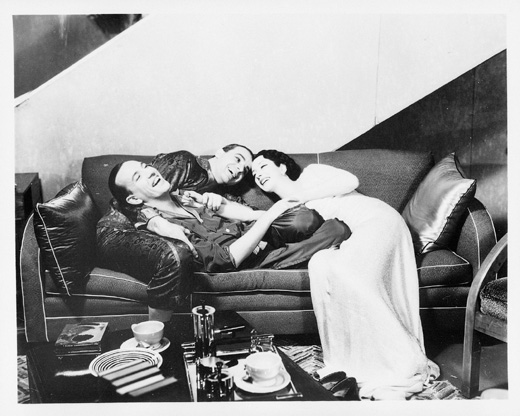
ps_the_cd15_229.jpgThe last few days of my cross-country reviewing trip were typically hectic. I traveled from Smalltown, U.S.A., to Washington, D.C., on Tuesday, a twelve-hour-long journey that seemed to last for at least a fortnight. That night I met a friend for dinner and a show, the Shakespeare Theatre Company's revival of Design for Living, one of Noël Coward's most interesting and, in my opinion, inadequately appreciated plays. On Thursday I returned to New York--this time, thank God, by train. I dragged two bags of snail mail home from the post office, took a suitcase full of dirty clothes to the laundry, went to the gym, and spent the evening on the couch, watching TV and doing as little as possible.

Today I'll be back at work with a vengeance. If you should happen to be in town for BookExpo America, you can catch me at the Javits Center: I'll be signing bound galleys of Pops: A Life of Louis Armstrong at Table 19 from 12:30 to one p.m., then appearing on the Uptown Stage at 2:30, where Ben Moser will be interviewing me about Pops. Tonight I'm seeing a press preview of Coraline at the Lucille Lortel Theatre, and tomorrow I'm catching Norman Corwin's The Rivalry, a play about the Lincoln-Douglas debates, at the Irish Repertory Theatre.

Sunday marks the start of a new theater-related adventure: Mrs. T and I will be flying north to Toronto to spend four days at the Stratford Shakespeare Festival, where we'll be seeing Three Sisters, The Importance of Being Earnest, and Macbeth. You can't get much eggheadier than that! Watch this space for details, though I don't expect to do a whole lot of blogging from Stratford.

And so ends my first theater-related marathon trip of the summer of 2009. It's been one hell of a sprint--I wouldn't care to know how many miles I traveled--but I enjoyed nearly every minute of it, not counting the time I spent sitting on planes or in departure lounges. I only wish I could take a week off to pull myself together, but The Letter and ten more summer festivals await my presence, and I have miles and miles and miles to go before I sleep.
(Last of six parts)

May 30, 2009

TT: Broadway's no-hitter

I panned every musical that opened on Broadway in the 2008-09 season, revivals included. While this may well say more about me than it does about Broadway, I'm more inclined to think that my unfailing displeasure points to something amiss with contemporary musical comedy. In my "Sightings" column for Saturday's Wall Street Journal, I argue that the Broadway musical is suffering from four chronic problems that have grown increasingly pronounced in recent seasons. To find out what they are, pick up a copy of today's Journal and see what I have to say.

UPDATE: Read the whole thing here.

BOOK

Judith Mackrell, Bloomsbury Ballerina: Lydia Lopokova, Imperial Dancer and Mrs. John Maynard Keynes (Phoenix, $14.95 paper). She was a star of the Ballets Russes whose long list of lovers included Igor Stravinsky and Heywood Broun. He was a world-famous economist, a member of the Bloomsbury circle, and a confirmed homosexual. They were, in short, the least likely of couples--but they fell in love, married, and lived happily ever after, much to the dismay of Keynes' viciously snobbish friends, Virginia Woolf foremost among them. Their story had previously been told in bits and pieces, but Judith Mackrell, the dance critic of the Guardian, has now given us an impeccably well-written book that pulls a half-forgotten ballerina out of the memory hole and restores her to her proper place among the key figures of twentieth-century ballet. Lopokova's marriage to Keynes turns out to have been a full-fledged romance on both sides, and Mackrell describes it with sympathy and candor. Rarely have I read a better dance biography--or a more touching love story (TT).

CD

The Complete Louis Armstrong Decca Sessions (1935-1946) (Mosaic, seven CDs). Most jazz critics regard the late Twenties and early Thirties as Satchmo's peak years, but a vocal and steadily growing minority begs to differ. This box set will give them plenty of ammunition. Armstrong had simplified and purified his flamboyant style by the time he signed with Decca in 1935, and no apologies of any kind need be made for the recordings he made with his big band and a delightfully wide variety of guest artists, including Sidney Bechet, Bing Crosby and the Mills Brothers. Put on "2:19 Blues," "Darling Nellie Gray," "Ev'ntide," "Jodie Man," "Jubilee," "Nobody Knows the Trouble I've Seen," "Struttin' with Some Barbecue," or "Wolverine Blues" and you'll get the point instantly. Many of these 78 sides are comparatively unfamiliar, and all have been digitally remastered to gorgeous effect. Dan Morgenstern's liner notes deserve a Grammy, or maybe a Nobel Prize. This one's a must, and then some (TT).

May 31, 2009

EXHIBITION

The Collage Aesthetic of Louis Armstrong: "In the Cause of Happiness" (Peter Jay Sharp Arcade, Frederick P. Rose Hall, Broadway at 60th St., up through Sept. 26). Now that a book of Louis Armstrong's collages has been published, a growing number of music lovers are becoming aware that the greatest jazz musician of the twentieth century was also a gifted amateur artist who decorated the boxes that held his reel-to-reel tape collection and the walls of his New York home with colorful scissors-and-Scotch-tape assemblages of newspaper and magazine clippings whose freely associational quality recalls the "visionary art" of untrained painters. Jazz at Lincoln Center is currently mounting an exhibition of large-scale reproductions of Armstrong's collages, and a selection of the fragile one-of-a-kind originals will also be on view at the Louis Armstrong House Museum in Queens through July 12. Both shows offer a fascinating glimpse of a little-known aspect of Armstrong's proliferating creativity (TT).

BROADWAY'S NO-HITTER

"Unlike some highbrow critics, I love musicals--and not just old ones, either. But the new shows that opened in the season just past illustrate my belief that the Broadway musical is suffering from four chronic problems that are growing increasingly pronounced..."

About May 2009

This page contains all entries posted to About Last Night in May 2009. They are listed from oldest to newest.

April 2009 is the previous archive.

June 2009 is the next archive.

Many more can be found on the main index page or by looking through the archives.

Powered by
Movable Type 3.33