
AJ Logo an ARTSJOURNAL weblog | ArtsJournal Home | AJ Blog Central

« February 2008 | Main | April 2008 »

March 31, 2008

CAAF: Culture clash

Last week I discovered the show Damages and watched all 13 episodes of Season 1 over a marathon of on-the-couch dinners and before-bed cups of tea (see Top 5 at right). One of the best parts of the show is Ted Danson's character of billionaire Arthur Frobisher, the defendant in an Enron-esque class-action lawsuit brought by the former employees of his bankrupt company. Danson was nominated for a Golden Globe for his part, and if the world were a right one, his giant block of a brow and his white, wolfish chompers also would have gotten nods.

As his case comes closer to trial, Frobisher is taking a p.r. beating in the media and, against the advice of his attorney, he arranges to have his biography written. Now Frobisher is very much Forster's man on the golf course, and it's clear he expects this project to be a glossy piece of hagiography, one that will chart his self-made rise to captain of industry, his triumph over childhood dyslexia, his family values, etc. etc. In due time, a biographer is procured -- a nervous plug of a guy named George, "a fellow from Yale, writes fiction no one reads but he's one hell of a biographer" -- and the project commences. Yet as the interviews between writer and subject continue Frobisher's confidence visibly wavers as he becomes more nervous about how his biographer (and hence history) will judge him. He pays a midnight visit to his biographer's tiny city apartment to drum up camaraderie. The attempt fails, and, desperate, Frobisher tries one last sally:

FROBISHER: Tell me about your book.

GEORGE: My novel?

FROBISHER: Sorry, your novel.

GEORGE (looking pained & emo): It's hard to describe.

FROBISHER: Just tell me what it's about, will you?

GEORGE: On the face of it, it's a love story. It's about nostalgia and how that affects our core relationships --

FROBISHER (incredulous): Jesus, George! I mean, that sounds like crap! Are you kidding me? Look what you're doing here? (motions around apartment) You're living in -- You're sleeping on a futon. C'mon! Of course you're writing about my life. You don't have one!

A short scene but the "On the face of it, it's a love story" line and the sputtering "You're sleeping on a futon" (I do!) are killers.

Posted March 31, 2:18 PM

CAAF: Loose notes

"If you ask one type of man, 'What does a novel do?' he will reply placidly: 'Well--I don't know--it seems a funny sort of question to ask--a novel's a novel--well, I don't know--I suppose it kind of tells a story, so to speak.' He is quite good-tempered and vague, and probably driving a motor bus at the same time and paying no more attention to literature than it merits. Another man, whom I visualize as on a golf-course, will be aggressive and brisk. He will reply: 'What does a novel do? Why, it tells a story of course, and I've no use for it if it didn't. I like a story. Very bad taste on my part, but I like a story. You can take your art, you can take your literature, you can take your music, but give me a good story. And I like a story to be a story, mind, and my wife's the same way.' And a third man he says in a sort of dropping regretful voice, 'Yes--oh dear, yes--the novel tells a story.' I respect and admire the first speaker. I detest and fear the second. And the third is myself. Yes--oh, dear, yes--the novel tells a story . . . The more we look at the story (the story that is a story, mind), the more we disentangle it from the finer growth it supports, the less we shall find to admire. It runs like a backbone--or may I say a tapeworm, for its beginning and end are arbitrary . . . It is a narrative of events arranged in their time sequence--dinner coming after breakfast, Tuesday after Monday, decay after death and so on. Qua story, it can only have one merit: that of making the audience wonder what happens next. And conversely it can only have one fault: that of making the audience not want to know what happens next. These are the only two criticisms that can be made on the story that is a story . . . When we isolate the story like this and hold it out on the forceps--wriggling and interminable, the naked worm of time--it presents an aspect both unlovely and dull. But we have much to learn from it."

E.M. Forster, Aspects of the Novel, as quoted and elided by Samuel R. Delany in About Writing

Posted March 31, 1:40 PM

THE METROPOLITAN OPERA GOES TO THE MOVIES

"Watching a well-directed high-definition digital telecast of an opera on a movie-house screen puts you within arm's length of the singers. (One of the cameras is actually mounted on a remote-controlled dolly placed on the lip of the stage.) In a large house like the Met, all but a few seats are far from the stage, meaning that you have to use opera glasses to see the singers' faces. Not so on screen..."

Posted March 31, 10:04 AM

PLAY

The Four of Us (City Center, 131 W. 55, extended through May 18). Prodigy playwright Itamar Moses' latest is a sharp-witted study of two young writers whose friendship is endangered when they succeed at different rates of speed. It has the feel of a first-rate indie flick, enhanced by the intimacy of an off-Broadway stage production. Smart, crisp, touching (TT).

Posted March 31, 9:42 AM

CAAF: Morning coffee

• David Orr's review of Elegy, a book of poetry by Mary Jo Bang, explores the difficulties of transforming great grief into art.

• After a couple clunkers, it sounds as if Salman Rushdie's latest novel, The Enchantress of Florence, is a return to form. Ursula K Le Guin praises it to the "brilliant, fascinating" moon.

• Once more with feeling!: Three different accounts of the recent Buffy reunion panel in L.A. Each one contains different morsels of trivia, backstage gossip, and reads on the personalities, so if you're a fan you'll want to read all three. If you're not a fan, you'll, um, just want to skip the whole thing. (Via.)

Posted March 31, 8:00 AM

TT: Eight days a week

FRIDAY Our Girl in Chicago knocks on my door at midnight, having braved a snowstorm to fly to Manhattan to celebrate her birthday. We stay up way too late talking.
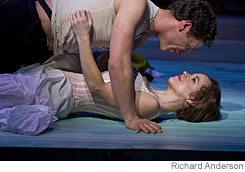
PETRA.jpgSATURDAY To Baltimore via train for CenterStage's very sexy revival of Stephen Sondheim's A Little Night Music, preceded by pizza and gelato at Iggie's. At the theater we meet fellow Sondheim buff Laura Lippman, whose new book has just come out, then pick up her husband David Simon after the show for dinner and conversation. I shamefacedly admit to David (who is incredibly nice about it) that I've never seen The Wire, but that OGIC is giving me the first season on DVD as a belated birthday present. Exhausted, Our Girl and I nap on the train after the show, then stay up way too late talking.

SUNDAY Brunch at Madaleine Mae, the fancy new southern-style restaurant on my corner, whose owners hope to succeed where three previous dining establishments have failed since I moved here five or so years ago. The grits and biscuits are excellent. Our Girl gives me a big hug and a copy of Rachel Ries' new CD and leaves for the airport, toting a bagful of warm H&H bagels. Chicago is a great town for hot dogs, but they don't get bagels there.

I spend the afternoon straightening pictures, listening to a new CD of Grieg and Saint-Saëns playing their own music, and reading a book about Chekhov. At seven I go to City Center to see The Four of Us, Itamar Moses' latest play, accompanied by my new friend Rosalie Sullivan, who sang in the workshop for The Letter.

MONDAY I spend the whole day writing an essay for Commentary about The Magical Chorus, Solomon Volkov's new study of Russian art and culture in the twentieth century. Dinner with an old friend who has good news--she's pregnant--followed by two hours of intensive editing on the Commentary essay. Early(ish) to bed after calling Mrs. T in Connecticut and my mother in Missouri. For some reason I've been waking up at six-thirty every morning, alarm or no alarm, so I figure I'd better go with the flow or pay the price.

TUESDAY Another deadline, this one for Saturday's Wall Street Journal "Sightings" column about my trip to Philadelphia to see the movie-house simulcast of the Metropolitan Opera's new production of Peter Grimes. The column comes easily, leaving me with enough free time to work in a trip to the gym before meeting Paul Moravec at his apartment to hear him play through his sketches for the seventh and eighth scenes of The Letter.

To Broadway after dinner for a press preview of Gypsy, where I run into Chris Jones, my opposite number at the Chicago Tribune, who is in town for Gypsy and In the Heights. I quiz him about what shows I should see when Mrs. T and I come to Chicago in June. Then I spot my companion for the evening, escort her into the St. James Theatre, and discover that our seats are five rows from the stage, meaning that listening to Patti LuPone sing "Rose's Turn" feels like sitting in a wind tunnel.

"You know what Gypsy is?" my friend says as we file out of the theater three hours later. "It's the Platonic ideal of the golden-age Broadway musical."

"Can I steal that?" I ask.

"I want points," she replies.

633303947550156250.jpgWEDNESDAY To Washington, D.C., via the Acela Express for the March meeting of the National Council on the Arts. I write Friday's drama column on the train, e-mail it to the Journal from the lobby of Union Station, then take a cab to the Smithsonian Museum of American Art to see Color as Field, a touring exhibition curated by Karen Wilkin about which I'm thinking of writing a column for the Journal.

From there I go straight to the National Endowment for the Arts, where I spend the rest of the afternoon in conference, then board a bus for Kennedy Center to see August Wilson's Jitney with my fellow council members. I arrive at the hotel at ten o'clock, check in, call Mrs. T and my mother, and fall into bed.
018191W4.jpgTHURSDAY I wake at six-thirty and spend an hour writing before going down to breakfast, then take a cab to the NEA and spend the next nine hours reviewing a thousand (count 'em, a thousand) grant applications and discussing various other arts-related matters with the council and permanent staff. Lunch consists of sandwiches snarfed down at the conference table. The meeting runs long, forcing me to sneak out to meet Megan McArdle for dinner and Macbeth at the Folger Theatre.

FRIDAY I read today's drama column over breakfast in the hotel restaurant, whose buffet features smoked salmon, one of my food groups. It's the first time in months that I've looked at a copy of the Journal on paper (I now read newspapers and magazines online or not at all).

Back to the NEA for one more meeting, a public session at which the NCA votes on grant applications and listens to a presentation about jazz by Paquito d'Rivera and Gunther Schuller. Schuller and I have spoken briefly on the phone but never met face to face, so I spend a few minutes after the meeting chatting with him about my Louis Armstrong biography, in which he figures prominently. Then I go to Union Station and catch the next train to New York, catching up on my accumulated e-mail during the three-hour trip.

At home I open my accumulated snail mail, correct the galleys of my Commentary essay, and grab a quick nap. In the evening I take a blogfriend to a press preview of South Pacific at Lincoln Center. Afterward we wolf down burgers across the street at P.J. Clarke's and catch up on recent events. She goes home and blogs about the performance. I call Mrs. T and fall into bed.

SATURDAY Up at six-thirty, arrgh. I spend the morning writing a book review, working on expense reports, and running errands. At three o'clock I board a train bound for Hartford and start reading the newly published final installment of Henry-Louis de La Grange's multi-volume Gustav Mahler biography, which is 1,758 pages long (the last volume, not the whole thing!).

Mrs. T picks me up at the station and delivers a sternly worded ultimatum: no more work until Monday, or else. I do as I'm told.

Posted March 31, 12:00 AM

TT: Almanac

"Chekhov's way is the way of Russian freedom, the embodiment of that Russian democracy, true and humane, which never materialized."

Vasily Grossman, Life and Fate

Posted March 31, 12:00 AM

March 30, 2008

DVD

Damages (Season 1). This show has it all: Smart scripts, stylish direction, and a phenomenal cast anchored by Glenn Close. Not to mention murder, skullduggery, and noir action galore. Yet despite a fistful of Golden Globe nominations (and a Best Actress award for Close) this FX series still seems to be flying under the radar. With Season 2 not scheduled to air until January 2009, now's the perfect time to catch up. Close plays Patty Hewes, a high-profile litigator who is gunning for Arthur Frobisher (Ted Danson), a billionaire CEO accused of emptying his company's retirement coffers. Patty Hewes' protégé, Ellen Parsons (Rose Byrne), is the young lamb/ first-year associate who ends up on the dark side of the looking glass (CAAF).

Posted March 30, 9:00 PM

March 28, 2008

CAAF: Morning coffee

• Bookslut pushes the poetry of Philip Whalen. In addition to those links, you can read some of Whalen's poetry as well as explore other writings and biographia.

• Joan Didion, short and long.

• "Read this and never come back": Marginalia of a county jail library. The jail is located in Dade County, Wisconsin, so Madison-ish. Here is the library's "Most Wanted" list (jail humor!), and you can help with a book or two. (Via The Dizzies.)

• Speaking of breaking the law, one of the best news stories to emerge from Asheville in recent weeks was the arrest of (alleged) moonshine king Marvin "Popcorn" Sutton. The ATF has shut down quite a few moonshiners in the area in the past year; I don't know the reason for the stepped-up policing, but it certainly invites some investigative reportage beyond "boy, it sure is harder to procure moonshine lately". As Mountain Xpress notes, Popcorn once authored a book called Me and My Likker, which may have, you know, helped tip off authorities. The book's out of print now so it's impossible to verify the rumor that it included a fold-out map with the sites of Popcorn's stills marked with big black "x"s.

Posted March 28, 7:00 AM

TT: Sondheim here, Sondheim there

This week's Wall Street Journal drama column is a triple-header in which I report on the new (sort of) Broadway revival of Gypsy, a Baltimore production of A Little Night Music, and the New York premiere of The Four of Us. Here's an excerpt.

* * *

Patti_LuPone_as_Rose_in_GYPSY_%284%29%2C_photo_by_Joan_Marcus.jpgThe production of "Gypsy" that opened on Broadway last night is the same one that ran for three weeks last July at City Center, so I needn't say much beyond this: No matter how long you live, you'll never see a more exciting or effective revival of a golden-age musical. Everything you've heard about Patti LuPone's performance as Mama Rose, the stage mother from hell, is true--she's so ferociously compelling that you'll have to remind yourself to breathe between songs--but part of what makes this production so special is that the rest of the cast is just as memorable. I doubt there's been a better Louise than Laura Benanti, who starts out as Rose's mousy little daughter, then turns herself before your astonished eyes into Gypsy Rose Lee, the world's most glamorous stripper. Boyd Gaines is no less fine in the ungratefully self-effacing role of Herbie, Mama Rose's lover, while Leigh Ann Larkin brings off the even more challenging task of making a strong impression as June, Louise's sister.

The show itself is a miracle, one of the top contenders for the title of Best Musical Ever. The songs, by Stephen Sondheim and Jule Styne, are classics one and all, as are Jerome Robbins' impeccably theatrical dances. Arthur Laurents, who wrote the book of "Gypsy," has staged this revival, and his knowing hand is everywhere in evidence....

Mark Lamos has done almost as well by CenterStage's revival of "A Little Night Music" as Mr. Laurents has by "Gypsy," in part for one of the same reasons: His cast is all but unimprovable. Led by Barbara Walsh, one of the stars of John Doyle's much-admired Broadway revival of "Company," Mr. Lamos' ensemble of singing actors strips away the mirrored surfaces of Mr. Sondheim's lyrics and shows us the hard kernels of honesty that lie within. "A Little Night Music" may sound like a frothy waltz-time operetta, but its real subject is romantic disillusion, and in song after song we are invited to contemplate unpalatable truths about the "dirty business" of love: Men are stupid, men are vain/Love's disgusting, love's insane. Only through the stoic acceptance that comes with maturity do the characters find their way to more or less happy endings, and even then you go home wondering what the future holds in store for them.

Mr. Lamos makes the most of the pointed ironies of Mr. Sondheim's brilliant songs and Hugh Wheeler's wry book. Everyone in the cast is on the director's acerbic wavelength....

Is there a more promising playwright in America than Itamar Moses? "The Four of Us," his latest play, delighted me when I saw it in San Diego last season, and now Off Broadway audiences can revel in this crisply witty study of a pair of up-and-coming young writers (Gideon Banner and Michael Esper) whose friendship is threatened when one of them hits the celebrity jackpot while the other is still struggling to find himself....

* * *

Read the whole thing here.

Posted March 28, 12:00 AM

TT: The Met goes to the movies

Here's an excerpt from a "Sightings" column I wrote for The Wall Street Journal in 2006 about Peter Gelb, the then-new general manager of the Metropolitan Opera:

Mr. Gelb has set music lovers to buzzing yet again, this time about his latest innovation. Starting in December, the company will beam a half-dozen of its Saturday matinees into movie theaters in the U.S., Canada and Europe--live. "We want to make the Met as available electronically to its followers as the Yankees are to theirs," Mr. Gelb told the Washington Post. The first broadcast will be Julie Taymor's much-admired "Lion King"-style production of Mozart's "The Magic Flute," cut to 90 minutes and performed in a new, family-friendly English-language version.

I can already hear the purists rumbling, and I hate to put a damper on their high dudgeon, but the truth is that most of Mr. Gelb's "new" ideas are older than I am. Among the first things Rudolf Bing did when he took charge of the Met in 1949, for instance, were to start hiring big-name stage and screen directors like Garson Kanin and Alfred Lunt and to give selected performances of popular operas in English. As for the notion of piping closed-circuit broadcasts of the Met's performances into movie theaters, it was tried a half-century ago. Alas, the Met's 1952 movie-house "Carmen" flopped, as did a similar attempt to broadcast Richard Burton's 1964 Broadway production of "Hamlet."

Will the company's new venture be more successful? I doubt it. Not only are large-screen versions of actual stage performances visually unsatisfying, but opera itself is simply not a mass medium, PBS's increasingly infrequent telecasts from the Met notwithstanding. Even such ambitious undertakings as Franco Zeffirelli's big-budget films of "La Traviata" (1982) and "Otello" (1986) failed to make it out of art-house purgatory. Significantly, last week's announcement contained no information about how many theaters would be showing the Met's broadcasts, and Mr. Gelb did his best to keep expectations low, explaining that "The Magic Flute" would be opening "right in the middle of the biggest box office weekend of the year." Translation: Who's going to bother with Mozart when he can see "Dreamgirls" instead?

Answer: lots and lots and lots of people. The Met's movie-house high-definition simulcasts have turned out to be one of Gelb's biggest successes to date. So since I'd put my foot in it up to my eyebrows, I resolved to do penance by trying to figure out why I'd been wrong--and what I was missing. To this end, I went to see the Met's new production of Peter Grimes at the Metropolitan Opera House on February 28, then took a train to Philadelphia two weeks later to watch the same production telecast on the silver screen.

What did I learn? The answer is in this week's "Sightings" column. Pick up a copy of tomorrow's Journal, turn to the "Weekend Journal" section, and watch me dine on freshly roasted crow.

UPDATE: Read the whole thing here.

Posted March 28, 12:00 AM

TT: Almanac

"It's hard enough to write a good drama, it's much harder to write a good comedy, and it's hardest of all to write a drama with comedy. Which is what life is."

Jack Lemmon (quoted in The Independent, Feb. 21, 1990)

Posted March 28, 12:00 AM

March 27, 2008

TT: So you want to see a show?

Here's my list of recommended Broadway, off-Broadway, and out-of-town shows, updated weekly. In all cases, I gave these shows favorable reviews in The Wall Street Journal when they opened. For more information, click on the title.

Warning: Broadway shows marked with an asterisk were sold out, or nearly so, last week.

BROADWAY:
August: Osage County (drama, R, adult subject matter, closes Apr. 20 and reopens Apr. 29 at the Music Box Theatre for an open-ended run, reviewed here)
Avenue Q (musical, R, adult subject matter and one show-stopping scene of puppet-on-puppet sex, reviewed here)
A Chorus Line (musical, PG-13/R, adult subject matter, reviewed here)
Grease * (musical, PG-13, some sexual content, reviewed here)
homecomingprod200.jpgThe Homecoming (drama, R, adult subject matter, closes Apr. 13, reviewed here)
In the Heights (musical, PG-13, some sexual content, reviewed here)
The Little Mermaid (musical, G, entirely suitable for children, reviewed here)
November (comedy, PG-13, profusely spattered with obscene language, reviewed here)
Passing Strange (musical, PG-13, adult subject matter, reviewed here)
Sunday in the Park with George * (musical, PG-13, too complicated for children, closes June 16, reviewed here)

OFF BROADWAY:
Adding Machine (musical, PG-13, adult subject matter, too musically demanding for youngsters, reviewed here)
The Seagull (drama, PG-13, adult subject matter, closes Apr. 13, reviewed here)

IN CAMBRIDGE, MASS.:
The Tempest (drama, G, possible for very intelligent tweens, reviewed here)

ON TOUR:
Moby-Dick--Rehearsed (drama, G, not suitable for children, touring the U.S. through May 17, reviewed here)

CLOSING THIS WEEKEND ON BROADWAY:
Alfred Hitchcock's The 39 Steps * (comedy, G, suitable for bright children, closes Saturday and reopens at the Cort Theatre on Apr. 29, reviewed here)
The Seafarer (drama, PG-13, adult subject matter, closes Sunday, reviewed here)

Posted March 27, 12:00 AM

TT: Almanac

"Theatre invites its audience to use its imagination in a social setting. By doing this, it creates a space where we can dream together and via that dreaming activity reconnect with the world and each other. Doing this can be an uncomfortable experience, but by engaging imaginatively in a work of art as a group and as individuals simultaneously, we experience theatre's power. The power to make us feel more alive. The power to create new possibilities within our brains. The power to tell stories in different ways."

Isaac Butler, Parabasis (Mar. 19, 2008)

Posted March 27, 12:00 AM

March 26, 2008

CAAF: Everyone's a critic

Over the weekend both our cars were broken into. Nothing too serious, just a change box and the handful of CDs in the carrier -- all the CDs, that is, except for one, which pointedly got left behind on the driver's seat: My copy of Nilsson Schmilsson.

I love the record, Lowell hates it, and we've bickered about it a kazillion times the way you do when you're married and go everywhere together and are appalled by what the other one wants to play on the stereo on the way there. You can tell Lowell feels super-vindicated that the car burglar took his side.

Posted March 26, 3:06 PM

CAAF: Post-mortem

What a relief, The Return of Jezebel James has been cancelled. Out of loyalty to Amy Sherman-Palladino I watched the first two weeks and would have continued to watch -- but it was painful. About five minutes in to the first episode it was clear the show was a bust, and after that it was just like sitting vigil. It felt like, if you had a friend who rammed her ship into an iceberg and everyone knows the boat's sinking but you kind of owe it to her to stay on board anyway and drink with her until the whole thing goes down. Or something like that. It was bad.

So that laugh track was an abomination before God, but what else went wrong (I ask ye, the other four people who watched the show)? For me, Parker Posey seemed overly vague and drifting in her role, like she never clued in that she was a lead and had to hold the center down. Instead she played her part like a satellite character: A two-note sidekick.

And then, I think, part of the fault must lie with how her character was written, with scavenged Frankenstein-ish pieces of Lorelai Gilmore (e.g., the compulsive list-making, the fascination with girlie monstrosities like Hello Kitty) stapled on here and there, which made for an incoherent whole -- again, at least as Posey played it. I hate to say this because I adore her, but these tics felt less like a return of beloved tropes, than a failure of imagination on ASP's part*. She writes so well about neurotic, complicated, high-strung women, but I want her to push on.

* I felt the same way when Anna and April, Luke's ex-girlfriend and daughter, were introducted in GG Season 6 -- Anna with her fast-talking and her quirks, April as a bookish brainiac -- and it was all a little too mirror, mirror on the wall to the Lorelai-Rory houseold.

Posted March 26, 2:38 PM

TT: Almanac

"If tragedy elicits our compassion, comedy appeals to our self-interest. The former confronts life's failures with noble fortitude, the latter seeks to circumvent them with shrewd nonchalance. The one leaves us momentarily in a mood of resignation, the other in a condition of euphoria."

Harry Levin, Playboys and Killjoys

Posted March 26, 12:00 AM

March 25, 2008

CAAF: Afternoon coffee

• This profile of Bret Easton Ellis is about a hundred times more interesting than you'd think. Or, than I thought it'd be. Ellis' novels aren't favorites but I think they're smarter thought experiments than they get credited for (if sometimes wildly uneven in the follow through). For cultural juxtaposition, I suggest reading the profile while viewing this terrifying footage of Demi Moore talking about her "leech therapy."

(First link via TEV.)

• Three books I'm desperate to read, with links to the why's and wherefore's so you can be desperate to read them too: Jiang Rong's Wolf Totem, Roger Deakin's Wildwood, and Richard Fortey's Dry Store Room No. 1: The Secret Life of the Natural History Museum. I'm also already hearing great things about Jincy Willett's new novel, The Writing Class, which comes out in June.

• From the vaults: Marianne Moore's zealous editing wasn't confined to her friends' poems, she was just as active at hacking away at her own. In a 2003 essay for The Believer, Dan Chiasson writes:

"Omissions are not accidents," was the adage, self-minted, that served as the epigraph to Moore's 1967 Complete Poems. That book was anything but "complete," except in the sense of "finished off." It seemed more a tally of subtractions than additions; Moore had radically revised some poems, and radically erased others. The resulting dainty book misrepresented her, and Moore has seemed, though never less interesting, somehow less ambitious than her male counterparts, Stevens, Eliot, and Williams.

Grace Schulman's new collected Moore, The Poems of Marianne Moore (November 2003), prints every significant poem Moore wrote, including many she later suppressed and several she never printed at all. It is not a desecration of Moore to do so; as Schulman points out, "change" was at the heart of her aesthetic, and had she lived another thirty years she most surely would have found her own Complete Poems inadequate.

Posted March 25, 2:29 PM

TT: Under fire

This is my week: three deadlines, five shows, and a trip to Washington, D.C. tomorrow morning.

Later. Maybe.

Posted March 25, 12:00 AM

TT: Almanac

"Unless comedy touches me as well as amuses me, it leaves me with a sense of having wasted my evening. I go to the theatre to be moved to laughter, not to be tickled or bustled into it."

George Bernard Shaw, "An Old New Play and a New Old One"

Posted March 25, 12:00 AM

March 24, 2008

TT: Entries from an unkept diary

rman_for_all_seasons.jpg• I never saw Paul Scofield on stage. Few Americans did: he performed in this country only once, in the 1961 Broadway production of Robert Bolt's A Man for All Seasons. So his death last week failed to make much of an impression on me. On the other hand, I never saw John Gielgud, either, yet I felt a real sense of loss when he died. What accounts for the difference?

The answer, of course, is that Gielgud appeared in dozens of feature films, usually playing small but strikingly written parts that allowed him to make a memorable impression. Not so Scofield. He made very few movies, and only two of them, Robert Redford's Quiz Show and the 1966 screen version of A Man for All Seasons, are reasonably well known to American audiences.

Time was when I might have used that fact to preach a sermonette about the cultural primacy of film over theater, a point I made in "Tolstoy's Contraption," an essay I published in The Wall Street Journal in 1999 and reprinted in A Terry Teachout Reader:

We are not accustomed to thinking of art forms as technologies, but that is what they are--which means they can be rendered moribund by new technological developments, in the way that silent films gave way to talkies and radio to TV. Well into the eighteenth century, for example, most of the West's great storytellers wrote plays, not novels. But the development of modern printing techniques made it feasible for books to be sold at lower prices, allowing storytellers to reach large numbers of readers individually; they then turned to writing novels, and by the twentieth century the theatrical play had come to be widely regarded as a cultural backwater. To be sure, important plays continue to be written and produced, but few watch them (unless they are made into movies).

1052.jpgI still stand by that paragraph. Having spent the past five years as a working drama critic, though, I hasten to point out that I never meant to suggest that live theater is less aesthetically important than film simply because fewer people see it. Nevertheless, it strikes me as both revealing and ironic that most Americans under the age of sixty--myself, alas, included--will remember Paul Scofield not as one of the greatest stage actors of the twentieth century but as the man who played Charles Van Doren's father in Quiz Show.

Ask Me Again, a two-CD set of previously unreleased recordings by the late Nancy LaMott, turned up on the Billboard jazz charts last week, ascending to the #15 spot, a few notches below Tony Bennett, Michael Bublé, Diana Krall, Wynton Marsalis, Pink Martini, and Queen Latifah. That is, to put it mildly, a decidedly miscellaneous group of artists, one whose makeup says much about the no less decidedly marginal place of jazz in postmodern America.

Needless to say, Nancy herself would have smiled to see herself described as a jazz singer: she was nothing of the kind, though she loved jazz and was comfortable working with those who played it. Even so, it pleased me greatly to see my old friend sharing a page in Billboard with Diana Krall. They never met, and an untimely death robbed Nancy of the chance to ride the same wave of changing taste that swept Diana to the well-deserved fame she now enjoys. If only...

ashmore1128_copy.jpg• Onstage humor is a delicate plant, capable of wilting without warning. I saw Mark Morris' staging of Purcell's King Arthur at New York City Opera a couple of weeks ago and laughed all the way through it, but it took the rest of the audience an hour or so to catch up with me. A minute or so into the evening, a woman sitting in front of me turned around and glared when I snickered at one of Morris' more obvious visual punch lines. If a thought balloon had formed over my head at that moment, it would have read as follows: Hey, lady, didn't you get the memo? This is supposed to be funny!

Then it hit me: I was surrounded by operagoers, not dancegoers. Opera buffs aren't in the habit of laughing in the theater, not even at comic operas. Dance buffs, by contrast, are well aware of Morris' reputation as a comedian, so much so that they sometimes laugh at scenes whose beauty makes me want to cry.

As for me, I regard comedy as the highest form of art. "Human existence," I once wrote apropos of the music of Emmanuel Chabrier, "is so indissoluble a mixture of heartbreak and absurdity that it can often be more acutely portrayed through the refracting lens of comedy." Alas, the world is full of earnest, humorless souls, and my impression is that they usually make a better living than those of us who find life funny--though I doubt they have nearly as good a time as we do.

Posted March 24, 12:00 AM

TT: Almanac

"The cause of laughter is simply the sudden perception of the incongruity between a concept and the real object."

Arthur Schopenhauer, The World as Will and Idea

Posted March 24, 12:00 AM

March 21, 2008

TT: Paul Scofield, R.I.P.


Posted March 21, 12:15 PM

TT: Introducing...The Amazing Prospero!

Today's Wall Street Journal drama column consists of a rave and a pan, in that order. First I report on a production of The Tempest that I saw last Sunday in Cambridge, Massachusetts, followed by a review of the American premiere of Caryl Churchill's Drunk Enough to Say I Love You? Here's a sample.

* * *

All theater is magic. Even the most naturalistic of productions seek to deceive us into supposing that the stage we see is really someplace else: a cluttered living room, a sterile doctor's office, a grimy inner-city diner. But few things can be so spellbinding as a play whose director shrugs off literalism and chooses instead to wave the wand of imagination. That's what happens in the production of "The Tempest" currently being presented by Boston's Actors' Shakespeare Project, in which Patrick Swanson takes Shakespeare's tale of a ship run ashore on an enchanted isle and turns it into a 19th-century magic show. I've reviewed many memorable Shakespeare productions in this space, but Mr. Swanson's "Tempest," like the "King Lear" that he mounted for Actors' Shakespeare two seasons ago, ranks very near the top of my list....

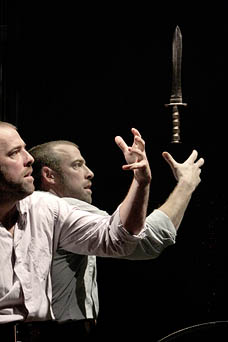
13215a.jpgProspero (Alvin Epstein) is decked out in a velvet-lined cape, Ariel (Marianna Bassham) dons the top hat and black tights of a conjuror's assistant, and the play itself becomes a music-hall turn acted on a tiny thrust stage ringed with footlights that look as though they'd been made by Tom Edison himself. The "theater" is an 1889 Cambridge courtroom that has been converted into a performing space. All of Actors' Shakespeare's productions are site-specific, and David R. Gammons, the designer, makes the most of this one, using the second-story gallery as an alternate playing area whose staircase allows for grand entrances and exits. Eric McDonald performs his incidental music in full view of the audience, rattling a thunder sheet and tootling on a slide whistle with the flair of an old-time radio sound-effects man.

Mr. Epstein, who turns 83 in May, played Lear to awesomely eloquent effect for Actors' Shakespeare in 2005. Now he speaks the lines of Prospero, Shakespeare's other old-age star turn, with a fullness of understanding to which no actor can aspire until he reaches the time of life when (as Prospero puts it) "every third thought shall be my grave."...

I've never seen a worse play by a better author than Caryl Churchill's "Drunk Enough to Say I Love You?" That Ms. Churchill should make so embarrassing an impression in a mere 45 minutes is further proof that politics can make artists stupid, for this pathetic little playlet is nothing more than a political cartoon, one whose draftsmanship is as crude as its underlying premise.

The lights go up on Sam (Scott Cohen), a handsome homosexual who has seduced Guy (Samuel West), a married man with children, and persuaded him to abandon his family and job. Within a half-minute or so, we figure out that Guy is England, Sam is the U.S. (duh, get it?) and the abandoned wife and kids are the European community. The rest of "Drunk Enough to Say I Love You?" consists of a lovers' quarrel conducted in unpunctuated sentence fragments: "so much fun in my life...being powerful and being on the side of good is...God must have so much fun...win win win." Needless to say, the point of these coy exchanges is that the American government bears sole responsibility for all the evil in the modern world...

* * *

Read the whole thing here.

Posted March 21, 12:00 AM

TT: Jon Hassler, R.I.P.

One of my favorite American novelists, Jon Hassler, died
yesterday. I wrote about him last summer:

Hassler is more a middlebrow than a modernist, and his (mostly) sympathetic chronicles of Minnesota life are written in a straightforward, accessible style. Judge him by the exalted standards of Proust and Joyce--or, for that matter, O'Connor--and he'll come up short. Try thinking of him as a Midwestern John P. Marquand and you'll get a better idea of what he's about. "Of all the people I know," Marquand observed, "only Americans, because of some sort of inferiority complex, keep attempting the impossible and trying to get away from their environment." Jon Hassler has never made that mistake. His novels are set in the small-town world where he was born and in which he has spent the whole of his 74 years, and his characters are ordinary people who spend their days grappling, sometimes successfully and sometimes not, with the ordinary problems of life, love, aging, and death.

One of the things that makes these characters so distinctive is that many (though not all) of them are churchgoers. Not coincidentally, Hassler is a Catholic novelist, and certain of his books are very decidedly the work of a Catholic Novelist. Yet their temperate emotional climate has little in common with the claustrophobic creations of, say, Graham Greene or François Mauriac. In Hassler's novels, no one, not even the priests, is obsessed with the problem of faith in the modern world, nor do his teachers, grocery-store owners, and family doctors take much of an interest in what Browning called "the dangerous edge of things." They are simply trying to get along in a complicated world, and though they view that world through the prism of belief, most have learned that few answers are quite so easy as they look...

North of Hope, Hassler's best novel, was reissued two years ago by Loyola Classics. I commend it to your attention.

Posted March 21, 12:00 AM

TT: Almanac

"Without the meditative background that is criticism, works become isolated gestures, ahistorical accidents, soon forgotten."

Milan Kundera, "On Criticism, Aesthetics, and Europe"

Posted March 21, 12:00 AM

March 20, 2008

TT: So you want to see a show?

Here's my list of recommended Broadway, off-Broadway, and out-of-town shows, updated weekly. In all cases, I gave these shows favorable reviews in The Wall Street Journal when they opened. For more information, click on the title.

Warning: Broadway shows marked with an asterisk were sold out, or nearly so, last week.

BROADWAY:
August: Osage County (drama, R, adult subject matter, closes Apr. 20 and reopens Apr. 29 at the Music Box Theatre for an open-ended run, reviewed here)
Avenue Q (musical, R, adult subject matter and one show-stopping scene of puppet-on-puppet sex, reviewed here)
A Chorus Line (musical, PG-13/R, adult subject matter, reviewed here)
Grease * (musical, PG-13, some sexual content, reviewed here)
The Homecoming (drama, R, adult subject matter, closes Apr. 13, reviewed here)
In the Heights (musical, PG-13, some sexual content, reviewed here)
The Little Mermaid (musical, G, entirely suitable for children, reviewed here)
November (comedy, PG-13, profusely spattered with obscene language, reviewed here)
Passing Strange (musical, PG-13, adult subject matter, reviewed here)
Sunday in the Park with George * (musical, PG-13, too complicated for children, closes June 16, reviewed here)

OFF BROADWAY:
Adding Machine (musical, PG-13, adult subject matter, too musically demanding for youngsters, reviewed here)
THE%20SEAGULL.jpgThe Seagull (drama, PG-13, adult subject matter, closes Apr. 13, reviewed here)

ON TOUR:
Moby-Dick--Rehearsed (drama, G, not suitable for children, touring the U.S. through May 17, reviewed here)

CLOSING NEXT WEEK ON BROADWAY:
Alfred Hitchcock's The 39 Steps * (comedy, G, suitable for bright children, closes Mar. 29 and reopens at the Cort Theatre on Apr. 29, reviewed here)
The Seafarer (drama, PG-13, adult subject matter, closes Mar. 30, reviewed here)

CLOSING SUNDAY IN LOS ANGELES:
Victory (drama, PG-13, adult subject matter, reviewed here)

Posted March 20, 12:00 AM

TT: Almanac

"Beauty is like piety--you cannot run and read it; tranquility and constancy, with, now-a-days, an easy chair, are needed."

Herman Melville, "The Piazza"

Posted March 20, 12:00 AM

March 19, 2008

TT: Almanac

"A work is never completed except by some accident such as weariness, satisfaction, the need to deliver, or death: for, in relation to who or what is making it, it can only be one stage in a series of inner transformations."

Paul Valéry, "Recollection"

Posted March 19, 12:00 AM

March 18, 2008

OGIC: Band of brothers

I was completely won over by Eran Kolirin's The Band's Visit. Unassuming but quietly wise, this little movie from Israel and France appears to have come and gone from New York already, but it opened in Chicago last weekend and one can hope it is playing in other cities now as well. If you get a chance to see it, don't miss out.

Band%27s%20Visit.bmpEight Egyptian policemen, who comprise the Alexandria Police Ceremonial Orchestra, travel to Israel to perform at the opening of an Israeli-Arab cultural center. The opening scenes find them negotiating with difficulty but with dignity the challenges of a foreign airport, identically dressed in stately powder-blue uniforms. In the movie's signature image, they stand in a row in an empty landscape, waiting. Each carries a standard black suitcase and his instrument, from a large, curvy double bass case to a small, boxy clarinet case with many sizes and shapes in between. The dry comedy of this image--a little reminiscent, to me, of a William Booth cartoon--characterizes a good deal of the movie, in which the band gets lost on the way to their concert in a sort of fortuitous, or at least adventurous, detour.

The movie has its somber side, too, leavened but not dissolved by the gentle humor it finds in simply observing, with a certain patience, human behavior. There's much to be said about the delicacy with which it probes relationships, especially the particular intimacy that can take hold between two people who were strangers yesterday. But that's better experienced by you than broken down by me, and there's something else that I want to point to here: the film's capacious view of what it is to be an artist.

The men in the Alexandria Police Ceremonial Orchestra--which their leader, Tawfiq, refers to by its full name almost without exception--are a staid and well-ordered bunch. They are, after all, policemen. You might not see them, at first blush, as true artists. They're a far cry from being free spirits. But as the unfolding plot reveals--and the joyous last scene, in which they play gloriously for a crowd of delighted faces, confirms--they're most serious and passionate musicians underneath the regalia. Even that's not quite right, though: the very point is that they're serious and passionate musicians in their regalia. Their vocation and avocation aren't separate. Early in the movie, the incongruity of "Alexandria Police Ceremonial Orchestra" plays for gentle laughs. By the end, "Police" and "orchestra" coexist frictionlessly--they make perfect sense together.

Also surprising is the movie's treatment of what you might expect to be its central subject: friction between the Israeli characters and their Egyptian visitors. But political friction is not what this movie is interested in. To be sure, Kolirin acknowledges this tension in subtle, fleeting ways. But, though you're highly attuned to its possibility as the movie begins, by the end it's displaced by the spectrum of other, more interesting ways hosts and visitors have found to relate and react to one another.

Posted March 18, 12:42 PM

MOVIE

Eran Kolirin, The Band's Visit. This modest, wise, and funny movie plops down a band of Egyptian policeman-musicians in an Israeli nowhere land. Kolirin sidelines explicit political themes in favor of drawing out characters who are, to be sure, shaped by their cultures but not defined by them. Filled with subtle surprises, from the musical passion simmering quietly beneath its characters' uniforms to the deeper truths that fuel that passion (OGIC).

Posted March 18, 11:59 AM

TT: Almanac

"I have had such a sickening of men in masses, and of causes, that I would not cross this room to reform parliament or prevent the union or to bring about the millennium. I speak only for myself, mind--it is my own truth alone--but man as part of a movement or a crowd is indifferent to me. He is inhuman. And I have nothing to do with nations, or nationalism. The only feelings I have--for what they are--are for men as individuals; my loyalties, such as they may be, are to private persons alone."

Patrick O'Brian, Master and Commander

Posted March 18, 12:00 AM

March 17, 2008

BOOK

A.J. Liebling, World War II Writings (Library of America, $40). An omnibus collection of wartime dispatches to The New Yorker, plus twenty-eight previously uncollected articles and Normandy Revisited, the uncommonly elegant 1958 memoir in which Liebling wove together present- and past-tense accounts of his wartime and postwar visits to the site of D-Day. The contents may sound miscellaneous, but in fact they're magnetically readable. Except for Ernie Pyle, no American journalist did a better job of serving as a witness to war in the twentieth century, and these pieces combine lightness of touch with high seriousness to tremendously powerful effect (TT).

Posted March 17, 5:20 AM

TT: Perpetual motion

peter460.jpgI'm in Cambridge, Massachusetts, and it wasn't easy getting there, either. Last week I saw Caryl Churchill's Drunk Enough to Say I Love You? at the Public Theater and Mark Morris' production of Purcell's King Arthur at New York City Opera. On Saturday morning I took a train to Philadelphia, where I met Ms. Household Opera for lunch, then took her to the Metropolitan Opera's high-definition closed-circuit live movie-house telecast of Benjamin Britten's Peter Grimes, which we viewed in an amusingly pretentious theater. (I'll be writing about the experience in my next "Sightings" column.)

ENGAGEMENT%20RING.jpgAs soon as the show was over, I headed straight to the Philadelphia airport and flew from there to Boston, then drove to Cambridge, where Mrs. T awaited me. Yesterday afternoon the two of us saw the production of The Tempest that I'll be reviewing in Friday's Wall Street Journal, then dined at the home of the jewelry designer who made the one-of-a-kind engagement ring that is now to be found on Mrs. T's finger. Not only is she a fabulous cook, but she has an excellent boyfriend to boot.

Later today we'll be heading back to our hideout in Connecticut, where I plan to spend the week sleeping late and working on Rhythm Man: A Life of Louis Armstrong, which got short shrift while I was preoccupied with my opera workshop. On Thursday we return to New York, on Friday Our Girl in Chicago pays us a house call, and on Saturday the three of us go to Baltimore to see CenterStage's production of Stephen Sondheim's A Little Night Music. Whew!

All this incessant activity is likely to slow my blogging for the coming week, but I'll do what I can, and CAAF and OGIC will do the rest.

See you in passing.

Posted March 17, 12:00 AM

TT: Almanac

"I esteem biography, as giving us what comes near to ourselves, what we can turn to use."

Samuel Johnson, quoted in James Boswell, Journal of a Tour to the Hebrides (courtesy of Anecdotal Evidence)

Posted March 17, 12:00 AM

March 15, 2008

TT: A piano, a camcorder, and a competition

The Van Cliburn Foundation has just announced a new competition for amateur pianists, the Cliburn YouTube Contest, whose participants post videos of their piano playing. The winner will receive $2,000 and be automatically entered in the next face-to-face Cliburn Amateur Competition, to be held in 2011. It's a great gimmick, one that's bound to attract attention--but will it be good for those pianists who choose to participate? That's the subject of my latest "Sightings" column in today's Wall Street Journal. Here's a sample.

* * *

Fifty years ago next month, a 23-year-old whiz kid from Texas won the Tchaikovsky International Piano Competition in Moscow, instantaneously becoming America's best-known classical musician and earning a hatful of money in the process. Van Cliburn, then as now a generous man, thereupon started his own piano competition, hoping to give other gifted young artists the same opportunity that the Tchaikovsky Competition had given him. Mr. Cliburn hasn't played regularly in public since 1978, but the Van Cliburn Competition is still doing business in Fort Worth, and it's celebrating the anniversary of his Cold War triumph by launching a new venture that would have been unthinkable in 1958: the Cliburn YouTube Contest, in which amateur pianists over the age of 35 shoot videos of their own playing and upload them to the Cliburn Foundation's YouTube channel, youtube.com/vancliburnfoundation, where computer-savvy music lovers will view them and pick a winner....

So far as I know, the Cliburn YouTube Contest is the first such event of its kind, but the Cliburn Foundation has been holding amateur competitions since 1999. Michael Kimmelman, the New York Times' senior art critic, was one of the finalists that year, and his participation, not surprisingly, brought the competition a fair amount of press coverage. I expect that the YouTube Contest will have the same effect--as well it should. It is an idea so self-evidently ingenious that your immediate response will probably be to wonder why nobody ever thought of such a thing before.

I have less clear-cut feelings about the Amateur Competition itself, however. Seven years ago I sat on the jury for a jazz piano competition, and came away as dubious about the virtues of artistic competitions as I'd been when I started. Does it really advance the cause of art to treat musicians, painters or novelists as if they were beauty-pageant contestants? Very likely not--but such undertakings will always be with us, for there is something in the nature of head-to-head competition that audiences find inherently exciting. That's why I agreed to serve as a judge: I thought it my duty to see how the process worked in practice. Yet I still felt equivocal about what I was doing. In a race, somebody always comes in first; in art, nobody does. Why, then, encourage amateurs to put themselves through the wringer of a high-profile competition? Might the experience diminish their passion for the artistic endeavors to which they freely devote such big chunks of their lives?

That Van Cliburn should be lending his name to the YouTube Contest is ironic, for he is one of the saddest examples of the damage that can be done to a serious artist who unexpectedly hits the celebrity jackpot....

* * *

Read the whole thing here.

Posted March 15, 12:00 AM

March 14, 2008

CAAF: Huzzahs

Terry, OGIC, and I are all big fans of Kate Christensen's work, so it was thrilling to hear that her most recent novel, The Great Man, has received a well-deserved honor, taking home the 2008 Pen/Faulkner Award for Fiction.

I was also pleased to learn from Galleycat that Sonya Hartnett, author of the phenomenal Thursday's Child and other novels, has received the Astrid Lindgren Memorial Award for children's literature. Yay yay!

Posted March 14, 12:31 PM

TT: The slickest show in New York

In today's Wall Street Journal I review two very different shows, In the Heights and The Seagull. Here's a sample.

* * *

intheheights.jpgThe hit of the year is here. "In the Heights," the Latino musical that tore up Off Broadway last season, has transferred to Broadway in a revised version that is without doubt the slickest show in town. This high-stepping tale of immigrant life in the Upper Manhattan barrio throbs with self-confidence, and its theatrical craftsmanship is gleamingly immaculate. If it's originality you want, go elsewhere on the double, but if all you require of a musical is an evening of ultra-familiar plot devices buffed to the highest possible gloss and revved up to hypersonic speed, you're in luck and then some....

If life were fair, Classic Stage Company's version of Anton Chekhov's "The Seagull" would move uptown, settle into one of Broadway's smaller houses, and run for a year. Instead, you have a month to catch it, so don't wait. It's been a long time since New York has seen a classical revival comparable in quality or immediacy.

Much of the strength of this engrossing production lies in the fact that it was staged by Viacheslav Dolgachev, who spent a decade as the leading director of the Moscow Art Theatre, the company with which Chekhov's plays are most closely identified. Yet except for Alan Cumming, who plays Trigorin, everyone in the cast is more or less American, and the play is performed in Paul Schmidt's clean, colloquial English-language version, which Mr. Schmidt aptly describes as "an American translation, not simply another 'English' translation." The blending of Russian emotionalism with American directness is what gives this "Seagull" its distinctive quality: It sounds American, yet feels Russian....

* * *

Read the whole thing here.

Posted March 14, 12:00 AM

TT: Almanac

"I once won one of Mary Ann Madden's 'Competitions' in New York magazine. The task was to name or create a '10' of anything, and mine was the World's Perfect Theatrical Review. It went like this: 'I never understood the theater until last night. Please forgive everything I've ever written. When you read this I'll be dead.' That, of course, is the only review anybody in the theater ever wants to get."

David Mamet, "Why I Am No Longer a 'Brain-Dead Liberal'" (Village Voice, Mar. 11, 2008)

Posted March 14, 12:00 AM

March 13, 2008

CAAF: Morning coffee

• Julian Barnes writes about Flaubert's late correspondence in the Times Literary Supplement. Barnes quotes a letter the author wrote near the end of his life where he said, "Giving the public details about oneself is a bourgeois temptation I have always resisted," killing hopes that if Flaubert lived today he would be on Tumblr (URL: farouche.tumblr.com).

• I also finally got to Hilary Mantel's essay on Chambers Dictionary of the Unexplained and think you should get to it too:

To many of us, a great deal of what we encounter daily is unexplained. If you are in mid-life now, it is possible to have received what was described at the time as a good education and still know nothing of science or technology. Those on the other side of the cultural divide complain that the artists are proud of their deficiency, but this is seldom so. It's easy, if you can read, to brush up your Shakespeare, but not so easy to use your spare half-hours to catch up on the inorganic chemistry you missed. It's the people cringing from their scientific illiteracy who buy Stephen Hawking books they can't read, as if having them on the shelf will make the knowledge rub off; they snap up tracts on atheism, too, to show that if they're ignorant they're at least rational.

If she'd only mentioned that never-read copy of Gödel, Escher, Bach, it'd be like she was seeing into my soul.

(Both these links purloined over various months from Jenny Davidson.)

• Also, finally, against my better judgment, and with fear that I will make my dear co-bloggers grip their heads and exclaim, "What have you done to our blog! Our beautiful arts blog!" but I have to share my outrage with everyone, I am including a link to David Cook doing unspeakable things to "Eleanor Rigby" on American Idol. Just watching this performance nearly turned me into Seymour Glass, it was that phony, and people are praising it! Simon! Joe R.! I look forward to next week when David will freestyle for ten minutes, then break his guitar over the speaker while performing "The Sound of Silence."

Posted March 13, 11:22 AM

CAAF: Loose notes

"Girls, take my advice, marry an animal. A wooly one is most consoling. Find a fur man, born midwinter. Reared in the mountains. Fond of boxing. Make sure he has black rubbery lips, and a sticky sweet mouth. A winter sleeper. Pick one who likes to tussle, who clowns around the kitchen, juggles hot baked potatoes, gnaws playfully on a corner of your apron. Not one mocked by his lumbering instincts, or who's forever wrestling with himself, tainted with shame, itchy with chagrin, but a good-tempered beast who plunges in greedily, grinning and roaring. His backslapping manner makes him popular with the neighbors, till he digs up and eats their Dutch tulip bulbs. Then you see just how stuffy human beings can be. On Sundays his buddies come over to play watermelon football. When they finally get tired, they collapse on heap of dried grass and leaves, scratching themselves elaborately, while I hand out big hunks of honeycomb. They've no problem swallowing dead bees stuck in the honey."

-- Amy Gerstler, "Bear-Boy of Lithuania," included in Medicine

Posted March 13, 10:55 AM

TT: So you want to see a show?

Here's my list of recommended Broadway, off-Broadway, and out-of-town shows, updated weekly. In all cases, I gave these shows favorable reviews in The Wall Street Journal when they opened. For more information, click on the title.

Warning: Broadway shows marked with an asterisk were sold out, or nearly so, last week.

BROADWAY:
August: Osage County (drama, R, adult subject matter, closes Apr. 20 and reopens Apr. 29 at the Music Box Theatre for an open-ended run, reviewed here)
Avenue Q (musical, R, adult subject matter and one show-stopping scene of puppet-on-puppet sex, reviewed here)
A Chorus Line (musical, PG-13/R, adult subject matter, reviewed here)
Grease * (musical, PG-13, some sexual content, reviewed here)
The Homecoming (drama, R, adult subject matter, closes Apr. 13, reviewed here)
The Little Mermaid (musical, G, entirely suitable for children, reviewed here)
November (comedy, PG-13, profusely spattered with obscene language, reviewed here)
Passing Strange (musical, PG-13, adult subject matter, reviewed here)
The Seafarer (drama, PG-13, adult subject matter, closes Mar. 30, reviewed here)
SUNDAY%20PICTURE%202.jpgSunday in the Park with George * (musical, PG-13, closes June 16, reviewed here)

OFF BROADWAY:
Adding Machine (musical, PG-13, too musically demanding for youngsters, reviewed here)

ON TOUR:
Moby-Dick--Rehearsed (drama, G, not suitable for children, touring the U.S. through May 17, reviewed here)

CLOSING SOON ON BROADWAY:
Alfred Hitchcock's The 39 Steps * (comedy, G, suitable for bright children, closes Mar. 29 and reopens Apr. 29 at the Cort Theatre for an open-ended run, reviewed here)

CLOSING NEXT WEEK IN LOS ANGELES:
Victory (drama, PG-13, adult subject matter, closes Mar. 23, reviewed here)

CLOSING SUNDAY ON BROADWAY:
Come Back, Little Sheba (drama, PG-13, adult subject matter, reviewed here)

Posted March 13, 12:00 AM

TT: Almanac

"Hypocrisy is the most difficult and nerve-racking vice that any man can pursue; it needs an unceasing vigilance and a rare detachment of spirit. It cannot, like adultery or gluttony, be practised at spare moments; it is a whole-time job."

W. Somerset Maugham, Cakes and Ale

* * *

"A hypocrite despises those whom he deceives, but has no respect for himself. He would make a dupe of himself too, if he could."

William Hazlitt, Characteristics: In the Manner of Rochefoucault's Maxims

Posted March 13, 12:00 AM

March 12, 2008

CAAF: Wishers were ever fools

While the Ted Hughes moment is afoot, now is maybe a good time to publicly wish that his book Shakespeare and the Goddess of Complete Being be brought back into print. It's such an eccentric and dazzling piece of criticism, it seems terrible that it's fallen out of print in both the United States and England.* Especially since Hughes claimed writing it gave him cancer -- the least we could do is keep the book circulating a while longer.

Faber & Faber? NYRB? Anyone?

* Currently, the cheapest copy on Abebooks is $88; a used copy on Amazon.uk is 80 pounds. Every time I check out the local library's copy, I worry that I'm going to misplace it somewhere and have to wash dishes in the library kitchen forever.

RELATED: A nice piece about Hughes and myth from the Journal of Mythic Arts.

Posted March 12, 11:29 PM

CAAF: Loose notes

"Usually his wit was austerely pure, but sometimes he could jolt the more cynical. Once we were looking at a furnished apartment that one of our friends had just rented. It was overbearingly eccentric. Life-size clay lamps like flowerpots remodeled into Matisse nudes by a spastic child. Paintings made from a palette of mud by a blind painter. About the paintings Randall said, 'Ectoplasm sprinkled with zinc.' About the apartment, 'All that's missing are Mrs. X's illegitimate children in bottles of formaldehyde.'"

Robert Lowell, "Randall Jarrell, 1914-1965: An Appreciation"

Posted March 12, 3:30 PM

TT: Almanac

"The sense of doing good, the satisfaction of being right, the joy of looking favorably upon oneself, dear sir, are powerful levers for keeping us upright and making us progress. On the other hand, if men are deprived of that feeling, they are changed into rabid dogs."

Albert Camus, The Fall

Posted March 12, 12:00 AM

March 11, 2008

TT: Almanac

"A negative judgment gives you more satisfaction than praise, provided it smacks of jealousy."

Jean Baudrillard, Cool Memories

Posted March 11, 12:00 AM

March 10, 2008

TT: Men (and women) at work (VI)

Last week Paul Moravec and I spent four days preparing a workshop performance of the first six scenes of The Letter, our Somerset Maugham opera-in-progress, at a midtown rehearsal studio. On Wednesday morning we recorded all six scenes at the New York headquarters of Santa Fe Opera, after which we performed them for a small invited audience of opera and theater professionals. Then, on Thursday evening, we gave a second performance, this time at an Upper East Side cocktail party thrown on behalf of Santa Fe Opera by two longtime friends of the company who live in the biggest townhouse I've ever seen. (It looks like the set of Holiday, only in color.) We presented twenty minutes' worth of excerpts from The Letter to an audience of hundred-odd well-heeled opera buffs, augmented by a sprinkling of singers and other music-business types.

GROUP%20SCENE%20FROM%20FILM.jpgWhen I say "we," of course, I don't mean "Paul and I." Santa Fe engaged eleven professional singers, flew in one of of its staff accompanists, and turned the lot of them over to us for the week. They did the performing. All we did was rehearse them, then introduce the opera on Wednesday afternoon and Thursday night. One of the singers with whom we worked, James Maddalena, is well known in the opera world (he created the title role in John Adams' Nixon in China). The others were up-and-comers whose names will likely be unfamiliar to you--though I doubt they'll stay that way. All of them, Jim very much included, worked incredibly hard at learning The Letter, then sang it with the utmost sympathy and comprehension. I don't care for laundry lists, but sometimes they're unavoidable, and Paul and I are grateful beyond words to Jim, Jennifer Aylmer, Jon-Michael Ball, Jeffrey Behrens, Benjamin Bloomfield, David Giuliano, Stephen Hartley, Alex Mansoori, Kelly Markgraff, Alex Richardson, and Rosalie Sullivan--as well as to Kirt Pavitt, our pianist, who had only a few days to prepare Paul's complicated score, yet somehow managed to pull it off. No matter who performs The Letter in the future, Paul and I will never forget the twelve talented men and women who first showed us what we had wrought.

Workshopping The Letter gave us a chance to hear what the score sounds like when performed by real singers--and to talk to those singers about how it feels to perform the opera. Theater is an empirical art form: it's about what works. If an opera doesn't work for the people who perform it, it won't work for the people who watch it. Hence our interest was mainly in practical matters. What parts of the score are particularly difficult to learn? Are the vocal lines well written for the voice? Do the words sit comfortably on the tongue? These were some of the questions we brought with us into the studio, and by the time everybody went home on Thursday night, Paul and I had learned many important things about the score as it stands now. He made a considerable number of small but significant changes on the spot--lowering high notes, raising low notes, inserting rests to add dramatic punctuation at key moments--and I did the same to the libretto.

Here's an example of what we did. In Scene Two, Leslie Crosbie, the star of The Letter, asks Robert, her cuckolded husband, "Is he...is he still there?" The "he" in question is the corpse of Geoff Hammond, whom the pistol-packing Leslie has just filled with lead. "No, I had the body taken away," Robert responds in the draft of the scene that Paul set. But as soon as he heard Kelly Markgraff sing that line to Jen Aylmer at the first rehearsal, he told me, "It's not coming through clearly. Can you think of a crisper-sounding line?"

"Something with a p or t in the middle?"

"Yeah, something like that. Something that pops. But I don't want to change the rhythm of the vocal line. I like it the way it is. Can you make the new words fit what I've written?"

I considered the problem for a moment, running over the scansion of the line in my head: DUM da-da-da DUM-da da-da-da-DUM. Then I scribbled an alternate version into my score: "No, I told the men to take him away."

"Does that work?" I asked Paul.

"I think so," he said. "Kelly, would you try singing this line instead?"

Kelly sang it, Paul wrote the line into his score, and that was that.

STORY%20VS.%20PLAY.jpgThis exchange says a lot about what a librettist does. His job is, above all, to make the composer more effective. "There is a great satisfaction in building good tools for other people to use," Freeman Dyson wrote in Disturbing the Universe. That's how I feel about my libretto for The Letter: I see it not as an independent art object but as a tool, an opera-shaped vessel into which Paul is pouring his music. And it's his music, not mine, which means that at the end of the day, Paul is by definition the senior partner in our collaboration. Neither one of us is shy about making suggestions--we've talked over every page of the score, often in excruciatingly niggling detail--but he has to feel comfortable with my words in order to do his best work, and so on the rare occasions when we have a disagreement about some aspect of the libretto that can't be resolved through discussion, I always do what he wants.

What has been most striking about the process of writing The Letter, at least to me, is how infrequently the two of us disagree about anything at all. This is partly because we discussed the opera time and again for several months before I started writing the libretto, but even more because we are, aesthetically speaking, on the same page. We're so closely in sync, in fact, that we ran last week's rehearsals jointly. It wasn't something we planned in advance--it simply happened that way.

peoplect600.jpgOur personalities, however, are quite different, and to some extent the public aspect of our collaboration reflects that difference. Paul is a serious, soft-spoken person who sounds like an artist when he talks. I, on the other hand, come across more like a newspaperman (or a jazz musician) than an aesthete, and I suspect that some of the people I've been meeting in the opera world have found me to be rough around the edges. Paul, by contrast, is so gentlemanly that his zany streak isn't immediately apparent to those meeting him for the first time. I'm sure that some of the singers who performed The Letter for us last week found it intimidating to work with a Pulitzer Prize-winning composer--that is, until Paul strolled into the studio, sat down at the piano, and started singing "Sexy Sadie" in his very best John Lennon accent. Everybody loosened up pretty quickly after that.

Even though we appear to be ill sorted, Paul and I are birds of a feather when it comes to artistic matters, which may help to explain why we're not planning to make any drastic changes to the first six scenes of The Letter now that we've heard them performed. As the saying goes, operas aren't written, they're rewritten, yet this one has turned out so far not to need all that much rewriting. Details, yes--we're sweating those--but it's starting to look as though we'd already gotten most of the big things right by the time we brought The Letter into the studio. Paul and I wanted to write an "audience piece," a tradition-based opera that would excite mainstream audiences, and judging by the enthusiastic response of the two groups who heard it last week, we seem to be well on our way to doing so. Hard-nosed professionals were present at both of those performances, too, and their comments were equally enthusiastic and encouraging. A playwright--no names, but you'd probably recognize his--came to the first run-through, and when it was over, Paul asked if he had any "notes," which is backstage talk for "suggestions." To my astonishment, he replied, "My only note is more. Don't change anything. You have a winner here." (In case you're wondering, I've never reviewed any of his plays in The Wall Street Journal.)

Two especially interesting people came to the Thursday-night performance. One, believe it or not, is a member of the Singapore Club, in which Scene Five of The Letter is set. The scene opens with a drinking song performed by the clubmen, and I was amused by a comment made to me later in the evening by the real-life clubman: "What time does this scene take place? You have the characters drinking whisky, but in Singapore we don't start drinking whisky until sunset. Before then, it's gin."

I laughed. "Not to worry," I said. "The time is late afternoon. And you're not going to believe this, but the very next line that comes after the chorus we did tonight is Ah, counselor! Would you like to fire the sunset gun?"

"I think that will pass muster," he replied.

As if that weren't unlikely enough, the next person I met was Melanie Wyler, the daughter of William Wyler, who directed the 1940 film version of The Letter. I nearly fell down.

CHINESE%20WOMAN.jpg"I'm honored to meet you, ma'am," I told her, resisting the impulse to ask for her autograph. "Were you surprised when the Chinese woman started singing?" (In Maugham's 1927 play and Howard Koch's 1940 screenplay, the Chinese mistress of Leslie's lover does not speak English and never says a word.)

"I was glad to hear from her!" she replied. "And I loved your opera. I can't wait to see it in Santa Fe."

"Me, neither," I said.

So...what next? Plenty. I've still got a book to finish, not to mention my regular reviewing duties at The Wall Street Journal. I'll be going to a press preview of Caryl Churchill's new play on Thursday, then flying to Boston to see Alvin Epstein in The Tempest on Sunday. Never a dull moment around this shop, in other words. But I did make a point of giving myself some time off over the weekend. I went to see Be Kind Rewind with a friend on Saturday night, and I spent Sunday curled up on the couch reading Patrick O'Brian, listening to Aaron Copland and Donald Fagen, and talking to Mrs. T on the phone (she drove back to Connecticut on Friday after attending the Thursday-night performance).

DRAMATIC%20SCENE%20OF%20OPERA%20HOUSE.jpgMostly, though, I spent the day marveling at the improbable fact that at the age of fifty-two, I've somehow metamorphosed into a librettist whose first project is in the process of being produced by one of the best-known opera companies in the world. Paul Hindemith and Igor Stravinsky conducted at Santa Fe. Kiri Te Kanawa and Bryn Terfel made their American debuts there. Thomas Adés, Peter Lieberson, Tobias Picker, and Bright Sheng were all commissioned to write operas that were performed there. And now...me.

Paul, unlike me, is used to this sort of thing. One of his pieces, Songs of Love and War, was performed at Carnegie Hall the night before the first run-through of The Letter. But I have a sneaking feeling that when I stand in the wings of the Crosby Theater next August, getting ready to take my bow and checking to make sure that my fly is zipped, I'll still feel more like an actor who's playing the part of a librettist, waiting for the director to say, "All right, everybody, that's it for today. See you first thing tomorrow morning. Oh, yes, Terry--would you please brush up on your lines?"

Posted March 10, 12:00 AM

TT: Almanac

"You do not become a critic until it has been completely established to your own satisfaction that you cannot be a poet."

Théophile Gautier, preface to Mademoiselle de Maupin

Posted March 10, 12:00 AM

March 7, 2008

TT: Cat, freshly skinned

In this morning's Wall Street Journal I review two New York shows, the all-black Broadway revival of Tennessee Williams' Cat on a Hot Tin Roof and the New York premiere of Sarah Ruhl's Dead Man's Cell Phone. Here's a sample.

* * *

james_left.jpgIf you want to behold a great actor giving of his very best, the show to see is "Cat on a Hot Tin Roof." James Earl Jones has turned his back on Broadway in recent years--his last appearance there since the 1987 premiere of "Fences" was in a short-lived 2005 revival of "On Golden Pond," a synthetic weeper that was unworthy of his towering talent--and so it is a pleasure to welcome him back to town in a role that puts him to the test. Needless to say, Mr. Jones plays Big Daddy, the cancer-ridden plantation owner whose greedy children can barely wait to gobble up his estate, and watching him tear through that giant-sized part is like standing in the path of a cannonball. Alas, you'll have to pay a high price for the privilege of seeing Mr. Jones strut his stuff, because much of the rest of this unfortunate production borders at times on the downright amateurish.

The amateur-in-chief is Terrence Howard, the erstwhile star of "Hustle & Flow," who is making his stage debut--not his Broadway debut, mind you, but his stage debut--in the role of Brick, Big Daddy's favorite son. Mr. Howard is the latest in a long line of inexperienced innocents from Hollywood who have been offered up as burnt sacrifices to the gods of the box office, and the best I can say about his vain attempt to make an impression is that he must have had a lot of nerve to think that he could get away with sharing a curtain call with Mr. Jones....

So far as I know, this is the first all-black professional production of "Cat on a Hot Tin Roof," and it's easy to imagine how well such a concept might have worked had it been executed by a first-rate director. Instead we get Debbie Allen, whose experience at the helm of various sitcoms and musical comedies did not prepare her for the challenge of making sense out of a grossly overwritten melodrama whose verbal extravagance approaches the operatic. Ms. Allen's way of putting a black spin on "Cat" runs more to such condescendingly on-the-nose directorial details as having a saxophonist wander across the stage at the start of each act, playing hot licks in order to reassure the audience that this production will be racially correct....

Sarah Ruhl writes whimsical, ironic plays about incredibly irritating people. They make me queasy, but her many fans evidently have stronger stomachs. Ms. Ruhl is American theater's flavor-of-the-month, a playwright whose work is produced all over the country and reviewed with a hushed respect that I once found utterly inexplicable. Then I figured it out: Ms. Ruhl is an arrant sentimentalist who is embarrassed to admit it, so she covers up her old-fashioned tearjerking with a thick sauce of postmodern trickery and tweeness, thus making it palatable to would-be hipsters who are too cool to whip out their hankies....

* * *

Read the whole thing here.

Posted March 07, 12:00 AM

TT: Almanac

"I shall christen this style the Mandarin, since it is beloved by literary pundits, by those who would make the written word as unlike as possible to the spoken one. It is the style of all those writers whose tendency is to make their language convey more than they mean or more than they feel, it is the style of most artists and all humbugs."

Cyril Connolly, Enemies of Promise

Posted March 07, 12:00 AM

March 6, 2008

CAAF: Marianne Moore critiques your poems... finds them wanting

From Rachel Cohen's A Chance Meeting:

After they had been friends for six years, [Elizabeth] Bishop sent Moore a new poem, "Roosters"--"At four o'clock / in the gun-metal blue dark / we hear the first crow of the first cock." Bishop described her roosters "marking out maps like Rand McNallys" with: "glass-headed pins, / oil-golds and copper greens, / anthracite blues, alizarins." Marianne Moore and her mother were so upset by "Roosters" that they stayed up until three o'clock in the morning rewriting it, taking out everything that smacked of vulgarity, particularly a most objectionable reference to a "water-closet." Bishop kept the poem as she had written it, but she and Moore remained close friends--testament to how loyal and sure they both were.

In his introduction to One Art, a collection of Bishop's (amazing) letters, Robert Giroux observes that Moore (and her mother) even changed the title of "Roosters", noting parenthetically, "their choice was 'The Cock'."

Rewriting of "Roosters" aside, Moore, it should be noted, was an early and important champion and mentor of Bishop's. She also sat on a panel that awarded Sylvia Plath a first prize in a poetry contest while Plath was at Smith. Yet, a few years later, when Plath sent her a group of poems and requested a reference for the Saxton grant (Moore had previously written a reference for Plath's husband Ted Hughes), Moore was less supportive. As Anne Stevenson writes in her biography of Plath, Bitter Fame:

In July, to Sylvia's surprise and keen distress, Miss Moore sent her in reply what Sylvia saw as "a queerly ambiguous spiteful letter... 'Don't be so grisly,'" she commented; "you are too unrelenting.'" And she added "certain pointed remarks about 'typing being a bugbear.'" Sylvia concluded that Miss Moore was annoyed because she had sent carbon copies instead of fresh top sheets. That seems unlikely. While Marianne Moore usually admired Ted's work, she never warmed to Sylvia's, disliking the early traces of the very elements that later were to carry her to fame: macabre doom-laden themes, heavy with disturbing colors and totemlike images of stones, skulls, drownings, snakes, and bottled fetuses -- hallmarks of Sylvia's gift.

I will forever love "Don't be so grisly!" as a remark to Plath.

RELATED: Marianne Moore's suggestions for the naming of a new model of Ford, submitted in 1955. Alas, the car company didn't pick The Utopian Turtletop, The Mongoose Civique orThe Turcotingo, and went with the Edsel instead.

Posted March 06, 1:24 PM

CAAF: Loose notes

"Do
You still hang your words in air, ten years
Unfinished, glued to your notice board, with gaps,
Or empties for the unimaginable phrase--
Unerring Muse who makes the casual perfect?"

Robert Lowell, "For Elizabeth Bishop 4"

Posted March 06, 12:25 PM

CAAF: The dream that came through a million years, that lived on through all the tears ...

Terry's Almanac from this morning reminds me of this observation by John Ruskin about the Greeks, "... there is no dread in their hearts; pensiveness, amazement, often deepest grief and desolation, but terror never. Everlasting calm in the presence of all Fate, and joy such as they might win, not indeed from perfect beauty, but from beauty at perfect rest."

Jane Harrison uses that quote in Prolegomena to the study of Greek Religion, which was first published in 1903. In her introduction, Harrison argues that our understanding of Greek religion "is an affair mainly of mythology, and moreover of mythology as seen through the medium of literature."

She continues:

This habit of viewing Greek religion exclusively through the medium of Greek literature has brought with it an initial and fundamental error in method--an error which in England, where scholarship is mainly literary, is likely to die hard. For literature Homer is the beginning, though every scholar is aware that he is nowise primitive; for theology, or--if we prefer so to call it--mythology, Homer presents, not a starting-point, but a culmination, a complete achievement, an almost mechanical accomplishment, with scarcely a hint of origines, an accomplishment moreover, which is essentially literary rather than religious, sceptical and moribund already in its very perfection. The Olympians of Homer are no more primitive than his hexameters. Beneath this splendid surface lies a stratum of religious conceptions, ideas of evil, of purification, of atonement, ignored or suppressed by Homer, but reappearing in later poets and notably in Aeschylus.

It's a fascinating book, and even if I weren't interested in her topic, Harrison's writing style alone would make me swoon. If you're at all interested in Greek mythology and haven't read this one yet, it's worth searching out (Google books has it). I first learned about it thanks to a comments thread here.

Posted March 06, 12:21 PM

CAAF: Morning coffee

I'm still processing Brett Favre's retirement*, which if you're from Wisconsin is a little like experiencing a death in the family -- you're sad he's gone but you feel joy in remembering your time together, etc., etc. -- so in honor of the moment a couple literary items about death, dying, and staying forever young:

• From a review of Julian Barnes's new memoir/treatise about death, Nothing to be Frightened Of: "The youngest in his family, nothing if not competitive, Julian who longed as a child to grow old enough to crack the whip himself has finally achieved a lonely and illusory autonomy: 'Far from having a whip to crack, I am the very tip of the whip myself ... what is cracking me is a long and inevitable plait of genetic material which can't be shrugged or fought off.'"

• Vampire books never grow old:

And Columbia University comparative literature professor Jenny Davidson, 36, who is the author of a forthcoming paranormal YA book, The Explosionist, argued that vampire books going back to Dracula, Bram Stoker's 1897 novel, often represent anxiety about modernity. "The Stoker novel really is a book about technology and modernity," she told me. "It really is a book about telegraphs and letter-writing and wax cylinders that you might record madmen speaking onto. And that intersects with the idea that the vampire isn't modern, the vampire is from the deep past. ... The vampire seems to be a place for that intersection--very modern, but very much from the romantic past."

* Earlier this week I was emailing with some friends from high school about the retirement. My friend K., who has two young sons, wrote, "The boys will be crushed. Sometimes when I say,'Hi Erik!' first thing in the morning or getting in to the car with him, he'll say, 'I'm not Erik, I'm the children's Brett Favre!'" For myself, I can say I know the exact moment that Brett decided to let go. It was during the playoff game against the Giants. The temperature at Lambeau was, you may remember, something like -200 degrees with wind chill, so that every time a player fell on the frozen field you thought their bones would just ... shatter from the impact. Somewhere during that grueling overtime the camera panned in on Favre and I distinctly saw him think, "I am too old for this shit" And he threw an interception and went off the field.**
** Sorry to go on like this. I know this is an arts blog. But as long as we're here celebrating Packer greatness, let's also take a moment to remember Reggie White, who passed away a few years ago and who I don't think gets talked about and remembered nearly as much as he should. Reggie, I remember!

Posted March 06, 11:14 AM

TT: So you want to see a show?

Here's my list of recommended Broadway, off-Broadway, and out-of-town shows, updated weekly. In all cases, I gave these shows favorable reviews in The Wall Street Journal when they opened. For more information, click on the title.

Warning: Broadway shows marked with an asterisk were sold out, or nearly so, last week.

BROADWAY:
August: Osage County (drama, R, adult subject matter, closes Apr. 20 and reopens Apr. 29 at the Music Box Theatre for an open-ended run, reviewed here)
Avenue Q (musical, R, adult subject matter and one show-stopping scene of puppet-on-puppet sex, reviewed here)
A Chorus Line (musical, PG-13/R, adult subject matter, reviewed here)
Grease * (musical, PG-13, some sexual content, reviewed here)
The Homecoming (drama, R, adult subject matter, closes Apr. 13, reviewed here)
The Little Mermaid * (musical, G, entirely suitable for children, reviewed here)
November (comedy, PG-13, profusely spattered with obscene language, reviewed here)
PASSING%20STRANGE.jpgPassing Strange (musical, PG-13, adult subject matter, reviewed here)
The Seafarer (drama, PG-13, adult subject matter, closes Mar. 30, reviewed here)
Sunday in the Park with George * (musical, PG-13, extended through June 16, reviewed here)

OFF BROADWAY:
Adding Machine (musical, PG-13, too musically demanding for youngsters, reviewed here)

IN LOS ANGELES:
Victory (drama, PG-13, adult subject matter, closes Mar. 23, reviewed here)

ON TOUR:
Moby-Dick--Rehearsed (drama, G, not suitable for children, touring the U.S. through May 17, reviewed here)

CLOSING SOON ON BROADWAY:
Alfred Hitchcock's The 39 Steps * (comedy, G, suitable for bright children, closes Mar. 23, reviewed here)
Come Back, Little Sheba (drama, PG-13, adult subject matter, closes Mar. 16, reviewed here)

CLOSING SUNDAY IN SAN FRANCISCO:
Blood Knot (drama, PG-13, reviewed