
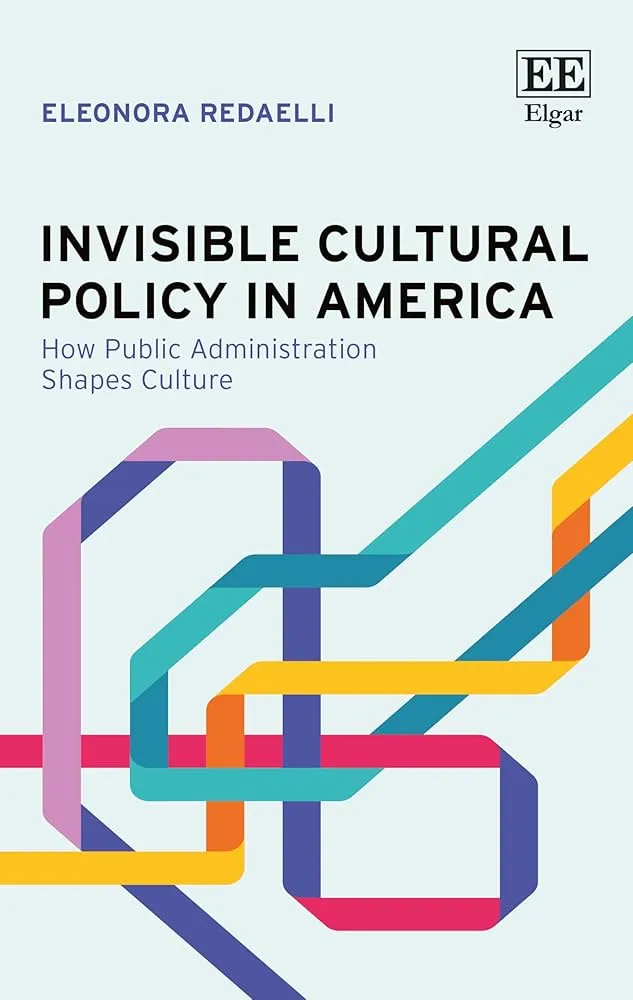
This recent book is open access, here. And my full review in the International Review of Public Policy is also open access, here. My review begins:
There is an old joke: An American tourist is visiting Oxford for the first time, and on his first morning signs up for a guided walking tour. The group sees the Ashmolean Museum, the Bodleian Library, the beautiful college quadrangles, and they pass beneath the Bridge of Sighs, before finally going for a pub lunch at the Lamb & Flag. At lunch the tourist asks the guide: but when will we get to see the University?
American cultural policy is something like our tourist’s experience. Despite observing the various publicly funded granting agencies, charitable foundations, individual donors who receive tax-preferred status, tax credit schemes to promote commercial film and television production and music recording, and local investments in cultural infrastructure, we are still left asking: but where is the cultural policy?
Eleonora Radaelli is a professor in the School of Planning, Public Policy, and Management at the University of Oregon. … In Invisible Cultural Policy in America, she seeks to solve the problem of where exactly an observer can discern the nature of American cultural policy and why it is, for the most part, “invisible.” …
Arts administration and policy folks, especially those with a public administration focus, should check it out.
Footnote: A version of the Oxford anecdote is in Gilbert Ryle’s A Theory of Mind (1949).
Cross-posted at https://michaelrushton.substack.com/
Leave a Reply