
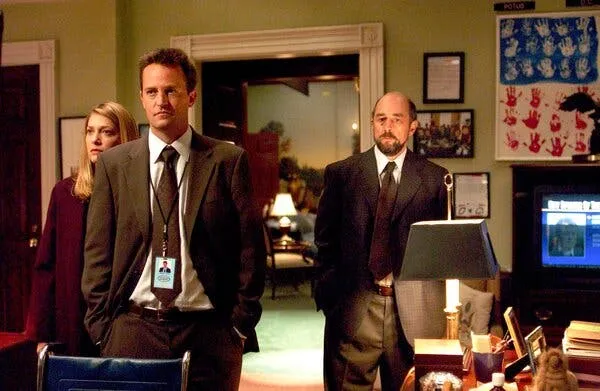
(Kudos to the art director who chose that American flag done with handprints – it’s perfect).
I enjoyed reading Becca Rothfield’s “Listless Liberalism” in The Point, in which she reviews Ezra Klein and Derek Thompson’s Abundance, and Cass Sunstein’s Liberalism, and also asks the question of why the aesthetics of a liberal society, barely addressed in either of these books’ defenses of liberalism, seems such weak tea:
There are reams of writing about fascist military parades and socialist-realist murals, yet there is almost nothing comparable about the dull tint at the end of history. Where is liberalism’s “Fascinating Fascism”? Who is its Riefenstahl? At least in its most recent incarnation, it tends to disdain these questions. In its dreams of itself, it is unadorned—a skeletal set of principles and policies without any attendant body. Its heroes are too busy scanning polls and skimming white papers to bother with self-fashioning: in the quintessentially liberal TV series The West Wing, harried wonks pace the halls of the White House in ill-fitting suits and sensible shoes, trying to appear as if they eschewed the distractions of appearance altogether.
The challenge to the arts presented by liberalism is its principle of non-perfectionism – that the state, and society at large, has no business telling people what projects, what goals, what art, they ought to value. We are all to sort that for ourselves, so long as we don’t tread upon each other’s goals. The state can still have its own projects, but they are focused upon an efficiency in public services that everybody ought to agree on (Klein and Thompson) and on legal rules that protect our liberal rights (Sunstein). In this liberal world, the government doesn’t have a role in the arts, as it would violate the principle of state neutrality over what things in life are more worthy pursuits.
So in the end a liberal order produces whatever art is sustainable on its own, hoping at least some audience fragment will buy into it, and this is going to produce something of a hodgepodge, without a defining aesthetic, or, as Rothfield says of the most pro-liberal products of this entertainment economy, almost an anti-aesthetic:
Among the marquee mannerisms of recent liberalism we find chains selling salad bowls, mixed-use developments featuring glassy apartment complexes, the television show Parks and Recreation, the grocery store Trader Joe’s, the word “nuance,” glasses with rectangular frames, group-fitness classes, the profession of consulting, news startups focusing not on criticism or reporting but on commentary, and nonfiction that is a little too good for an airport bookstore but a little too slick and credulously economics-heavy for a literary magazine. The smug yet unconvincing performance of non-aesthetics amounts to aesthetics too.
It is because so many of liberalism’s most prominent defenders fail to recognize this patent fact that they are so mystified by their harshest critics. What so-called post-liberals like Notre Dame professor Patrick Deneen and Vice President J. D. Vance rail against is not their antagonists’ doctrine—not really. Indeed, the post-liberals play so fast and loose with the actual tenets of liberalism that they are scarcely intelligible, so long as they are regarded as participants in a contest of ideas. But it is a mistake to suppose, as so many earnest liberals do, that these details matter. What the post-liberals get right—and the reason they are winning—is that the end of history has been sallow, ugly and deflating. Theirs is decidedly not an intellectual objection. It is not even an ethical objection, though it is often trussed up in the trappings of moral outrage. At its core, it is an aesthetic aversion. The long and short of it is that the post-liberals do not like liberalism’s manners. Would-be proponents of a waning world order can only hope to parry this attack if they confront it on its own terms.
Rothfield thinks the best liberal culture in America was able to produce was Partisan Review in its glory years:
One model for this kind of cultural production is the journal in which Trilling first published these lines: the fabled Partisan Review, a literary and political magazine that ran from 1934 until 2003 and that is perhaps the best that American cultural history—and certainly the best that American left-liberalism—has to show for itself. The Review published essays and roundtables alongside fiction from the likes of Kafka and Bellow. Its contributors argued about politics, but they also reviewed all sorts of art, from theater to paintings to novels. Its offerings were smart but never slick; its tone was learned but never condescending; its writers addressed the reader not as if she were a neophyte requiring illumination, but as if she were an interlocutor working out her principles in tandem. Its writers bickered with each other often—indeed, the magazine is bursting with passionate and sometimes bitter disagreement—but they never talked down to each other, much less to their audience. Its writers were proffering the most arduous efforts of their minds, and they were proffering them not in the certainty of rectitude or in the expectation of congratulations but in the hope of correction. The resultant essays were good because they were informed yet curious; the magazine as a whole was good because it was as variegated and crackling as the country itself.
I agree it was grand, but it was a liberalism with a clear sense of what art and criticism was about. There were judgments involved – criticism, obviously, demands it. In recent years, cultural policy in the US has been adrift because of a reluctance on the part of policy-makers to make any sort of claims regarding the support of excellence in the arts. Everything is about quantity, more “arts participation”, or simply “more art”, hoping the claim that these are good things is not too judgmental (I know I harp on about this, but “guaranteed income for artists” programs are the ultimate in “who are we to judge? – just do whatever” arts policy). The National Endowment for the Arts was founded around the mid-life of Partisan Review, and was a part of what was a liberal consensus that a small dose of perfectionism can be compatible with liberal principles; pure liberalism and full-on Nietzscheism are not the only two options.
Art can explicitly proclaim liberal values, though trying too hard can simply produce something dull and preachy (I’ll admit to never having made it all the way through a single episode of West Wing), or it can more subtly represent the artist’s desire to experiment with form and narrative. But it never comes from nowhere; great art cannot help but draw from what has come before. Even a liberal art world requires young people, audiences, budding artists, to know something about tradition, about why people thoughtful about the arts particularly value some works and some artists.
Thomas Nagel, in Equality and Partiality, said this about the strict Rawlsian anti-perfectionist position:
That there are things good in themselves … seems to me a position on which reasonable persons can be expected to agree, even if they do not agree about what those things are. And acceptance of that position is enough to justify ordinary tax support for a society’s effort to identify and promote such goods…
I’m with him. It’s possible to uphold liberal freedoms to be who you want to be and pursue those projects that you find most valuable while at the same time supporting a foundation of the best of our culture, in education and in public policy, and in supporting artists who have promise to do great things. If liberal culture now seems pretty listless, it is maybe because we have departed from what used to be, I think, a more reasonable balance between liberalism and recognition of what is most valuable in our culture. But we’re now to the point where the most prominent liberal writers can’t find anything at all to say about art or our cultural lives.
Cross-posted at https://michaelrushton.substack.com/
Leave a Reply