
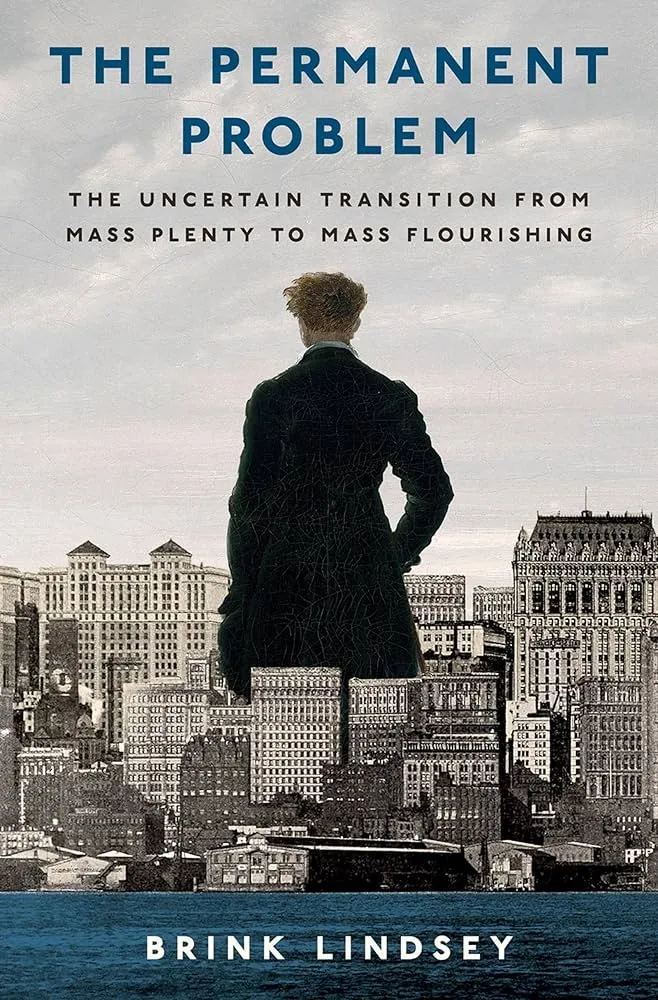
Brink Lindsey takes his title from one of my favourite essays, John Maynard Keynes’s “Economic Possibilities for Our Grandchildren” (which I wrote about here). Keynes, in 1930, wondered what lives might be like in our present. There are three big predictions in the essay, interrelated, of which I would say he got two right, which ain’t bad.
The first right prediction was about how the world’s material wealth would continue to grow, such that by this time we would be much more affluent in aggregate terms. We would have solved what he called the “economic problem”, which has dogged us since our clans roamed the savannah, of where we are going to find enough food, water and shelter to survive. His predictions on income growth, to come from growing productivity, were remarkably good given the long time period he was considering.
His wrong prediction, famously, was that he thought the trend he saw in declining hours of work, partly a result of that increased material wealth, would continue, such that by now even a fifteen-hour work week wouldn’t be strictly necessary. If anything, I continue to see commentators on the right suggest we don’t work enough – kids need to “get their hands dirty” earlier (they mean other people’s kids, not their own), and we need to push back the retirement age, a claim which indicates a lack of familiarity with people who do physical labour for a living.
His third prediction, and this is the other one he got right, was that it would not be easy, would not be a seamless transition, to go from worrying about the economic problem to worrying about our “permanent problem”: how can we ensure this material abundance is shared, and how can we learn to lead happy and fulfilling lives that do not have paid work at their centre?
Lindsey wants to address the permanent problem, with the knowledge, that Keynes could not have had, of how our lives have changed during the past century, not always in ways that have left us feeling better off.
Keynes wrote:
When the accumulation of wealth is no longer of high social importance, there will be great changes in our morals. We shall be able to rid ourselves of many of the pseudo moral principles which have hag-ridden us for two hundred years, by which we have exalted some of the most distasteful of human qualities into the position of the highest virtues. We shall be able to afford to dare to assess the money-motive at its true value. The love of money as a possession – as distinguished from the love of money as a means to the enjoyments and the realities of life – will be recognised for what it is, a somewhat disgusting morbidity, one of those semi-criminal, semi-pathological propensities which one hands over with a shudder to the specialists in mental disease. All kinds of social customs and economic practices, affecting the distribution of wealth and of economic rewards and penalties, which we now maintain at all costs, however distasteful and unjust they may be on themselves, because they are tremendously useful in promoting the accumulation of capital, we shall then be free, at last, to discard.
Keynes, and Lindsey, recognize the need for a cultural change, but public policy can only go so far in trying to nudge our values in a particular direction, if in fact an elected government would even wish to do so, before a natural human resistance to being nannied would kick in. So what can be done?
Lindsey’s first point is that the “economic problem” can never really be “solved”: human flourishing needs to allow for economic dynamism, new technologies and practices and things, first because it is simply in our nature to want to create new things, and second because efforts to achieve greater equality in human well-being and capabilities is much easier when economic opportunity continues to expand. Otherwise, redistribution takes place in a zero-sum game, and that’s a game the poor do not have good odds of winning.
Consider, for example, housing affordability. A few weeks ago, and I am quoting from memory here, Trump was asked at a press conference what he was going to do about it, and he said he doesn’t want to do anything about it: people who own homes have worked hard to achieve that goal, their home is often their most important capital asset, and they don’t want to see house prices fall. Well, stopped-clock-twice-a-day etc, he was saying a true thing. Even in my very outwardly progressive college town, where everyone publicly agrees something ought to be done about the housing crisis, unstated among those same people is “but not at the expense of the value of my house.”
Lindsey says the best means to housing affordability is to find new places to build, and to ensure that incomes are not left stagnant in the left-hand side of the distribution.
Lindsey cares about the state of our natural environment (he admits to being a bit slow to come around to environmental risks), but here again the trick is not to slow down economic growth, but to encourage new technologies that solve the twin goals of higher incomes and greener living.
Throughout, Lindsey is a technological optimist. But what can we say about technology in Artificial Intelligence that might have a tremendous, and involuntary, effect on working hours, making Keynes’s permanent problem rather immediate? Universal Basic Income could give short-term relief, but it would be an unstable and unhappy way to support half the working-age population. On this question Lindsey, running counter to trends that show no slow down in urbanization, thinks that the solution might lie, at least for some hearty souls, in new, small, planned communities. These would be towns where as much as possible was done locally: schooling, elder care, health, building, and food production. Even energy can now be harnessed at small scale due to advances in solar panels. It would be a way to an affordable and fulfilling life for those who are not going to have whatever jobs remain in major centres, looking at screens (and he is quite right to note that the financial “services” industry already takes up far too much human potential). And these communities would give residents and their children (of whom he expects there would be more) the chance to, as they say, touch grass, and to have better opportunities for forming the deep relationships that are so essential to our well-being. He calls this an “economic independence” movement, and recognizes that people who took it up would lose some familiar urban and suburban creature comforts.
Is all this viable? I’m all for expanding the domain of choice in what John Stuart Mill called experiments in living, but frontier communities, to this day, can turn out very badly indeed, and we’ve had plenty of recent evidence of the number of people who would take a chance to play dictator in such a place if they could get away with it. Lindsey, as I do, hopes for a world of increased face-to-face human connection, but I see that as achievable in existing towns, big and small, without starting from scratch.
Coda: this is sort of an arts policy blog, and so I am obliged to note that the arts as we know them do not really make an appearance in the book (though it was a very important consideration for Keynes), except to say, rightly, that we could be more creative if copyright and patent laws were scaled back a bit. Arts policy debates happen within an arts policy bubble, with very little influence in these sorts of general what-is-to-be-done books. Just saying.
Reposted at https://michaelrushton.substack.com/
Leave a Reply