
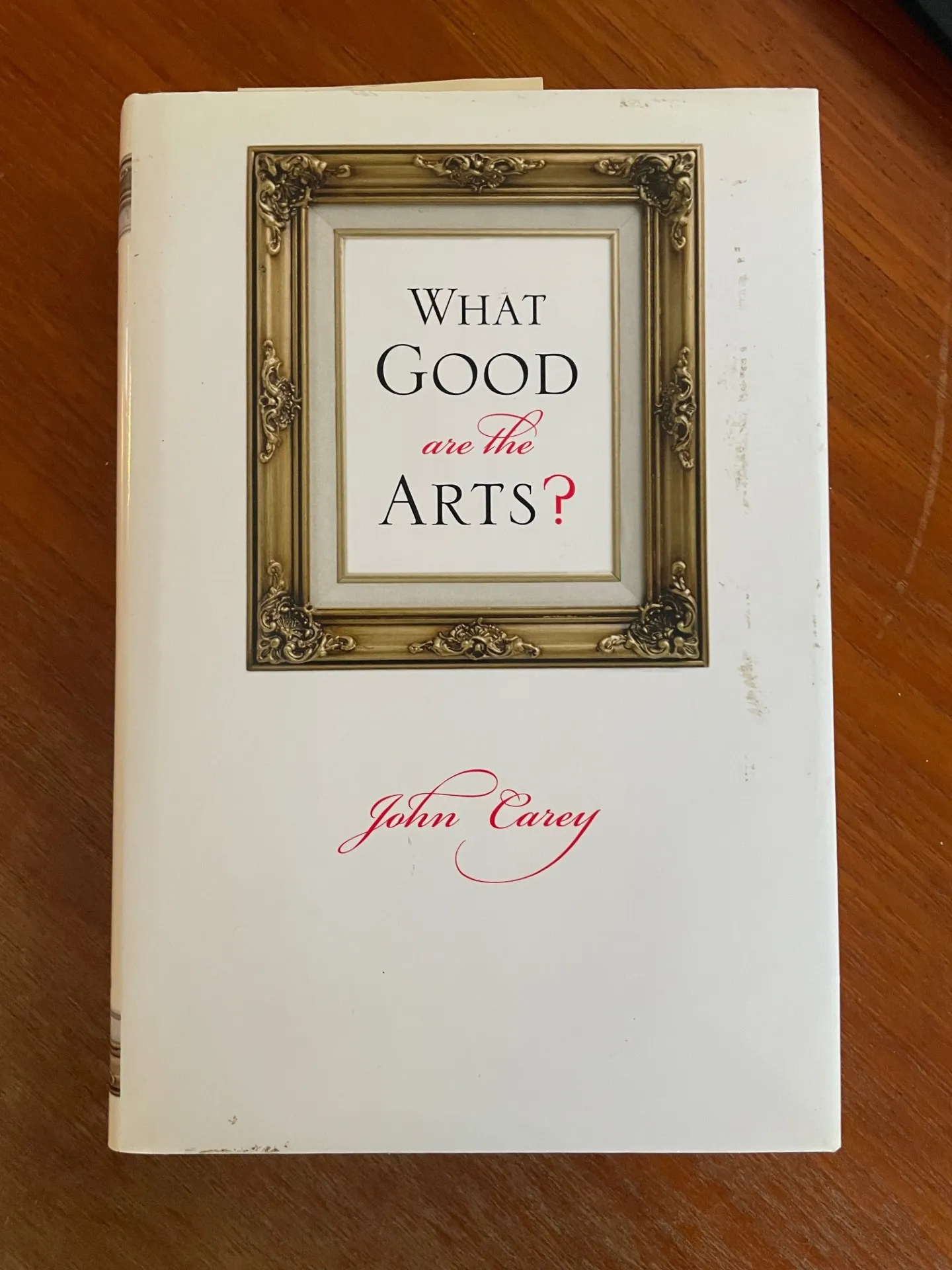
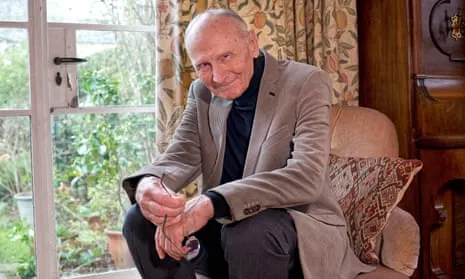
Literary critic and academic John Carey died last week at the age of ninety-one. I always enjoyed reading his reviews. If you hadn’t already guessed how the Bloomsbury set and their literary contemporaries viewed common folk, his book The Intellectuals and the Masses gives you chapter and verse. I enjoyed Henry Oliver’s appreciation of Carey’s criticism. Carey’s own account of his “life in books” is given in The Unexpected Professor.
I read What Good are the Arts? in 2006 when it was first published. I thought it would be worth revisiting.
In the first part of the book, Carey sets out to knock down all the grandiose claims that the arts have the power to make us better people living in a better society. He doesn’t conclude that the arts are of no value at all – that would be an odd thing for a professor of literature to do – but he does want to clear through any sloppy thinking to get to the essence of what engaging with art does to us, if we are open to it.
The book opens with his attempt, which I don’t think is successful, to define “art.” After some gentle and not-so gentle poking at Kant and Hegel, he devotes most of his time to Arthur Danto’s claim that anything can be a work of art so long as people in the art world, people educated and cultured in such matters, believe it to be art. The artist’s intention is not the point (and is for the most part unknowable); what matters is how an object is received. Carey thinks the art world has become debased, and objects to the idea that there is a class of people on whom we should rely for such judgments, and so he provides his own definition: “A work of art is anything that anyone has ever considered a work of art, though it may be a work of art only for that person.”
He continues: “It follows, of course, that the old use of ‘work of art’ as a term of commendation, implying membership of an exclusive category, becomes obsolete.” I can’t quite agree with him here. The term “art”, like the terms “justice” or “freedom” is, as Gallie once defined it, an “essentially contested concept.” We will not all come to agreement as to whether something is a work of art, or that an action is just, or that a law will enhance freedom. The value of these terms is in the discussion they provoke about what we think they mean. But all of these examples are terms of commendation. If I draw a blue line on a piece of paper, and most people do not think it is art, but one person who sees it does think it is art, that person has some concept of “art” in mind, and should be able to say, even if very imprecisely, “here is why I think the blue line is art.” And by that they are making a valuation; they are saying there is something more to what is in front of them that just a blue line on a piece of paper. Carey’s definition evades the question of what reason someone might have for thinking something is art. I’m no longer on twitter, but I do recall @artdecider who would answer the question for any offered image “art or not art.” Their judgements might not be my judgements, but they had something in mind.
In the middle section of the book he extends his skepticism to other claims that have been made about art. He claims that there is no fundamental difference between what is commonly called high art and mass art or entertainment (Collingwood says there is a difference based upon the creator’s intent in making the work, but Carey does not want to involve us in questions about intent). And he claims that science, while it might be capable of discovering things about what is happening in our brains when we experience art, cannot answer the question of why different people are drawn to different things, our relationships to art being too complicated (there has been a lot of research in the neuroscience of the arts since Carey wrote this book twenty years ago, but he was correct in his prediction that the answers to the important questions are unknowable by science).
He devotes a chapter to dismissing the idea that engaging with art can turn us into better, more moral, people. There is no evidence that people are elevated by the consuming the arts, and too many counter-examples to name (he devotes some time to the collector of fine art and appalling human being John Paul Getty). It might be the case that we empathize with characters in narrative art, but we are not really getting inside their heads, walking a mile in their shoes, because they are fictions – they have no heads or feet. And although psychologists have tried to uncover a link between reading fiction and being more empathetic towards actual, real-life humans, no causal link has been found (I wrote about this research agenda here (paywalled, but let me know if you actually want a copy)). That said, active participation in making art is something different, as an outlet and a means of expression – he praises the work of those bringing the chance to create art to those in prison, and by extension to increased arts education in schools, a more worthy public expenditure than subsidizing elite presenters of high art.
Having cleared away what he sees as simply a muddle, in part two of the book he makes a case for the importance of literature. Having expressed his skepticism regarding great claims for the power of art, he turns to what can be said.
For Carey, what makes literature special is that it has the ability to critically respond to itself and to “moralize.” When I first saw his use of that word I wondered if this was the same John Carey who had written the first part of the book, but he goes on to explain: literature is something of a conversation (not an “argument”, which presumes that out there is some objective truth) between authors, even if not writing directly to one another, about what it is to be human and to make moral choices. What do we owe one another? Is it true that to understand is to forgive? What are the limits of rational calculation in human affairs? He takes different pairs of authors – Samuel Johnson and Jonathan Swift, William Wordsworth and Jane Austen, George Eliot and Joseph Conrad – to illustrate the moral frameworks and assumptions that underlie their fiction (these frameworks cannot be too opposed; an ethic completely at odds with our ordinary, very general notions of right and wrong can ruin the aesthetic appeal of the work). None of these authors is giving a sermon on how to be moral. But they do give us ideas, different ways of thinking about people, the tools for reflection.
Carey:
I am not suggesting that reading literature makes you more moral. It may do, but such evidence as I have come across suggests that it would be unwise to depend on this. Envy and ill-will are, I should say, at least as common in the literature departments of universities as outside. … It is literature that gives you ideas to think with. It stocks your mind. It does not indoctrinate, because diversity, counter-argument, reappraisal and qualification are its essence. But it supplies the materials for thought.
The final chapter of the book, which draws most of its examples from poetry, is about how literature’s indistinctness allows for the play of imagination. We are given suggestions about a character or a scene, but the images are ours alone; the reader creates. And…
How we read, and how we give meanings to the indistinctness of what we read, is affected by what we have read in the past. Our past reading becomes part of our imagination, and that is what we read with. Since every reader’s record of reading is different, this means every reader brings a new imagination to each book or poem. It also means that every reader makes new connections between texts, and puts together, in the course of time, personal networks of association. This is another way in which what we read seems to be our creation. It seems to belong to us because we assemble our own literary canon, held together by our preferences. The networks of association we build up will not depend on spotting allusions or echoes, though sometimes we may notice these, but on imaginative connections that may exist only for us.
Twenty years ago Carey was worried about the decline in reading by young people; we can only imagine what he would have made of the current state of things, what can seem like an awfully unimaginative and unreflective world. The optimist can respond: but all that great literature is still there – it is not impossible to return to it.
I am glad to have re-read What Good are the Arts?; on a personal level he helps me, very much a layperson when it comes to English literature, to become something of a better reader. It refines how to think about what the arts can and cannot do, what matters in arts education, and, from a policy perspective, what our arts councils and foundations ought to be thinking about.
Cross-posted at https://michaelrushton.substack.com/
Thanks! I hadn’t come across John Carey prior to this. I look forward to reading the book!
His The Intellectuals and the Masses is also really worth your while.
Nice read! Carey’s idea that art doesn’t automatically make us better people was surprising but refreshing it makes the whole discussion feel more honest