
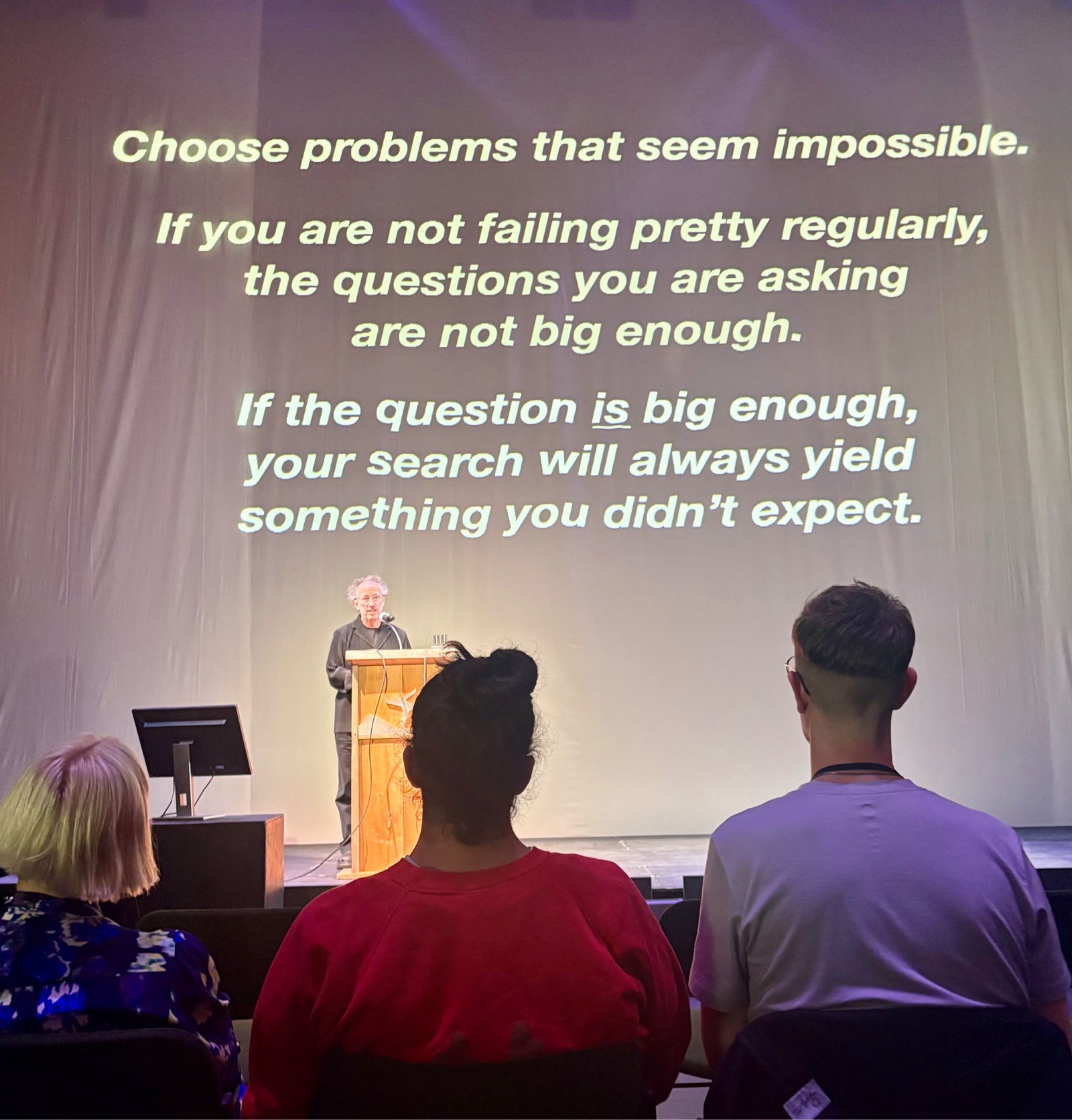
For the second consecutive summer, Jacob’s Pillow invited choreographers, presenters, producers, academics, and funders to its inspiring home in the Berkshires to exchange ideas and inspirations around dance and emerging technologies. Future Figures, an evolving program of Jacob’s Pillow, is a convening of field leaders as well as a public symposium where work is shared, opportunities are imagined, and shared obstacles are confronted.
The symposium takes advantage of the advanced production capabilities of the Pillow’s gorgeous new Doris Duke Theater, rebuilt after a tragic fire in 2020 and re-opened in 2025, one of the most technologically advanced dance theaters in the world. (Learn more about this building.)
This year’s event was emceed and facilitated by choreographer Sydney Skybetter, director of the Brown Arts Institute, podcaster (Dances with Robots), and founder of the Conference for Research on Choreographic Interfaces. He’s also a member of the Pillow’s digital futures think tank.
Below I’ve posted links to the artists who spoke or performed at the symposium. But the takeaways for me were more about the conditions that make the work possible, and the urgency for curation, production, and funding to evolve to support artists who need different kinds of space, time, knowledge, and money to thrive. In this regard, Jacob’s Pillow is leading the way for dance. The Pillow’s commitment to building a larger network among like-minded artists and presenters is exactly what’s needed to foster and share the work.
There’s no question that earlier decades’ excitement about technology’s possibilities has faded into a sea of indignation (and fear) about accumulating wealth among our tech overlords, concerns over privacy when our devices listen to and track our every move, and frustrations with algorithms that keep us from connecting across differences, instead feeding us a constant stream of what we “like.” Rejecting technology altogether, or trying to minimize your participation in it, is an understandable choice.
Nonetheless, artists continue to look at these same tech tools and ask, “How can these tools help us reimagine a world worth living in?” and “How can I use these tools to reshape or subvert the very forces they’re unleashing?” and, “How can I use these tools as instruments of creative expression?” Artists are not just using technology tools, they are making them, and making them in ways that increase access and representation, that challenge commercial frameworks and approaches to user privacy and autonomy, and that invite questioning of social constructs and help us reimagine relationships among artists, audiences, and each other.
The requirements to support such work begin with architecture and infrastructure, conceiving spaces that artists can shape to their aesthetic intentions and technology needs. Rehearsal periods need adjustment because the tech needs testing, iteration, and debugging. Production support also shifts, and increases, when not only traditional lighting, sound, and staging support is needed but also technical expertise that is not common among traditional presenters. Something as simple as a sufficient number of electrical outlets is frequently mentioned as a problem, let alone strong and consistent internet connectivity and other basic capabilities.
I helped lead a project that resulted in the 2021 National Endowment for the Arts research report, Tech as Art: Supporting Artists Who Use Technology as a Creative Medium, which looked at the challenges and opportunities in these emerging practices, considered the strength of the ecosystems around them, and made recommendations to supporters and policymakers. Five years later, the report’s recommendations are still timely – not much has evolved to support these artists.
Why is that? In the current political, social, and economic context, it is fair to ask why “arts and technology” is a worthwhile focus. But the answer lies in the future-focus of the work itself, and in the benefit that artists bring to imagining and using technology in human- and community-centered, creative ways.
Symposium speaker and composer Todd Machover, faculty director of the MIT Media Lab, said, “We can have AI that enhances instead of obliterates creativity, we can have social media that promotes not destroys democracy, we can have biology that cures rather than kills. Art has never been more important than it is now. Art allows us to imagine a world worth living in.” He concluded with a call to action. “Where will the future come from? From you.”
Skybetter’s opening remarks also hit home, “William Gibson’s old line still holds: the future is already here; it’s just not evenly distributed. But we should also heed Ruha Benjamin’s warning that Black folx live in the future, not in the utopian sense of appropriated Afrofuturism, but in the sense that emerging technologies, especially those marched out under the banner of creativity and democratization, are almost always perfected at the expense of marginalized and minoritized communities. There are futures, plural, in this room [at Jacob’s Pillow] with us, and we can hold tactical faith that there is no fate but what we make. Our charge … is to read those futures through what already lives among us, and to insist, against considerable odds, on realizable hope for ourselves.”
Not convinced? At the very least, I invite you to spend time learning more about the dance and movement artists working in this field, and to experience the timeliness of their aesthetic inquiry. It will leave you feeling more hopeful about how technology can shape and reflect a better world. “Not everything in the world is bad,” said one participant. On a beautiful summer weekend in the Berkshires, these artists proved that to be true.
Symposium artists to check out:
Andrew Schneider