
At home we watch a lot of BBC-produced television. Some of it is very good, some of it is very silly, but we are entertained enough.
Anyone who has seen older and newer episodes of shows will pick up on the fact that productions at the BBC have made an increasing effort to include more non-white actors in shows (I’m going to use “non-white” as shorthand for all racial and ethnic minorities in Britain) as well as actors and characters with disabilities. This is true across the board, with programs that have either contemporary or historical settings, and regardless of location (even Shetland, which is a very white place, has room, in the show of that name, in each of the last few seasons for non-white characters to get mixed up in a murder plot, or at least to serve as a red herring).
In 2011, ITV (not the BBC) suspended Brian True-May, the producer of the very popular (and very silly) Midsomer Murders, when an interview with him was released. The Daily Telegraph reported:
“We are a cosmopolitan society in this country, but if you watch Midsomer you wouldn’t think so. I’ve never been picked up on that, but quite honestly I wouldn’t want to change it,” [True-May] said.
Asked what he meant by “cosmopolitan”, Mr True-May, 65, replied: “Well, we just don’t have ethnic minorities involved. Because it wouldn’t be the English village with them. It just wouldn’t work. Suddenly we might be in Slough. Ironically, Causton [the town in Midsomer Murders] is supposed to be Slough. And if you went to Slough you wouldn’t see a white face there.
“We’re the last bastion of Englishness and I want to keep it that way.” …
Explaining the secret of its popularity, he said: “When I talk to people and other nations they love John Nettles, but they also love the premise of the show. They love the perceived English genteel eccentricity. It’s not British. It’s very English.”
Midsomer is odd in that it is set in contemporary England (people use mobile phones and drive recent models of cars) yet is also meant to evoke Miss Marple’s St. Mary Mead. Which I suppose was as white as Mr. True-May imagined. (There is a separate piece to be written on why the British are so attached to programs set in the mid-twentieth century).
In any case, the BBC (and probably ITV as well) have made efforts to increase representation. A part of BBC’s Royal Charter is:
To reflect, represent and serve the diverse communities of all of the United Kingdom’s nations and regions and, in doing so, support the creative economy across the United Kingdom: the BBC should reflect the diversity of the United Kingdom both in its output and services. In doing so, the BBC should accurately and authentically represent and portray the lives of the people of the United Kingdom today, and raise awareness of the different cultures and alternative viewpoints that make up its society. The BBC should bring people together for shared experiences and contribute to the social cohesion and well-being of the United Kingdom. In commissioning and delivering output the BBC should invest in the creative economies of each of the nations and contribute to their development.
A new report commissioned by the BBC asks how it is going – you can download the pdf here. The report was written by Anne Morrison and Chris Banatvala, and is based upon many interviews on the production side, a large audience survey, a look at audience complaints to the BBC, and watching the actual programs.
I won’t try to summarize the whole report here, but I’ll say at the outset I thought it was very good – the authors care about the right things, and are pragmatic in their recommendations. If this is a subject you care about the report is well worth your time.
The report distinguishes between representation – a countable measure of whether and how much people from different groups appear on screen – and portrayal – a subjective assessment of what roles those actors are playing, and how their characters fit into the plot.
Representation is a matter of fairness: we wouldn’t tolerate minorities being blocked from careers in teaching or law or medicine because of their race, and neither would it be right to block them from acting, on the grounds that this is a profession restricted to whites, so that it all looks “English” (or “Scottish”, or “Irish”). Representation also has long-run implications: if young people never see people of their own background on screen, they will quite rationally deduce that acting is not a viable career path, even if they have a lot of talent. Representation, in any of the arts, is a signal that the path is there (even if, as it is for all artists, a very difficult path). These issues are covered well, with extensive interviews and data, in Culture is Bad for You (2020) by Orian Brook, Dave O’Brien, and Mark Taylor, which I would recommend as a companion piece (my paywalled review of the book is here – if you don’t have access just send me an email and I’ll sort it).
Representation by some metrics can be relatively easily achieved: instruct producers to hire more non-white actors. Done, and, as I said above, if you watch any shows that have had a long run, or compare old series to new ones, you can see the change take place.
But respondents thought there was work to be done in a few areas.
For one, the categories of race and gender and disability that are used in, for example, laws against employment discrimination, are not necessarily the most relevant characteristics of people that could appear in scripted drama. On screen, there remains an underrepresentation of the working class. And the report found that people often define themselves in terms of class, where they live, and their opinions and tastes and values and beliefs over various matters more than by their race or gender. Representation has been over-focused on the immediately visible (this is a problem that appears in many places other than television).
Second, seeking to have representation across programming at the network should not mean that every single program ought to meet some quota. That often leads to tokenism, and characters who are there simply to represent “diversity” without being anything like a three-dimensional presence, or having an interesting storyline (the report uses the word “clunky”, and it is apt).
We encourage the BBC to elevate the debate above the concept of diversity and the arguments about culture wars, to one about how it represents the whole of the UK. This includes the diversity characteristics but goes way beyond them and directly plays into the BBC’s fourth Public Purpose [the one I quote above: MR].
Programme-making isn’t a science. It needs to be informed by data, but you can’t approach it with a checklist and produce something genuine. It’s an artistic and creative process that requires intelligence, instinct, collaboration and often a deep emotional connection to the material. Directors, journalists and producers play a crucial role. Above all in scripted programmes, writers generate the narratives which we watch and listen to. Collectively, these creative voices are the ones shaping the stories and perspectives that audiences hear and see.
To reflect this richness of life, you need programme makers from a wide range of backgrounds – different cultures, regions, classes and experiences – because authentic storytelling starts with lived experience, not box-ticking. Programme makers also need to understand the population around them and how people see themselves. [the emphasis is theirs: MR].
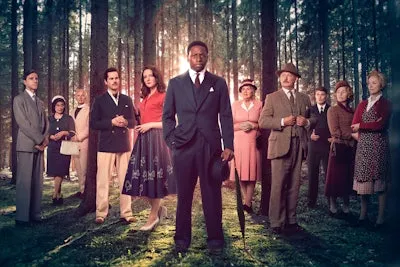
Regarding colour-blind casting, the report says it is going to be unavoidable if you want to have opportunities and representation. So, for example, casting a black actor as the lead in Agatha Christie’s Murder is Easy – which, after all, is fiction – is not particularly a problem. Most complaints about that program were about trying to impose an anti-colonial subplot into a story where it was indeed “clunky” (I watched the show). Complaints were received at the BBC over the casting of an actor of South Asian descent as Isaac Newton in an episode of Dr. Who, but the report has the brilliant response:
In Doctor Who, if we can ask viewers to believe that the central character is an extra-terrestrial being who can regenerate into a range of different actors and travels in a time machine through the space-time continuum, a mixed-race Sir Isaac Newton seems much less of a stretch.
That said…
Productions should consider their choices carefully when it comes to colour-blind casting. In depicting an anachronistic historical world in which people of colour are able to rise to the top of society as scientists, artists, courtiers and Lords of the Realm, there may be the unintended consequence of erasing the past exclusion and oppression of ethnic minorities and breeding complacency about their former opportunities. According to Omari Newton, a black Montreal-based theatre actor, director and writer,
Colour-blind casting is rooted in systemic racism. It is a form of erasure. It is the theatrical equivalent of ignorantly telling your black friend, ‘I don’t see colour’, when they try to engage you in a conversation about race. It is passively dehumanising in the way that it dismisses the racism that is embedded in the very fabric of how colonised countries were founded.
We’re not in the business of issuing blanket recommendations on this topic, because each production will differ and the pros and cons will vary. What needs to be avoided is ethnic diversity which looks forced and tick box, and we found our interviewees of colour as emphatic on this point as those who were white. [again, their emphasis]. …
While this review has been asked to focus on on-air representation, we’ve been repeatedly told by interviewees that having people writing and making the programmes who are from the demographic in question is much more likely to lead to authentic portrayal. When this goes against the majority demographic, they need not just to be employed in junior roles, but at a level where they can have creative influence. This must be in a culture which actively seeks to learn from their feedback and makes it possible for them to criticise a programme without jeopardising their future employment.
Cross-posted at https://michaelrushton.substack.com/
Leave a Reply