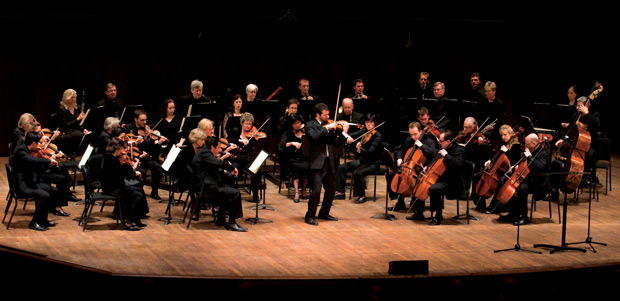
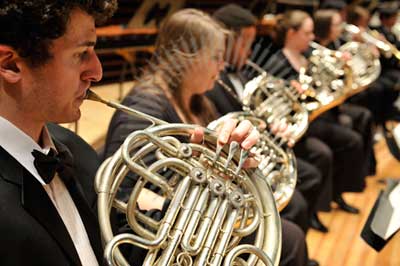
Curtis Symphony Orchestra
On the agenda at a recent Board of Overseers’ meeting at the Curtis Institute of Music were past graduates, some with non-traditional careers both in music and not, speaking about the preparation their Curtis education provided them. The backdrop to the conversation was a speech the previous afternoon by Derek Bok, who advocated for the importance of liberal education beyond music as an essential component of an artist’s preparation. Â The context for the entire discussion was the current state of the classical music field and the idea that young musicians will need resourcefulness to make their way in the world. Music “jobs” in the future are likely to be less attached to institutions (many of which are troubled in one way or another), entrepreneurial, and varied beyond a straight performance career to include all manner of teaching, coaching, Â and work we could loosely call “public engagement.” Â And while society’s appetite for classical music seems to be as strong or stronger than ever (more on that in a future post), the manner in which people want to engage with music and musicians is changing. What can an elite music school do to prepare its students for new opportunities?
Curtis is not the only institution thinking about this. New England Conservatory, Julliard, and places like Parsons and Cal Arts all are wrestling in one way or another with the question of young artists’ development and what new experiences and information should be added to their courses of study. Â Higher ed increasingly thinks about justifying the expense of education with its practicality; Â note the number of recent news stories calling the question on whether a liberal arts education can be justified financially (check out Who Needs an English Major?). The most popular college degree in America today is Business.
A life in the arts has always meant resourcefulness and artists are inspiringly resourceful — how else could they get their work done? I wonder whether a conservatory-based classical music education has really been less helpful than it could have been in this regard; witness the number of chamber ensembles (think Eighth Blackbird, among many others), chamber orchestras (think The Knights, East Coast Chamber Orchestra, many others), and music projects like Play On, Philly or KidZNotes that musicians are avidly founding and leading.  I also wonder whether resourcefulness can be taught. The most resourceful people I know are propelled by an inner muse, not one that can be gained in the classroom or studio. Their resourcefulness comes from curiosity, from courage, and from necessity, or from some combination of these.
Becoming resourceful means making a lot of mistakes. It’s an inherently creative process of trying, messing things up, learning, and trying again. On the one hand, this sounds exactly like practicing music: try/learn. On the other hand, perfecting a piece of music for performance is also about learning not to make any mistakes. So, maybe there is something in the musical training itself, rather than in any ancillary training, that could be considered if faculty want creativity and resourcefulness to flourish. Being rapped with a ruler for every mistake has fallen out of favor in the classroom. Â Let’s be sure that conservatories don’t use the old-fashioned equivalent.
Conservatories should encourage young artists to read broadly, learn history, and understand science; these things make life fuller and more interesting. Many subjects can be self-taught by a motivated learner, particularly given the resources available on-line. And personally, I think everyone should know a bit of accounting. If I led a conservatory I’d be sure every young artist knows at least something about accounting and a bit about contracts, at least enough to know whether they need an accountant’s or a lawyer’s help, and enough not to be taken to the cleaners.
Beyond that, I think creating an environment where young artists can try things, make mistakes, and learn, perhaps with some mentoring but maybe without any — this is what I think will most help develop resourcefulness. The worst thing a school could do is to be over-protective, to anticipate situations where mistakes could occur and pre-empt them, or to squelch enthusiasm for an idea that seems dubious, but from which learning will occur, even if it bombs. In other words, the last thing young artists need is for someone to cut up their food and serve it to them. They need to learn how to cook.
I’m glad that Curtis is thinking about this. Curtis grads form a distinguished cohort in classical music and their future resourcefulness will be a boon to the sector. What would you change, if you could, about conservatory training?