
 For about ten hours in Bob Katz’s studio in Florida, I listened with him. We were adjusting the final mastering of my new CD. I like the sound on our previous discs, but I hope that this is going to be better. A piano sound not as edgy as pop, and not as distant as some classical piano recordings.
Apparently, during part of one of the recording sessions, there was a taxi radio or some other kind of transmitter outside. Traces of those signals became part of the recording. I noticed scratches or crackles, and it turned out Bob’s twentysomething intern could hear these high-frequency noises better. There was a symphony goin’ on up there!
Some teenagers have high-pitched cell phone ringtones that their older-eared teachers cannot hear. Such sounds were previously used in a security device, developed in the U.K., intended to drive youngsters out of shops where the high-pitched sounds were broadcast — a rodent-control noisemaker for kids!
Certainly, recordings are heard specifically and differently by every listener. And it’s not only a matter of physical differences in the receptiveness of our auricles. Hearing is interpretation. Psychoacoustics is not acoustics. Still, I now imagine a piece of music that could be designed to be heard differently by hearers of different ages — or again and again by an aging listener. A kind of sound hologram through time.
In If on a Winter Night a Traveler, Italo Calvino writes: “I, too, feel the need to reread the books I have already read, but at every reading I seem to be reading a new book for the first time. Is it I who keep changing and seeing new things of which I was not previously aware?”
The noises in our project can be removed through spectral editing. On a computer screen, the sound material appears 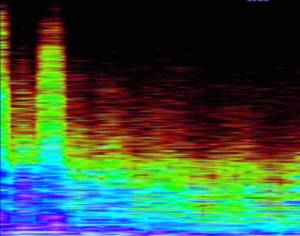 in bright colors, top to bottom through the frequency range. Individual bits of the picture can be modified or removed. It’s finicky work. The “normal” musical sounds show up as organic-looking overlapping curved shapes. In one very brief section of the music where I still heard some of the taxi, Bob displayed the spectral image and we saw the telltale, regular vertical lines — each one making the speakers emit a tiny crackle. The absolutely straight lines are like the cliché of every emergency room TV drama — flatline. Not the jaunty, nuanced vital signals of a living human, but the totally flat signal on a monitor hooked up to someone who is dead.
With a few clicks of Bob’s mouse, our bright red sonic flatlines were removed…