
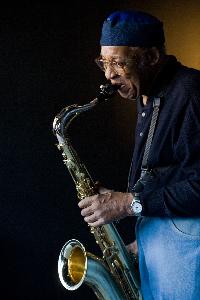
As a teenager in pursuit of the avant garde, I took tenor saxophonist Fred Anderson, who died June 24 at age 81, as a hero upon first hearing him in 1966. It was at a Unitarian Church-run coffee house in downtown Evanston near Northwestern U., and attention clearly had to be paid to the long, fierce, unreeling, knotty improvisations Anderson delivered in an ever-more hunkered-down posture as the evening went on.
I was told that Fred stooped that way because he had worked as a carpet-tacker; I imagined he swung a tack hammer like John Henry. He played all over town at clubs I could get into though I was underage, and he always seemed to be playing — with musicians who had a lot of soulful chops but were given to fervid, far-out modal excursions, rather like John Coltrane. Anderson didn’t sound like Trane — his phrases came in knotty nuggets rather than a liquid flow, though keeping his head down as if bucking the breeze he’d huff and puff ’til he blew out resistance, then he’d blow some more.
howardmandel.com
Subscribe by Email |
Subscribe by RSS |
Follow on Twitter
All JBJ posts |


Fred Anderson was in a sense guided by Charlie Parker. As long as I knew him personally, he was always talking about his latest discovery in the history of Charlie Parker.
In my article,http://www.allaboutjazz.com/php/article.php?id=27762, several of his younger colleagues talk about his importance on the Chicago scene and the improvisation scene in general. I should have interviewed Kidd Jordan for that article for those two were close musical brothers.
The Chicago Tribune reported before he died that he said that maybe people will remember him from his records.
People have to remember him, not only for his discography, but from the influence he had on the development of improvisational music. His music attracted listening attention. He was not out to the change the world of music; he had already changed it.
Fred was also one of the kindest people I have ever known. I will miss him so much.
Having returned to Chicago in 2008 after being away for almost 20 years, it was one of my truly signature pleasures to be able to regularly frequent the Velvet Lounge. The “new” one reminds me of a place that could be stuck somewhere in Manhattan. The old one, as Mandel notes, was pure Chitown. It was called the Velvet, appropriately I would think, because of the place’s extensive use of velvet (seating, wall, etc.). Old and funky, but what atmosphere.
Fred I only got to really know (as in a few brief conversations) these last two years or so. Although very nice and approachable, to me he always seemed somewhat deep in thought. I remember well when he volunteered to autograph a poster of himself that I had bought. I’m more grateful for that now. The last CD I purchased there was also one fronting Fred.
I attended several of those 80th birthday concerts and the tribute to Fred last summer in Millennium Park. What wonderful, powerful music happened those nights. Perhaps my greatest appreciation of Fred’s playing came with his duets with Kidd Jordan, an avant-garde player from New Orleans. The two had a kind of chemistry like Coltrane and Pharaoh Sanders. Their commanding, energetic blowing complemented each other so well. What a thing to hear. I will miss those duets. I will miss Fred.
Thank you, Mr. Mandel, for the memories.
HM: The first time Fred Anderson and Kidd Jordan played together was at a Chicago Jazz Festival after-fest set — and it was in trio with Douglas Ewart. The multiple saxophones, polyphonic, is one of the things that attracted me to Song For, come to think of it — and it was also an attribute of much of the writing or arrangements for the various AACM big bands, which with reeds musicians including Anderson, Jarman, Ewart, Roscoe Mitchell, Henry Threadgill, Anthony Braxton, Wallace McMillan, Vandy Harris, Kalaparusha, John Stubblefield and Ari Brown at hand made good use of bountiful resources.