AJ Logo an ARTSJOURNAL weblog | ArtsJournal Home | AJ Blog Central

« October 2011 | Main | December 2011 »

November 30, 2011

TT: Snapshot

Truman Capote appears on The Dean Martin Comedy Hour in 1974:

(This is the latest in a series of arts-related videos that appear in this space each Monday and Wednesday.)

Posted November 30, 12:00 AM

TT: Almanac

"It is not true that suffering ennobles the character; happiness does that sometimes, but suffering, for the most part, makes men petty and vindictive."

W. Somerset Maugham, The Moon and Sixpence

Posted November 30, 12:00 AM

November 29, 2011

TT: Almanac

"I was suffering from that mysterious self-consciousness which often attacks the adolescent, a malady as agonising and overwhelming as seasickness or stage fright."

Francis Wyndham, "Obsessions"

Posted November 29, 12:00 AM

November 28, 2011

TT: Stocking stuffers

National Review asked me (among others) to make some Christmas gift recommendations. To find out what I suggested, go here and scroll down.

Posted November 28, 8:34 AM

TT: Get happy

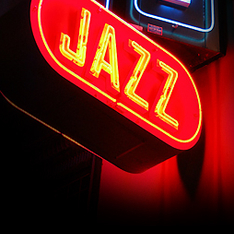
To go to a basement nightclub in Manhattan and sit ten feet away from a big band in full cry is one of the most exhilarating experiences known to man. Once upon a time I did so fairly often, but nowadays I rarely manage to do it more than once a year, when Mrs. T and I head down to the Jazz Standard on the Sunday after Thanksgiving to hear Maria Schneider's band.

jazz_standard.png.jpgEach year we do our best not to miss the last night of Maria's annual week-long residency at the Jazz Standard, but this time around I felt more strongly than ever before the absolute need to flee from life and immerse myself in the world of art. Too much work, too much stress, too much everything...so we walked away from our worries, lined up at the door, and within minutes found ourselves sitting two tables away from the musicians, the very place where we most wanted to be.

The sound of a big band in a small room hits you like a benign tornado, filling the air with glowing clouds of harmony. It is, I suppose, possible to think of other things in the midst of such a maelstrom, but I didn't: I let the outside world go and was content.

Eventually the music stopped, as it always does, and we said our farewells to Maria and caught a cab outside the club.

"Why don't we do that more often?" asked Mrs. T as we pulled away.

"Beats me," I replied.

* * *

The Maria Schneider Orchestra plays "Journey Home":

Posted November 28, 12:00 AM

TT: Just because

Zora Neale Hurston talks about zombies on Mary Margaret McBride's radio show in 1943:

Posted November 28, 12:00 AM

TT: Almanac

"Late love has this in common with first love, it is again involuntary."

Sybille Bedford, A Legacy

Posted November 28, 12:00 AM

November 25, 2011

TT: Monster class

In today's Wall Street Journal drama column I report on the premiere of Seminar, Theresa Rebeck's new play. Here's an excerpt.

* * *

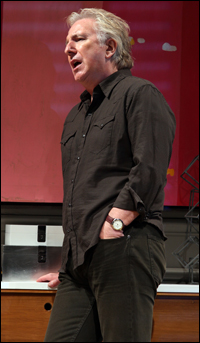
rickman200_1321639182.jpgNobody does nasty like Alan Rickman, and in "Seminar," Theresa Rebeck's new play, he goes the whole hog, playing a monstrously brutal teacher who hates his students almost as much as he hates himself. It's no surprise that the man who brought Severus Snape to the screen should be so good at spewing verbal cyanide onstage. To hear him dismiss a short story written by one of his hapless charges as "a soul-sucking waste of words" is to know what a mouse feels like as it peers down the mouth of an ill-fed snake. What's surprising and gratifying about "Seminar" is that Ms. Rebeck, a prolific playwright with a hit-or-miss average, should have connected so firmly with the dramatic ball this time at bat. Like "The Understudy," her last play, "Seminar" is an intermission-free comedy that gets serious at the halfway point, and for all the shiny slickness of its surface, Ms. Rebeck has once again contrived to conjure up a stageful of too-clever-for-their-own-good characters who'll sneak right under your skin.

The premise of "Seminar" requires explaining, since it will undoubtedly be alien to anyone who hasn't dipped a toe into the creative-writing racket. Mr. Rickman plays Leonard, a burned-out novelist turned high-octane book editor who makes extra cash on the side by leading private seminars in The Fine Art of Getting Published. Pony up $5,000 and you get to participate in 10 kick-me sessions at which he tells a small group of up-and-coming young writers what dim-witted boobs they are...

It goes without saying that Mr. Rickman is the star of the show. Ms. Rebeck has given him a lengthy speech about unsuccessful writers ("You'll feel like you're in the ninth circle of hell, where the betrayers of Christ are frozen in eternal cannibalistic silence") that he delivers as if it were an operatic aria, using his hissing, sinister drawl to color each phrase so tellingly that you'll catch your breath from start to finish. But "Seminar" is in no way a one-man show, and Mr. Rickman's "supporting" cast backs him brilliantly and effortlessly....

* * *

Read the whole thing here.

Posted November 25, 12:00 AM

TT: When art goes up in smoke

Today's Wall Street Journal "Sightings" column is occasioned by the recent discovery of sketches for Sibelius' Eighth Symphony. Here's an excerpt.

* * *

The most famous bonfire in the history of classical music was lit by Jean Sibelius in 1945. The composer of "Finlandia," who had succumbed to depression and stopped writing music years earlier, burned a basketful of manuscripts in his fireplace, and it's thought that his unperformed Eighth Symphony, over which he had struggled for nearly two decades, went up in flames that day.

Or did it?

sibelius.jpgThe Finnish newspaper Helsingin Sanomat published a story last month called "Is This the Sound of Sibelius' Lost Eighth Symphony?" Finnish scholars now claim to have located three fragments from Sibelius' sketches for the Eighth Symphony, and John Storgårds and the Helsinki Philharmonic recently performed them. It's impossible to know for sure whether these snippets actually belong to the Eighth Symphony, but the possibility that they might has set musicians around the world to buzzing.

Lost, unfinished and destroyed works of art have always tickled the fancies of art lovers, sometimes to the point of outright obsession. Did Buddy Bolden, the legendary New Orleans jazzman, really record a cylinder of his cornet playing? Probably not--but that hasn't stopped fanatics from looking for it. Whatever happened to the missing finale of Schubert's "Unfinished" Symphony? Nobody knows--but cockeyed theories abound.

Max Beerbohm wrote an essay called "Quia Imperfectum" in which he reflected on the "peculiar charm" exerted by unfinished works of art, suggesting that it would be worthwhile to construct "a museum of incomplete masterpieces" whose collection would be "full of unfulfillment." It's a clever idea, and a thoroughly romantic one. Most of the best-known unfinished works of art, after all, including Bach's "Art of Fugue," Charles Dickens' "Mystery of Edwin Drood," F. Scott Fitzgerald's "The Last Tycoon" and Gustav Mahler's Tenth Symphony, were short-circuited by the deaths of their creators. Just as we are intrigued by the last words of great men, so are we fascinated by the last works of great artists, and when they are left incomplete, the fascination is heightened still further by the universal longing to see beyond the grave.

That Sibelius should have put his Eighth Symphony to the torch is no less fascinating. It's not unusual for artists to suppress works with which they're dissatisfied, but rarely do they actually destroy them....

* * *

Read the whole thing here.

To hear a performance of the sketches for Sibelius' Eighth Symphohy, go here and click on the small video screen. (The music is preceded by a two-minute-long interview in Finnish.)

Posted November 25, 12:00 AM

TT: Almanac

"For many readers a good critic, in whatever field, is someone they agree with or who agrees with them. For me, a good critic is a good writer. A good critic is someone who recognizes and acknowledges the artist's intentions and the work's aspirations, and judges the work by them, not by what his own objectives would have been. A good critic is so impassioned about his subject that he can persuade you to attend something you'd never have imagined going to. A good critic is an entertaining read. A good critic is hard to find."

Stephen Sondheim, Look, I Made a Hat: Collected Lyrics (1981-2011) with Attendant Comments, Amplifications, Dogmas, Harangues, Digressions, Anecdotes and Miscellany

Posted November 25, 12:00 AM

November 24, 2011

TT: For which much thanks

Snoopy-Woodstock-Thanksgiving.jpg"When we exist without thought or thanksgiving we are not men, but beasts." So said M.F.K. Fisher in How to Cook a Wolf. I quoted her words in this space six years ago, and they are as true now as they were then, or in 1942, when Fisher wrote them. Today Mrs. T and I are preparing to go to her sister's house in Connecticut, there to sit at a groaning table and eat to our hearts' content. We are lucky and we are grateful--for the meal, for those with whom we'll share it, for one another. Spouses who come together in middle age don't take their good fortune for granted.

I've been favored by fortune my whole life long, which isn't to say that I haven't stepped in my fair share of potholes. Six years ago I ate my Thanksgiving dinner in a restaurant, thinking dark thoughts as I dined, and a few short weeks later I was carried out of my apartment on a stretcher, wondering if I'd ever see it again. Not only did I make it back home in one piece, but I found my true love along the way. And even on the darkest of days I wasn't alone: I've always been surrounded by friends, and they've never failed to come when I called.

Unlike many, perhaps most folk, I earn my living doing something that gives me pleasure, and I don't take that for granted, either. I get paid to write about the plays of Shakespeare and Chekhov and Brian Friel and the music of Louis Armstrong and Duke Ellington. How lucky can you get? That I also have to write about significantly less worthy things from time to time is surely the smallest of prices to pay for such a privilege (though sometimes it doesn't seem like it!).

303021_10150389947507868_665917867_10323350_1208784340_n.jpgAs if all that bounty weren't enough, I wrote my first play and saw it performed in the year just past, an experience so unforeseen that I still have trouble believing that it really happened. I hope to see Satchmo at the Waldorf performed again before too much time goes by, and I also hope that other plays of mine (I've written two more since finishing Satchmo at the Waldorf) will someday make it to the stage. But even if that doesn't happen, I'll still be farther ahead of the game than I ever dreamed.

Nobody's luck holds forever, but when hard times come again--as they surely will--I hope I'll be warmed by the memory of how I feel today.

* * *

The finale of Stephen Sondheim's Company, as performed in 2008 by Raul Esparza and the members of the original Broadway cast of John Doyle's production:

Posted November 24, 12:00 AM

TT: So you want to see a show?

Here's my list of recommended Broadway, off-Broadway, and out-of-town shows, updated weekly. In all cases, I gave these shows favorable reviews (if sometimes qualifiedly so) in The Wall Street Journal when they opened. For more information, click on the title.

BROADWAY:
Anything Goes (musical, G/PG-13, mildly adult subject matter that will be unintelligible to children, closes Apr. 29, most performances sold out last week, reviewed here)
Chinglish (comedy, PG-13, adult subject matter, closes Apr. 29, reviewed here)
Follies (musical, PG-13, adult subject matter, closes Jan. 22, reviewed here)
Godspell (musical, G, suitable for children, most performances sold out last week, reviewed here)
How to Succeed in Business Without Really Trying (musical, G/PG-13, perfectly fine for children whose parents aren't actively prudish, reviewed here)
Other Desert Cities (drama, PG-13, adult subject matter, most performances sold out last week, reviewed here)
Private Lives (comedy, PG-13, closes Feb. 5, reviewed here)
Venus in Fur (serious comedy, R, adult subject matter, closes Dec. 18, most performances sold out last week, reviewed here)

OFF BROADWAY:
Dancing at Lughnasa (drama, G/PG-13, extended through Jan. 15, reviewed here)
Avenue Q (musical, R, adult subject matter and one show-stopping scene of puppet-on-puppet sex, reviewed here)
The Fantasticks (musical, G, suitable for children capable of enjoying a love story, reviewed here)
Million Dollar Quartet (jukebox musical, G, off-Broadway remounting of Broadway production, original run reviewed here)

CLOSING NEXT WEEK OFF BROADWAY:
The Agony and the Ecstasy of Steve Jobs (monologue, PG-13, closes Dec. 4, reviewed here)

CLOSING NEXT WEEK IN GLENCOE, ILLINOIS:
The Real Thing (serious comedy, PG-13, closes Dec. 4, reviewed here)

CLOSING SUNDAY ON BROADWAY:
Man and Boy (drama, PG-13, adult subject matter, most performances sold out last week, reviewed here)

Posted November 24, 12:00 AM

TT: Almanac

"Let the man who would be grateful think of repaying a kindness even while receiving it."

Seneca, De Beneficiis

Posted November 24, 12:00 AM

November 23, 2011

TT: Snapshot

A rare kinescope of Stan Getz playing excerpts from Eddie Sauter's Focus, as originally telecast on The Edie Adams Show in 1963:

(This is the latest in a weekly series of arts-related videos that appear in this space each Wednesday.)

Posted November 23, 12:00 AM

TT: Almanac

"George Abbott later told me that no matter what part you're playing, the audience makes up its mind when you first step onstage, before you speak, whether it likes you or not."

Edie Adams and Robert Windeler, Sing a Pretty Song...

Posted November 23, 12:00 AM

November 22, 2011

TT: Almanac

"Even the worst of us would like to change, like at least to think--and talk--of becoming better; the attentions of our reformers are so flattering, and at no other time is the ascending path tripped so lightly as when we are in love."

Sybille Bedford, A Legacy

Posted November 22, 12:00 AM

November 21, 2011

TT: Evasive tactic

Pierre-Auguste-Renoir-Conversation-Oil-Painting.jpgOscar Wilde claimed to have put all his genius into his life, leaving only his talent for his work. Many a great conversationalist has done much the same thing. Most people (though not all!) find it easier to talk than to write, and some, like the now-forgotten Desmond MacCarthy, talk so well that they never manage to write anything memorable.

For the professional writer, blogging is an intermediate state. It's writing, but writing of a peculiarly ephemeral kind, the postmodern equivalent of penning a thrice-weekly newspaper column, and those who do it too assiduously run the risk of dribbling away the stuff books are made of. Hilaire Belloc once managed to finesse a similar problem by publishing a collection of more than usually ephemeral essays called On Nothing and Kindred Subjects, but the fact that On Nothing is now as forgotten as Desmond MacCarthy suggests that he was kidding himself.

I've been blogging more or less regularly since 2003, during which time I've also published more than six hundred columns in The Wall Street Journal and written three books, two opera libretti, and a play. I'm not sure what this means, if anything, but at the very least it suggests that I find blogging stimulating. Usually it is, but there are times when all my talent (I have no genius) goes into my work, leaving nothing left over for the blog.

Having suspected from the outset that this might happen, I resolved to keep the ball rolling by posting a pointed quotation each day. Two thousand almanac entries later, I find that the choosing of this daily quotation is one of the self-imposed duties that I enjoy most. Between the almanac, the Thursday theater guide, the teasers for my Wall Street Journal columns, and the art-related videos that I now post twice weekly, I like to think that "About Last Night" is worth visiting even when I have nothing else to say other than that I have nothing else to say.

dd_mencken.jpgI'm not telling you anything that you don't already know when I confess that I haven't had all that much to say in recent months, a fact that is amply explained by what's been happening to me during that time. Between the premieres of my second opera and first play, the continuing illness of my mother, and my endless theater-related travels, I've been finding it increasingly difficult to blog.

This, too, shall pass, and until it does, I mean to continue posting the usual quotations and videos, keeping you abreast of my various print-media appearances and professional activities, and updating the right-hand column at reasonably frequent intervals. I'll also continue to tweet my random thoughts on the passing scene, and I'll write should the spirit move me, as it doubtless will from time to time.

What I won't do is bore you by making constant excuses for not blogging more often. You can henceforth take it for granted that I wish I were doing so--and that I'll be back on the case as soon as possible.

Posted November 21, 12:00 AM

TT: Just because

Chuck Jones' "Double or Mutton," written by Michael Maltese:

Posted November 21, 12:00 AM

TT: Almanac

"The moment 'talk' is put into print you recognize that it is not what it was when you heard it; you perceive that an immense something has disappeared from it. That is its soul. You have nothing but a dead carcass left on your hands. Color, play of feature, the varying modulations of voice, the laugh, the smile, the informing inflections, everything that gave that body warmth, grace, friendliness, and charm, and commended it to your affection, or at least to your tolerance, is gone, and nothing is left, but a pallid, stiff and repulsive cadaver."

Mark Twain (quoted in Edward Bok, The Americanization of Edward Bok)

Posted November 21, 12:00 AM

November 18, 2011

TT: Mr. Coward's little sermon

In today's Wall Street Journal I review the Broadway revival of Private Lives. Here's an excerpt.

* * *

Throughout most of his life, Noël Coward was widely regarded as a theatrical lightweight, albeit a brilliant one. Not until the '60s did the critics start to figure out that "Private Lives," his masterpiece, was something more than (in his own ironically self-deprecating words) "a reasonably well-constructed duologue for two experienced performers, with a couple of extra puppets thrown in to assist the plot and to provide contrast." Needless to say, Coward knew better, and now so do we. Yes, "Private Lives" is a comedy--one of the funniest ever written--but beneath its slapstick lunacy and impish repartee, it preaches a stealthy sermon about hypocrisy that is as much to the point today as it was in 1930. Elyot, the playwright's fictional alter ego, gets right to the heart of the matter when he tells Amanda, his ex-spouse and companion in adultery, to laugh at "the futile moralists who try to make life unbearable....Flippancy brings out the acid in their damned sweetness and light." Indeed it does, and you don't have to be an anarchist to smile wickedly as Coward's characters poke bruising fun at all the censorious prigs, both moral and political, who talk a better game than they play.

GROSS-articleLarge.jpgSuch artful tutorials deserve to be seen regularly. Alas, it's been nine years since "Private Lives" was last performed on Broadway, but that production, which starred Lindsay Duncan and Alan Rickman, was so good that playgoers are still buzzing about it. Not since then has there been a first-rate big-ticket Coward revival in New York, which explains part of the general interest in the new "Private Lives" that just sailed in from London by way of Toronto. Most of it, though, arises from the onstage presence of Kim Cattrall, lately and famously of "Sex in the City," who plays Amanda. In New York that may sound like stunt casting of the worst kind, but Ms. Cattrall is well known in England as a serious stage actress. She is not, however, an ideal Amanda...

For starters, Ms. Cattrall lacks the silken lightness of touch necessary to play Amanda convincingly. Paul Gross, her Elyot, has it in abundance, which is why he gets most of the laughs. Not only does he know how to flick off his lines with sly casualness, but he does it without imitating Coward's style of acting, which makes his performance all the more effective. He and Ms. Cattrall have terrific onstage chemistry, and their romantic scenes couldn't be sexier, but whenever the tone of "Private Lives" turns comic, her overemphatic, inadequately varied delivery undercuts the humor.

Just as important, Ms. Cattrall, who makes no secret of being 55, has been cast as a thirtyish beauty in a play about the "bright young things" of whom Coward himself was a prime example. When "Private Lives" opened in 1930, he was 30 and Gertrude Lawrence, his co-star, was 32, and their self-evident youth was central to the play's effect. Ms. Cattrall, to be sure, looks gorgeous, but she doesn't look 30, and the fact that the play has been recast to accommodate her age--Mr. Gross is 52--distorts it still further...

* * *

Read the whole thing here.

Noël Coward and Gertrude Lawrence in an excerpt from the balcony scene of Private Lives, recorded in 1930. (The video has no relation to the recording!)

UPDATE: To hear Gertrude Lawrence and Orson Welles in a heavily abridged 1939 Campbell Playhouse radio adaptation of Private Lives, go here.

Posted November 18, 12:00 AM

TT: Almanac

"Surely that little pseudo-gothic church on Broadway, hidden amongst the skyscrapers, is symbolic of the age! On the whole face of the globe the civilization that has conquered it has failed to build a temple or a tomb."

André Malraux, Voices of Silence

Posted November 18, 12:00 AM

November 17, 2011

TT: So you want to see a show?

Here's my list of recommended Broadway, off-Broadway, and out-of-town shows, updated weekly. In all cases, I gave these shows favorable reviews (if sometimes qualifiedly so) in The Wall Street Journal when they opened. For more information, click on the title.

BROADWAY:
Anything Goes (musical, G/PG-13, mildly adult subject matter that will be unintelligible to children, closes Apr. 29, most performances sold out last week, reviewed here)
Chinglish (comedy, PG-13, adult subject matter, closes Apr. 29, reviewed here)
Follies (musical, PG-13, adult subject matter, closes Jan. 22, reviewed here)
Godspell (musical, G, suitable for children, most performances sold out last week, reviewed here)
How to Succeed in Business Without Really Trying (musical, G/PG-13, perfectly fine for children whose parents aren't actively prudish, most performances sold out last week, reviewed here)
Other Desert Cities (drama, PG-13, adult subject matter, most performances sold out last week, reviewed here)
Venus in Fur (serious comedy, R, adult subject matter, closes Dec. 18, most performances sold out last week, reviewed here)

OFF BROADWAY:
Dancing at Lughnasa (drama, G/PG-13, extended through Jan. 15, reviewed here)
Avenue Q (musical, R, adult subject matter and one show-stopping scene of puppet-on-puppet sex, reviewed here)
The Fantasticks (musical, G, suitable for children capable of enjoying a love story, reviewed here)
Million Dollar Quartet (jukebox musical, G, off-Broadway remounting of Broadway production, original run reviewed here)

CLOSING SOON OFF BROADWAY:
The Agony and the Ecstasy of Steve Jobs (monologue, PG-13, closes Dec. 4, reviewed here)

CLOSING SOON IN GLENCOE, ILLINOIS:
The Real Thing (serious comedy, PG-13, closes Dec. 4, reviewed here)

CLOSING SUNDAY ON BROADWAY:
Man and Boy (drama, PG-13, adult subject matter, most performances sold out last week, reviewed here)

Posted November 17, 12:00 AM

TT: Almanac

"Athirst for personal salvation, the West forgets that many religions had but a vague notion of the life beyond the grave; true, all great religions stake a claim on eternity, but not necessarily on man's eternal life."

André Malraux, Voices of Silence

Posted November 17, 12:00 AM

November 16, 2011

TT: Snapshot

Kirsten Flagstad and Wilfred Pelletier perform an excerpt from Wagner's Die Walküre. This clip comes from The Big Broadcast of 1938 and is introduced by Bob Hope:

(This is the latest in a weekly series of arts-related videos that appear in this space each Wednesday.)

Posted November 16, 12:00 AM

TT: Almanac

"A large share of our art heritage is now derived from peoples whose idea of art was quite other than ours, and even from peoples to whom the very idea of art meant nothing."

André Malraux, Voices of Silence

Posted November 16, 12:00 AM

November 15, 2011

TT: Gone (for now) but not forgotten

I'm worn out from last week's travels, and so have withdrawn from the world for a couple of days of total seclusion. I'm reading P.G. Wodehouse novels, listening to music, seeing no shows, and doing no work of any kind.

Pizzarelli-Molaskey_Tanglewood_JF_2010-KFranckling-038sm_depth1.jpgI am, however, checking my e-mail from time to time, which is why I know that my downstairs neighbors were kind enough to send me a link to a recent episode of Radio Deluxe, the John Pizzarelli-Jessica Molaskey radio show. If you listen to the second track, a performance of "Let's Fall in Love" by Louis Armstrong and the Oscar Peterson, you'll hear John and Jess serve up a big fat plug for Pops: A Life of Louis Armstrong, which is still selling two years after the fact. How cool is that?

I'm also pleased to report that Pops is going be published in Russia, though the publisher has yet to get in touch with me about it. Indeed, I have a sneaking suspicion that the Russian edition of Pops may not redound to my benefit! Be that as it may, I'm pleased to know that my magnum opus will be translated into yet another language, and that an excerpt will soon appear in Jazz.Ru, Russia's only jazz magazine (read all about it here).

And now...back to inactivity.

Posted November 15, 12:00 AM

TT: Almanac

"What is man? A miserable little pile of secrets."

André Malraux, Antimémoires

Posted November 15, 12:00 AM

November 14, 2011

TT: Just because

Mary Martin sings Irving Berlin's "You Can't Get a Man with a Gun." This clip comes from the 1957 TV version of Annie Get Your Gun:

Posted November 14, 12:00 AM

TT: Almanac

"Sandra pulled far to the right to let him by, then looked in the rearview mirror and said, 'The funny thing is, most fools get away with being fools.'

"'Until they count on it,' Parker said."

Richard Stark, Dirty Money

Posted November 14, 12:00 AM

November 11, 2011

TT: On the air

The latest episode of Freakonomics Radio, hosted by Stephen Dubner, is called "Boo...Who?" It's a wide-ranging discussion of the phenomenon of booing, and seeing as how I held forth on the subject in a 2009 Wall Street Journal "Sightings" column, I was asked to participate.

If you're curious, go here to download the podcast version.

Posted November 11, 8:49 AM

TT: In memoriam

The New Dublin Voices sing Thomas Tomkins' "When David heard":

Posted November 11, 7:59 AM

TT: That wild and crazy Messiah

In today's Wall Street Journal I report on three shows, the Broadway revival of Godspell, the Public Theater production of King Lear, and the Broadway transfer of David Ives' Venus in Fur. My thoughts about the first of these shows are--shall we say--countercultural. Here's an excerpt.

* * *

6fea913e0ac7d419fd0e6a70670080a2_0.jpgSkeptics be damned: "Godspell" is a joyously noisy romp that goes off like an extra-long string of firecrackers. It took 34 years for Stephen Schwartz's once-ubiquitous rock musical, in which the gospel according to St. Matthew is enacted as a circus-like vaudeville turn, to make it back to Broadway, and by all rights the results should have been dated beyond hope of resuscitation. But Daniel Goldstein, the director of this revival, has blown all the dust off "Godspell," and the result is not a stale exercise in boomer nostalgia à la "Hair" but a fizzy, family-friendly show that deserves to run...well, forever....

In a way, the most surprising thing about "Godspell" is that Mr. Schwartz's score still sounds so fresh, partly because of Michael Holland's up-to-the-second arrangements (and the high-energy playing of the seven-piece pit band) but mostly because it was so well written in the first place. You'll remember "Day by Day" if you were around in the '70s, but the other songs are, if anything, even catchier. That said, I doubt this revival would be half so effective had Messrs. Schwartz and Goldstein not spruced up the show, inserting pop-culture references that move John-Michael Tebelak's original book into the age of iPads, hip-hop and Occupy Wall Street with little sense of strain. It helps, too, that everyone in the cast is funny, especially George Salazar, and that nearly everyone sings well...

Sam Waterston, the erstwhile star of "Law & Order," is--or can be--an accomplished stage actor. He was impressive as the star of Long Wharf Theatre's 2005 revival of Tom Stoppard's "Travesties," less so as Polonius in the Public Theater's 2008 Shakespeare in the Park "Hamlet." That he should now be taking on one of the theater's most demanding parts, the title role of "King Lear," is an entirely different sort of challenge, and Mr. Waterston's fussy, doddering performance, in which he clearly means to give us a Lear on the verge of senility, is dramatically monochromatic and vocally inadequate. Indeed, he sounded so hoarse on Sunday as to suggest that he was on the verge of succumbing to laryngitis. Could it be that a decade and a half of small-screen acting has dulled Mr. Waterston's ability to fill a theater with the sound of his voice? Whatever the reason, his Lear is a well-meant failure....

25046a.jpgIf it's possible to become a full-fledged stage star in an Off-Broadway show, then Nina Arianda did it in the 2010 premiere of David Ives' "Venus in Fur," a dazzlingly serious two-person comedy about a ditzy actress who auditions for a new play about a masochistic relationship and ends up seducing the self-important author-director (Hugh Dancy). "Venus in Fur" has now transferred to Broadway's Samuel J. Friedman Theatre, where the gleefully sexy Ms. Arianda comes across every bit as powerfully as she did in the Classic Stage Company's smallish performance space....

* * *

Read the whole thing here.

Posted November 11, 12:00 AM

TT: The forgotten man of jazz

My "Sightings" column in today's Wall Street Journal is occasioned by the publication of the first biography of Norman Granz, Tad Hershorn's Norman Granz: The Man Who Used Jazz for Justice. Here's an excerpt.

* * *

According to Percy Shelley, poets--and, by extension, artists of all kinds--are "the unacknowledged legislators of the world." Yet the people who make it possible for artists to make art typically get even less acknowledgment. Agents, managers, editors, patrons, producers, art dealers, even the odd critic: All play pivotal roles in the creation and dissemination of art, but few are known by name save to insiders, and fewer still receive the posthumous credit that they deserve. Yes, Joe Orton's emergence as a major playwright was one of the great theatrical success stories of the '60s--but the author of "What the Butler Saw" might never have gotten anywhere if Peggy Ramsay, Orton's agent, hadn't taken him on. Yes, Jasper Johns is now universally acknowledged as a key figure in the history of postwar American art--but it was Leo Castelli's decision to show Johns' work at his gallery in 1958 that set the painter on the path to fame.

9008721e-dd9f-4002-a010-d71dd98480fc.jpgNowadays the name of Norman Granz, who died in 2001, is known only to gray-headed jazz buffs, but there's a fair chance that you own at least one of the hundreds of albums that he produced for Verve, the record label that he founded in 1956. The "songbook" albums in which Ella Fitzgerald recorded her interpretations of the collected works of such classic songwriters as Harold Arlen, George Gershwin and Johnny Mercer were Granz's idea. So were the 14 albums taped at a series of marathon sessions in 1954 and 1955 in which Art Tatum, the greatest of all jazz pianists, recorded 120 stupendously virtuosic solo performances--nearly the whole of his working repertoire. So was Jazz at the Philharmonic, the now-legendary series of concert tours in which Granz brought together such illustrious artists as Fitzgerald, Duke Ellington, Stan Getz, Coleman Hawkins, Charlie Parker, Oscar Peterson, Buddy Rich and Lester Young....

Granz was notorious in the world of jazz for his arrogance. He was the kind of man who never hesitated to say that he knew better than you, even when he didn't. But when it came to the musicians he admired, he was genuinely modest. "He looks upon himself as a kind of conduit down which the music has flowed, that's all," one of his close friends said. "In that sense, he has no ego at all." That's why he was reluctant to cooperate with the many scholars who sought to chronicle his achievements. "I don't care about posterity," he told Mr. Hershorn. "I don't care about what I accomplished, if anything." Maybe he didn't--but posterity will....

* * *

Read the whole thing here.

This excerpt from "Improvisation," a 1950 promotional film produced by Norman Granz and directed by Gjon Mili, features Coleman Hawkins, Charlie Parker, Hank Jones, Buddy Rich, and Ray Brown in a performance of "Ballade":

Posted November 11, 12:00 AM

TT: Almanac

"True happiness, we are told, consists in getting out of one's self; but the point is not only to get out--you must stay out; and to stay out you must have some absorbing errand."

Henry James, Roderick Hudson

Posted November 11, 12:00 AM

November 10, 2011

TT: So you want to see a show?

Here's my list of recommended Broadway, off-Broadway, and out-of-town shows, updated weekly. In all cases, I gave these shows favorable reviews (if sometimes qualifiedly so) in The Wall Street Journal when they opened. For more information, click on the title.

BROADWAY:
Anything Goes (musical, G/PG-13, mildly adult subject matter that will be unintelligible to children, closes Apr. 29, most performances sold out last week, reviewed here)
Chinglish (comedy, PG-13, adult subject matter, closes Apr. 29, reviewed here)
Follies (musical, PG-13, adult subject matter, closes Jan. 22, reviewed here)
How to Succeed in Business Without Really Trying (musical, G/PG-13, perfectly fine for children whose parents aren't actively prudish, most performances sold out last week, reviewed here)
Other Desert Cities (drama, PG-13, adult subject matter, most performances sold out last week, reviewed here)

OFF BROADWAY:
The Agony and the Ecstasy of Steve Jobs (monologue, PG-13, closes Dec. 4, reviewed here)
Dancing at Lughnasa (drama, G/PG-13, extended through Jan. 15, reviewed here)
Avenue Q (musical, R, adult subject matter and one show-stopping scene of puppet-on-puppet sex, reviewed here)
The Fantasticks (musical, G, suitable for children capable of enjoying a love story, reviewed here)
Million Dollar Quartet (jukebox musical, G, off-Broadway remounting of Broadway production, original run reviewed here)

IN GLENCOE, ILLINOIS:
The Real Thing (serious comedy, PG-13, closes Dec. 4, reviewed here)

CLOSING SOON ON BROADWAY:
Man and Boy (drama, PG-13, adult subject matter, closes Nov. 27, reviewed here)

CLOSING SUNDAY IN CHICAGO:
Follies (musical, PG-13, adult subject matter, reviewed here)

Posted November 10, 12:00 AM

TT: Almanac

"It was in Rome during the autumn of 1877; a friend then living there but settled now in a South less weighted with appeals and memories happened to mention--which she might perfectly not have done--some simple and uninformed American lady of the previous winter, whose young daughter, a child of nature and of freedom, accompanying her from hotel to hotel, had 'picked up' by the wayside, with the best conscience in the world, a good-looking Roman, of vague identity, astonished at his luck, yet (so far as might be, by the pair) all innocently, all serenely exhibited and introduced: this at least till the occurrence of some small social check, some interrupting incident, of no great gravity or dignity, and which I forget I had never heard, save on this showing, of the amiable but not otherwise eminent ladies, who weren't in fact named, I think, and whose case had merely served to point a familiar moral; and it must have been just their want of salience that left a margin for the small pencil-mark inveterately signifying, in such connections, 'Dramatize, dramatize!' The result of my recognizing a few months later the sense of my pencil-mark was the short chronicle of Daisy Miller."

Henry James, preface to Daisy Miller

Posted November 10, 12:00 AM

November 9, 2011

TT: Snapshot

Joanne Woodward and Laurence Olivier star in a 1977 TV version of William Inge's Come Back, Little Sheba:

(This is the latest in a weekly series of arts-related videos that appear in this space each Wednesday.)

Posted November 09, 12:00 AM

TT: Almanac

"It's a complex fate, being an American, and one of the responsibilities it entails is fighting against a superstitious valuation of Europe."

Henry James, letter to Charles Eliot Norton, Feb. 4, 1872

Posted November 09, 12:00 AM

November 8, 2011

TT: Almanac

"Never underestimate the role of the will in the artistic life. Some writers are all will. Talent you can dispense with, but not will. Will is paramount. Not joy, not delight, but grim application."

Alan Bennett, The Habit of Art

Posted November 08, 12:00 AM

November 7, 2011

TT: On the move

I'm making an unscheduled trip to Missouri to spend some time with my mother. I depart this morning and will be on the road all week. You can count on the usual almanac entries, videos, and theater-related postings, but everything else will be (like me) up in the air until I return to New York some time on Saturday.

To keep you additionally amused in my absence, I've completely updated the Top Five and "Out of the Past" modules of the right-hand column and added new entries to "TT in Commentary" and "TT Elsewhere." If you're in search of food for thought, take a look.

Till soon.

Posted November 07, 12:00 AM

TT: Just because

Marian Anderson and Leopold Stokowski perform Schubert's "Ave Maria" in 1944:

Posted November 07, 12:00 AM

TT: Almanac

"I desired the hitherto unattainable--to be left alone: what Henry James once described as 'uncontested possession of the long, sweet, stupid day': that peace to which no living creature has a natural right."

Francis Wyndham, "The Ground Hostess"

Posted November 07, 12:00 AM

November 6, 2011

HARD SZELL

"In 1966, NBC broadcast a Bell Telephone Hour program about George Szell and the Cleveland Orchestra called 'One Man's Triumph.' Nowadays, most viewers would find it presumptuous for that phrase to be used as the title of a TV documentary about a hundred-man ensemble whose members included some of America's top instrumentalists. But no one would have thought to complain at the time--for Szell was universally believed to be solely responsible for the transformation of a merely regional group into a virtuoso ensemble..."

Posted November 06, 7:19 AM

THE CHARMING CONSERVATIVE

"It's impossible to talk intelligibly about William F. Buckley Jr., without talking about his personality. Indeed, it's far more important to talk about his personality than about his philosophy, which was anything but original. He was a journalist, not a systematic thinker, and in addition to his personal charm, his other special gift was the ability to popularize the ideas of others. The Brits call such folk 'publicists,' and Buckley was, if such a thing exists, a publicist of genius..."

Posted November 06, 7:09 AM

November 5, 2011

SCRIPT

Horton Foote, Horton Foote's Three Trips to Bountiful: Teleplay, Stageplay, and Screenplay. Originally written for live TV in 1953, The Trip to Bountiful, the poignant story of an old woman trapped in Houston who longs to visit her rural home one last time, was adapted by Foote for the stage and, in 1983, the screen. This invaluable 1993 volume, published by Southern Methodist University Press, contains all three scripts, accompanied by interviews with Foote and his various collaborators. I can't think of a better way to study the differences between the three media--or to deepen your familiarity with a once-obscure play that is now rightly regarded as an American classic (TT).

Posted November 05, 12:30 PM

NOVEL

V.S. Naipaul, The Mimic Men. Now that the uproar over Sir Vidia's nastiness has started to subside, it's worth recalling why we cared about him in the first place. Start with this bracingly astringent 1967 novel about a Caribbean politician whose uneasy embrace of Western manners and mores leaves him doubly estranged from the two worlds that he straddles. To my mind, it's the best of Naipaul's books--and the wisest (TT).

Posted November 05, 12:20 PM

BOOK

Sabine Feisst, Schoenberg's New World: The American Years (Oxford, $35). A satisfyingly thorough and probing study of Arnold Schoenberg's life in America, to which he emigrated in 1933. Even if, like me, you don't care much for his music, you'll find it absorbing to read about how this most European of composers came to grips with the strange new world of southern California, which he liked far more than is generally realized. Though Feisst's prose style is decidedly academic, Schoenberg's New World tells a story so interesting that--for once--the quality of the writing doesn't matter (TT).

Posted November 05, 12:15 PM

CD

Pat Metheny, What's It All About (Nonesuch). A lovely sequel to One Quiet Night, Metheny's 2009 album of acoustic-guitar solos. This time around the fare consists of pop standards, some likely ("Alfie"), others joltingly unexpected ("Betcha by Golly, Wow"), and all played with luminescent sensitivity. Ideal for wee-small-hours listening (TT).

Posted November 05, 12:03 PM

PLAY

Dancing at Lughnasa (Irish Repertory Theatre, 132 W. 22, extended through Jan. 29). Brian Friel's 1990 masterpiece, a tragicomic memory play about the coming of modernity to Ireland, has been revived to piercingly enthralling effect by my favorite off-Broadway company. Absolutely not to be missed under any circumstances whatsoever (TT).

Posted November 05, 11:56 AM

BOOK

Clark Terry, Clark: The Autobiography of Clark Terry (University of California, $34.95). A pungent, unusually plain-spoken memoir by the celebrated jazz trumpeter and educator. Though Terry, one of the few remaining musicians to have played with both Count Basie and Duke Ellington, is speaking through a ghostwriter (his second wife), Clark sounds like a real person swapping stories after hours, and the results are hugely readable (TT).

Posted November 05, 11:53 AM

November 4, 2011

TT: The not-so-small world of Brian Friel

In today's Wall Street Journal drama column I report enthusiastically on two New York openings, the Irish Repertory Theatre's revival of Dancing at Lughnasa and the Broadway transfer of Lincoln Center Theater's production of Other Desert Cities. Here's an excerpt.

* * *

dancing-popup.jpgIn this country, Brian Friel's name is known only to frequent playgoers, and those who don't follow theater closely will likely be unaware that he is one of the world's foremost living writers. Yet if I were to draw up a list of the half-dozen best English-language plays of the postwar era, one of them would definitely be by Mr. Friel, and that one would almost certainly be "Dancing at Lughnasa." First performed in this country in 1991, "Dancing at Lughnasa" is a tragedy disguised as a comedy, a tender yet unsparingly truthful tale of how the coming of modernity wreaks havoc on a close-knit Irish family during two warm summer days in 1936. It is a timeless work of genius, unmistakably influenced by Chekhov (and also, I suspect, by "Our Town" and "The Glass Menagerie") yet at least as good as anything the Russian master ever wrote, and the Irish Repertory Theatre has given it a revival that is worthy in every conceivable way.

Part of the beauty of "Dancing at Lughnasa" lies in the way in which Mr. Friel uses the smallest and most intensely local of cultures, that of rural Ireland, as a stage on which the wrenching story of worldwide change is played out. The Mundys would seem at first glance to be as far removed from contemporary Europe as it is possible to get. But just as their battery-powered radio brings them brief, ecstasy-making glimpses of the unknown world beyond their narrow borders, so does the coming of a footloose, ne'er-do-well Welshman (Kevin Collins) thrust them abruptly into the fast-flowing stream of 20th-century life. All at once Ballybeg, the tiny Irish village where most of Mr. Friel's plays are set, is invaded by sex, war and ambition, the three horses of the modern apocalypse...

Charlotte Moore, the director, whose Irish Rep revival of Mr. Friel's "Molly Sweeney" recently had an equally successful run at New Haven's Long Wharf Theatre, has worked her usual miracle with the awkward yet oddly comfortable L-shaped space in which New York's best off-Broadway company performs. The small world of Ballybeg fits neatly onto the Irish Rep's teabag-sized stage, and Ms. Moore's cast, well led by Orlagh Cassidy and featuring an especially striking performance by Aedín Moloney, is so evenly matched that you might almost think the actors were blood relatives....

OTHER-articleInline.jpgJon Robin Baitz's "Other Desert Cities," which had a very successful run at Lincoln Center Theater last winter, has now transferred to Broadway, where it will surely do as least as well--and deservedly so. Though not without flaw, Mr. Baitz's latest play, a group portrait of a Reaganesque show-business family whose members are keeping secrets from one another, is for the most part both soundly made and emotionally persuasive, and Stockard Channing, Rachel Griffiths, Stacy Keach, Judith Light and Thomas Sadoski are as good as a cast as anyone could hope for.

The high quality of "Other Desert Cities" may come as a surprise to those who saw Mr. Baitz's "Chinese Friends," a glib, hysterical dystopian fantasy about politics in postmodern America that couldn't have been much dumber. "Other Desert Cities" is not without its own moments of slickness, both political (the Republicanism-as-pathology thread gets old fast) and theatrical (too much of the first act feels like one of Neil Simon's joke-encrusted "serious" plays). But the second act, in which Mr. Baitz's characters face up at last to the destructive consequences of their well-meant deceptions, packs a roundhouse punch...

* * *

Read the whole thing here.

Posted November 04, 12:00 AM

TT: Almanac

"The possibility of venting or distilling friendly or unfriendly feelings through the medium of literary criticism is what makes that art such a skewy one."

Vladimir Nabokov, interview with Alvin Toffler (Playboy, January 1964)

Posted November 04, 12:00 AM

November 3, 2011

TT: Recent exasperations

mediaManager.jpegYou probably read about the surprise winter storm that shut down much of Connecticut earlier this week. You may not know, however, that I got caught in it.

After seeing three shows in New York, I took the Sunday-morning train to Hartford to join Mrs. T, who had preceded me to our place in the woods near Storrs. The day after I arrived, the power went out--not just in Storrs but in the greater part of the state. Since we were taking care of our nephew, we couldn't pull up stakes and return to New York, so we packed our bags and evacuated ourselves to my mother-in-law's house in Southbury, one of the few places in Connecticut that had electricity, and spent two nights camping out in her guest room.

When it rains, hurricanes have been known to follow. I realized en route to Southbury that I was about to undergo a bout of what I euphemistically refer to as periodic plumbing problems. This happens to me every year or so, and it's been known to happen at extremely unfavorable moments (i.e., during performances that I'm reviewing). All I could do was drink plenty of water and hope for the best, which occurred shortly before the power went back on in Storrs, to which we returned last night.

I'd been hoping to spend a few quiet days in the woods, emulating Jake Gittes and doing as little as possible. Needless to say, that didn't happen, and now I'm headed back to New York, where I have three more shows to see, four more pieces to write, and a houseguest to amuse. If you've been wondering why I haven't been posting or tweeting of late, that's the reason: I wasn't able to do much more in Southbury than check my e-mail twice a day.

francis460x276.jpgThe good news--yes, there's a bit of it--is that I read The Complete Fiction of Francis Wyndham during my unscheduled period of inactivity, and relished every page. (Go here to read more about this exceedingly curious character.) I also managed to write tomorrow's Wall Street Journal drama column, which turned out better than I'd expected.

Otherwise, the week just past was a near-total loss, and I'm damned glad it's over.

Posted November 03, 11:47 AM

TT: So you want to see a show?

Here's my list of recommended Broadway, off-Broadway, and out-of-town shows, updated weekly. In all cases, I gave these shows favorable reviews (if sometimes qualifiedly so) in The Wall Street Journal when they opened. For more information, click on the title.

BROADWAY:
Anything Goes (musical, G/PG-13, mildly adult subject matter that will be unintelligible to children, closes Apr. 29, most performances sold out last week, reviewed here)
Chinglish (comedy, PG-13, adult subject matter, closes Apr. 29, reviewed here)
Follies (musical, PG-13, adult subject matter, closes Jan. 22, reviewed here)
How to Succeed in Business Without Really Trying (musical, G/PG-13, perfectly fine for children whose parents aren't actively prudish, most performances sold out last week, reviewed here)

OFF BROADWAY:
The Agony and the Ecstasy of Steve Jobs (monologue, PG-13, closes Dec. 4, reviewed here)
Avenue Q (musical, R, adult subject matter and one show-stopping scene of puppet-on-puppet sex, reviewed here)
The Fantasticks (musical, G, suitable for children capable of enjoying a love story, reviewed here)
Million Dollar Quartet (jukebox musical, G, off-Broadway remounting of Broadway production, original run reviewed here)

IN GLENCOE, ILLINOIS:
The Real Thing (serious comedy, PG-13, closes Dec. 4, reviewed here)

CLOSING SOON ON BROADWAY:
Man and Boy (drama, PG-13, closes Nov. 27, reviewed here)

CLOSING NEXT WEEK IN CHICAGO:
Follies (musical, PG-13, adult subject matter, closes Nov. 13, reviewed here)

CLOSING THIS WEEKEND IN ASHLAND, OREGON:
August: Osage County (drama, PG-13/R, closes Saturday, reviewed here)
Julius Caesar (Shakespeare, PG-13, closes Sunday, reviewed here)
Measure for Measure (Shakespeare, PG-13, closes Sunday, reviewed here)

CLOSING SUNDAY OFF BROADWAY:
We Live Here (drama, PG-13, reviewed here)

Posted November 03, 12:00 AM

TT: Almanac

"A creative writer must study carefully the works of his rivals, including the Almighty. He must possess the inborn capacity not only of recombining but of re-creating the given world. In order to do this adequately, avoiding duplication of labor, the artist should know the given world. Imagination without knowledge leads no farther than the back yard of primitive art, the child's scrawl on the fence, and the crank's message in the market place. Art is never simple."

Vladimir Nabokov, interview with Alvin Toffler (Playboy, January 1964)

Posted November 03, 12:00 AM

November 2, 2011

TT: Snapshot

David Oistrakh and Sviatoslav Richter perform the first movement of Prokofiev's F Minor Violin Sonata in 1972:

(This is the latest in a weekly series of arts-related videos that appear in this space each Wednesday.)

Posted November 02, 12:00 AM

TT: Almanac

"Journalism largely consists in saying 'Lord Jones Dead' to people who never knew Lord Jones was alive."

G.K. Chesterton, "The Purple Wig"

Posted November 02, 12:00 AM

November 1, 2011

TT: Almanac

"Precisely because our political speeches are meant to be reported, they are not worth reporting. Precisely because they are carefully designed to be read, nobody reads them."

G.K. Chesterton, "On the Cryptic and the Elliptic"

Posted November 01, 12:00 AM

e="application/atom+xml" title="Atom" href="http://www.artsjournal.com/aboutlastnight/atom.xml" /> About Last Night: November 2011 Archives

« October 2011 | Main | December 2011 »

November 2011 Archives

November 1, 2011

TT: Almanac

"Precisely because our political speeches are meant to be reported, they are not worth reporting. Precisely because they are carefully designed to be read, nobody reads them."

G.K. Chesterton, "On the Cryptic and the Elliptic"

November 2, 2011

TT: Almanac

"Journalism largely consists in saying 'Lord Jones Dead' to people who never knew Lord Jones was alive."

G.K. Chesterton, "The Purple Wig"

TT: Snapshot

David Oistrakh and Sviatoslav Richter perform the first movement of Prokofiev's F Minor Violin Sonata in 1972:

(This is the latest in a weekly series of arts-related videos that appear in this space each Wednesday.)

November 3, 2011

TT: Almanac

"A creative writer must study carefully the works of his rivals, including the Almighty. He must possess the inborn capacity not only of recombining but of re-creating the given world. In order to do this adequately, avoiding duplication of labor, the artist should know the given world. Imagination without knowledge leads no farther than the back yard of primitive art, the child's scrawl on the fence, and the crank's message in the market place. Art is never simple."

Vladimir Nabokov, interview with Alvin Toffler (Playboy, January 1964)

TT: So you want to see a show?

Here's my list of recommended Broadway, off-Broadway, and out-of-town shows, updated weekly. In all cases, I gave these shows favorable reviews (if sometimes qualifiedly so) in The Wall Street Journal when they opened. For more information, click on the title.

BROADWAY:
Anything Goes (musical, G/PG-13, mildly adult subject matter that will be unintelligible to children, closes Apr. 29, most performances sold out last week, reviewed here)
Chinglish (comedy, PG-13, adult subject matter, closes Apr. 29, reviewed here)
Follies (musical, PG-13, adult subject matter, closes Jan. 22, reviewed here)
How to Succeed in Business Without Really Trying (musical, G/PG-13, perfectly fine for children whose parents aren't actively prudish, most performances sold out last week, reviewed here)

OFF BROADWAY:
The Agony and the Ecstasy of Steve Jobs (monologue, PG-13, closes Dec. 4, reviewed here)
Avenue Q (musical, R, adult subject matter and one show-stopping scene of puppet-on-puppet sex, reviewed here)
The Fantasticks (musical, G, suitable for children capable of enjoying a love story, reviewed here)
Million Dollar Quartet (jukebox musical, G, off-Broadway remounting of Broadway production, original run reviewed here)

IN GLENCOE, ILLINOIS:
The Real Thing (serious comedy, PG-13, closes Dec. 4, reviewed here)

CLOSING SOON ON BROADWAY:
Man and Boy (drama, PG-13, closes Nov. 27, reviewed here)

CLOSING NEXT WEEK IN CHICAGO:
Follies (musical, PG-13, adult subject matter, closes Nov. 13, reviewed here)

CLOSING THIS WEEKEND IN ASHLAND, OREGON:
August: Osage County (drama, PG-13/R, closes Saturday, reviewed here)
Julius Caesar (Shakespeare, PG-13, closes Sunday, reviewed here)
Measure for Measure (Shakespeare, PG-13, closes Sunday, reviewed here)

CLOSING SUNDAY OFF BROADWAY:
We Live Here (drama, PG-13, reviewed here)

TT: Recent exasperations

mediaManager.jpegYou probably read about the surprise winter storm that shut down much of Connecticut earlier this week. You may not know, however, that I got caught in it.

After seeing three shows in New York, I took the Sunday-morning train to Hartford to join Mrs. T, who had preceded me to our place in the woods near Storrs. The day after I arrived, the power went out--not just in Storrs but in the greater part of the state. Since we were taking care of our nephew, we couldn't pull up stakes and return to New York, so we packed our bags and evacuated ourselves to my mother-in-law's house in Southbury, one of the few places in Connecticut that had electricity, and spent two nights camping out in her guest room.

When it rains, hurricanes have been known to follow. I realized en route to Southbury that I was about to undergo a bout of what I euphemistically refer to as periodic plumbing problems. This happens to me every year or so, and it's been known to happen at extremely unfavorable moments (i.e., during performances that I'm reviewing). All I could do was drink plenty of water and hope for the best, which occurred shortly before the power went back on in Storrs, to which we returned last night.

I'd been hoping to spend a few quiet days in the woods, emulating Jake Gittes and doing as little as possible. Needless to say, that didn't happen, and now I'm headed back to New York, where I have three more shows to see, four more pieces to write, and a houseguest to amuse. If you've been wondering why I haven't been posting or tweeting of late, that's the reason: I wasn't able to do much more in Southbury than check my e-mail twice a day.

francis460x276.jpgThe good news--yes, there's a bit of it--is that I read The Complete Fiction of Francis Wyndham during my unscheduled period of inactivity, and relished every page. (Go here to read more about this exceedingly curious character.) I also managed to write tomorrow's Wall Street Journal drama column, which turned out better than I'd expected.

Otherwise, the week just past was a near-total loss, and I'm damned glad it's over.

November 4, 2011

TT: Almanac

"The possibility of venting or distilling friendly or unfriendly feelings through the medium of literary criticism is what makes that art such a skewy one."

Vladimir Nabokov, interview with Alvin Toffler (Playboy, January 1964)

TT: The not-so-small world of Brian Friel

In today's Wall Street Journal drama column I report enthusiastically on two New York openings, the Irish Repertory Theatre's revival of Dancing at Lughnasa and the Broadway transfer of Lincoln Center Theater's production of Other Desert Cities. Here's an excerpt.

* * *

dancing-popup.jpgIn this country, Brian Friel's name is known only to frequent playgoers, and those who don't follow theater closely will likely be unaware that he is one of the world's foremost living writers. Yet if I were to draw up a list of the half-dozen best English-language plays of the postwar era, one of them would definitely be by Mr. Friel, and that one would almost certainly be "Dancing at Lughnasa." First performed in this country in 1991, "Dancing at Lughnasa" is a tragedy disguised as a comedy, a tender yet unsparingly truthful tale of how the coming of modernity wreaks havoc on a close-knit Irish family during two warm summer days in 1936. It is a timeless work of genius, unmistakably influenced by Chekhov (and also, I suspect, by "Our Town" and "The Glass Menagerie") yet at least as good as anything the Russian master ever wrote, and the Irish Repertory Theatre has given it a revival that is worthy in every conceivable way.

Part of the beauty of "Dancing at Lughnasa" lies in the way in which Mr. Friel uses the smallest and most intensely local of cultures, that of rural Ireland, as a stage on which the wrenching story of worldwide change is played out. The Mundys would seem at first glance to be as far removed from contemporary Europe as it is possible to get. But just as their battery-powered radio brings them brief, ecstasy-making glimpses of the unknown world beyond their narrow borders, so does the coming of a footloose, ne'er-do-well Welshman (Kevin Collins) thrust them abruptly into the fast-flowing stream of 20th-century life. All at once Ballybeg, the tiny Irish village where most of Mr. Friel's plays are set, is invaded by sex, war and ambition, the three horses of the modern apocalypse...

Charlotte Moore, the director, whose Irish Rep revival of Mr. Friel's "Molly Sweeney" recently had an equally successful run at New Haven's Long Wharf Theatre, has worked her usual miracle with the awkward yet oddly comfortable L-shaped space in which New York's best off-Broadway company performs. The small world of Ballybeg fits neatly onto the Irish Rep's teabag-sized stage, and Ms. Moore's cast, well led by Orlagh Cassidy and featuring an especially striking performance by Aedín Moloney, is so evenly matched that you might almost think the actors were blood relatives....

OTHER-articleInline.jpgJon Robin Baitz's "Other Desert Cities," which had a very successful run at Lincoln Center Theater last winter, has now transferred to Broadway, where it will surely do as least as well--and deservedly so. Though not without flaw, Mr. Baitz's latest play, a group portrait of a Reaganesque show-business family whose members are keeping secrets from one another, is for the most part both soundly made and emotionally persuasive, and Stockard Channing, Rachel Griffiths, Stacy Keach, Judith Light and Thomas Sadoski are as good as a cast as anyone could hope for.

The high quality of "Other Desert Cities" may come as a surprise to those who saw Mr. Baitz's "Chinese Friends," a glib, hysterical dystopian fantasy about politics in postmodern America that couldn't have been much dumber. "Other Desert Cities" is not without its own moments of slickness, both political (the Republicanism-as-pathology thread gets old fast) and theatrical (too much of the first act feels like one of Neil Simon's joke-encrusted "serious" plays). But the second act, in which Mr. Baitz's characters face up at last to the destructive consequences of their well-meant deceptions, packs a roundhouse punch...

* * *

Read the whole thing here.

November 5, 2011

BOOK

Clark Terry, Clark: The Autobiography of Clark Terry (University of California, $34.95). A pungent, unusually plain-spoken memoir by the celebrated jazz trumpeter and educator. Though Terry, one of the few remaining musicians to have played with both Count Basie and Duke Ellington, is speaking through a ghostwriter (his second wife), Clark sounds like a real person swapping stories after hours, and the results are hugely readable (TT).

PLAY

Dancing at Lughnasa (Irish Repertory Theatre, 132 W. 22, extended through Jan. 29). Brian Friel's 1990 masterpiece, a tragicomic memory play about the coming of modernity to Ireland, has been revived to piercingly enthralling effect by my favorite off-Broadway company. Absolutely not to be missed under any circumstances whatsoever (TT).

CD

Pat Metheny, What's It All About (Nonesuch). A lovely sequel to One Quiet Night, Metheny's 2009 album of acoustic-guitar solos. This time around the fare consists of pop standards, some likely ("Alfie"), others joltingly unexpected ("Betcha by Golly, Wow"), and all played with luminescent sensitivity. Ideal for wee-small-hours listening (TT).

BOOK

Sabine Feisst, Schoenberg's New World: The American Years (Oxford, $35). A satisfyingly thorough and probing study of Arnold Schoenberg's life in America, to which he emigrated in 1933. Even if, like me, you don't care much for his music, you'll find it absorbing to read about how this most European of composers came to grips with the strange new world of southern California, which he liked far more than is generally realized. Though Feisst's prose style is decidedly academic, Schoenberg's New World tells a story so interesting that--for once--the quality of the writing doesn't matter (TT).

NOVEL

V.S. Naipaul, The Mimic Men. Now that the uproar over Sir Vidia's nastiness has started to subside, it's worth recalling why we cared about him in the first place. Start with this bracingly astringent 1967 novel about a Caribbean politician whose uneasy embrace of Western manners and mores leaves him doubly estranged from the two worlds that he straddles. To my mind, it's the best of Naipaul's books--and the wisest (TT).

SCRIPT

Horton Foote, Horton Foote's Three Trips to Bountiful: Teleplay, Stageplay, and Screenplay. Originally written for live TV in 1953, The Trip to Bountiful, the poignant story of an old woman trapped in Houston who longs to visit her rural home one last time, was adapted by Foote for the stage and, in 1983, the screen. This invaluable 1993 volume, published by Southern Methodist University Press, contains all three scripts, accompanied by interviews with Foote and his various collaborators. I can't think of a better way to study the differences between the three media--or to deepen your familiarity with a once-obscure play that is now rightly regarded as an American classic (TT).

November 6, 2011

THE CHARMING CONSERVATIVE

"It's impossible to talk intelligibly about William F. Buckley Jr., without talking about his personality. Indeed, it's far more important to talk about his personality than about his philosophy, which was anything but original. He was a journalist, not a systematic thinker, and in addition to his personal charm, his other special gift was the ability to popularize the ideas of others. The Brits call such folk 'publicists,' and Buckley was, if such a thing exists, a publicist of genius..."

HARD SZELL

"In 1966, NBC broadcast a Bell Telephone Hour program about George Szell and the Cleveland Orchestra called 'One Man's Triumph.' Nowadays, most viewers would find it presumptuous for that phrase to be used as the title of a TV documentary about a hundred-man ensemble whose members included some of America's top instrumentalists. But no one would have thought to complain at the time--for Szell was universally believed to be solely responsible for the transformation of a merely regional group into a virtuoso ensemble..."

November 7, 2011

TT: Almanac

"I desired the hitherto unattainable--to be left alone: what Henry James once described as 'uncontested possession of the long, sweet, stupid day': that peace to which no living creature has a natural right."

Francis Wyndham, "The Ground Hostess"

TT: Just because

Marian Anderson and Leopold Stokowski perform Schubert's "Ave Maria" in 1944:

TT: On the move

I'm making an unscheduled trip to Missouri to spend some time with my mother. I depart this morning and will be on the road all week. You can count on the usual almanac entries, videos, and theater-related postings, but everything else will be (like me) up in the air until I return to New York some time on Saturday.

To keep you additionally amused in my absence, I've completely updated the Top Five and "Out of the Past" modules of the right-hand column and added new entries to "TT in Commentary" and "TT Elsewhere." If you're in search of food for thought, take a look.

Till soon.

November 8, 2011

TT: Almanac

"Never underestimate the role of the will in the artistic life. Some writers are all will. Talent you can dispense with, but not will. Will is paramount. Not joy, not delight, but grim application."

Alan Bennett, The Habit of Art

November 9, 2011

TT: Almanac

"It's a complex fate, being an American, and one of the responsibilities it entails is fighting against a superstitious valuation of Europe."

Henry James, letter to Charles Eliot Norton, Feb. 4, 1872

TT: Snapshot

Joanne Woodward and Laurence Olivier star in a 1977 TV version of William Inge's Come Back, Little Sheba:

(This is the latest in a weekly series of arts-related videos that appear in this space each Wednesday.)

November 10, 2011

TT: Almanac

"It was in Rome during the autumn of 1877; a friend then living there but settled now in a South less weighted with appeals and memories happened to mention--which she might perfectly not have done--some simple and uninformed American lady of the previous winter, whose young daughter, a child of nature and of freedom, accompanying her from hotel to hotel, had 'picked up' by the wayside, with the best conscience in the world, a good-looking Roman, of vague identity, astonished at his luck, yet (so far as might be, by the pair) all innocently, all serenely exhibited and introduced: this at least till the occurrence of some small social check, some interrupting incident, of no great gravity or dignity, and which I forget I had never heard, save on this showing, of the amiable but not otherwise eminent ladies, who weren't in fact named, I think, and whose case had merely served to point a familiar moral; and it must have been just their want of salience that left a margin for the small pencil-mark inveterately signifying, in such connections, 'Dramatize, dramatize!' The result of my recognizing a few months later the sense of my pencil-mark was the short chronicle of Daisy Miller."

Henry James, preface to Daisy Miller

TT: So you want to see a show?

Here's my list of recommended Broadway, off-Broadway, and out-of-town shows, updated weekly. In all cases, I gave these shows favorable reviews (if sometimes qualifiedly so) in The Wall Street Journal when they opened. For more information, click on the title.

BROADWAY:
Anything Goes (musical, G/PG-13, mildly adult subject matter that will be unintelligible to children, closes Apr. 29, most performances sold out last week, reviewed here)
Chinglish (comedy, PG-13, adult subject matter, closes Apr. 29, reviewed here)
Follies (musical, PG-13, adult subject matter, closes Jan. 22, reviewed here)
How to Succeed in Business Without Really Trying (musical, G/PG-13, perfectly fine for children whose parents aren't actively prudish, most performances sold out last week, reviewed here)
Other Desert Cities (drama, PG-13, adult subject matter, most performances sold out last week, reviewed here)

OFF BROADWAY:
The Agony and the Ecstasy of Steve Jobs (monologue, PG-13, closes Dec. 4, reviewed here)
Dancing at Lughnasa (drama, G/PG-13, extended through Jan. 15, reviewed here)
Avenue Q (musical, R, adult subject matter and one show-stopping scene of puppet-on-puppet sex, reviewed here)
The Fantasticks (musical, G, suitable for children capable of enjoying a love story, reviewed here)
Million Dollar Quartet (jukebox musical, G, off-Broadway remounting of Broadway production, original run reviewed here)

IN GLENCOE, ILLINOIS:
The Real Thing (serious comedy, PG-13, closes Dec. 4, reviewed here)

CLOSING SOON ON BROADWAY:
Man and Boy (drama, PG-13, adult subject matter, closes Nov. 27, reviewed here)

CLOSING SUNDAY IN CHICAGO:
Follies (musical, PG-13, adult subject matter, reviewed here)

November 11, 2011

TT: Almanac

"True happiness, we are told, consists in getting out of one's self; but the point is not only to get out--you must stay out; and to stay out you must have some absorbing errand."

Henry James, Roderick Hudson

TT: The forgotten man of jazz

My "Sightings" column in today's Wall Street Journal is occasioned by the publication of the first biography of Norman Granz, Tad Hershorn's Norman Granz: The Man Who Used Jazz for Justice. Here's an excerpt.

* * *

According to Percy Shelley, poets--and, by extension, artists of all kinds--are "the unacknowledged legislators of the world." Yet the people who make it possible for artists to make art typically get even less acknowledgment. Agents, managers, editors, patrons, producers, art dealers, even the odd critic: All play pivotal roles in the creation and dissemination of art, but few are known by name save to insiders, and fewer still receive the posthumous credit that they deserve. Yes, Joe Orton's emergence as a major playwright was one of the great theatrical success stories of the '60s--but the author of "What the Butler Saw" might never have gotten anywhere if Peggy Ramsay, Orton's agent, hadn't taken him on. Yes, Jasper Johns is now universally acknowledged as a key figure in the history of postwar American art--but it was Leo Castelli's decision to show Johns' work at his gallery in 1958 that set the painter on the path to fame.

9008721e-dd9f-4002-a010-d71dd98480fc.jpgNowadays the name of Norman Granz, who died in 2001, is known only to gray-headed jazz buffs, but there's a fair chance that you own at least one of the hundreds of albums that he produced for Verve, the record label that he founded in 1956. The "songbook" albums in which Ella Fitzgerald recorded her interpretations of the collected works of such classic songwriters as Harold Arlen, George Gershwin and Johnny Mercer were Granz's idea. So were the 14 albums taped at a series of marathon sessions in 1954 and 1955 in which Art Tatum, the greatest of all jazz pianists, recorded 120 stupendously virtuosic solo performances--nearly the whole of his working repertoire. So was Jazz at the Philharmonic, the now-legendary series of concert tours in which Granz brought together such illustrious artists as Fitzgerald, Duke Ellington, Stan Getz, Coleman Hawkins, Charlie Parker, Oscar Peterson, Buddy Rich and Lester Young....

Granz was notorious in the world of jazz for his arrogance. He was the kind of man who never hesitated to say that he knew better than you, even when he didn't. But when it came to the musicians he admired, he was genuinely modest. "He looks upon himself as a kind of conduit down which the music has flowed, that's all," one of his close friends said. "In that sense, he has no ego at all." That's why he was reluctant to cooperate with the many scholars who sought to chronicle his achievements. "I don't care about posterity," he told Mr. Hershorn. "I don't care about what I accomplished, if anything." Maybe he didn't--but posterity will....

* * *

Read the whole thing here.

This excerpt from "Improvisation," a 1950 promotional film produced by Norman Granz and directed by Gjon Mili, features Coleman Hawkins, Charlie Parker, Hank Jones, Buddy Rich, and Ray Brown in a performance of "Ballade":

TT: That wild and crazy Messiah

In today's Wall Street Journal I report on three shows, the Broadway revival of Godspell, the Public Theater production of King Lear, and the Broadway transfer of David Ives' Venus in Fur. My thoughts about the first of these shows are--shall we say--countercultural. Here's an excerpt.

* * *

6fea913e0ac7d419fd0e6a70670080a2_0.jpgSkeptics be damned: "Godspell" is a joyously noisy romp that goes off like an extra-long string of firecrackers. It took 34 years for Stephen Schwartz's once-ubiquitous rock musical, in which the gospel according to St. Matthew is enacted as a circus-like vaudeville turn, to make it back to Broadway, and by all rights the results should have been dated beyond hope of resuscitation. But Daniel Goldstein, the director of this revival, has blown all the dust off "Godspell," and the result is not a stale exercise in boomer nostalgia à la "Hair" but a fizzy, family-friendly show that deserves to run...well, forever....

In a way, the most surprising thing about "Godspell" is that Mr. Schwartz's score still sounds so fresh, partly because of Michael Holland's up-to-the-second arrangements (and the high-energy playing of the seven-piece pit band) but mostly because it was so well written in the first place. You'll remember "Day by Day" if you were around in the '70s, but the other songs are, if anything, even catchier. That said, I doubt this revival would be half so effective had Messrs. Schwartz and Goldstein not spruced up the show, inserting pop-culture references that move John-Michael Tebelak's original book into the age of iPads, hip-hop and Occupy Wall Street with little sense of strain. It helps, too, that everyone in the cast is funny, especially George Salazar, and that nearly everyone sings well...

Sam Waterston, the erstwhile star of "Law & Order," is--or can be--an accomplished stage actor. He was impressive as the star of Long Wharf Theatre's 2005 revival of Tom Stoppard's "Travesties," less so as Polonius in the Public Theater's 2008 Shakespeare in the Park "Hamlet." That he should now be taking on one of the theater's most demanding parts, the title role of "King Lear," is an entirely different sort of challenge, and Mr. Waterston's fussy, doddering performance, in which he clearly means to give us a Lear on the verge of senility, is dramatically monochromatic and vocally inadequate. Indeed, he sounded so hoarse on Sunday as to suggest that he was on the verge of succumbing to laryngitis. Could it be that a decade and a half of small-screen acting has dulled Mr. Waterston's ability to fill a theater with the sound of his voice? Whatever the reason, his Lear is a well-meant failure....

25046a.jpgIf it's possible to become a full-fledged stage star in an Off-Broadway show, then Nina Arianda did it in the 2010 premiere of David Ives' "Venus in Fur," a dazzlingly serious two-person comedy about a ditzy actress who auditions for a new play about a masochistic relationship and ends up seducing the self-important author-director (Hugh Dancy). "Venus in Fur" has now transferred to Broadway's Samuel J. Friedman Theatre, where the gleefully sexy Ms. Arianda comes across every bit as powerfully as she did in the Classic Stage Company's smallish performance space....

* * *

Read the whole thing here.

TT: In memoriam

The New Dublin Voices sing Thomas Tomkins' "When David heard":

TT: On the air

The latest episode of Freakonomics Radio, hosted by Stephen Dubner, is called "Boo...Who?" It's a wide-ranging discussion of the phenomenon of booing, and seeing as how I held forth on the subject in a 2009 Wall Street Journal "Sightings" column, I was asked to participate.

If you're curious, go here to download the podcast version.

November 14, 2011

TT: Almanac

"Sandra pulled far to the right to let him by, then looked in the rearview mirror and said, 'The funny thing is, most fools get away with being fools.'

"'Until they count on it,' Parker said."

Richard Stark, Dirty Money

TT: Just because

Mary Martin sings Irving Berlin's "You Can't Get a Man with a Gun." This clip comes from the 1957 TV version of Annie Get Your Gun:

November 15, 2011

TT: Almanac

"What is man? A miserable little pile of secrets."

André Malraux, Antimémoires

TT: Gone (for now) but not forgotten

I'm worn out from last week's travels, and so have withdrawn from the world for a couple of days of total seclusion. I'm reading P.G. Wodehouse novels, listening to music, seeing no shows, and doing no work of any kind.

Pizzarelli-Molaskey_Tanglewood_JF_2010-KFranckling-038sm_depth1.jpgI am, however, checking my e-mail from time to time, which is why I know that my downstairs neighbors were kind enough to send me a link to a recent episode of Radio Deluxe, the John Pizzarelli-Jessica Molaskey radio show. If you listen to the second track, a performance of "Let's Fall in Love" by Louis Armstrong and the Oscar Peterson, you'll hear John and Jess serve up a big fat plug for Pops: A Life of Louis Armstrong, which is still selling two years after the fact. How cool is that?

I'm also pleased to report that Pops is going be published in Russia, though the publisher has yet to get in touch with me about it. Indeed, I have a sneaking suspicion that the Russian edition of Pops may not redound to my benefit! Be that as it may, I'm pleased to know that my magnum opus will be translated into yet another language, and that an excerpt will soon appear in Jazz.Ru, Russia's only jazz magazine (read all about it here).

And now...back to inactivity.

November 16, 2011

TT: Almanac

"A large share of our art heritage is now derived from peoples whose idea of art was quite other than ours, and even from peoples to whom the very idea of art meant nothing."

André Malraux, Voices of Silence

TT: Snapshot

Kirsten Flagstad and Wilfred Pelletier perform an excerpt from Wagner's Die Walküre. This clip comes from The Big Broadcast of 1938 and is introduced by Bob Hope:

(This is the latest in a weekly series of arts-related videos that appear in this space each Wednesday.)

November 17, 2011

TT: Almanac

"Athirst for personal salvation, the West forgets that many religions had but a vague notion of the life beyond the grave; true, all great religions stake a claim on eternity, but not necessarily on man's eternal life."

André Malraux, Voices of Silence

TT: So you want to see a show?

Here's my list of recommended Broadway, off-Broadway, and out-of-town shows, updated weekly. In all cases, I gave these shows favorable reviews (if sometimes qualifiedly so) in The Wall Street Journal when they opened. For more information, click on the title.

BROADWAY:
Anything Goes (musical, G/PG-13, mildly adult subject matter that will be unintelligible to children, closes Apr. 29, most performances sold out last week, reviewed here)
Chinglish (comedy, PG-13, adult subject matter, closes Apr. 29, reviewed here)
Follies (musical, PG-13, adult subject matter, closes Jan. 22, reviewed here)
Godspell (musical, G, suitable for children, most performances sold out last week, reviewed here)
How to Succeed in Business Without Really Trying (musical, G/PG-13, perfectly fine for children whose parents aren't actively prudish, most performances sold out last week, reviewed here)
Other Desert Cities (drama, PG-13, adult subject matter, most performances sold out last week, reviewed here)
Venus in Fur (serious comedy, R, adult subject matter, closes Dec. 18, most performances sold out last week, reviewed here)

OFF BROADWAY:
Dancing at Lughnasa (drama, G/PG-13, extended through Jan. 15, reviewed here)
Avenue Q (musical, R, adult subject matter and one show-stopping scene of puppet-on-puppet sex, reviewed here)
The Fantasticks (musical, G, suitable for children capable of enjoying a love story, reviewed here)
Million Dollar Quartet (jukebox musical, G, off-Broadway remounting of Broadway production, original run reviewed here)

CLOSING SOON OFF BROADWAY:
The Agony and the Ecstasy of Steve Jobs (monologue, PG-13, closes Dec. 4, reviewed here)

CLOSING SOON IN GLENCOE, ILLINOIS:
The Real Thing (serious comedy, PG-13, closes Dec. 4, reviewed here)

CLOSING SUNDAY ON BROADWAY:
Man and Boy (drama, PG-13, adult subject matter, most performances sold out last week, reviewed here)

November 18, 2011

TT: Almanac

"Surely that little pseudo-gothic church on Broadway, hidden amongst the skyscrapers, is symbolic of the age! On the whole face of the globe the civilization that has conquered it has failed to build a temple or a tomb."

André Malraux, Voices of Silence

TT: Mr. Coward's little sermon

In today's Wall Street Journal I review the Broadway revival of Private Lives. Here's an excerpt.

* * *

Throughout most of his life, Noël Coward was widely regarded as a theatrical lightweight, albeit a brilliant one. Not until the '60s did the critics start to figure out that "Private Lives," his masterpiece, was something more than (in his own ironically self-deprecating words) "a reasonably well-constructed duologue for two experienced performers, with a couple of extra puppets thrown in to assist the plot and to provide contrast." Needless to say, Coward knew better, and now so do we. Yes, "Private Lives" is a comedy--one of the funniest ever written--but beneath its slapstick lunacy and impish repartee, it preaches a stealthy sermon about hypocrisy that is as much to the point today as it was in 1930. Elyot, the playwright's fictional alter ego, gets right to the heart of the matter when he tells Amanda, his ex-spouse and companion in adultery, to laugh at "the futile moralists who try to make life unbearable....Flippancy brings out the acid in their damned sweetness and light." Indeed it does, and you don't have to be an anarchist to smile wickedly as Coward's characters poke bruising fun at all the censorious prigs, both moral and political, who talk a better game than they play.

GROSS-articleLarge.jpgSuch artful tutorials deserve to be seen regularly. Alas, it's been nine years since "Private Lives" was last performed on Broadway, but that production, which starred Lindsay Duncan and Alan Rickman, was so good that playgoers are still buzzing about it. Not since then has there been a first-rate big-ticket Coward revival in New York, which explains part of the general interest in the new "Private Lives" that just sailed in from London by way of Toronto. Most of it, though, arises from the onstage presence of Kim Cattrall, lately and famously of "Sex in the City," who plays Amanda. In New York that may sound like stunt casting of the worst kind, but Ms. Cattrall is well known in England as a serious stage actress. She is not, however, an ideal Amanda...

For starters, Ms. Cattrall lacks the silken lightness of touch necessary to play Amanda convincingly. Paul Gross, her Elyot, has it in abundance, which is why he gets most of the laughs. Not only does he know how to flick off his lines with sly casualness, but he does it without imitating Coward's style of acting, which makes his performance all the more effective. He and Ms. Cattrall have terrific onstage chemistry, and their romantic scenes couldn't be sexier, but whenever the tone of "Private Lives" turns comic, her overemphatic, inadequately varied delivery undercuts the humor.

Just as important, Ms. Cattrall, who makes no secret of being 55, has been cast as a thirtyish beauty in a play about the "bright young things" of whom Coward himself was a prime example. When "Private Lives" opened in 1930, he was 30 and Gertrude Lawrence, his co-star, was 32, and their self-evident youth was central to the play's effect. Ms. Cattrall, to be sure, looks gorgeous, but she doesn't look 30, and the fact that the play has been recast to accommodate her age--Mr. Gross is 52--distorts it still further...

* * *

Read the whole thing here.

Noël Coward and Gertrude Lawrence in an excerpt from the balcony scene of Private Lives, recorded in 1930. (The video has no relation to the recording!)

UPDATE: To hear Gertrude Lawrence and Orson Welles in a heavily abridged 1939 Campbell Playhouse radio adaptation of Private Lives, go here.

November 21, 2011

TT: Almanac

"The moment 'talk' is put into print you recognize that it is not what it was when you heard it; you perceive that an immense something has disappeared from it. That is its soul. You have nothing but a dead carcass left on your hands. Color, play of feature, the varying modulations of voice, the laugh, the smile, the informing inflections, everything that gave that body warmth, grace, friendliness, and charm, and commended it to your affection, or at least to your tolerance, is gone, and nothing is left, but a pallid, stiff and repulsive cadaver."

Mark Twain (quoted in Edward Bok, The Americanization of Edward Bok)

TT: Just because

Chuck Jones' "Double or Mutton," written by Michael Maltese:

TT: Evasive tactic

Pierre-Auguste-Renoir-Conversation-Oil-Painting.jpgOscar Wilde claimed to have put all his genius into his life, leaving only his talent for his work. Many a great conversationalist has done much the same thing. Most people (though not all!) find it easier to talk than to write, and some, like the now-forgotten Desmond MacCarthy, talk so well that they never manage to write anything memorable.

For the professional writer, blogging is an intermediate state. It's writing, but writing of a peculiarly ephemeral kind, the postmodern equivalent of penning a thrice-weekly newspaper column, and those who do it too assiduously run the risk of dribbling away the stuff books are made of. Hilaire Belloc once managed to finesse a similar problem by publishing a collection of more than usually ephemeral essays called On Nothing and Kindred Subjects, but the fact that On Nothing is now as forgotten as Desmond MacCarthy suggests that he was kidding himself.

I've been blogging more or less regularly since 2003, during which time I've also published more than six hundred columns in The Wall Street Journal and written three books, two opera libretti, and a play. I'm not sure what this means, if anything, but at the very least it suggests that I find blogging stimulating. Usually it is, but there are times when all my talent (I have no genius) goes into my work, leaving nothing left over for the blog.

Having suspected from the outset that this might happen, I resolved to keep the ball rolling by posting a pointed quotation each day. Two thousand almanac entries later, I find that the choosing of this daily quotation is one of the self-imposed duties that I enjoy most. Between the almanac, the Thursday theater guide, the teasers for my Wall Street Journal columns, and the art-related videos that I now post twice weekly, I like to think that "About Last Night" is worth visiting even when I have nothing else to say other than that I have nothing else to say.

dd_mencken.jpgI'm not telling you anything that you don't already know when I confess that I haven't had all that much to say in recent months, a fact that is amply explained by what's been happening to me during that time. Between the premieres of my second opera and first play, the continuing illness of my mother, and my endless theater-related travels, I've been finding it increasingly difficult to blog.

This, too, shall pass, and until it does, I mean to continue posting the usual quotations and videos, keeping you abreast of my various print-media appearances and professional activities, and updating the right-hand column at reasonably frequent intervals. I'll also continue to tweet my random thoughts on the passing scene, and I'll write should the spirit move me, as it doubtless will from time to time.

What I won't do is bore you by making constant excuses for not blogging more often. You can henceforth take it for granted that I wish I were doing so--and that I'll be back on the case as soon as possible.

November 22, 2011

TT: Almanac

"Even the worst of us would like to change, like at least to think--and talk--of becoming better; the attentions of our reformers are so flattering, and at no other time is the ascending path tripped so lightly as when we are in love."

Sybille Bedford, A Legacy

November 23, 2011

TT: Almanac

"George Abbott later told me that no matter what part you're playing, the audience makes up its mind when you first step onstage, before you speak, whether it likes you or not."

Edie Adams and Robert Windeler, Sing a Pretty Song...

TT: Snapshot

A rare kinescope of Stan Getz playing excerpts from Eddie Sauter's Focus, as originally telecast on The Edie Adams Show in 1963:

(This is the latest in a weekly series of arts-related videos that appear in this space each Wednesday.)

November 24, 2011

TT: Almanac

"Let the man who would be grateful think of repaying a kindness even while receiving it."

Seneca, De Beneficiis

TT: So you want to see a show?

Here's my list of recommended Broadway, off-Broadway, and out-of-town shows, updated weekly. In all cases, I gave these shows favorable reviews (if sometimes qualifiedly so) in The Wall Street Journal when they opened. For more information, click on the title.

BROADWAY:
Anything Goes (musical, G/PG-13, mildly adult subject matter that will be unintelligible to children, closes Apr. 29, most performances sold out last week, reviewed here)
Chinglish (comedy, PG-13, adult subject matter, closes Apr. 29, reviewed here)
Follies (musical, PG-13, adult subject matter, closes Jan. 22, reviewed here)
Godspell (musical, G, suitable for children, most performances sold out last week, reviewed here)
How to Succeed in Business Without Really Trying (musical, G/PG-13, perfectly fine for children whose parents aren't actively prudish, reviewed here)
Other Desert Cities (drama, PG-13, adult subject matter, most performances sold out last week, reviewed here)
Private Lives (comedy, PG-13, closes Feb. 5, reviewed here)
Venus in Fur (serious comedy, R, adult subject matter, closes Dec. 18, most performances sold out last week, reviewed here)

OFF BROADWAY:
Dancing at Lughnasa (drama, G/PG-13, extended through Jan. 15, reviewed here)
Avenue Q (musical, R, adult subject matter and one show-stopping scene of puppet-on-puppet sex, reviewed here)
The Fantasticks (musical, G, suitable for children capable of enjoying a love story, reviewed here)
Million Dollar Quartet (jukebox musical, G, off-Broadway remounting of Broadway production, original run reviewed here)

CLOSING NEXT WEEK OFF BROADWAY:
The Agony and the Ecstasy of Steve Jobs (monologue, PG-13, closes Dec. 4, reviewed here)

CLOSING NEXT WEEK IN GLENCOE, ILLINOIS:
The Real Thing (serious comedy, PG-13, closes Dec. 4, reviewed here)

CLOSING SUNDAY ON BROADWAY:
Man and Boy (drama, PG-13, adult subject matter, most performances sold out last week, reviewed here)

TT: For which much thanks

Snoopy-Woodstock-Thanksgiving.jpg"When we exist without thought or thanksgiving we are not men, but beasts." So said M.F.K. Fisher in How to Cook a Wolf. I quoted her words in this space six years ago, and they are as true now as they were then, or in 1942, when Fisher wrote them. Today Mrs. T and I are preparing to go to her sister's house in Connecticut, there to sit at a groaning table and eat to our hearts' content. We are lucky and we are grateful--for the meal, for those with whom we'll share it, for one another. Spouses who come together in middle age don't take their good fortune for granted.

I've been favored by fortune my whole life long, which isn't to say that I haven't stepped in my fair share of potholes. Six years ago I ate my Thanksgiving dinner in a restaurant, thinking dark thoughts as I dined, and a few short weeks later I was carried out of my apartment on a stretcher, wondering if I'd ever see it again. Not only did I make it back home in one piece, but I found my true love along the way. And even on the darkest of days I wasn't alone: I've always been surrounded by friends, and they've never failed to come when I called.

Unlike many, perhaps most folk, I earn my living doing something that gives me pleasure, and I don't take that for granted, either. I get paid to write about the plays of Shakespeare and Chekhov and Brian Friel and the music of Louis Armstrong and Duke Ellington. How lucky can you get? That I also have to write about significantly less worthy things from time to time is surely the smallest of prices to pay for such a privilege (though sometimes it doesn't seem like it!).

303021_10150389947507868_665917867_10323350_1208784340_n.jpgAs if all that bounty weren't enough, I wrote my first play and saw it performed in the year just past, an experience so unforeseen that I still have trouble believing that it really happened. I hope to see Satchmo at the Waldorf performed again before too much time goes by, and I also hope that other plays of mine (I've written two more since finishing Satchmo at the Waldorf) will someday make it to the stage. But even if that doesn't happen, I'll still be farther ahead of the game than I ever dreamed.

Nobody's luck holds forever, but when hard times come again--as they surely will--I hope I'll be warmed by the memory of how I feel today.

* * *

The finale of Stephen Sondheim's Company, as performed in 2008 by Raul Esparza and the members of the original Broadway cast of John Doyle's production:

November 25, 2011

TT: Almanac

"For many readers a good critic, in whatever field, is someone they agree with or who agrees with them. For me, a good critic is a good writer. A good critic is someone who recognizes and acknowledges the artist's intentions and the work's aspirations, and judges the work by them, not by what his own objectives would have been. A good critic is so impassioned about his subject that he can persuade you to attend something you'd never have imagined going to. A good critic is an entertaining read. A good critic is hard to find."

Stephen Sondheim, Look, I Made a Hat: Collected Lyrics (1981-2011) with Attendant Comments, Amplifications, Dogmas, Harangues, Digressions, Anecdotes and Miscellany

TT: When art goes up in smoke

Today's Wall Street Journal "Sightings" column is occasioned by the recent discovery of sketches for Sibelius' Eighth Symphony. Here's an excerpt.

* * *

The most famous bonfire in the history of classical music was lit by Jean Sibelius in 1945. The composer of "Finlandia," who had succumbed to depression and stopped writing music years earlier, burned a basketful of manuscripts in his fireplace, and it's thought that his unperformed Eighth Symphony, over which he had struggled for nearly two decades, went up in flames that day.

Or did it?

sibelius.jpgThe Finnish newspaper Helsingin Sanomat published a story last month called "Is This the Sound of Sibelius' Lost Eighth Symphony?" Finnish scholars now claim to have located three fragments from Sibelius' sketches for the Eighth Symphony, and John Storgårds and the Helsinki Philharmonic recently performed them. It's impossible to know for sure whether these snippets actually belong to the Eighth Symphony, but the possibility that they might has set musicians around the world to buzzing.

Lost, unfinished and destroyed works of art have always tickled the fancies of art lovers, sometimes to the point of outright obsession. Did Buddy Bolden, the legendary New Orleans jazzman, really record a cylinder of his cornet playing? Probably not--but that hasn't stopped fanatics from looking for it. Whatever happened to the missing finale of Schubert's "Unfinished" Symphony? Nobody knows--but cockeyed theories abound.

Max Beerbohm wrote an essay called "Quia Imperfectum" in which he reflected on the "peculiar charm" exerted by unfinished works of art, suggesting that it would be worthwhile to construct "a museum of incomplete masterpieces" whose collection would be "full of unfulfillment." It's a clever idea, and a thoroughly romantic one. Most of the best-known unfinished works of art, after all, including Bach's "Art of Fugue," Charles Dickens' "Mystery of Edwin Drood," F. Scott Fitzgerald's "The Last Tycoon" and Gustav Mahler's Tenth Symphony, were short-circuited by the deaths of their creators. Just as we are intrigued by the last words of great men, so are we fascinated by the last works of great artists, and when they are left incomplete, the fascination is heightened still further by the universal longing to see beyond the grave.

That Sibelius should have put his Eighth Symphony to the torch is no less fascinating. It's not unusual for artists to suppress works with which they're dissatisfied, but rarely do they actually destroy them....

* * *

Read the whole thing here.

To hear a performance of the sketches for Sibelius' Eighth Symphohy, go here and click on the small video screen. (The music is preceded by a two-minute-long interview in Finnish.)

TT: Monster class

In today's Wall Street Journal drama column I report on the premiere of Seminar, Theresa Rebeck's new play. Here's an excerpt.

* * *

rickman200_1321639182.jpgNobody does nasty like Alan Rickman, and in "Seminar," Theresa Rebeck's new play, he goes the whole hog, playing a monstrously brutal teacher who hates his students almost as much as he hates himself. It's no surprise that the man who brought Severus Snape to the screen should be so good at spewing verbal cyanide onstage. To hear him dismiss a short story written by one of his hapless charges as "a soul-sucking waste of words" is to know what a mouse feels like as it peers down the mouth of an ill-fed snake. What's surprising and gratifying about "Seminar" is that Ms. Rebeck, a prolific playwright with a hit-or-miss average, should have connected so firmly with the dramatic ball this time at bat. Like "The Understudy," her last play, "Seminar" is an intermission-free comedy that gets serious at the halfway point, and for all the shiny slickness of its surface, Ms. Rebeck has once again contrived to conjure up a stageful of too-clever-for-their-own-good characters who'll sneak right under your skin.

The premise of "Seminar" requires explaining, since it will undoubtedly be alien to anyone who hasn't dipped a toe into the creative-writing racket. Mr. Rickman plays Leonard, a burned-out novelist turned high-octane book editor who makes extra cash on the side by leading private seminars in The Fine Art of Getting Published. Pony up $5,000 and you get to participate in 10 kick-me sessions at which he tells a small group of up-and-coming young writers what dim-witted boobs they are...

It goes without saying that Mr. Rickman is the star of the show. Ms. Rebeck has given him a lengthy speech about unsuccessful writers ("You'll feel like you're in the ninth circle of hell, where the betrayers of Christ are frozen in eternal cannibalistic silence") that he delivers as if it were an operatic aria, using his hissing, sinister drawl to color each phrase so tellingly that you'll catch your breath from start to finish. But "Seminar" is in no way a one-man show, and Mr. Rickman's "supporting" cast backs him brilliantly and effortlessly....

* * *

Read the whole thing here.

November 28, 2011

TT: Almanac

"Late love has this in common with first love, it is again involuntary."

Sybille Bedford, A Legacy

TT: Just because

Zora Neale Hurston talks about zombies on Mary Margaret McBride's radio show in 1943:

TT: Get happy

To go to a basement nightclub in Manhattan and sit ten feet away from a big band in full cry is one of the most exhilarating experiences known to man. Once upon a time I did so fairly often, but nowadays I rarely manage to do it more than once a year, when Mrs. T and I head down to the Jazz Standard on the Sunday after Thanksgiving to hear Maria Schneider's band.

jazz_standard.png.jpgEach year we do our best not to miss the last night of Maria's annual week-long residency at the Jazz Standard, but this time around I felt more strongly than ever before the absolute need to flee from life and immerse myself in the world of art. Too much work, too much stress, too much everything...so we walked away from our worries, lined up at the door, and within minutes found ourselves sitting two tables away from the musicians, the very place where we most wanted to be.

The sound of a big band in a small room hits you like a benign tornado, filling the air with glowing clouds of harmony. It is, I suppose, possible to think of other things in the midst of such a maelstrom, but I didn't: I let the outside world go and was content.

Eventually the music stopped, as it always does, and we said our farewells to Maria and caught a cab outside the club.

"Why don't we do that more often?" asked Mrs. T as we pulled away.

"Beats me," I replied.

* * *

The Maria Schneider Orchestra plays "Journey Home":

TT: Stocking stuffers

National Review asked me (among others) to make some Christmas gift recommendations. To find out what I suggested, go here and scroll down.

November 29, 2011

TT: Almanac

"I was suffering from that mysterious self-consciousness which often attacks the adolescent, a malady as agonising and overwhelming as seasickness or stage fright."

Francis Wyndham, "Obsessions"

November 30, 2011

TT: Almanac

"It is not true that suffering ennobles the character; happiness does that sometimes, but suffering, for the most part, makes men petty and vindictive."

W. Somerset Maugham, The Moon and Sixpence

TT: Snapshot

Truman Capote appears on The Dean Martin Comedy Hour in 1974:

(This is the latest in a series of arts-related videos that appear in this space each Monday and Wednesday.)

About November 2011

This page contains all entries posted to About Last Night in November 2011. They are listed from oldest to newest.

October 2011 is the previous archive.

December 2011 is the next archive.

Many more can be found on the main index page or by looking through the archives.

Powered by
Movable Type 3.33