« December 2007 | Main | February 2008 »
January 31, 2008
TT: So you want to see a show?
Here's my list of recommended Broadway and off-Broadway shows, updated weekly. In all cases, I gave these shows favorable reviews in The Wall Street Journal when they opened. For more information, click on the title.
Warning: Broadway shows marked with an asterisk were sold out, or nearly so, last week.
BROADWAY:
• Alfred Hitchcock's The 39 Steps (comedy, G, suitable for bright children, closes Mar. 23, reviewed here)
• August: Osage County (drama, R, adult subject matter, closes Apr. 13, reviewed here)
• Avenue Q * (musical, R, adult subject matter and one show-stopping scene of puppet-on-puppet sex, reviewed here)
• A Chorus Line (musical, PG-13/R, adult subject matter, reviewed here)
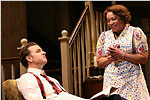
• Come Back, Little Sheba (drama, PG-13, adult subject matter, closes Mar. 16, reviewed here)
• The Farnsworth Invention (drama, PG-13, reviewed here)
• Grease (musical, PG-13, some sexual content, reviewed here)
• The Homecoming (drama, R, adult subject matter, closes Apr. 13, reviewed here)
• Is He Dead? (farce, G, reasonably family-friendly, reviewed here)
• The Little Mermaid * (musical, G, entirely suitable for children, reviewed here)
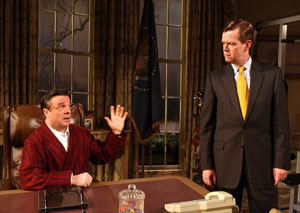
• November (comedy, PG-13, profusely spattered with obscene language, here)
• Rock 'n' Roll (drama, PG-13, way too complicated for kids, closes Mar. 9, reviewed here)
• The Seafarer (drama, PG-13, adult subject matter, reviewed here)
CLOSING SOON:
• The Fantasticks (musical, G, suitable for children old enough to enjoy a love story, closes Feb. 24, reviewed here)
• The New Jerusalem (drama, G, too complicated for children but accessible to mature adolescents, closes Feb. 20, reviewed here)
CLOSING NEXT WEEK:
• The Devil's Disciple (drama, G/PG-13, not suitable for children, closes Feb. 10, reviewed here)
CLOSING SATURDAY:
• Happy Days (drama, PG-13, too complicated for kids, closes Feb. 2, reviewed here)
Posted January 31, 12:00 AM
TT: Almanac
"Many plays--certainly mine--are like blank checks. The actors and directors put their own signatures on them."
Thornton Wilder (quoted in the New York Mirror, July 13, 1956)
Posted January 31, 12:00 AM
January 30, 2008
TT: Almanac
"There's a constitutional amendment that I've been pushing for years without success. It says, 'Anyone willing to do what is required to become president of the United States is thereby barred from taking that office.' I'm only half joking."
Alan Greenspan, The Age of Turbulence: Adventures in a New World
Posted January 30, 12:00 AM
January 29, 2008
CAAF: Morning coffee
• Quiet Bubble's appreciation of The Royal Tenenbaums riffs fruitfully on the film's debt to Charles Schulz's Peanuts.
• If you haven't yet caught up with Lizzie Skurnick's wonderful "Fine Lines" feature at Jezebel, now is the time. The series revisits classics of children and YA literature. The subject of last week's entry was Katherine Paterson's Jacob Have I Loved, a book I haven't re-read in a long while but which I think about all the time. (Random, inside-baseball observation: Lately I've taken to hoping that Lizzie will write a girl detective series with a heroine named Mirabile Dictu. Or if not Lizzie, someone should write it.)
• Speaking of such, The Independent gets ten writers to share their failed darlings, the books they wrote or planned to write that never made it into print. Like Jenny, from whom I pinched the link, I was especially charmed by Amanda Cross's entry, which begins:
I have a few "sock drawer novels" knocking around - a dreadful romantic thriller set on Capri, a historical tragedy inspired by the life of the poet Catullus and a mock-Gothic mystery involving the Brothers Grimm. All were half-written in my teens and early twenties, when I was under the delusion that fiction was about fame, money and the love of beautiful men.
Two things: 1) I would happily read any and all of those books as outlined; and 2) fame, money and the love of beautiful men are the main reasons I write: Don't take away my dreams, Cross!
Posted January 29, 12:30 AM
TT: Almanac
"The historian's job is to aggrandize, promoting accident to inevitability and innocuous circumstance to portent."
Peter Conrad, The Art of the City
Posted January 29, 12:00 AM
January 28, 2008
TT: Coming up for air
On Saturday I took Mrs. T and her father to see Sweeney Todd at a small-town Connecticut multiplex. It was the first time in two and a half years that I'd seen a movie in the company of a paying audience. The night before, she and I drove down to Fairfield University to catch a performance by the Acting Company of Orson Welles' Moby Dick Rehearsed. Prior to that evening I hadn't set foot outside our rural Connecticut home since arriving there nine days ago, save for the most pressing reasons. I was busy writing the ninth and tenth chapters of Rhythm Man, my biography of Louis Armstrong, which between them come to 16,300 words. I also wrote a thousand-word drama column for The Wall Street Journal, and on Sunday I wrote a 2,500-word review-essay for Commentary about a new book called The Mighty Wurlitzer.
That's a whole lot of words, and it doubtless explains why I haven't been returning my calls lately, as well as why my blogging has been a bit desultory. Mrs. T and I are returning to New York tomorrow morning, and come Wednesday I expect to be plugged into the world again. For the moment, though, my head is still spinning. I expected at most to finish a rough draft of Chapter 9 of Rhythm Man last week, not to come back to New York with two fully polished chapters in my suitcase. I haven't had an experience quite like this since the orgy of work in January and February of 2004 that led to the completion of my last book, All in the Dances.
Such experiences are not the stuff of everyday life, and I need a break. Alas, I'm not getting one. My goal is to get another chapter of Rhythm Man written between now and February 9, when I fly to California to see six shows in the Los Angeles and San Francisco areas. But the end is finally in sight, and I can't begin to tell you how exciting that feels.
Sometimes I wish I lived the kind of life that would allow me to do nothing but write books. Not often, though: I'm well aware that I thrive on being able to move at will from task to task, and I love seeing two or three shows each week. Whether that makes me a better writer is, of course, another matter, and not for me to judge. My guess is that we are what we are, pretty much, and that I probably write about as well as I can, whether I'm busy or not.
But enough speculation: I have work to do, and while I'm doing it, I'll leave you with a fresh snippet of Chapter 10. I hope it pleases you.
* * *
In 1940 Jack Kapp, who ran Armstrong's record label, unbent so far as to allow the trumpeter to cut a small-group date for Decca, his first of any significance since he had started recording with big bands in 1929. He did so in the stimulating company of Sidney Bechet, with whom he had made some of his best recordings of the Twenties. The session, which also featured Luis Russell and Zutty Singleton, was a deliberate attempt to evoke the old days. The tunes included "2:19 Blues," a traditional New Orleans lament that Jelly Roll Morton recorded the same year, and "Coal Cart Blues," a song by Armstrong himself in which he sang about selling coal on the streets of Storyville. It was touching to hear Armstrong and Bechet playing together for the first time in a decade and a half, but the results were musically uneven, and Bechet, for one, thought he knew why: "Louis, it seemed like he was wanting to make it a kind of thing where we were supposed to be bucking each other, competing instead of working together for that real feeling that would let the music come new and strong...it was like he was a little hungrier."
It didn't help that Decca's engineers buried Bechet in the mix (he is barely audible behind Armstrong's vocals). Just as important, though, the trumpeter was competing against himself when young, and his younger self had been given a decidedly unfair advantage by one of Jack Kapp's competitors. Life's 1938 article about the history of swing had inspired Ted Wallerstein, a Columbia Records executive, to hire George Avakian, a Yale undergraduate who was producing small-group jazz records on the side, to troll through the company's vaults and put together a series of reissue albums of "the original recordings that made jazz history." The resulting "Hot Jazz Classics" line was launched in 1940 with King Louis, a four-disc set that contained eight sides by the Hot Five and Seven, two of them previously unreleased. At last "Heebie Jeebies," "Potato Head Blues," and "Knockin' a Jug" were available again, packaged in a fetching yellow-and-red album. Columbia followed up King Louis with sets devoted to Bix Beiderbecke, Fletcher Henderson, and Bessie Smith, plus a second album of Hot Fives and Sevens whose liner notes, written by Avakian, proclaimed "Armstrong's early OKeh records" to be "perhaps the most important he ever made--and the best."
True or not, they were certainly better than the four new sides he had recorded with Bechet, an experiment that in any case would not be repeated. Armstrong may have longed in his heart to be playing small-group jazz, but he knew that the big money, at least for now, was in big bands. He had watched Joe Oliver hesitate over leaving Chicago for New York: "The agents and everybody...had wanted to bring him in someplace, any night club, with his band. But Joe wouldn't leave. 'I'm doing all right here, man,' he'd tell them. He had good jobs with good tips. So time ran out on him. He looked around, and when he came to New York--too late."
That had been bad enough. Then, in 1937, Armstrong had run into his mentor on the streets of Savannah, pushing a vegetable cart and looking old and desperately tired. He emptied his pockets and gave all the cash he had to Oliver. That same night Papa Joe came to the dance at which Armstrong's band was playing, looking "sharp like the old Joe Oliver of 1915....Stetson hat turned down, high-button shoes, his box-back coat. He looked beautiful and he had a wonderful night, just listening to us--talking." A year later he was dead, and a year after that Armstrong received a letter from Bunk Johnson, another of the musicians he had known as a boy in New Orleans: "Your old boy is down and in real deep need for an upper plate and also a bottom plate and cannot make money enough to have my mouth fixed....Let your friend Bunk hear from you as I cannot blow any more." That settled it. Armstrong may not have wanted to die rich, but neither did he mean to live poor.
Posted January 28, 12:00 AM
TT: Almanac
"Between labor and play stands work. A man is a worker if he is personally interested in the job which society pays him to do; what from the point of view of society is necessary labor is from his point of view voluntary play. Whether a job is to be classified as labor or work depends, not on the job itself, but on the tastes of the individual who undertakes it. The difference does not, for example, coincide with the difference between a manual and a mental job; a gardener or a cobbler may be a worker, a bank clerk a laborer."
W.H. Auden, A Certain World: A Commonplace Book
Posted January 28, 12:00 AM
January 25, 2008
CAAF: Lookie loo
A review in the TLS of a new edition of Aldous Huxley's letters devotes special attention to the author's complicated relationship with Mary Hutchinson, noting:

What was kept a close secret was that the [Huxley] marriage went through a long period during which both Maria and Aldous were sexually involved with Mary Hutchinson - a writer, married to a barrister. She was also, but less discreetly, a mistress of Clive Bell's. (An unflattering portrait of her by Bell's wife, Vanessa, is now in the Tate.)
Emphasis is mine; the "unflattering portrait" is the sour, lemony one shown here. The Tate's display caption for the painting reads in part, "This portrait shows the short-story writer Mary Hutchinson. She was the mistress of Bell's husband Clive, a fact of which Bell was aware. This may account for the unflattering nature of the portrait. When it was exhibited, to the sitter's consternation, Vanessa Bell wrote 'It's perfectly hideous... and yet quite recognisable.'"
Image taken from the Tate's website. © Estate of Vanessa Bell.
Posted January 25, 12:00 PM
CAAF: Morning coffee
• "Fumes made me go lowbrow, said writer." (Via.)
• It's already been widely linked to but as an Amazon review obsessive I'm obliged to point you toward Garth Risk Hallberg's intelligent essay on the phenomenon. His thesis: that the top reviewers aren't so much disinterested amateurs as they are "a curious hybrid: part customer, part employee." (My favorite Amazon reviewer is G. Gibson of Rome, Italy. Misunderstood, maligned: I've spent a lot of time thinking about G. Gibson and eagerly await his definitive translation of The Aeneid, which will show all others as the grievous abominations they are.)
• A gallery of photos related to D.H. Lawrence and the Lady Chatterley's Lover trial.
Posted January 25, 8:00 AM
TT: Who was that masked man?
Yesterday I wrote the first 4,600 words of Chapter 10 of Rhythm Man: A Life of Louis Armstrong from a standing start, beginning at eight in the morning and ending at four-thirty in the afternoon. I still don't know what hit me, or what I hit.
More as it happens. In the meantime, forgive me if I don't call you back, no matter who you are. In the immortal words of Crash Davis, a player on a streak has to respect the streak....
UPDATE: I finished Chapter 10 five minutes ago. I am the king of the cats!
Posted January 25, 12:00 AM
TT: Return of a master
In today's Wall Street Journal drama column I review two plays, Come Back, Little Sheba and Almost an Evening. Here's a sample.
* * *
What happened to William Inge? Between 1950 and 1957 he racked up a stunning track record on Broadway--four plays, four hits--and all of his theatrical successes were turned into big-budget Hollywood movies with blue-chip casts. ("Bus Stop" starred Marilyn Monroe, while the Pulitzer-winning "Picnic" featured William Holden and Kim Novak.) For a time critics ranked him right behind Arthur Miller and Tennessee Williams. But Inge lost his sureness of touch as the buttoned-down '50s gave way to the unsettled '60s, and after a string of flops, he fled to California to teach and drink, dying by his own hand in 1973. Unlike his more celebrated colleagues, he then vanished down the memory hole, and except for a pair of failed revivals of "Bus Stop" and "Picnic" in the mid-'90s, none of his plays has been seen on Broadway since 1975. Thus it is very big news indeed that "Come Back, Little Sheba" has just been revived on Broadway for the first time since the original production opened there 57 years ago--and that this deeply moving revival, which stars S. Epatha Merkerson of "Law & Order," is pitch-perfect from curtain to curtain.
A good staging can't save a bad play, but it can paper over the cracks in a creaky one, so I want to start off by saying that "Come Back, Little Sheba" is close to flawless. I'd never seen it on stage prior to this revival, and I had no idea what a wallop it packed. It is, like all of Inge's major plays, a tale of disappointment and frustration set against a shabby, penny-plain backdrop of ordinary middle-class life--you might be watching an Edward Hopper painting come to life--and much of its impact arises from the patience with which the author deals his thematic cards, waiting until just the right moment to throw down his hand and fill the stage with pain and sorrow....
I'm no fan of the Coen brothers, whose smirking nihilism has always left a nasty taste in my mouth. Still, you can't help but respect the sheer professionalism of films like "Fargo," "O Brother, Where Art Thou?" and "No Country for Old Men," and so I was eager to see what "Almost an Evening," Ethan Coen's playwriting debut, might have to offer. The answer, as befits a nihilist, is nothing whatsoever....
* * *
Read the whole thing here.
Posted January 25, 12:00 AM
TT: Almanac
"Great simplicity is only won by an intense moment or by years of intelligent effort, or by both. It represents one of the most arduous conquests of the human spirit: the triumph of feeling and thought over the natural sin of language."
T.S. Eliot (The Athenaeum, Apr. 11, 1919)
Posted January 25, 12:00 AM
January 24, 2008
TT: Milestone
Yesterday I wrote my drama column for Friday's Wall Street Journal in the morning, then conferred by telephone with Paul Moravec about the fourth scene of The Letter. In the afternoon I finished writing the ninth chapter of Rhythm Man: A Life of Louis Armstrong. I have three chapters to go.
I can't quite grasp the fact that I knocked off an entire chapter in three days. (It must be Mrs. T's cooking.) Needless to say, I plan to push on to Chapter 10 at once, but for the moment I feel like celebrating. In case you care to join me, here's an excerpt from the chapter I just wrote.
The year is 1937. Armstrong has just signed with a new manager and a new record label, made his feature-film debut in Bing Crosby's Pennies from Heaven, and become the first black person to host his own variety show on radio. He is now famous, not just in the world of jazz or among his fellow blacks but to the American public at large. This is a brief glimpse of what his life is like.
* * *
Being a star made little difference to Armstrong's everyday life. He had always been an uncomplaining workhorse, and Joe Glaser, his new manager, worked him harder than ever now that he was starting to make serious money. "Once we jumped from Bangor, Maine, to New Orleans for a one-nighter, then on to Houston, Texas, for the next night," Pops Foster, Armstrong's bassist, recalled in his autobiography. He lived in the continuous present, playing pretty for the people, grabbing a bite to eat between shows, signing autographs after the last set, rapping out a dozen letters on his portable typewriter before bedtime, then repeating the cycle the next day. After each dance he peeled off his sweat-drenched clothes and cleaned himself as best he could. "I mean, you see, places did not have them fine dressing rooms and showers and things then," Charlie Holmes said. "You just waited until everybody got out of the place, and then he could change his clothes after everybody had gone, and dry himself with his own towels and things." It wasn't always that rough--sometimes the band traveled by private railroad car--but more often they rode the bus, and Armstrong rode it with them. "He was a hard worker and a hard-workin' man," Holmes added, "and he didn't ask you to do nothin' that he wouldn't do."
Few survivors of the big-band era have been inclined to romanticize the rigors of life on the road. Charlie Barnet summed it up in six devastatingly well-chosen words: "You stay tired, dirty and drunk." The trombonist Mike Zwerin, who toured with Claude Thornhill in the Fifties, was more expansive about its horrors: "You skim more than read, pass out rather than fall asleep. You work when everybody else is off, breakfast in the evening, dinner at dawn. Disorder is the order, physical alienation is so powerful, so omnipresent, that no treatment seems to extreme. Nobody can even question the need for treatment. Playing chess will not do the trick. You've got to find a familiar internal place to hang on to, it's a matter of survival. And there is one place, a warm corner called stoned." Armstrong curled up in that corner most nights, though he was disciplined in his use of marijuana, his drug of choice. "He never worked with it," said one of his sidemen. "He'd wait until he got off and get with his typewriter and hunt and peck jokes. When he'd write someone a letter, that would be his letter. He'd send them a joke....Write jokes every night. Get off of work, put some salve on his lips, handkerchief on his head."
It was no way to live, but the trumpeter knew no other, and he appeared by all accounts to thrive on it. His playing, according to Charlie Holmes, was better than ever: "Other trumpet players would hit them [high] notes, just like they do nowadays. They'd be hitting high notes, but they sound like a flute up there or something. But Louis wasn't playing them like that. Louis was hittin' them notes right on the head, and expanding. They would be notes. He was hittin' notes. He wasn't squeakin'. They wasn't no squeaks. They were notes. Big, broad notes. And nobody had never heard no trumpet player like that before....The higher he went, the broader his tone got--and it was beautiful!"
But even Armstrong had his limits, and Glaser, unlike his predecessor, was smart enough to recognize them. In 1937 he hired J.C. Higginbotham and Henry "Red" Allen, both of whom had graced Luis Russell's group back in the days when it was known as one of the hottest bands in Harlem. Allen, a fellow New Orleans expatriate and alumnus of Fate Marable's floating conservatory who had, like Armstrong, worked with Joe Oliver and Fletcher Henderson, was a hugely imaginative trumpet soloist with a knack for making harmonically "wrong" notes sound right. Not only had he recorded with Armstrong back in 1930, but the two men had even split a chorus on "I Ain't Got Nobody," interweaving their styles so seamlessly that few could (or can) tell them apart. Glaser hired Allen to be Armstrong's relief man, a role he played so well that he would be billed as "LOUIS ARMSTRONG'S UNDERSTUDY."
Armstrong featured Allen extensively at his public appearances. "Louis gave Red an hour's time on his own, to play his own numbers....Red could do anything he wanted to play," Charlie Holmes said. In the recording studio, by contrast, Allen stuck exclusively to ensemble parts--he only recorded one solo with the Armstrong band--but that was fine with him. "It was no fault of Louis', and I played plenty with the band," he recalled. "It was a happy feeling. I don't care whose band it was, I'd have been happy about it if Louis was there, because I enjoy being in his company so much, on and off the bandstand."
Armstrong was glad to have him there, too. At the age of thirty-six he was learning at last how to burn the bright candle of his talent at one end, and for the rest of his life he would take care to make room on the bandstand for musicians who could help him carry the load without stealing the show out from under him....
Posted January 24, 12:00 AM
TT: So you want to see a show?
Here's my list of recommended Broadway and off-Broadway shows, updated weekly. In all cases, I gave these shows favorable reviews in The Wall Street Journal when they opened. For more information, click on the title.
Warning: Broadway shows marked with an asterisk were sold out, or nearly so, last week.
BROADWAY:
• Alfred Hitchcock's The 39 Steps (comedy, G, suitable for bright children, closes Mar. 23, reviewed here)
• August: Osage County (drama, R, adult subject matter, closes Apr. 13, reviewed here)
• Avenue Q * (musical, R, adult subject matter and one show-stopping scene of puppet-on-puppet sex, reviewed here)
• A Chorus Line (musical, PG-13/R, adult subject matter, reviewed here)
• The Farnsworth Invention (drama, PG-13, reviewed here)
• Grease (musical, PG-13, some sexual content, reviewed here)
• The Homecoming (drama, R, adult subject matter, closes Apr. 13, reviewed here)
• Is He Dead? (farce, G, reasonably family-friendly, reviewed here)
• The Little Mermaid * (musical, G, entirely suitable for children, reviewed here)
• November (comedy, PG-13, profusely spattered with obscene language, here)
• Rock 'n' Roll (drama, PG-13, way too complicated for kids, closes Mar. 9, reviewed here)
• The Seafarer (drama, PG-13, adult subject matter, reviewed here)
OFF BROADWAY:
• The Fantasticks (musical, G, suitable for children old enough to enjoy a love story, closes Feb. 24, reviewed here)
• The New Jerusalem (drama, G, too complicated for children but accessible to mature adolescents, extended through Feb. 20, reviewed here)
CLOSING SOON:
• The Devil's Disciple (drama, G/PG-13, not suitable for children, closes Feb. 10, reviewed here)
CLOSING NEXT WEEK:
• Happy Days (drama, PG-13, too complicated for kids, closes Feb. 2, reviewed here)
Posted January 24, 12:00 AM
TT: Almanac
"People say we're a country divided, but we're not a country divided. What we are is a democracy."
David Mamet, November
Posted January 24, 12:00 AM
January 23, 2008
OGIC: Morning coffee
Yep--I'm stealing a page from Carrie's playbook. It's a good book!
● David Ulin is wary of rereading once-loved books:
...you never know how a book will stick the second time around, whether it will continue to resonate or leave you oddly unfulfilled. That's what happened with "Wise Blood," a book that I revered in my late teens and early 20s; when I reread it this year, at the age of 45, it seemed to me less like a fully realized work of fiction than a young writer's pastiche, flat in its way, two-dimensional, not about life as it really is but a naif's projection of the way life could be.It's depressing when you lose a book like that, which is exactly what has happened: I've lost "Wise Blood" for good. It makes you gun-shy, wary of returning to an author; although O'Connor's second novel, "The Violent Bear It Away" (Farrar, Straus & Giroux, $14 paper), was also recently reissued, I can't bring myself to reread it, since I don't want it to dissipate for me as well.
● Peter Suderman thinks that blogs are the vehicle that television criticism has been waiting for all these years:
Clearly, [the blogging of The Sopranos' last season] showed that the two mediums belong together. Traditional newspaper reviewing has never been all that successful at writing about television. Reviewers are given a few episodes of a show before a season begins and expected to extrapolate, based on just a few, early hours, on the show's potential for success. But in the age of lengthy, arc-driven serials, one-time coverage of a story's beginning doesn't cut it. It's the equivalent of a movie reviewer writing a review after seeing only the film's first act. (Admittedly, this is easier than it sounds; rare is the movie that eventually reverses whatever opinion I hold of it at the 45 minute mark. But though you can often tell whether a film will be any good, it won't leave you with much to actually say about it - which explains some of the weaknesses in television criticism.)Even more to the point, regular blogging can cover the water-cooler buzz surrounding a show during a season. Part of the fun of being a TV fan these days is the anticipation, the guessing games, the questions and the chatter. No newspaper can really afford to devote enough column inches to the sort of obsession and minutiae that has become de rigueur for television fandom.
Posted January 23, 10:54 AM
TT: Almanac
"An opera has to have a foundation; something big, like unhappy love, or vengeance, or some point of honor. Because people are like that, you know. There they sit, all those stockbrokers and rich surgeons and insurance men, and they look so solemn and quiet as if nothing would rouse them. But underneath they are raging with unhappy love, or vengeance, or some point of honor or ambition--all connected with their professional lives. They go to La Bohème or La Traviata and they remember some early affair that might have been squalid if you weren't living it yourself; or they see Rigoletto and think how the chairman humiliated them at the last board meeting; or they see Macbeth and think how they would like to murder the chairman and get his job. Only they don't think it; very deep down they feel it, and boil it, and suffer it in the primitive underworld of their souls. You wouldn't get them to admit anything, not if you begged. Opera speaks to the heart as no other art does, because it is essentially simple."
Robertson Davies, The Lyre of Orpheus (courtesy of Alex Ross)
Posted January 23, 12:00 AM
January 22, 2008
TT: Lost in the ozone
Since arriving in Connecticut on Saturday evening, I've written nearly seven thousand words of the ninth chapter of my Louis Armstrong biography (which for the moment is now tentatively retitled Rhythm Man: A Life of Louis Armstrong). It feels as though I'd rammed a spade into the ground and struck oil on the first try.
For the moment I can't think about anything else--all I want to do is sit at the computer and write--and Mrs. T is being unbelievably patient with me. We went to the grocery store this afternoon to stock up for the coming week, and I actually got lost at one point. Instead of paying attention to what we were doing, I started thinking about Armstrong's Hollywood career, pushed the cart down the wrong aisle, and vanished from sight for a good five minutes.
I expect to return to the real world a little later this week, but for the moment it's 1938 in my head.
Please bear with me....
Posted January 22, 4:39 PM
CAAF: Original sin
I very much like Christina Rossetti's "Goblin Market" and revisit the poem (story? fairy tale?) every so often. Re-reading it this past time, I was struck by how much Laura's sin, of eating the goblin fruit, has its mirror in the new food asceticism, which also at times equates eating the wrong things with immorality. (I'm thinking of the Skinny Bitches and their ilk, though one imagines the only objection the Skinny Bitches would have to goblin fruit is if it wasn't organic.)
If this idea is phrased inelegantly, just be grateful I didn't approach you with any of the "Discussion Questions" that run alongside the poem. It's hard to imagine the discussion that wouldn't be stopped dead in its tracks by "feminist poem or religious allegory?"
Recently, Guardian blogger Shirley Dent took up a similar line of thought, finding parallels between the advice of modern diet books and 13th-century religious guides for women that warn, "Lechery comes from gluttony and from enjoyment of the flesh, for as St Gregory says, 'Food and drink beyond what is right give birth to three broods: frivolous words, frivolous deeds, and lechery's desire'".
Posted January 22, 12:18 AM
CAAF: Probably should put this on my Tumblr.
We are suffering an incursion of mice in the kitchen. This is the sort of thing the cat used to take care of, but she appears to have retired. In the evenings she's taken to sitting in the doorway and watching as mice dance back and forth across the floor, swishing her tail and forth like she's at a particularly enjoyable performance of The Nutcracker.
So a few nights ago we put out traps. Two different kinds; eight in all: Enough to booby-trap the main drawers and cabinets. Mr. Tingle just checked them and made this report:
1. No mice caught.
2. Peanut-butter bait has been eaten from all traps.
3. Three of the traps have been crapped on.
About the last he says, "Now I know what it's like to be bitch slapped by a mouse."
Posted January 22, 12:10 AM
TT: Almanac
"Blue as you enter it disappears. Red never does that. Every article of air might look like cobalt if we got outside ourselves to see it. The country of the blue is clear."
William H. Gass, On Being Blue: A Philosophical Inquiry
Posted January 22, 12:00 AM
January 21, 2008
TT: The piece I'll never read
I recently wrote about Harry Haskell's Boss-Busters and Sin Hounds, a history of the Kansas City Star, in my weekly online book column. One of the passages that struck me most forcibly was this description of how William Rockhill Nelson, the paper's founder, oversaw its coverage of his own death:
Nelson's obituary consumed two full pages of the April 13 edition. Autocratic to the last, the famously publicity-shy editor had made sure it said no less--and no more--than he wanted it to say. Mostly written by Ralph Stout, Henry Haskell, and A.B. Macdonald, the editor's death notice had been set in type weeks earlier and brought to Oak Hall for Nelson's approval.
H.L. Mencken, by contrast, did what he could to keep his obituary short and to the point, tucking the following note into his clip file in the morgue of the Baltimore Sun: "Save in the event that the circumstances of my death make necessary a news story it is my earnest request to my old colleagues of the Sunpapers that they print only a brief announcement of it, with no attempt at a biographical sketch, no portrait, and no editorial." Not surprisingly, the Sun's most celebrated staffer didn't get his wish. As I wrote in The Skeptic, my Mencken biography:
Some imperatives, however categorical, are meant to be ignored, and the editors of the Sun brushed this one aside without a second thought. The main story in Monday's paper broke the news simply: "Henry Louis Mencken, newspaper man, critic, wit and Baltimore's best-known writer, died early yesterday in his sleep at his house on Hollins street." But it was accompanied by a two-column portrait (in which Mencken, as was his wont when posing for formal photographs, contrived to look puzzled) and a page-one obituary by Hamilton Owens that ended on a personal note: "This is not the place or the time for any final appraisal of H.L. Mencken's contribution to the culture of the United States. But whatever the conclusions of the students of such things, his colleagues on THE SUN had the benefit, over many years, of association with one of the most stimulating personalities of their time."
I used to admire Mencken's determination to avoid that kind of retrospective fanfare, but I've since changed my mind. It was, I now believe, a peculiarly twisted kind of vanity: he knew perfectly well that he was going to get the hats-off treatment, and arranged it so that posterity would marvel at his modesty. I no longer find that kind of inverted posturing attractive. As Golda Meir is supposed to have said to someone who played the same card in her presence, "Don't be so modest--you're not that great."
Newspapers take care of their own, so I suppose I'll be treated to a shortish obituary when the time comes (and no, I'm not anticipating its early arrival). Presumably its author will mention my longstanding relationships with The Wall Street Journal and Commentary, my books, my collaboration with Paul Moravec on The Letter, my profoundly happy marriage to Mrs. T, and--I hope--this blog. Beyond that I doubt there'll be any personal details, nor should there be: I'm not famous and don't expect to become so between now and then. Nor am I witty enough to come up with a self-penned epitaph as irresistibly quotable as the one Mencken left behind: "If, after I depart this vale, you ever remember me and have thought to please my ghost, forgive some sinner and wink your eye at some homely girl."
But no matter what gets published about me on the day after the Distinguished Thing comes to call, this much is certain: I won't read it. Unless you happen to own a newspaper, you don't get to read your own obituary. And that's probably as it should be. I've written some pretty sharp remarks about the recently deceased, after all, and I wouldn't be surprised if somebody remembered them when my own time comes--or maybe not. Perhaps I'll outlive my own minor renown and be remembered solely, as I once speculated in this space, for having owned a Max Beerbohm caricature. Would I want to know that now? Not really. I have a pretty good sense of irony, but I'm not sure it's that robust.
Which reminds me that Beerbohm himself once wrote a wickedly funny short story called Enoch Soames about an obscure Victorian poet who sold his soul to the devil in return for a chance to peer into the future and see what the readers of the next century would think of his work. Soames jumped into Satan's time machine, set the controls for June 3, 1997, went straight to the reading room of the British Museum, and looked himself up in a volume called Inglish Littracher 1890-1900. (It seems that England in 1997 had succumbed to the blight of simplified phonetic spelling.) This is what it said:
Fr egzarmpl, a riter ov th time, naimed Max Beerbohm, hoo woz stil alive in th twentith senchri, rote a stauri in wich e pautraid an immajnari karrakter kauld "Enoch Soames"--a thurd-rait poit hoo beleevz imself a grate jeneus an maix a bargin with th Devvl in auder ter no wot posterriti thinx ov im! It iz a sumwot labud sattire, but not without vallu az showing hou seriusli the yung men ov th aiteen-ninetiz took themselvz. Nou that th littreri profeshn haz bin auganized az a departmnt of publik servis, our riters hav found their levvl an hav lernt ter doo their duti without thort ov th morro. "Th laibrer iz werthi ov hiz hire" an that iz aul. Thank hevvn we hav no Enoch Soameses amung us to-dai!
Poor Enoch. Some things are better left unread.
* * *
Here's a deliciously straight-faced parody of a nonexistent book called Enoch Soames: The Critical Heritage.
Posted January 21, 12:00 AM
TT: Almanac
White birds over the grey river.
Scarlet flowers on the green hills.
I watch the Spring go by and wonder
If I shall ever return home.
Tu Fu, "Another Spring" (trans. Kenneth Rexroth)
Posted January 21, 12:00 AM
January 20, 2008
BOOK
Sarah Caudwell, Thus Was Adonis Murdered. Before her death, in 2000, Sarah Caudwell wrote four mysteries, each one a little jewel of comedy and elegant construction. It's my fond wish that these will someday be published in a single omnibus volume. Alas, that day may be some time away; Caudwell's books have fallen out of print in the U.S., although used copies are widely available (you'll want the editions with the Edward Gorey covers). Begin with this one, which introduces Caudwell's merry cast of young London barristers and their friend (and chronicler) Professor Hilary Tamar. Read it the first time for the mystery; then re-read it again and again for a first-class entertainment (CAAF).Posted January 20, 3:19 PM
January 19, 2008
TT: The death effect
Why do the reputations of some artists go into eclipse immediately after their deaths, while others leave obscurity behind and become household names? In this week's Wall Street Journal "Sightings" column, I take a look at what I call the Death Effect, and consider its wide-ranging impact on the posthumous reputations of Béla Bartók, George MacDonald Fraser, Oscar Peterson, and Johannes Vermeer.
To find out more, pick up a copy of the Saturday Journal and turn to the "Weekend Journal" section, or go here to read my column online.
Posted January 19, 12:00 AM
January 18, 2008
CAAF: Loose notes
"He had come from Rome. 'Oh, Rome?' she exclaimed. 'How lovely!'
He shrugged: 'Too many nice people.'
She was surprised. He reflected on Roman society, but had enjoyed himself. Though not, evidently, a son of the Church, he was on the warmest of terms with it; prelates and colleges flashed through his talk, he spoke with affection of two or three cardinals; she was left with a clear impression that he had lunched at the Vatican. As he talked, antiquity became brittle, Imperial columns and arches like so much canvas. Mark's Rome was late Renaissance, with a touch of the slick mundanity of Vogue. The sky above Rome, like the arch of an ornate altar-piece, became dark and flapping with draperies and august conversational figures. Cecilia -- whose personal Rome was confined to one mildish Bostonian princess and her circle, who spent innocent days in the Forum displacing always a little hopefully a little more dust with the point of her parasol, who sighed her way into churches and bought pink ink-tinted freezias at the foot of the Spanish steps -- could not but be impressed."
Elizabeth Bowen, To the North
Posted January 18, 2:21 PM
CAAF: And I am Marie of Roumania.
Not to be the autocrat at the kitchen table but I hope at least some of you will watch the PBS production of Northanger Abbey this Sunday night. I'll be on the couch, in my cardigan with the Kleenex-stuffed sleeves, and it'd be nice to think there are others out there doing the same, like a thousand points of cat ladies. If they managed to make something so interestingly loopy out of a source as quiet and bittersweet as Persuasion I can't wait to see what gets done with Northanger Abbey, which is already a little schizophrenic as novels go.
Also on the decree front: Last night I was rattling around the house looking for a vampire novel. (We raged a little hard for Mr. Tingle's birthday on Wednesday night and I spent most of yesterday feeling like Charles Bukowski. Like, my kingdom for a fried-egg sandwich.) No hidden caches of vampire novels revealed itself, so I picked up To The North by Elizabeth Bowen instead. I'm not all that far in but I already want to order everyone in the world to read it too. I had some misguided idea that I wouldn't like Bowen's novels, that they'd be too glassy or formal. But they're not, or at least this one isn't. Just beautiful.
Posted January 18, 2:15 PM
BOOK
William Maxwell, Early Novels and Stories (Library of America, $35). At last--at last!--the Library of America brings out the first in a pair of volumes devoted to the writings of the New Yorker editor who in his spare time produced some of America's most lyrical and poignant fiction. Maxwell was never widely recognized in his lifetime, nor is he well known now, but connoisseurs covet his books with obsessive passion. (Don't take my word for it--read this.) Start with The Folded Leaf, his exquisitely sensitive 1945 novel of adolescent friendship, and go from there (TT).Posted January 18, 11:09 AM
TT: Funny man gets serious
I review three plays in this week's Wall Street Journal drama column, all in New York and all worth seeing: New Jerusalem, November, and Alfred Hitchcock's The 39 Steps. Here's a sample.
* * *
David Ives, the highbrow clown who writes explosively funny one-act plays about eggheads like Philip Glass and Leon Trotsky, has now given us a deadly serious two-act play about a 17th-century philosopher--and it's good. "New Jerusalem," in which Mr. Ives grapples with matters of life, death and the hereafter, is so disciplined and persuasive a piece of work that it makes me wonder whether the much-praised author of "Polish Joke" and "All in the Timing" might actually have his best days ahead of him.
The long subtitle of Mr. Ives' play, "The Interrogation of Baruch de Spinoza at Talmud Torah Congregation: Amsterdam, July 27, 1656," is fair warning to casual theatergoers that the laughter in "New Jerusalem," while not nonexistent, will be comparatively scarce. If you passed Philosophy 101, you'll recall that the author of "Tractatus Theologico-Politicus" was a pantheistic skeptic who at the far-from-ripe age of 23 was excommunicated by his co-religionists for promulgating the "abominable heresies" summed up three centuries later by Albert Einstein: "I believe in Spinoza's God who reveals himself in the orderly harmony of what exists, not in a God who concerns himself with the fates and actions of human beings." Nothing, however, is known of the trial that brought about Spinoza's expulsion from Talmud Torah save for the formal writ proclaiming his guilt. In the near-complete absence of concrete information about the proceedings, Mr. Ives has cooked up a courtroom drama of his own devising in which the arrogant young philosopher (Jeremy Strong) and the chief rabbi of Amsterdam (Richard Easton) wrestle passionately with the ever-contemporary problem of faith....
Mr. Ives' Spinoza is not a sober-sided thinker but a smug, immature young punk who revels in his own genius ("I do know a few things about God that nobody else does"). By choosing not to portray his hero heroically, Mr. Ives throws the viewer off balance and ups the dramatic ante several notches. He also takes care to leaven his script with pinches of black humor...
David Mamet is out to amuse in "November," his new play about a president (Nathan Lane) whose fathomless cynicism is matched only by his feckless incompetence. "Romance," Mr. Mamet's previous venture into knock-down-drag-out comedy, was funnier, but "November" contains plenty of triphammer punchlines. (Asked to name his price for a political favor, the Chief Executive replies, "I want a number so high even dogs can't hear it.") Though Mr. Lane is in the wrong show--his acting is too fussy--he gets his laughs anyway, mainly through sheer determination...
If it's pure fluff you crave, the Roundabout Theatre Company delivers the goods with "Alfred Hitchcock's The 39 Steps," a silly sendup of Hitchcock's witty 1935 film version of John Buchan's 1915 thriller. This piece of English toffee is performed by a hard-working cast of four, and much of the fun arises from the fact that two of the actors, Arnie Burton and Cliff Saunders, play most of the parts, changing hats and hurling themselves around the stage with mad abandon. The spoofery, which runs to inch-thick accents, who's-on-first dialogue and nudge-nudge references to other Hitchcock films, is decidedly collegiate...
* * *
Read the whole thing here.
Posted January 18, 12:00 AM
TT: Almanac
"A speech or an essay may be eloquent, but if it is, the eloquence is incidental to its aim. Eloquence, as distinct from rhetoric, has no aim: it is a play of words or other expressive means. It is a gift to be enjoyed in appreciation and practice. The main attribute of eloquence is gratuitousness: its place in the world is to be without place or function, its mode is to be intrinsic. Like beauty, it claims only the privilege of being a grace note in the culture that permits it."
Denis Donoghue, On Eloquence
Posted January 18, 12:00 AM
January 17, 2008
OGIC: Great expectations
Who remembers Jayne Anne Phillips? In high school, in the heyday of my fiction-writing ambitions, I became just possessed by her short stories in the collection Black Tickets. I could recite whole paragraphs of the stuff, which to my teenaged ear had at once a daring, quickening urgency and a quicksand sensuality that could bind you to a word at a time. The story that particularly impressed me was the title story, which starts: "Jamaica Delilah, how I want you; your smell a clean yeast, a high white yogurt of the soul." This, I thought, was how I wanted to write. Go ahead, laugh. I can take it.
Times change, and so do teenagers. I haven't thought about Jayne Anne Phillips in many years, but the bits of her prose I remember don't sound at all like what I'd like to write, if I were still writing fiction; to my adult ear, after a long evolution of taste, they sound for the most part pretentious and a little silly. But I wasn't alone in embracing them. A copy of Phillips's later story collection, Fast Lanes, recently turned up in a used bookstore and I picked it up out of curiosity and nostalgia. Its jacket boasts some pretty heady praise for her previous books (Black Tickets and her novel Machine Dreams) from some pretty powerful literary arbiters.
Robert Stone said "Machine Dreams in its wisdom and its compassionate, utterly unsentimental rendering of the American condition will rank as one of the great books of this decade." Our old friend Michiko Kakutani, writing when still a wunderkind, offered that the novel "will doubtless come to be seen as both a remarkable novelistic debut and an enduring literary achievement." As for Black Tickets, it is called "the unmistakable work of early genius trying her range" (Tillie Olsen) and "unlike any [stories] in our literature" (Raymond Carver). Nadine Gordimer pronounced her "the best short-story writer since Eudora Welty."
Now, I haven't reread Phillips, and any of this may be true. And of course we all know that praise in blurbs and book reviews is chronically overinflated. But it's striking how enormous the claims are in these plaudits, and how very little one hears Phillips discussed today, just a few decades later. She just doesn't seem to be part of the conversation, though she must have influenced some of the writers we do talk about. Without the benefit of rereading her, which I may try to do when I finish the book I'm reading now (Rabbit, Run, if you want to know), it's impossible to say whether she was simply a less prodigious talent than the critics and writers (some of them doubtless her teachers) thought they were beholding or whether Phillips's timing was unlucky, her style soon outmoded as literary taste changed. Who's to say that in another thirty years she won't be rediscovered and newly embraced by a new generation of readers, a la Dawn Powell?
As it happens, JL has been considering similar stories in the visual arts over at Modern Kicks: "It's a familiar enough story: an artist seemingly poised for fame finds the aesthetic winds changing and her formerly-lauded work out of favor," he writes of the painter Sonia Gechtoff, reminding us that failures like hers and Phillips's to fulfill the promise attached to them aren't always really failures at all.
Posted January 17, 9:49 AM
TT: So you want to see a show?
Here's my list of recommended Broadway, off-Broadway, and out-of-town shows, updated weekly. In all cases, I gave these shows favorable reviews in The Wall Street Journal when they opened. For more information, click on the title.
Warning: Broadway shows marked with an asterisk were sold out, or nearly so, last week.
BROADWAY:
• August: Osage County (drama, R, adult subject matter, extended through Apr. 13, reviewed here)
• Avenue Q * (musical, R, adult subject matter and one show-stopping scene of puppet-on-puppet sex, reviewed here)
• A Chorus Line (musical, PG-13/R, adult subject matter, reviewed here)
• The Farnsworth Invention (drama, PG-13, reviewed here)
• Grease (musical, PG-13, some sexual content, reviewed here)
• The Homecoming (drama, R, adult subject matter, closes Apr. 13, reviewed here)
• Is He Dead? (farce, G, reasonably family-friendly, reviewed here)
• The Little Mermaid * (musical, G, entirely suitable for children, reviewed here)
• Rock 'n' Roll (drama, PG-13, way too complicated for kids, closes Mar. 9, reviewed here)
• The Seafarer (drama, PG-13, adult subject matter, reviewed here)
OFF BROADWAY:
• The Devil's Disciple (drama, G/PG-13, not suitable for children, closes Feb. 10, reviewed here)
• The Fantasticks (musical, G, suitable for children old enough to enjoy a love story, closes Feb. 24, reviewed here)
CLOSING SOON:
• Happy Days (drama, PG-13, too complicated for kids, closes Feb. 2, reviewed here)
CLOSING SUNDAY:
• The 25th Annual Putnam County Spelling Bee (musical, PG-13, mostly family-friendly but contains a smattering of strong language and a production number about an unwanted erection, reviewed here)
CLOSING SUNDAY IN MILWAUKEE:
• The Norman Conquests (comic trilogy, PG-13, adult subject matter, reviewed here)
Posted January 17, 12:00 AM
TT: Almanac
"At bottom, every ideal of style dictates not only how we should say things but what sort of things we may say."
C.S. Lewis, preface to the paperback edition of The Screwtape Letters
Posted January 17, 12:00 AM
January 16, 2008
CAAF: Go on, ask me about what's playing at the National Theatre and "ecocritical readings of late medieval English literature"
My big holiday present this year was a subscription to the Times Literary Supplement. I've asked for one for several years, and this year someone finally believed me. I was (and am) over the moon about it, and my first issue arrived in the mail yesterday.
Two other excellent things that recently came in the mail:
• A galley of James Wood's How Fiction Works. You can read a tantalizing bit of it here.
• The Oxford University Press edition of Goethe's Faustus, translated by Samuel Taylor Coleridge. I probably shouldn't admit this to the world wide interweb but the arrival of this made me weep a little, I was so happy (what can I say? It's been a hard winter). As you may remember, I mentioned pining for this book a while back; a couple lux little birds took notice, and OUP was kind enough to send one.
The book is very scholarly and beautiful, with many engravings and an interesting "stylometric analysis" in the back to support the editors' claim that Coleridge was indeed the author of this mysterious 1821 translation (a hypothesis first floated in 1971). A stylometric analysis!
More on both of these books to come. For now just a couple observations:
1. I worry that a stylometric analysis of the contents of my mailbox would show a tiny old don lived at this address.
2. This tiny old don wonders about creating a Venn diagram displaying circles for "people who refer to Oxford University Press as 'OUP'" and "people who after referring to Oxford University Press as 'OUP' have an irresistible urge to follow it up with 'Yeah, you know me.'"
Posted January 16, 12:08 AM
CAAF: It is what it is
Today is Mr. Tingle's birthday. The photograph shown here is one he took this past weekend that I like a whole lot. If you'd like to see others, he keeps a photo blog, which he's lately resumed updating (after leaving a graveyard snap up for the holiday season).
When he started Serial Photo he would leave many of the photos unnamed. I said, "It's going to be hard for people to tell you which photographs they like when they're all called 'Untitled'." He responded with this title.
Photo: "Backyard Buick" by Lowell Allen
Posted January 16, 12:00 AM
TT: Almanac
"They say you lose your head for nostalgia, as you get older. That's also the time when waves of it come sweeping down without warning. You have to ration yourself, or a sudden dose knocks you out, as it did me."
Anthony Powell, Temporary Kings
Posted January 16, 12:00 AM
January 15, 2008
CAAF: Unpersuaded
PBS's presentation of Persuasion was a strange piece of television, wasn't it? In the promos it looked like a typical costume drama. And bits of it were: The costumes, the locations. The actors, the script. However, the camera clearly wanted nothing to do with so expected and static a project, and it roamed and reared about, with an extreme close-up here and a showoff-y long take there. All in all, a surprising way for a camera to act when bonnets and broughams are present.
Since watching it, I've been wondering off and on how that filming style was decided on. Generally, the camera seems to have been charged with acting out everything the stifled heroine Anne Elliot cannot. To be not just an observer, but a confidante and proxy. It's an interesting method for getting around a restrained and introverted heroine, to have the camera compensate for her.
(That, or someone wanted to show off all the tricks he or she learned in film school.)
The end result was distracting at times, nicely moody in others, and not entirely unsuccessful (how's that for a British construction?). I liked actress Sally Hawkin's toothiness and her full Duchess of Cleves face. Besides, the more Jane Austen adaptations I see, the more I admire how durable Austen's novels are in their DNA. They can hold up to all sorts of knocks and indignities.
PBS's Jane Austen series continues through April. Next Sunday is Northanger Abbey.
Posted January 15, 12:00 PM
TT: For better and worse
I was sitting on the couch eating a bowl of high-fiber cereal yesterday morning when the phone rang. It was Paul Moravec, my collaborator on The Letter.
"Can we talk?" he said. "I'm stuck on the high C in scene four. What do we do next?"
Translation: Paul is composing the fourth scene of our opera, in which Leslie Crosbie, the character played by Bette Davis in the 1940 film version of The Letter, shoots her lover dead when he tries to break off their affair. First, though, comes an aria in which Leslie lays it on the line to the faithless Geoff Hammond. Here's part of my text for the aria:
I hate myself for wanting you.
I hate the lust that makes a fool of me,
The heat between my thighs
Whenever I think of touching you.
I hate it all!
And yet...and yet...
I stand before you helpless,
Unable to resist,
A slave of my desire
In this stinking jungle
Halfway around the world from home.
You're all I have,
You're all I want,
And I can never let you go!
Never!
At this point Leslie lets loose with a high C sung triple forte as bombs go off in the orchestra pit. Which brings us to Paul's question: how do you get from Leslie's C to the moment shortly afterward when she shoots Geoff? Obviously some kind of pace-changing transitional device is needed--but what?
"Well, let's talk psychology," I replied. Paul and I spent the next ten minutes delving into Leslie's likely state of mind in the moments leading up to the killing, and how it might be portrayed musically.
"O.K.," he said when we were done. "Makes sense. I'll get to it." He hung up. I finished my now-soggy bowl of cereal, sat down at my desk, and went back to work on chapter eight of my Louis Armstrong biography.
I'd been writing about Armstrong's 1932 European debut, and was summing up the reviews of his opening-night performance at the London Palladium. The most interesting one is by Constant Lambert, a British composer-conductor-critic who knew far more about jazz than most classical musicians of the Thirties: "An artist like Louis Armstrong, who is one of the most remarkable virtuosi of the present day, enthralls us at a first hearing, but after a few records one realizes that all his improvisations are based on the same restricted circle of ideas, and in the end there is no music which more quickly provokes a state of exasperation and ennui."
It happens that Lambert was the first classical musician of importance to write about Armstrong, and I was struck by the negative tone of his comments. Why did so perceptive an artist fumble the ball on so significant an occasion? I spent the rest of the day trying without success to explain why Lambert misunderstood Armstrong, and was growing tired of beating my head against the wall.
The clouds finally lifted at the end of the afternoon and I knocked out the following paragraph:
What inspired this curt dismissal? If Lambert heard only the songs that Armstrong was performing at the Palladium, it is easy to see how he might have failed to recognize the full extent of the trumpeter's imaginative resources. It is striking that on the same occasion he praised Duke Ellington as "a real composer, the first jazz composer of distinction." Perhaps he would have responded differently to Armstrong had he heard "Beau Koo Jack" or "Skip the Gutter" instead of "When You're Smiling" and "You Rascal You." Or not: Lambert was the first of many critics who would fail to see that Armstrong the virtuoso-clown and Armstrong the endlessly fertile improviser were one and the same person.
Breathing a hard-earned sigh of relief, I jumped into the shower, changed clothes, and took a cab to the Jazz Standard to hear Maria Schneider's band. No sooner did I stroll into the club than Maria came up to me.
"Hey, be one of the birds tonight, O.K.?" she said, pressing a small wooden whistle into my hand.
Translation: Maria's band would be playing "Cerulean Skies," a piece from Sky Blue, her new album, that incorporates the sounds of birdsong. Here's how she describes the piece in her liner notes: "We begin in some imaginary forest--South American probably--a paradise filled with bird life. I tried to capture the vibration of such a place through the theme, gradually opening it up as a forest does at the start of every day."
The members of the band supply the sound effects on the record, but at live performances Maria hands out bird calls to selected members of the audience. This was the first time that I'd been asked to do the honors, and I felt unexpectedly nervous.
"You'll throw us a cue, right?" I asked.
"Don't worry," she said. "You'll know when. Oh, one more thing--be sure and project." Then she trotted off.
An hour later the composer of "Cerulean Skies" stood up in front of the band and signaled to Frank Kimbrough, the pianist. He played a cloudy arpeggio. She raised her left hand into the air and waggled her fingers. The club filled with the simulated cries of tropical birds. I took a deep breath, put my whistle to my mouth, and blew a long, warbling tone that trailed off into silence. The band eased in beneath me, and all at once I found myself in the middle of one of Maria's exotic, lushly colored musical landscapes, huffing and puffing for all I was worth. Wait till I tell Mrs. T about this, I thought.
I called her in Connecticut as soon as I got home. "Guess what happened to me tonight?" I said. "I made my debut with the Maria Schneider Orchestra!"
"And guess what happened to me?" she replied. "I nearly froze. It snowed up here last night. The power went out first thing this morning, and it didn't come back on until five o'clock. I pulled out an extra quilt and stayed in bed and read mysteries all day. Then I got up, made a grilled-cheese sandwich and a bowl of tomato soup, and watched a documentary about Jackie Gleason."
"I guess I had a better day than you did," I said, shamefacedly.
"I guess you did," she said, not unkindly.
UPDATE: A friend writes:
I dunno...Mrs. T's day sounds like a perfect day to me.
So far I've received a dozen other e-mails saying the same thing.
Posted January 15, 12:00 AM
TT: Almanac
"Finicky eaters and those who claim they forget to eat are never to be trusted. Absent from their bodies, they are a danger to themselves and others. They scorn pleasure, health, common sense and the call of their animal natures. They are vain, niggling and hard."
Patrick Kurp, Anecdotal Evidence (Jan. 8, 2008)
Posted January 15, 12:00 AM
January 14, 2008
TT: Overdose
I saw six shows on six consecutive days last week, five of them in my capacity as drama critic of The Wall Street Journal:
• The Little Mermaid, the new Disney musical
• A touring production of Samuel Beckett's Happy Days starring Fiona Shaw
• A workshop production of a new play by a friend of mine
• Classic Stage Company's off-Broadway production of New Jerusalem, a new play by David Ives whose subtitle is "The Interrogation of Baruch de Spinoza at Talmud Torah Congregation: Amsterdam, July 1656"
• A modern adaptation of Euripides' The Trojan Women performed at Harlem's Gatehouse by the Classical Theatre of Harlem
• The 39 Steps, a four-person spoof of the 1935 Alfred Hitchcock film
How much is too much? That much. To see any six plays in a single week would be a burden. To see an unbroken string of such widely varied shows, three of which were intellectually demanding, is a damned hard row to hoe. Nor did it help that I was simultaneously spending my days writing last Friday's Wall Street Journal drama column, opening a mountain of accumulated mail, drafting and polishing three sets of new lyrics for The Letter, restarting my temporarily stalled Louis Armstrong biography, and buying a new cellphone to replace my old one, which broke into two pieces Thursday morning due to circumstances beyond my control (don't ask).
Is it possible to be receptive to art in such distracting conditions? I sure as hell hope so, since that's my job. What's more, I think the five people who accompanied me to the shows I saw last week would be the first to tell you that I managed to tune out the world and pay close and careful attention to all six of them. Once I settle myself in my aisle seat and take a few deep breaths, it's rarely a struggle for me to involve myself in what's happening onstage.
Nevertheless, I'll be the first to admit that I didn't see any of those shows under anything like ideal circumstances. I would have preferred to savor each one individually instead of cramming them down seriatim like a contestant in a wienie-eating contest, just as I would have preferred to clear my head between shows by partaking of other kinds of art. No such luck: I didn't visit any galleries, didn't watch any movies, didn't listen to any music other than as background accompaniment to my daily labors. I did manage to read a book, but it was for professional reasons, not pleasure. I got a copy of Mosaic's new Woody Herman box in the mail, but I haven't even opened it yet, much less listened to it.
This week, I'm relieved to say, will be somewhat different. Tonight I'm going to slog through the snow to hear Maria Schneider at the Jazz Standard. Tomorrow afternoon I'm taking a friend to see the Jane Freilicher show at Tibor de Nagy Gallery. I have three plays on my schedule, all of which look promising. Come Saturday morning I'll head up to Connecticut, and Mrs. T has promised to cook something special when I get there. No, it's not a vacation, but it's still a wonderful life, even when it gets slightly out of hand, as it did last week.
"I have the best job in the world," I told Sarah as we left the theater last Friday night.
"You say that every time we see a show together," she said.
"Well, it's true," I replied. And it is, really and truly.
Posted January 14, 12:00 AM
TT: Almanac
"In most of mankind gratitude is merely a secret hope of further favors."
La Rochefoucauld, Sentences et Maximes Morales
Posted January 14, 12:00 AM
January 11, 2008
CAAF: Afternoon coffee
• Timothy Wu makes a convincing case for why J.K. Rowling should lose her copyright lawsuit against the Harry Potter Lexicon.
• It's always difficult to resist a scandal in the romance world. It's even harder when said scandal centers on (possibly) purloined phrases relating to the habits and hard times of "black-footed ferrets." (Via.)
Posted January 11, 2:44 PM
CAAF: Video stars and literary getaways
For your afternoon viewing pleasure, two troves of author videos:
• The Exhibit X archives features recordings of former guests of the series, including Samuel R. Delany (!), Rikki Ducornet, Lydia Davis, Kathryn Davis and several other great authors.
• Along with word of a possible new DFW novel in the offing, The Millions points the way to video of Wallace at Capri's Le Conversazioni festival in 2006. Pay attention when the camera pans through the crowd, you can see Lindsay Lohan making out with some Italian dude in the back row. Also on the Conversazioni site are readings and conversations with Zadie Smith, Nathan Englander, Martin Amis, and many others with flourishing royalty statements.
As no doubt you've noticed, literary festivals are getting very glamorous these days, with locations like Capri, a glass cave underneath a volcano in Mexico... Brooklyn. Still, none of these has caught my fancy as much as a literary getaway idea Maud floated a couple years back: Fishing trips with James Hynes. She was speaking lightheartedly but I think it's a lovely idea. $250 bucks and you get to spend the afternoon on Town Lake in Austin, shooting the breeze with Hynes and drinking Pearl from a cooler. Get anything published in the next year and the whole afternoon's tax-deductible. (Hynes may be alarmed at the prospect but he should bear in mind: a) no prepared remarks would be expected, and b) he could probably fit up to eight people in the boat.)
Posted January 11, 1:31 PM
TT: Fish tale
In today's Wall Street Journal drama column I return to New York to review two shows which could scarcely be more different, Disney's The Little Mermaid and Samuel Beckett's Happy Days. Here's a sample.
* * *
Rumors of doom have stalked "The Little Mermaid" ever since its Denver tryout last August, and the whispers grew louder as it swam toward Broadway. So let me start off by answering the big question: The new Disney musical is a charmer. No, it's not "Return of the Lion King," but "The Little Mermaid" passes the ooh-and-aah test with plenty of room to spare. Unlike the inexplicably grumpy "Mary Poppins," "Mermaid" is both visually ingenious and emotionally satisfying, and I expect it to run from here to eternity and back again.
Based on the much-loved 1989 animated feature that breathed new life into the cartoon trade, "The Little Mermaid" is a sugar-sparkled retelling of Hans Christian Andersen's darkly ironic fairy tale about a mermaid with a wandering eye who falls for a human prince and trades her tail and voice for a pair of legs so that she can woo him. In the Disney version, Ariel (Sierra Boggess) gets the guy (Sean Palmer) and lives happily ever after, though not before running afoul of Ursula (Sherie Rene Scott), a scene-stealing octopus who collects "poor unfortunate souls" and wants to put Ariel's on her shelf.
All this is vastly easier to tell--or draw--than it is to put on stage. To start with, how do you turn that stage into a seaful of swimming fish? Choreographer Stephen Mear solved part of the problem by equipping the underwater members of the cast with Heelys, the popular sneakers with wheels built into the heels, thus allowing them to glide instead of walking. Add to this the long-finned costumes of Tatiana Noginova, the fantastically elaborate sets of George Tsypin and the subaqueous rear projections of Sven Ortel and you get a nonliteral evocation of marine life that is not merely plausible but downright uncanny. Forget the kids: I oohed and aahed like a six-year-old as Ariel floated upward to the ocean's surface and turned into a human....
Written in 1961, "Happy Days" is among the starkest of Samuel Beckett's theatrical parables about the human condition. Despite its author's reputation for impenetrability, the symbolism of this two-hander is as intelligible as a kidney punch. The first act is a near-monologue by Winnie (Fiona Shaw), a woman of a certain age who is buried up to her waist in a mound of dirt. Willie (Tim Potter), her husband and audience of one, is a half-demented older man who leaves most of the talking to Winnie. In the second act Winnie is buried up to her chin and Willie is reduced to grunting...
Beckett leaves it up to the viewer to draw his own conclusions about the meaning of "Happy Days." I wish Deborah Warner, the director, had been as willing to leave its symbols completely open, but instead she has ignored the stage directions and set the play in the middle of what looks rather too much like a building that has been leveled by a bomb. (Cliché! Cliché!) Ms. Shaw's interpretation of the first act is similarly over-explicit--she treats Beckett's chiseled lines like a series of acting exercises--but once her torso is buried under the rubble, forcing her to act with her voice and face alone, she snaps into tight focus and escorts us to the edge of the abyss....
* * *
Read the whole thing here.
Posted January 11, 12:00 AM
TT: Almanac
"We grow tired of everything but turning others into ridicule, and congratulating ourselves on their defects."
William Hazlitt, "On the Pleasure of Hating"
Posted January 11, 12:00 AM
January 10, 2008
OGIC: Double feature
There Will Be Blood and The Diving Bell and the Butterfly each begin by taking us somewhere most moviegoers, and indeed the people who made these films, could otherwise only imagine: Blood to the depths of a nineteenth-century silver mine, Diving Bell behind the eyes of a paralyzed patient regaining consciousness after three weeks spent in a coma. In both cases I found myself conscious of and a little awed by the flights of imagination required to stage and film these scenes--the surmise that was necessarily involved to answer the question "What must it have been like?", not to mention the technical ingenuity (this piece in the Times last weekend on the production designer for Blood is illuminating on this point). And in both opening sequences space, vision, and movement are radically restricted so that we experience the passage into the rest of the movie as a widening of the given world--before it ultimately, inexorably narrows again.
I don't think there is a lot that connects these very different movies, but I was struck in each instance by a sense of sharing or seeing a foreign experience, one unavailable outside the movie house or the imagination. Seeing these movies in the same twenty-four hours was not necessarily my brightest idea ever: they both have powerful, distinctive visions that demand their own space in which to be absorbed and appreciated. In their own singular ways, they each have a hallucinatory quality and a series of indelible images. For me, the experience of Paul Thomas Anderson's booming, declamatory movie on Saturday overwhelmed the equally spectacular, but infinitely more delicate, sensual spectacle of Julian Schnabel's, which I saw at a Sunday matinee.
Still, it was better to have these two bump up against one another than to miss either one. They were among the very best 2007 releases I saw. I left Blood uncertain of what it was really about--greed? capitalism? capitalism and evangelism? obsessive ambition?--and I remain unmoved by any of the answers put forward in reviews I've read or conversations I've had, while remaining tremendously moved by the movie--especially any scene in which Daniel Day-Lewis's character, Daniel Plainview, wants something. The Diving Bell I might need to see again to fully grasp its beauty and its sharp irony: as seen, heard, and felt by a trapped and hungry mind, this world is an outrageously plenteous place.
Posted January 10, 1:28 PM
CAAF: "Why, Miss Strunk... you're beautiful."
On this week's Savage Lovecast, Dan fields a call from the befuddled boyfriend of a grammar nerd who likes to play out the usage wars in the bedroom (call begins at 31:50). NSFW, but enjoyable for anyone who's ever loved a copy editor.
Posted January 10, 12:43 PM
TT: So you want to see a show?
Here's my list of recommended Broadway, off-Broadway, and out-of-town shows, updated weekly. In all cases, I gave these shows favorable reviews in The Wall Street Journal when they opened. For more information, click on the title.
Warning: Broadway shows marked with an asterisk were sold out, or nearly so, last week.
BROADWAY:
• August: Osage County (drama, R, adult subject matter, closes Mar. 9, reviewed here)
• Avenue Q * (musical, R, adult subject matter and one show-stopping scene of puppet-on-puppet sex, reviewed here)
• A Chorus Line * (musical, PG-13/R, adult subject matter, reviewed here)
• The Farnsworth Invention (drama, PG-13, reviewed here)
• Grease * (musical, PG-13, some sexual content, reviewed here)
• The Homecoming (drama, R, adult subject matter, closes Apr. 13, reviewed here)
• Is He Dead? (farce, G, reasonably family-friendly, reviewed here)
• Rock 'n' Roll (drama, PG-13, way too complicated for kids, closes Mar. 9, reviewed here)
• The Seafarer (drama, PG-13, adult subject matter, reviewed here)
OFF BROADWAY:
• The Devil's Disciple (drama, G/PG-13, not suitable for children, extended through Feb. 10, reviewed here)
• The Fantasticks (musical, G, suitable for children old enough to enjoy a love story, reviewed here)
IN MILWAUKEE:
• The Norman Conquests (comic trilogy, PG-13, adult subject matter, closes Jan. 20, reviewed here)
CLOSING SOON:
• The 25th Annual Putnam County Spelling Bee (musical, PG-13, mostly family-friendly but contains a smattering of strong language and a production number about an unwanted erection, closes Jan. 20, reviewed here)
Posted January 10, 12:00 AM
TT: Almanac
"Old age equalizes--we are aware that what is happening to us has happened to untold numbers from the beginning of time. When we are young we act as if we were the first young people in the world."
Eric Hoffer, Reflections on the Human Condition
Posted January 10, 12:00 AM
January 9, 2008
CAAF: Afternoon coffee
• Jorge Luis Borges foretold the Internet.
• The marvelous James Hynes on what to read after Season 5 of The Wire. Nice to see some love for Denise Mina's great Paddy Meehan books. (Via Pinky's Paperhaus.)
• The Surreal Life: A fur lifejacket, "not intended for wear, but it would function perfectly in any capsize or other drowning emergency." So, stylish and practical. (Via Lux Lotus.)
Posted January 09, 1:56 PM
OGIC: A little housekeeping
Rats and consternation. Somehow, sometime, someway, M.S. Smith's new incarnation of his nonpareil culture blog, Where the Stress Falls, fell off our blogroll. We don't know how this happened--its predecessor site, CultureSpace, had been a longtime favorite here and in fact made an appearance as a Top Five--but we're happy to restore it now, and to give special mention to Smith's recently posted essays on his favorite movies and music of 2007.
And it's with keen regret that we note the tentative retirement of another blogroll mainstay and another Top Fiver, James Tata, whose blog chronicling his cultural and literary enthusiasms has long been a reliable pleasure. He says:
I'm tired of having opinions about everything I read and watch and listen to. I think I'd like to be an open aperture for a while, just taking it all in.
Here's to a rejuvenating break from opinion-having, and here's hoping for a mere hiatus.
Posted January 09, 1:31 PM
TT: Almanac
The stars are
Although I do not sing
About them--
The sky and the trees
Are indifferent
To whom they please
The rose is unmoved
By my nose
And the garland in your hair
Although your eyes be lakes, dies
Why sigh for a star
Better bay at the moon
Oh moon, moon, moon
Samuel Menashe, "The Stars Are"
Posted January 09, 12:00 AM
January 8, 2008
CAAF: Fictional ready to wear
Angela Carter's short story "The Bloody Chamber" is a Bluebeard tale in which the young narrator, a penniless pianist ("a virgin of the arpeggios"), becomes the bride of the richest man in France. He whisks her off to a remote seaside castle bristling with treasures: A Bechstein in the music room, cabinets of Limoges and Sèvres, a library lined with "calf-bound volumes, brown and olive, with gilt lettering on their spines, the octavo in brilliant scarlet morocco." From all this we're to conclude that this Bluebeard is a connoisseur and collector of many fine things, including wives. For these hapless young ladies, their husband's art collection must serve as a first warning sign, including, amid the Fragonards, Watteaus and Pouissins, an ominous trio of Symbolist paintings: A Moreau entitled Sacrificial Victim, an Ensor called The Foolish Virgins, and a late Gauguin called Out of the Night We Come, Into the Night We Go, which depicts "a tranced brown girl in the deserted house."*
Rereading "The Bloody Chamber" this weekend I grew interested in the bride's trousseau, especially a Poiret dress that she wears twice in the story -- once to the opera, when she is taken to Tristan during the courtship, and a second time when she loses her virginity at the castle by the sea. The dress is described as "a sinuous shift of white muslin tied with a silk string under the breasts," although later it's a "chaste little Poiret shift." So: It's sensually provoking to wear, yet virginal to look at. Both times M. Bluebeard requests that his child-bride wear the dress with a choker of crimson rubies around her throat, an aristocratic fashion rooted in guillotine humor. (Later, he will try to lop off her head. Ladies, I implore you, inspect those gifts of jewels for all possible meaning and significance before accepting!)
Interestingly, decapitation also pops up in an anecdote connected to Poiret's own life. As Hamish Bowles recounts in Vogue, the Parisian designer's early clients were put off by the "brazen modernity of his designs, such as a Confucius coat innovatively cut like a kimono. 'What a horror,' Poiret recalled the formidable Russian Princess Bariatinsky exclaiming when he presented her with it. 'When there are low fellows who run after our sledges and annoy us, we have their heads cut off, and we put them in sacks just like that.'"
Other gratifying Poiret links:
• A gallery of images from the Met's 2007 "Poiret: King of Fashion" exhibit.
• A slideshow paying tribute to Poiret's freeing influence on women's fashion (illuminating to tie this to the dress's stimulating qualities in the Carter story).
• A lengthy but fascinating article by Whitney Chadwick that highlights Poiret's costume design.
• Poiret paper dolls!
* I can't find images of these paintings online or indeed any mention of them independent of discussions of "The Bloody Chamber," so I leave it to ALN readers to tell me if Carter made them up.
The Poiret dress shown here is a 1913 "Théâtre des Champs-Élysées" evening gown made of ivory silk damask with an overskirt of ivory silk tulle. Credit: Photograph Studio, Metropolitan Museum of Art.
Posted January 08, 12:05 AM
TT: Almanac
"Old age is a shipwreck."
Charles de Gaulle, The Call to Honor
Posted January 08, 12:00 AM
January 7, 2008
GALLERY
Jane Freilicher: Recent Paintings (Tibor de Nagy, 724 Fifth Ave., up through Saturday). New work by an underrated artist whose deceptively quiet landscapes and still lifes reflect the influence of Bonnard and the cubists yet remain utterly American in tone and tint. (One of them is in the Teachout Museum.) Don't be deceived by Freilicher's soft, even-toned palette and seemingly conventional subject matter--her art is life-enhancing (TT).Posted January 07, 10:22 AM
TT: Back to the bustle
I looked in the bathroom mirror when I got up on Saturday morning in Smalltown, U.S.A., and saw dark circles around both of my eyes. That was when I knew I was starting to feel the strain of two weeks' worth of caregiving. Seventeen hours and two flights later, I was lugging my suitcases up the stairs of my Upper West Side apartment house, and an hour after that I was out cold.
The good news is that my mother's orthopedist and physical therapist have given her excellent reviews. She's healing nicely, has recovered her balance, and graduated last week from her walker to a cane. While she's not quite out of the woods yet, her recovery has been much faster than anyone expected. I can't begin to tell you how relieved I am.
Needless to say, I haven't been sleeping very well lately, and I returned to New York to find the usual mountain of snail mail awaiting me. Fortunately I have only one deadline to hit this week, but I'm several days behind schedule on The Letter and my Louis Armstrong biography, I need to plan a playgoing trip to California, and starting on Tuesday I'll be seeing six shows in six nights. For all these reasons and plenty more, I don't plan to do any more blogging this week except for the usual almanac entries and theater-related postings. OGIC and CAAF will pick up the slack. If I break my word, give me hell.
See you next Monday.
P.S. No, I haven't been answering my mail--but I will. Eventually.
Posted January 07, 12:00 AM
FILM
Sweeney Todd. Tim Burton's two-hour-long film version of Stephen Sondheim's greatest musical is a devastatingly concise, horrifically bloody exercise in neo-Gothic naturalism from which all the stage-specific presentational elements of the original production have been trimmed away. The results are effective in the extreme, not least because of Johnny Depp's cold, hard, unrelenting performance of the title role. No, the singing isn't great, but it's still the best film of a Broadway musical ever made, Cabaret included (TT).Posted January 07, 12:00 AM
CD
The Complete Louis Armstrong and the Dukes of Dixieland (Essential Jazz Classics, three CDs). The greatest jazz musician of the twentieth century teamed up with a banjo-and-tuba Dixieland septet in 1959 to knock off an early-stereo LP of very standard New Orleans standards. It should have been an infallible recipe for ennui, but Armstrong caught fire, and the result was one of the liveliest and most exciting albums of his middle age, followed a year later by a similarly satisfying sequel. Both albums have now been reissued in their entirety on this three-CD set, augmented by twenty alternate takes. Take a taste of "Bourbon Street Parade" and see if it doesn't make you feel like cooking up some of that good ol' red beans and rice (TT).Posted January 07, 12:00 AM
TT: Almanac
"The clock by the corner pointed to the hour of three, and Jesse Fineman had wanted to see him any time that afternoon in his office off Broadway. First he passed the restaurants on the corss street west and the windows of secondhand shops filled with bronze statuary and Arab pistols and all sorts of other articles which he could not imagine anyone's wanting to buy. Then there were the small hotels with marble fronts and with palm trees in the lobbies. Then there were the subway entrances where the Interborough and the B.M.T. entwined beneath the street, and then Times Square. Broadway was always shabby in the afternoon. The electric signs stood nakedly against the sky like the frames of elaborate fireworks displays. Although Times Square was crowded, it all seemed half-asleep. The picture houses and the drugstores and the newsstands never seemed to try in the afternoon.
"Nothing Jeffrey saw had changed much from the way he first remembered it. There was the same cynicism, the same disregard for sobriety, the same combined efforts of millions of people to escape from what troubled them. It was all pathetic like every fallacy, but at least it was not new.
"'Plenty of seats in just a minute,' the men in the horizon-blue uniforms were saying. 'The main picture will be over in three minutes. Seats now only in the mezzanine.'
"The police whistles were blowing, crowds were streaming solidly across the street. It was all more permanent than Fifth Avenue--timeless, too complicated to understand, but then, there was no reason to understand it."
John P. Marquand, So Little Time
Posted January 07, 12:00 AM
January 6, 2008
CD
The Mills Brothers: The 1930s Recordings. Long before the Mills Brothers were a middle-of-the-road quartet known for their close-harmony ballads, they were a smooth-toned, hipper-than-hip vocal group billed as "four boys and a guitar" that Lester Young once wittily described as "the best saxophone section I ever heard." Their first 116 recordings, pristinely remastered by John R.T. Davies, have been collected in this low-priced five-CD set that abounds with musical riches, including guest appearances by Louis Armstrong and Bing Crosby. The listening is easy, but the swinging is hard (TT).Posted January 06, 12:34 PM
FILM
The Trip to Bountiful. Peter Masterson's 1985 film of Horton Foote's 1953 TV play isn't quite as good as the stage version--Geraldine Page's Oscar-winning star turn is a bit too fluttery and flirtatious--but it still captures the essence of Foote's deeply moving tale of an old woman trapped in a Houston apartment who longs to see her home town once more before she dies. If you're anywhere near Chicago when the Goodman Theatre's revival opens in March, make every effort to see it. Otherwise, you won't go far wrong by renting this DVD (TT).Posted January 06, 12:22 PM
January 5, 2008
TT: When an artist retires
In today's Wall Street Journal "Sightings" column, I reflect on Alfred Brendel's recent announcement of his plans to retire from public performance next year. At what point should an aging artist call it quit