• Home
  • About
    • What’s going on here
    • Kyle Gann
    • Contact
  • AJBlogs
  • ArtsJournal

PostClassic

Kyle Gann on music after the fact

Archives for 2007

The Rule of Law Party

Please forgive this intrusion of politics into a blog that has been exclusively musical lately, but a comment at The Carpetbagger Report, echoing a thought I had already had, deserves as wide circulation as possible. Democratic Representative William Jefferson has been indicted for corruption, and the meme of the day is that corruption in Congress is bipartisan – meaning Jefferson on the Democrat side, Cunningham, Ney, DeLay, Safavian, Libby, Griles, Foggo, Crawford, Foley, Korsmo and quite a few others on the Republican side. And pace those who still insist there’s no significant difference between the parties, the Carpetbagger notes the respective reactions:

Even before the indictment against Jefferson was issued, congressional Democrats spoke out against him, distanced themselves from him, and removed him from power committee assignments. The Democratic leadership made clear they had no tolerance for Jefferson’s alleged crimes, and pivoted off his indictment to introduce a massive new ethics reform measure.

And then there’s the GOP. When Cunningham was exposed, House Republicans defended him. When DeLay was about to be indicted, they considered changing their own rules to let him stay in the leadership. When Ney was investigated, they stood by him. Indeed, the standard Republican strategy was to blame prosecutors, blame the media, make excuses, and defend the accused.

Even now, none of the current lawmakers facing criminal investigations have been ostracized for what appears to be a series of scandalous decisions, while most of the party wants a pardon (amnesty?) for a convicted felon caught lying and obstructing justice in the Plame leak scandal.
Mysteries of the Composing Brain

Sunkenexample.jpg

A playable draft of the 18-minute second movement of Sunken City, my piano concerto in homage to New Orleans, is completed. Now I have to go back and tackle the first movement’s complex coda. The problem with composing, for me, is that once I start it pretty much ruins me for any more practical work. It’s really not unlike drinking too much: once my head is absorbed in trying to figure out where the piece goes next, all quotidian matters, like e-mails I need to write, bills I need to pay, errands I need to run, fly out of my head and it’s difficult to remember that I was supposed to do anything else. Even forgetting to eat is quite common; I realized an hour ago that I didn’t have lunch today. So when I go into a composing period my life becomes very disorganized. If practical duties demand my attention, I basically have to take an entire day off from composing to do them, in which case I suddenly get a tremendous amount done. I’m just not the kind of artist, I don’t believe, like Anthony Trollope or Philip Glass, who can get up every day, compose from 8 to 11 or whenever, and then cut it off and go about the rest of my life.

I do, however, have a natural cutoff point. At some moment between 2 and 4 PM, my composing mind turns off as abruptly as a spigot. I’ll be working on a phrase and suddenly realize that I wrote four inelegant notes that make no sense and I don’t know why, or I write three variants of something and have no idea how to choose among them, and I know I’m just done. My mind steps out of that fog in which I know how to make artistic judgments. Sometimes I can start composing again around 7 or 8 in the evening, if family or social life haven’t intruded. In between my mind seems too sharply focussed. Peripheral vision perceives objects with a different kind of acuity than centrally focused vision, and I’m absolutely convinced something similar happens with the brain. But that still doesn’t mean I can get much done between 4 and 7, because my mind is still racing around trying to solve whatever problem the day’s work leaves me with. It’s a wonderful feeling, and I love it, but it’s extremely inconvenient.

Certain artists fall into creative patterns, but I believe there’s a wide range of artistic working types, and that nothing can possibly work for everyone. I’ve read enough about left- and right-brain activity to attribute the difference to physiological variations. Men (generally speaking) have less fluid communication between their brain hemispheres than women do, for example, and I’ve long had a distinct impression that my left and right brain barely stay in touch at all. Alternating between talking (left brain) and playing the piano (right brain), for instance, is extremely difficult for me; I have to take that in account in my lecture style. If I play well and then immediately try to talk, I stumble trying to form sentences, and if I talk first it’s difficult to lose myself in the music. And I gather that when I get into composing, I go into some kind of deep right-brain state, and making the transition back involves a painful effort.

Every artist has to figure out these patterns about himself, and it’s more difficult because they change over the course of your life. When I was young, I wrote almost all my music between 11 PM and 4 AM, something I could never do now. It’s very mysterious.

Unstoppable Force vs. Immovable Object

Stephen Colbert achieves what I can only dream of doing: out-talk my college president.

Totalistically Tenney

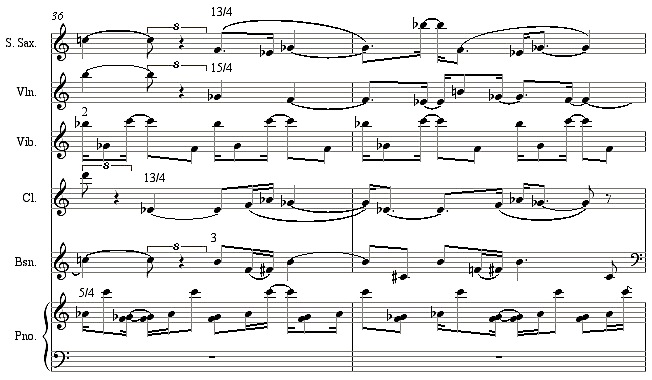
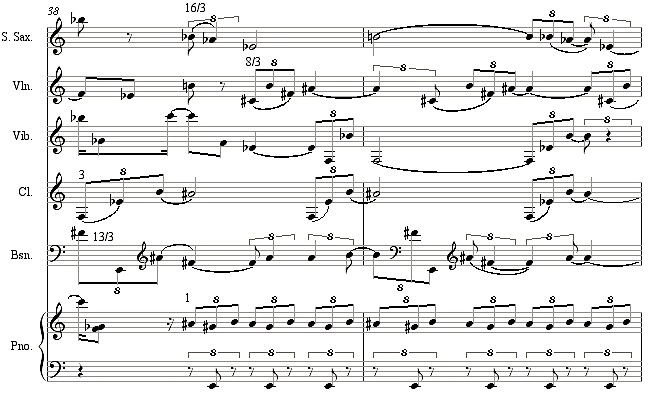
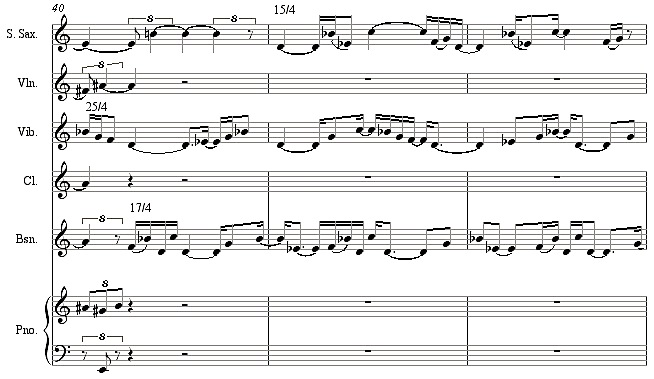
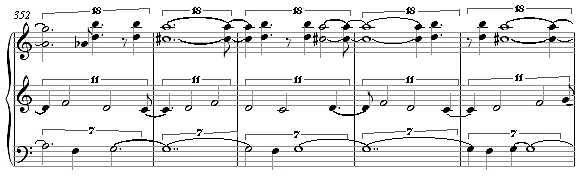
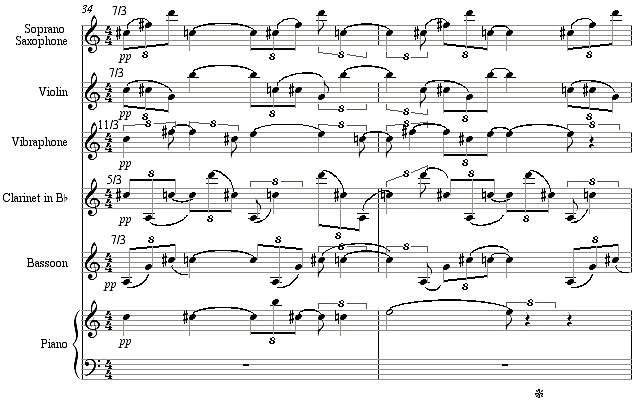
I spoke in my last post of James Tenney’s postminimalist streak, which I have always most associated with his Tableaux Vivants of 1990. A few years ago, learning of my intense interest in the piece, Jim kindly sent me a score, and I’ve long itched to analyze it, never finding the time until this week. As I start working my way through it, I realize that it is far more complex than it sounds on the recording by the Toronto ensemble Sound Pressure, and that it is really not postminimalist at all, but rather classically totalist, or, as we now call it here, metametric. It is unusual for Tenney in being composed mostly of repeated phrases, and in that those phrases loop at different lengths to create a counterpoint of recurring impulses at different speeds (or rather a “harmony of phrase lengths,” as Cowell would have said). The piece sounds gently undulating, not as wild as it looks, because of its uniformly soft dynamic level. May Doug McLennan and those with dial-up modems forgive me, but I’m going to post several measures of this 20-minute work here. All I’ve added, in numbers above each new phrase, is the length of the phrase expressed in beats (i.e., 11/3 = 11/3 of a quarter-note long, or 3 and 2/3 beats):

TableauxVivants1.jpg

TableauxVivants2.jpg

TableauxVivants3.jpg

TableauxVivants4.jpg

As you can see, or figure out anyway:

the first “moment” in mm. 34-35 forms lines in triplet 8th-notes, to make repeating periodicities of 5 against 7 against 11;

mm. 36-37 move to a 16th-note common unit for phrase/phase relationships of 5 against 12 against 13 against 15 (12 being the clarinet line three beats long);

m. 38 changes back to triplets for loops of 3 (piano) against 8 (violin) against 9 (clarinet) against 13 (bassoon) against 16 (sax);

and in mm. 40-42, a trio pursues phrase loops of 15 against 17 against 25 in 16th-notes. Notice that this last passage is entirely within the B-flat major scale.

I’ve posted Sound Pressure’s recording of the piece here. The excerpt given above begins at 2:18, immediately following the first sustained vibe-and-piano chord.

In his program notes, Jim calls the piece an attempt “to resume the exploration of harmony in the twentieth century without regressing to some earlier style….” He alludes to stochastic processes, by which I imagine he means the way the pitches are chosen, which seems somewhat random from “moment” to “moment”: the instruments overlap in pitch considerably (which puts the bassoon, you’ll notice, in an incredibly high register even above Le Sacre du Printemps), and the harmonies range from quite tonal to sharply dissonant. I take this to mean that the harmonic aspect of the piece is not susceptible to conventional analysis; if anyone knows more about the piece in this (or any other) respect, I’d appreciate some sharing of information.

What surprises me most is the use of repeated motives in lengths not divisible by the quarter-note beat to create an effect of conflicting periodicities not based on the beat, and also a kind of gear-shifting effect, as those periodicities switch among lengths like 13/3, 3, and 15/4, quite akin to what totalists like Michael Gordon, Mikel Rouse, and myself were doing in the ’80s and ’90s. Compare it, for instance to this gear-shifting effect, also using “misaccented” triplets to change the perceived pulse, from my Snake Dance No. 2 (1994) for unpitched percussion:

SnakeDancegear.jpg

Then with this passage from my Unquiet Night (2004) for Disklavier, which combines periodicities of 21/13 of a measure (top system), 16/11 of a measure, and 13/7 of a measure:

UnquietNight.jpg

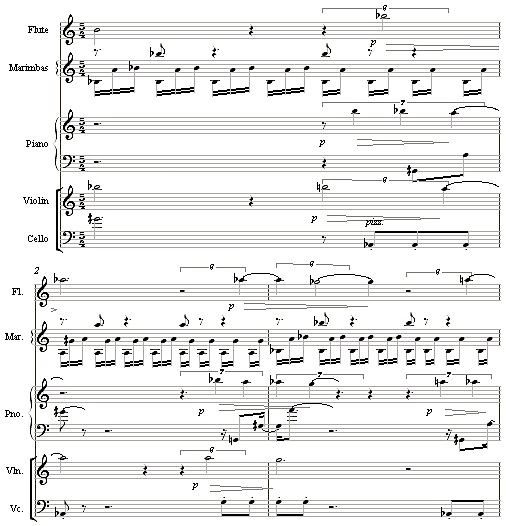
Then look at this passage near the end of Bunita Marcus’s chromatically saturated Adam and Eve (1987), with its implied periodicities slightly longer than a measure in the piano, violin, and flute, and an impression of layered tempos created by both triplets and septuplets:

AdamandEve.jpg

It so happens I still have Adam and Eve on my web site, so you can hear it here; the excerpt above comes late in the piece.

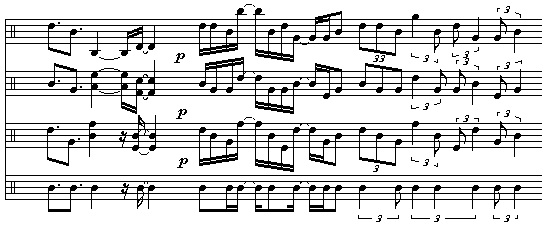
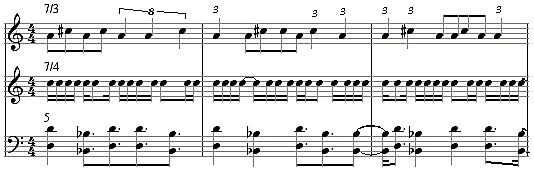
Next here’s an excerpt from Michael Gordon’s Yo Shakespeare (1993 – mp3 on my web site here). The little threes above the top system indicate triplet quarter notes, even though other notes are interpolated between them; the grouping of triplets in quantities indivisible by three was a potential Henry Cowell pointed to in New Musical Resources, which I also tried out in my Folk Dance for Henry Cowell (1997). I don’t even know what instruments these are in Michael’s score, because my old copy was pre-publication, but each line is doubled. The top system gives a repeating rhythm 7/3 beats long in quarter notes, the middle line has a rhythmic pattern 7 16th-notes long (7/4 of a beat), and the bottom repeating phrase is five beats long:

YoShakespeare.jpg

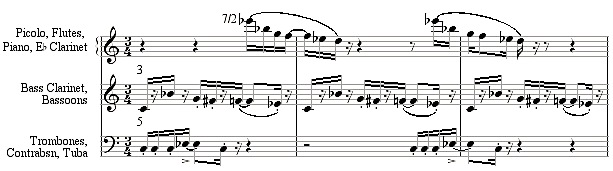
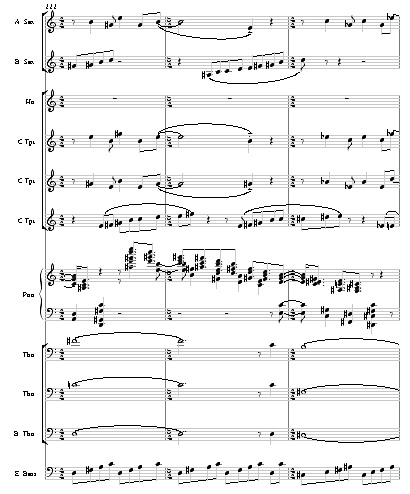
And we can even find the same basic idea in easier, more orchestrally digestible form in John Adams’s Lollapalooza (1995), one of his most totalist works. Here a three-beat ostinato in the bass clarinet marks a steady tempo against which the other instruments repeat ornamental phrases at various periodicities, including the title “Lollapalooza” motive every five beats in the triombones and tuba (score greatly simplified and much material omitted):

Lollapalooza.jpg

I’d like to think that Adams was inspired to play with loops-out-of-phase by listening to the younger generation, but he could well have absorbed the same technique from Nancarrow, whose music he has championed, and whose Studies Nos. 3, 5, and 9 in particular experiment with a similar device. Another example could be John Luther Adams’s Dream in White on White (1992), which carries out the idea at lengths too great to quote in notation here. Even I’ve got limits.

In any case, I was pleasantly surprised to find Tenney playing around with the same metametric concerns as me and my totalist crowd. Any info about Tableaux Vivants would be much appreciated. Perhaps he even has other similar pieces, I’m certainly not familiar with his entire output. The examples above will be raw material not only for my Music After Minimalism book, but for a paper I’m presenting (“Phase-Shifting as an American Compositional Temptation”) in September at a minimlism conference at the University of Bangor in Wales.

Postminimalism: Chapter One, Metaphorically Speaking

Someday someone will appear who has analyzed more minimalist-influenced music from the 1980s and ’90s than I have, and if that person feels that I have divided my era into categories inappropriately, I will be glad to listen to her argument. So far, I’ve gotten plenty of argument, but only from people who don’t come anywhere close to fitting that description.

There are several ways to characterize a style. One is to catalogue all relevant qualities associated with pieces associated with that style. I’ve done this for postminimalism elsewhere, and I have no intention of replicating that feat today. Another, less cautious tactic is to isolate a compositional aim that one perceives as the essence of a style. This has the disadvantage of marginalizing (or at least discategorizing) pieces that do not manifest that particular idea, for artistic styles, it seems to me, are rarely homogenous in their makeup. Nevertheless, if I had to point to one characteristic that strikes me as quintessential to postminimalism, it would be the impulse to write music freely and intuitively within a markedly circumscribed set of materials, outside of which the piece “knows in advance” it will not venture. For me, and reinforced by the contemporaneous writings of Steve Reich, minimalism’s essence was its quasi-objectivity, its linear movement from one point to another, along with its adherence to audible process or structure. Postminimalism at once became much more subjective, often even mysterious, imitating minimalism’s extreme limitation of resources but replacing the idea of linear, audible structure with that of a nuanced, intuitive musical language.

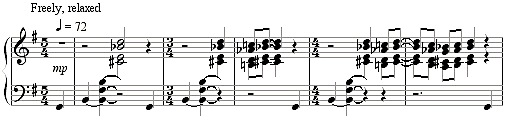
For instance: Several movements of Bill Duckworth’s Time Curve Preludes (1978-79) fit this paradigm exactly. Not all of them, for Time Curve Preludes is something of a transitional work, and several movements preserve the idea of additive and subtractive process that I think of as continuing minimalist practice. Prelude No. 7 is a movement that strikes me as the postminimalist piece par excellence:

TCP7.jpg

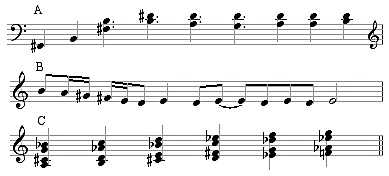
This languorous dance is made up of only three elements: a slowly arpeggiated bass line whose final dyad sometimes gets extended (A); a melody that here and there breaks the continuity (B); and a set of six chords that create an impression of bitonality by wandering conjunctly through scales from various keys, though the lower two lines are not actually diatonic (C):

TCP7elements.jpg

There is some inheritance from minimalism here in the systematic way the phrase lengths expand at first according to lengths proportional to the Fibonacci series, but even this structural element recedes as the B melody intrudes more and more. You can listen to the movement here. I don’t think of the Time Curve Preludes as Bill’s best piece any more than I think of In C as Terry Riley’s best piece, but they are parallel in that they seem to be their respective composers’ most memorable pieces, the ones everyone knows, the ones whose perfectly clear intentions serve as a manifesto, of which their subsequent music works out the ramifications.

Even more restrictive in their materials are some of Peter Garland’s works. Here is an excerpt, mm. 19-23 (showing a transition between sections) from the second movement of his piano piece Jornada del Muerto (1987):

Jornada.jpg

The entire movement employs only five chords in the right hand – given only as seen here, mind you, with no transpositions or octave displacements – plus the pitches B, D, and E in the left hand, usually as octaves, and in one section as single notes:

Jornadanotes.jpg

No process or continuity device informs this music; it is entirely and intuitively melodic in conception, if chordal in execution. Yet despite its extreme paucity of material, this lovely five-minute movement goes through seven sections touching on four different textures and rhythmic styles, undulating between two tempos. “I feel influenced,” Peter has said, “by American modernism from the ’20s, not the ’50s and ’60s. My take on modernism goes back to Cowell and Rudhyar.” Point taken: a line can be drawn from Garland’s use of only specific sonorities to the (vastly underrated) piano music of Rudhyar. Nevertheless, the conscious asceticism of his music is a far cry from Rudhyar’s employment of the entire piano as a mammoth sounding board, and it is worth noting that Peter studied at CalArts side by side with two other seminal postminimalists, Guy Klucevsek and John Luther Adams (all with Jim Tenney, who had his own postminimalist streak). In any case, the appearance of Jornada del Muerto in the late ’80s was exactly in keeping with the then-current postminimalist aesthetic. You can hear the second movement here.

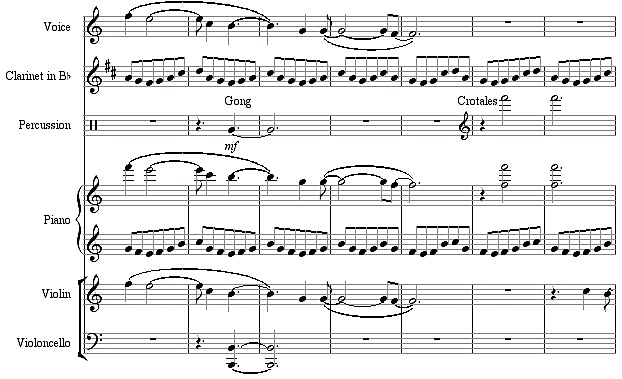
Like Duckworth’s, Janice Giteck’s music is widely heterogenous in its sources of inspiration, but each movement blends those sources into a seamless fusion. The fourth movement of her Om Shanti (1986) draws inspiration from Indonesian gamelan music, and its melody, sung wordlessly by the soprano and doubled in various other instruments, runs along a pelog scale, F G B C E:

OmShanti.jpg

The piece is pervaded by a single line of 8th-notes running without interruption through the piano left hand and clarinet, all on those five pitches E F G B C, without ever repeating, like an endlessly flowing river that is never the same twice. In addition, the pitch A appears in the voice melody and its doublings, but only in the upper register and at moments of maximum intensity. At various points the melody is punctuated, as shown above, by one or two notes in the upper piano and crotales, always on the ambiguously unresolving pitch F, rendered even more unsettling by a bass note B in the cello (whose C string gets tuned down to B in the third movement, but that’s another story). The movement, which you can hear here, is a masterpiece of intuitive intensification of melody, texture, and even harmony within an invariant limited scale.

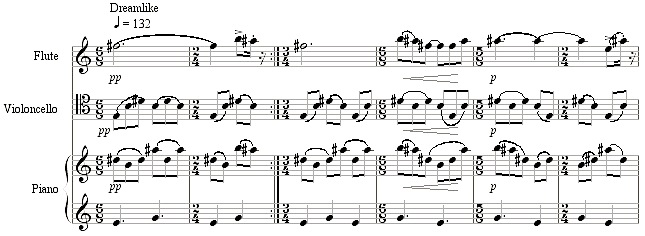
Merely five pitches also suffice for the nine-minute length and formal complexity of Paul Epstein’s Palindrome Variations (1995): G A Bb C D. The most formalist of them all, and a purveyor of note-by-note intricacy, Epstein could be called the Webern or Babbitt of postminimalism, the extremist in search of a purely musical logic. His 1986 Musical Quarterly article “Pattern Structure and Process in Steve Reich’s Piano Phase” gives almost more insight into his own composing impulses than it does into its ostensive topic; he is fascinated by note combinations that result from permutational patterns. All the same, Palindrome Variations is not (as some Epstein pieces are) a work composed by linear process. What’s interesting about Epstein is that the musical units with which he works intuitively are not notes, chords, or even phrases, strictly speaking, but notational units resulting from the interplay of meter and repetition. Here, the 6-beat phrase of the first two measures (repeated in the second one) is rotated within the measure afterward, so that in m. 3 the pattern starts on the third beat, in m. 4 on the fourth, in m. 5 on the sixth, m. 2 on the second, and so on:

PalindromeVar.jpg

Of course, in so uniform a texture, the meter isn’t felt as a unit, and so the effect is a constant unpredictable juggling of the same elements over and over. By a nonlinear process of note substitutions, the texture gradually transforms into a canon in which all instruments are playing the same motive but out of sync; then there are canonic solos for the flute and cello, and with inexplicable logic the piece moves to a conclusion foreshadowed by a dominant preparation and a convincingly logical, almost Bartokian, closing move to unison melody, all without any perceived breaks in Epstein’s tightly wound motivic flow. You can hear all that here. I think of Epstein as music’s answer to an op artist like Bridget Riley, whose superficially strict procedures result in wildly expressive visual surprises; similarly, Epstein’s rigorous attention to geometric detail creates conundrums for the ear. I doubt anyone can deny that, like Babbitt within the 12-tone world, he sets a certain edge beyond which postminimalism can go no further.

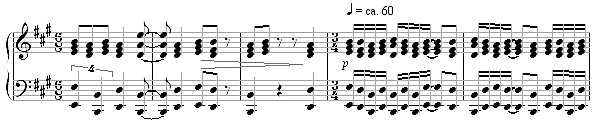
The first 25 measures of Belinda Reynolds’s Cover (1996) certainly seem to be those of a postminimalist piece. Again, only six pitches are used – E F# G A# B D# – with E in the piano as a low drone note, and a certain obsessive reiteration of characteristic figures, particularly the competing fifths E-B and D#-A# (repeat sign not in the original, but mm. 3 and 4 are identical to 1 and 2):

Cover.jpg

However, the music crescendoes to a sudden new chord at m. 26, and subsequently every few measures the music ups the energy by shifting to a new scale. There might be no reason to call this curvaceous, quasi-organic piece postminimalist except that, within each “moment” (to use the Stockhausenesque term), it tends to build up pitch sets and melodies additively, starting as an undulation of two notes and adding in others, almost like a memory of minimalism. Ultimately, Cover‘s form is not postminimalist – there are no more implied limitations on where the music could go than there are in Mozart – but its technique is. One of the advantages of defining postminimalism (or any style) in terms of its central idea is that we can treat the style itself as an ideal form, and talk about degrees to which a particular piece participates in that style. Just as Time Curve Preludes lies slightly on one side of postminimalism, coming from minimalism, Cover is a piece evolving from postminimalism and leaving it behind toward something else, but with its origins still much in evidence. You can hear the entire ten-minute work here.

* * * * * * * * * * * * * * * * * * * *

Now, don’t write in and tell me you don’t like these pieces. Who cares if you like these pieces? Do I care if you like these pieces? Do I, Kyle Gann, personally give a shit whether you like these pieces? No. No, my friend. I do not. What I care about is that you acknowledge that these pieces by different composers with very different creative personalities share several very clear stylistic characteristics – that they, in effect, define a style. What we name that style, I do not care. If everyone wants to call it Charlie, we can call it Charlie. But I have called it postminimalism, because that word was already in use in the early ’80s but floating around loose without any specific definition. (Rob Schwarz applied the word to John Adams and Meredith Monk in his Minimalists book of 1996. But I have trouble finding important differences in method between Meredith and the true minimalists, while composers of the “neoromanticism with minimalist elements” style that Adams represents were vastly outnumbered in the ’80s by the postminimalists who fit my definition. There are many more of them today.) And it is clear that these composers were all reacting to minimalism, but that minimalism was not their only influence. They defined, among them, a soundworld quite different from minimalism, one of brevity rather than attention-challenging length and stasis, one of intuitive lyricism and mysticism rather than obvious structure and worship of “natural” processes.

Nor – to preclude the kind of silly clichés that some composers bring to these discussions – is postminimalism a “club” that anyone ever decided to join. Not one of these composers ever sat down and said, “I’m going to write a postminimalist piece,” and it would be surprising if anyone (aside from myself) ever has. Anyone who thinks there could be a “doctrinaire” postminimalist doesn’t understand. The style is accompanied by no ideology. Nor was postminimalism even a “scene.” Duckworth and Giteck were unaware of each other until I introduced them. I doubt Peter Garland has crossed paths with Belinda Reynolds to this day. Minimalism unleashed a set, or several sets, of potentialities into the ether, and, in the way that great minds so often think alike, several dozen composers pulled new musical solutions out of the air that happened to have a lot in common. The grouping of these composers into a postminimalist style is not a fact of composition, but a fact of musicology. It is the perception of the first person to study all this music – and I have hundreds more examples where these came from, don’t even get me started on my John Luther Adams file – that commonalities among a certain body of pieces constitute a style. That perception will stand (and has already been widely quoted in the literature) until it is replaced by a more compelling perception, as perhaps will happen someday. This remains true even despite the music world’s refusal to deal with this music as a repertoire, after the vogue it enjoyed temporarily among the New Music America crowd in the mid-1980s.

I wonder if that indifference is perhaps due to postminimalism’s generally formalist concerns, its fascination with pattern and texture, at a time when the music world had become totally disenchanted with formalism. The widespread abandonment of serialism around 1988 (the year it seemed to me that disgust with the 12-tone idea reached a tipping point) inspired a near-universal move toward social relevance and widespread appropriation of pop and world-music elements, a conviction that music should refer to the world and not only to its own processes. Totalism, the other big movement that branched off from minimalism, throve much better in the post-serial milieu, as evident in the more visible careers of the Bang on a Can composers. In many respects, postminimalism was an answer to serialism far more than minimalism was. The postminimalists, like the serialists, worked at creating self-sufficient and self-consistent musical languages, in this case a language in which the reduction of musical elements made musical logic apparent. The attitude was almost, “Let’s do formalism over again and get it right this time, not anxious and apocalyptic and opaque like the serialists, but transparent and lyrical and pleasant.”

By 1990, however, formalism of any kind was a hard sell. Justifiably tired of music that begged for technical analysis, the world wanted big, messy Julian Schnabels of music, not clean, pristine Bridget Rileys. It was, and remains, difficult to argue for music so focused on its own musical processes, no matter how pleasant to the ear. In fact, postminimalism’s very pleasantness works against it: in the macho music world that John Zorn ushered in and the faux-blue-collar Bang-on-a-Canners have continued, postminimalism has never seemed kickass enough, its archetypes too feminine and conciliatory. (Kickass, kickass, kickass… I remember with perverse pleasure how ridiculously frequently that word came to everyone’s lips in the New York scene of the late ’80s, as though they had suffered some dire threat to their collective masculinity, and how easy it was to make fun of.) But pendulums swing, fashions change, and at some point the music world will remember that notes themselves can be made into patterns fascinating to listen to for their own sake. When that time arrives, the beautiful, varied, surprising postminimalist repertoire will be here to be rediscovered.

UPDATE: My little tirade above earned me a very funny comparison with Milton Babbitt via Darcy James Argue. Part of what’s funny is that the Babbitt paragraph he quotes is one I happen to have always agreed with. Babbitt’s a smart man, and not wrong all the time.

Art’s Place in Everyday Life

“Toward the seven deadly arts Sam had had the inarticulate reverence which an Irish policeman might have toward a shrine of the Virgin on his beat… that little light seen at three of a winter’s morning. They were to him romance, escape, and he was irritated when they were presented to him as a preacher presents the virtues of sobriety and chastity. He hadn’t the training to lose himself in Bach or Goethe; but in Chesterton, in Schubert, in a Corot, he had always been able to forget motors and [his competitor] Alec Kynance, and always he had chuckled over the gay anarchy of Mencken. But with rising stubbornness he asserted that if he had to take the arts as something in which he must pass an examination, he would chuck them altogether and be content with poker.”

– Sinclair Lewis, Dodsworth

It Must Be True

Hey, I got mentioned in the Times, in connection with Mark Morris. I love how the dance critics think the Disklavier is neat and sort of spooky, unlike musicians, who often see it as a problematic performance situation in need of rectification, somehow.

UPDATE: I can tell you why, as a composer, I prefer dance to theater. I’ve written for theater, and gotten always the same question, rehearsal after rehearsal: “Can it be softer?” Mark Morris asked if it could be louder, and I fell in love.

They Come In Pairs, Too

Two-movement form intrigues me, partly because there are so few two-movement pieces. Unlike three- and four-movement form, its paradigm is so far from being done to death that it is impossible to call any two-movement work typical – it still feels like partly unexplored territory. I love the Clementi two-movement sonatas, which come close to the most perfect balance in the genre, the movements differentiated in meter and density, yet weighted just alike; the Op. 33 No. 2 sonata in F major is the most exquisite case (though less well-known than the F# minor). The elephantine example, of course, is Beethoven’s Op. 111, which is perhaps second only to the Concord Sonata as a work that hangs over my life. Other instances are easy to ennumerate:

Webern’s Opp. 20 through 22

Nielsen’s Fifth

Mahler’s Eighth

Schoenberg’s Chamber Symphony No. 2

Gottschalk’s A Night in the Tropics Symphony

Copland’s Piano Concerto

Bernstein’s Age of Anxiety Symphony (actually six movements in two continuous parts)

the Becker Third Symphony.

(No one knows John J. Becker anymore, but when we dedicated New Music America ’82 to Cage, Cage asked us to include a work by Becker because of his historical importance to the midwest. His Third Symphony is aptly regarded as his best work.) The two-part form of Beckett’s novel Molloy, with the second half mysteriously parallel to the first, is an incredibly masterful new paradigm of the genre. Other examples that come to mind seem like cheating; Schubert didn’t finish his Eighth, Schuman’s Third is in two movements but each divides into two sections (like the Berg Violin Concerto), and the two Branca Symphonies, Nos. 8 and 10, are companion pieces, with four movements between them.

I find the simple duality of two movements inspiring: either this or that, black and white, happy and sad, before and after. Three-movement form is so classical, so easy with its matching fast bookends around an aria (or in Ives’s refreshingly reversed slow-fast-slow pattern). By contrast, two-movement form defies you to find a balance. The very fact that one movement is first and the other last makes a true balance impossible; one of them will have the last word, and it can’t refer back too much to the first movement and still achieve a satisfying diversity. The second movement’s finality represents, in effect, the death of the first movement’s idea, and it can’t come back to life in the cheery third to make you feel better. These elements are not going to synthesize. One philosophy of life is going to win, and there’s no escape.

Perhaps that’s why it seems problematic. In 1994 I wrote a two-movement sonata for pianist Lois Svard, and it seemed like no performance would go by without someone coming up to me afterward and blithely telling me, “Great piece, Kyle. You oughta write a third movement.” The second 15 people who said this to me never realized how close they came to being throttled within an inch of their lives. I had balanced those movements by making them the same length, but – perhaps thinking subliminally of Nielsen’s Fifth, which I adore – I built up a great crescendo of energy in the first movement and slowly released it in the second. I never even had a glimmer of an idea for another movement: those two gestures were the piece, from its first conception. So either I failed to make my bipartite emotional arc convincing, or else my listeners were just so conditioned by the classical Oreo cookie with its creme filling in the middle that they were unable to quit waiting for the third shoe to drop. To mix metaphors.

And so, in my piano concerto, which is “about” Katrina’s devastation of New Orleans – thus “before” and “after” – I’m taking a tip from Op. 111. The first movement is seven minutes long, the second somewhere between 16 and 20. I imagine that Beethoven (along with Mahler in the Eighth and Becker in the Third) realized that, to make the classical audience quit waiting for a reassuring synthesis, they had to be dragged through a mysterious, disturbing, second-movement landscape that would kill any yearning for a glib rondo. Where Beethoven’s first movement is angry and the second transcendently accepting, my first is pure rowdy fun and the second devastatingly sad (before transcendent acceptance, of course). Like the first movement to the Ives Fourth, my first movement is almost little more than introduction, the setup for the devastation. As I see it, to cure the audience of thinking about third-movement symmetry depends on making the second sufficiently dreary, daunting, and disorienting (being only slightly tongue-in-cheek here) to make them forget there had ever been a first movement. And I swear to god that if people come up afterward and tell me it needs a third movement, I’ll double the length of the second movement and only use the pitches C and D-flat in the second half. In whole notes. Pianissimo. Muted.

UPDATE 2015: Can’t believe I left out the Wolpe String Quartet.

UPDATE later in 2015: Ethel Smyth Piano Sonata No. 3 in D.


Devant moi, le déluge

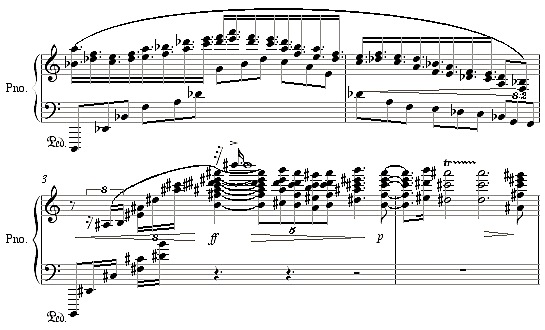
PCon2.jpg

The remainder of May is hereby proclaimed Finish-My-Piano-Concerto-and-Get-On-with-the-Rest-of-My-Life Month, so don’t expect much else from me. The job has taken on the terrible proportions of Alex Ross’s recent book. I’m 18 minutes into a first draft with at least five more minutes to go, and then a deluge of polishing details. I’ll tell you about it soon, but everything beyond its barlines is outside my focus for a while.

Perfect

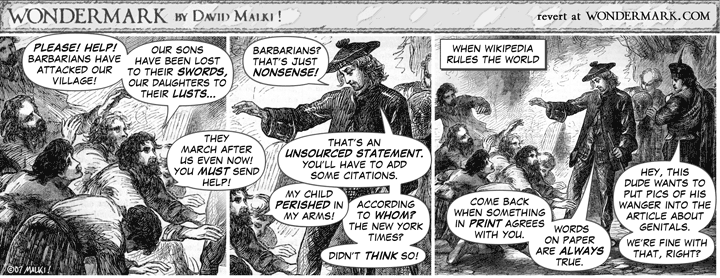
The world according to Wikipedia, as told by David Malki at Wondermark.com (thanks to B. McLaren):

Wikirule.gif

Color Me Copland

I’ve finally figured out what I want to do when I grow up: write Disklavier pieces for dance. The music is irreproachably acoustic, the performances endlessly perfect and unchanging, the audience superbly friendly and impressionable, you get to watch nice-looking people transfer your rhythmic ideas into three-dimensional space in gestures surprising, comical, and poignant, and then you stumble onstage and bow at the end. What could possibly be better? The gratification-to-work ratio is through the roof. In fact, having seen the Mark Morris Dance Group perform to my music last night, I’m convinced now that dancers, as intermediaries, create a sympathy for the music that it could never inspire by itself. The audience enjoys the dancers, the dance is visibly indebted for its energy to the music, therefore, the music must be something special; or, perhaps, the dancers so underline the ideas in the music that they come across with an immediacy no simple audio presentation could achieve. In any case, I received an outpouring of enthusiasm from total strangers at intermission far beyond anything I’d experienced before, and that I don’t believe could possibly result from a mere music concert.

My music has been choreographed a couple of times before, but never by someone who translates the music phrase by phrase with the thoroughness that Mark Morris does. Taking five pieces from my Nude Rolling Down an Escalator CD and repeating two of them, he fashioned a seven-movement dance called Looky all around the general theme of actors versus spectators. Tango da Chiesa became a group of people taking a tour through a museum as a guard sat idle but vigilant. Folk Dance for Henry Cowell became two rows of statues who surreptitiously changed position for each new group of tourists. Most hilariously, Bud Ran Back Out became a four-minute Western movie, with gun-slinging hero (female), Mae West-style hooker (male), poker game, floor show, drunk, and final gun fight in which everyone died but the principals. And in Texarkana, I saw my oh-so-clever 29-against-13 cross rhythms translated into arm and leg movements with a precision of which I thought only computers were capable. Those five pieces melded into a ballet with beginning, middle, and end, as though Mark was Martha Graham and I was Aaron Freakin’ Copland. Never before has my music been so savored, so analyzed, so complimented.

Dance is the artform I least understand (I probably should harbor more of a grudge than I have against the pretty girl who told me in high school I couldn’t dance and shouldn’t try, for I took her advice), and I’ve never felt I possessed the vocabulary to distinguish Fred Astaire from Merce Cunningham. But I know what goes into my music, and to see dance come out taught me more about it than I’d ever known. What struck me most was how much Mark had to think, as much as any composer, in terms of time proportions. Some moments were drawn out in slow motion, others so hurried that I feared the music wouldn’t be long enough, and I was quite impressed by the variety of tempos, and the counterintuitive imagination of Mark’s pacing. Equally impressive was his associative imagination. I think of Bud Ran Back Out, my Bud Powell homage, as pure New York, but its transformation into a tawdry western was inspired. Mark also played a lovely joke with the Disklavier: the piece opened with 50 seconds of darkness, and the audience chuckled appreciatively when a spotlight faded on to reveal a piano playing by itself. But within 25 seconds, the simultaneity of independent lines in the high treble, middle register, and low bass implied the presence of at least three hands on the keyboard if any at all, and posed a conundrum for the ear.

Whenever I play those Disklavier pieces at a concert, a few people inevitably come up and irritatingly ask, “Wouldn’t you rather have them played by a piano duo?” (As if that were possible. And the answer is “no.”) But with the dancers providing the human element, no one asked any such thing. A good dance audience is amazing: they expect empathy and surprise, and, unlike a classical music audience, they are exhilarated rather than upset by divergences from traditional boundaries. Personally I think classical music audiences should be fed the uniform diet of endless Schubert they crave until they die, thus vindicating my friend Greg Sandow. But dance lovers aren’t afraid of creativity and innovation, and these people, led by Mark’s sensitive orchestration of my rhythms into movement, connected with me in a way no audience ever had before. It was extremely generous of Mark to share his perfect-vintage audience with me, as one would share a $200 bottle of rare single-malt scotch.

There are reviews in the Boston papers here and here. The climax of the concert was not Looky, but Grand Duo, set to a powerful, impressively memorable, emponymous work for violin and piano by Lou Harrison that seems not to be available on recording at the moment. If I thought I could do the dance justice in words, I would try. It was unforgettable.

Trailing the Elusive Disklavier

I had five hours yesterday to program the Disklavier for Mark Morris’s dance Looky, which is being performed to my Disklavier music tonight. Had I had a clue how Disklavier technology has changed in the last few years, I would have known I didn’t need nearly so much. Yamaha used to employ a proprietary file format for the Disklavier. It wouldn’t read standard MIDI files; you had to record a special Disklavier file by playing a MIDI file from your computer. It took me, Mark’s excellent tech crew, and someone at Yamaha tech support two hours to learn that the new Disklavier grands won’t even record a MIDI file from a computer anymore, so we had spent a lot of time trying to do the impossible. Instead, the Disklavier can now read MIDI files directly – and once we realized that, all I had to do was burn a MIDI file to a CDR and pop it in. It worked beautifully at rehearsal last night – as easy as playing an mp3.

The thing is, Yamaha gives the impression that it works according to a completely utilitarian paradigm: it sells (or loans in this case) these marvelous computerized pianos to schools and performance spaces for purely workaday purposes, like recording song accompaniments and providing background music. They no longer provide a manual, there’s no how-to info on the internet, and the tech support people were difficult to reach because they were out traveling. There’s no assumption that someone might be trying to transfer a file from an old Disklavier to a new one, nor that anyone might be trying to do anything more elaborate than pressing “record” and playing a tune on the keyboard. The idea that a composer might actually write pieces for the instrument and tour with them doesn’t seem to have occurred to them. Still, now that Disklaviers read MIDI files they’ll be a lot more versatile to use, and with luck – as long as they don’t keep altering the way the thing works every year or so – I won’t run into any of these problems again.

Geez, there are 18 dancers in Looky! It’s like being played by a chamber orchestra, very exciting.

The Postclassical Program Note, Exhibit A

My arm twisted by my ACA chum Andrea La Rose, I went to hear Anti-Social Music in New York last night. I’m not going to review them, because the opinion-forming center in my brain burned out a few years ago and doesn’t work any more. But I think I can convey in this space the extraordinary quality of their program notes, which give the appearance of having been produced in the same amount of time it takes to read them – as though they were read into a dictaphone hooked to a computer with instant voice-transcribing software. The general feel is not so much stream-of-consciousness as extemporization under extreme pressure:

Berry Seroff wrote Guitar Duo #2 for two rockin’ guitars. I can’t find any program notes for this piece, so I’ll just say that Barry Seroff is a jerk who once shunned me on MySpace. Sure, he’s befriended me since then, but the bruises will never heal….

Pat Muchmore is a complete douche bag, but sometimes he writes pieces too. This one is called:

[an ornate wordless diagram follows]

See what I mean?

Peter Hess may or may not have written a Voiceprint. If he did, you should be hearing it now. If he didn’t, you should be hearing the next piece. If you’re hearing your mother’s voice telling you to kill small animals, you are awesome….

Jean Cook has played violin since 1979. She recently started buying stamps online and thinks it’s fabulous. www.usps.com

Brad Kemp (bass) would rather talk about YOU….

What can I say about Ed Rosenberg that hasn’t already been said?

Scrapworm did the art. who is scrapworm? what’s the point? a new worldview is possible. art is a function of such energies. activate the noosphere. resonate in the 5th day….

What can I say about Pete Wise (vibes) that hasn’t already been said about Ed Rosenberg?

The ensemble patter between pieces was identical in tone and apparent speed. I enjoy these guys. Unlike classical composers they don’t flash their credentials at you, but unlike rockers, they’re not so cool that they have to keep mum and leave you wondering, either. The underlying message – “Who gives a shit where we went to college?” – is a healthy one for postclassical music. The patter filled up the spaces between the pieces and left no room for boredom. The show was a fast-paced circus, and the actual music, performed with an attractive looseness and the occasional rough edge, was interesting, savvy, and intricate enough to prove that the surrounding irreverent verbiage did not indicate any superficiality of compositional intent.

An incidental note to all those New York spaces whose managers think that the way to keep audiences entertained between pieces is to turn on recorded music in between the live performances: I hate you! I hate you! I hate you! Die! Die! Die! Anti-Social Music’s solution was infintely smarter.

« Previous Page
Next Page »

What’s going on here

So classical music is dead, they say. Well, well. This blog will set out to consider that dubious factoid with equanimity, if not downright enthusiasm [More]

Kyle Gann's Home Page More than you ever wanted to know about me at www.kylegann.com

PostClassic Radio The radio station that goes with the blog, all postclassical music, all the time; see the playlist at kylegann.com.

Recent archives for this blog

Archives

Sites to See

American Mavericks - the Minnesota Public radio program about American music (scripted by Kyle Gann with Tom Voegeli)

Kalvos & Damian's New Music Bazaar - a cornucopia of music, interviews, information by, with, and on hundreds of intriguing composers who are not the Usual Suspects

Iridian Radio - an intelligently mellow new-music station

New Music Box - the premiere site for keeping up with what American composers are doing and thinking

The Rest Is Noise - The fine blog of critic Alex Ross

William Duckworth's Cathedral - the first interactive web composition and home page of a great postminimalist composer

Mikel Rouse's Home Page - the greatest opera composer of my generation

Eve Beglarian's Home Page- great Downtown composer

David Doty's Just Intonation site

Erling Wold's Web Site - a fine San Francisco composer of deceptively simple-seeming music, and a model web site

The Dane Rudhyar Archive - the complete site for the music, poetry, painting, and ideas of a greatly underrated composer who became America's greatest astrologer

Utopian Turtletop, John Shaw's thoughtful blog about new music and other issues

Return to top of page

an ArtsJournal blog

This blog published under a Creative Commons license