John Cage used to enjoy what repeating what he said was a quotation from Thoreau. Thoreau's first book A Week on the Concord and Merrimack Rivers did not sell, and at some point the publisher sent him back the remaining 700 copies. According to Cage, Thoreau said in response, “It makes me feel so good that no one is interested in my work, because it leaves me free to go in any direction that is necessary.” I fear that I have played some role in the dissemination of this misquote, for when I Google it my name often comes up. But for a long … [Read more...]
Oh Yeah, I’m a Composer
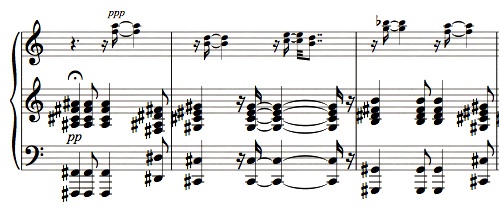
After a dry spell, I'm suddenly having eight nine performances in five months, with six world premieres included. (I guess for a lot of composers, nine in five months still sounds like a dry spell.) Two of the premieres slipped by me because I'm not very good at keeping track of dates. On June 23, Aron Kallay premiered my Echoes of Nothing at Beyond Baroque in Venice, California. Last Friday, August 17, Italian pianist Emanuele Arciuli premiered my Earth-Preserving Chant on a program of American Indian-inspired music by Peter Garland, John … [Read more...]
Birthplace of a Sonata

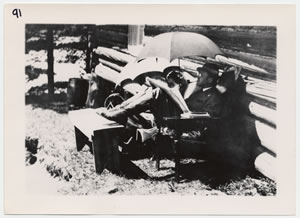
ELK LAKE, NEW YORK - Charles Ives wrote in his Memos that he got the idea for the Concord Sonata in the summer of 1911 at Pell's. Pell was Henry Pelletier Jones, a friend of Ives's father-in-law Joseph Twichell, his establishment more formally known as Pell Jones's Cabin. The Twichell family used to spend a few weeks in August or September there, and Ives and his wife joined them in 1909, 1910, and 1911. Ives suffered from what was then called neurasthenia, kind of a tendency toward nervous breakdowns (and his first heart attack came in 1906, … [Read more...]
A Truthful Job Creator
[T]he $1,800,000 that I made, though made openly, legally, and in accordance with rules etc. of the business, was all out of proportion to the "idea," to the service that I rendered society. A blacksmith who has made a shoe so that a horse will slip less, and incidentally $18 per week, has come nearer earning that $1,800,000 than I did. - Charles Ives, "George's Adventure," 1919 (in Memos, p. 226) … [Read more...]
Backstage Pass to Liturgy

The black metal band Liturgy is down to just two members plus electronics. I don't know how they do that yet, but I'll see them play in Hudson, NY, Friday night and find out. Meanwhile, you can see them here, backstage at the Pitchfork festival in Chicago last month. Hunter Hunt-Hendrix does most of the talking, but you can see my son Bernard look really, really cool, and he talks a little about having been born in Chicago. Not a life I could have chosen, but I'm envious. … [Read more...]
All the Different Concords

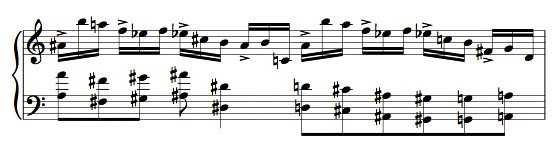
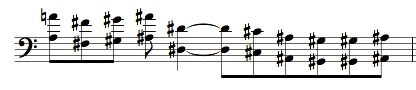
One of my sabbatical-and-summer goals, which I have now achieved, was to finish five out of the fifteen chapters of my book on the Concord Sonata. In particular, I wanted to finish the analytical chapters on "Emerson" and "Hawthorne." Between them those two movements account for more than 3/4 of the sonata's pages, and by far the most complex ones as well; comparatively, "Alcotts" and "Thoreau" will be a snap. If I could finish "Emerson" and "Hawthorne," I thought, accounting for every measure and system - and I have, with 14,000 words and 80 … [Read more...]
Back to the Basics
Last time a commenter called me a fascist, I wrote an Idiot's Guide to PostClassic. Guess it's time to remind people it's there. Thugs from the Conventional Wisdom crowd do fall in here accidentally from time to time. I'd rather they just go here and leave us alone. … [Read more...]
Music is Fluid Architecture

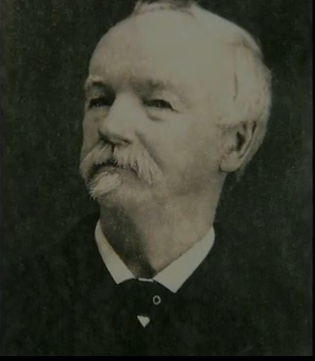
David Patterson, whose copious and well-researched writings about John Cage I've quoted nearly every time I've written about the man, has a new obsession these days: William Carey Wright (1825-1904), a composer whose son Frank Lloyd Wright became a famous architect. The video linked to is part of a Kickstarter program to finance a recording of W.C. Wright's music, and you get to hear some of it, along with speculation about why F.L. Wright considered his buildings "symphonic," and why he built them up with motifs and variations the way a … [Read more...]
Well, He Was a TV Star There

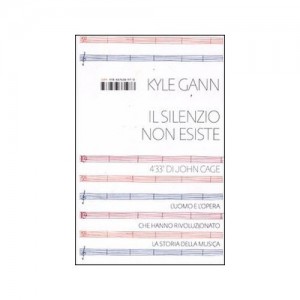
Apparently "The Silence Does Not Exist" (as Google retranslates it) can now be read in Italian. UPDATE: I do enjoy Google's automatic translation of Amazon's Italian synopsis: In the world of contemporary music is a before and after "4'33" "of John Cage. This composition is not known, this silence" active "- not a pianist who plays for 4 minutes and 33 seconds - is one of the works art's most famous, controversial and misunderstood of all time. Kyle Gann tells the imaginative life of John Cage and analyzes his masterpiece, illuminating … [Read more...]
Cage’s Red Pencil
I just received Michael Hicks's and Christian Asplund's book on Christian Wolff, part of the University of Illinois Press's "American Composers" series in which my Robert Ashley book will be coming out in October. Don't have time to read it at the moment (my current summer pleasure reading is another wolf: Virginia Woolf's Orlando), but I'm looking forward. Browsing through it I immediately notice two startling things. The first is a reprint of one of Wolff's early exercises in first-species counterpoint with parallel and hidden fifths and … [Read more...]

Recent Comments
Bob Gilmore on Ives, Caught Between Two Caricatures
Agreed. I love Ives 1, terrific piece. But I'd have to say my favourite of all the symphonies is the...M. on Ives, Caught Between Two Caricatures
Mr. Plush has already written, in his first sentence, what I would have liked to. Consider it seconded.Bill B on Ives, Caught Between Two Caricatures
You can hear it without going to it. The concert is streamed live over WQXR, as are all of...Vincent Plush on Ives, Caught Between Two Caricatures
Kyle, you have just reminded us (as if we needed reminding) why we regard you as one of the most...Steven Ledbetter on Minimalism Invented in England, It Turns Out
Sullivan did, indeed, brilliantly solve the problem set him by Gilbert's lyric, but he didn't find it easy. In fact...Paul Schleuse on Minimalism Invented in England, It Turns Out
The additive process is clearly there, but the harmony isn't really static. The alternation between D and D maj7/sus4 is...Gene on Minimalism Invented in England, It Turns Out
"Das Rheingold" opens with six minutes of tonic, not dominant. KG replies: But after six minutes of E-flat the curtain opens...Juhani Nuorvala on Minimalism Invented in England, It Turns Out
The minimalist I'm most reminded of by that Gilbert and Sullivan piece is Tom Johnson. - For additive process, there's...Ian Stewart on Minimalism Invented in England, It Turns Out
For additive precedents there is also the the folk song "Green Grow the Rushes, O". I also believe that the big...Paul A. Epstein on Minimalism Invented in England, It Turns Out
This is one of my very favorite G&S numbers. It's not only gorgeous, but if done right it can...