
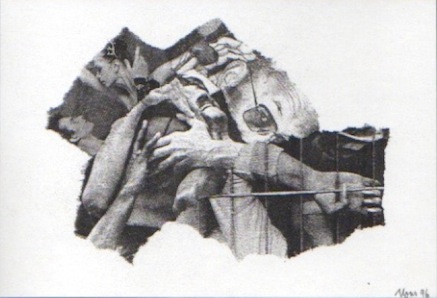
 ... and this was postcard numero uno.
]]>
... and this was postcard numero uno.]]>A Long Shot for Carl the SurvivorBy Jurgen Ploog
Death, the last cut, always leaves a bitter feeling mixed with pain & loss . . . and because of its finality gives you no choice but to look back
Carl & I were companions, & in the literary field accomplices. The occasion to commemorate him forces me to think about where it all began. It was May 1968, a year to remember. During a trip to the US I had discovered a magazine called San Francisco Earthquake with a piece by a German author in it. It was a faithful cut-up text that struck my curiosity. I wanted to know who was behind it & suspected a wacky American with a pen name.
To my surprise my letter of inquiry was answered by a guy named Weissner, & a lively exchange of letters followed. He had spent 2 years in New York, San Francisco & Hawaii & was getting ready to return to Germany. The letters kept flying & a yearlong collaboration started.
In Germany there was a lot of action in the streets & in our minds but it was nothing compared to what was happening in the States. Keen observers from the European side of the Atlantic looked West, & not only for the music. It was the period when Rolf Dieter Brinkmann wrote Westwärts 1&2 (published in 1975). It was a time when places like Istanbul, Tangier or Beirut seemed far away & strange, & the dystopian vision of 1984 was beyond reach just over the horizon. It was also a time when we did a lot of reading. But most of all it was a time of upheaval & rebellion.
Carl & I had some biographical background in common. I had spent a year in the States in 1952 & he the years 66-68. From the beginning our correspondence took off bilingually, not either/or but jumping within & between sentences. In a way it was a bipolar language in which fragments of German & American phrases blended easily. Yep, American with an undercurrent of the colloquial, of slang & street talk, an orientation toward the spoken word. The urge was to get away from the German written lingo, which took over automatically when it got to putting things in writing.
In this respect he was certainly ahead of me because in his early years he had hung out with GIs in Heidelberg jazz joints, where he must have come in contact with poems & stories that shared the same sound as those offbeat places, where the prevailing attitude was hip, i.e. antibourgeois, open & in opposition to anything square. This mind-set must have felt like a liberating concept for someone who had grown up in a bureaucractic environment like Karlsruhe's.
The decision to publish samples of uninhibited expression in a magazine wasn't inevitable, but it seemed necessary for someone who didn't want to get stuck in a bohemian atmosphere or who would be happy just being part of it. For me, that's a non-artistic effect based, on one hand, on a specific Lebensgefühl (attitude towards life) &, on the other hand, on the intention to move beyond simply being part of something. What followed was a remarkable little mag called KLACTO.
At the end of 1968 Carl showed up at my door in Frankfurt. He had managed to contact Brinkmann & Ralf-Rainer Rygulla, who were preparing an anthology dedicated to the "new American scene" which hit the German "pigpen" (as Carl phrased it in a letter) like a hammer. It was obvious that those with a taste for unconventional writing didn't want to leave it at translating imports from abroad. It was time to start publishing one's own stuff & show the literary establishment that carefully orchestrated celebrations like those of Group 47 were not without a moldy smell.
Joerg Fauser, a young writer who had experienced some hard times in Istanbul & was eager to present his first written efforts, soon joined the group. Writing was experimental by nature because it reflected outlandish experiences. Most of all, "experimental" meant recklessness in handling form & content face to face with situations involving drugs. The motto was: "Why stop here?" The volume of material from both sides of the Atlantic seemed inexhaustible, so we started to publish it on our own account. The first go was called UFO & was soon followed by Gasolin 23. Distribution relied mainly on a catalogue-like magazine that catered to offbeat publications, fanzine & little mags, called ULCUS MOLLE. Our project made it to nine issues.
At the time Gasolin was only one of many independent ventures in an abundant variety of pamphlets, literary mags, comics & poetry papers with widespread proliferation based on iconoclastic attacks on established & recognized attitudes & literary categories. The aim was not to produce "texts", poems, short stories or novels & not even a "literary magazine" (those lay around in bookstores & were for most part sponsored by established publishing houses). To us, writing meant an act of conviction if not an offense of conviction with a gut feeling based on personal experience requiring verve, chutzpah & the spice of rebellion. Writing/publishing was the assertion of a revolutionary act.
Every young generation caters to its own illusions, & that can only work if it doesn't know what it is doing. Or if it knows & does it anyway. Gasolin & other independent mags were about language & specifically a language with the potential to express resistance, deviation & rejection with no consideration for what others thought, especially the so-called mainstream, the critics, editors, or the rest of its collaborators & watchdogs. Yep, the more they wondered & the more they disapproved the better. All means & ways of handling a text were allowed. Tape-recorder experiments, collaborations where one author started & another continued, & yet another cut in, remixing all previous material. Carl used this method with Burroughs & Pélieu (So Who Owns Death TV) & Jan Herman, Carl & I got together & produced Cut Up or Shut Up (1972).
Carl is mostly recognized as the translator of Burroughs, Bukowski, Ginsberg, Bob Dylan, J.G. Ballard & others & rightly so. I see him mainly as a writer in a unique combination: namely as a blend of author & translator with a special capacity -- the ability to superimpose his own language on the original and thus merge it into an amalgam of its own. This was in a way an alchemical procedure. His great achievement was to meld both languages, resulting in an unmistakable sound. That was Carl's trademark, an authentic translated language that proved its validity especially in the cases of Burroughs' Naked Lunch & all the writings of "Hank" Bukowski. That was a task demanding the man's full capacity, the whole Weissner who was always struggling & searching for the right expression even (as he once said) during his sleep.
I am afraid, Carl was forced to take this detour because his linguistic engagement demanded it, & I presume there were phases in which it would have looked like treason to him to devote himself solely to his own writing. Sure, the fact that he had to make a living was a factor too, an angle that cannot be ignored. It was all an effort to remain true to his dedication to language, & controversial American writers provided plenty of challenges to demonstrate his skill.
Is there an escape from the treadmill of translating? Only in rare cases, & as his last years showed, Weissner could achieve that almost effortlessly. Weissner was never only a translator; Weissner was Weissner & remained as solid as a rock to his last breath. A survivor & he knew it.
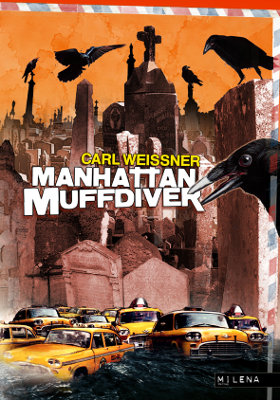
As he began writing his own stuff, he returned not only geographically to the origin of his work as a writer, picking up the thread almost seamlessly, with Manhattan Muffdiver & The Adventures of Trashman, from where he had left off in his earlier years. It was as if the last 30 years had passed with a mere blink. This was probably intended as the groundwork for a new literary start that was as watertight as possible. As he said, he was working on 2 or 3 novels simultaneously, which was quite possible when you are doing cut-ups & using the montage technique.
He was never in danger of getting lost in the mainstream. His language & his views were much too independent & authentic for that. That's why it is not significant how much of "own" writing he left behind. Any of those literary prizes that are handed out in Germany, flimsily & to serve vested interests, would have been wasted on him. Linguistically (& in his unwavering attitude) he was nothing less than a rock in the undertow of a dubious literary establishment.
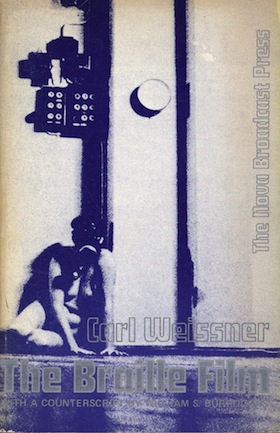 Carl wrote his first book, The Braille Film, in English. I published it in 1970, under the Nova Broadcast imprint. Although his native language was German, he had an incomparable ear for phrases that made his written English sing, certainly his American lingo. And he seemed to toss it off with the ease and sophistication of a Bill Evans solo. The Braille Film is prescient and panoramic, an extended cut-up riffing about a world gone mad. Here is the jazzy opening:
The passengers of this hopped up mixed media set are on a trip to the end of the nervous system, to the end of the Invisible Environment. There is no guide, no voice, no word. Walled in by oscillographs of the past the crew plot a precarious course in dead space of random topograhies. Infra-red TV screens, exposed nerve ends, phosphorescent comics, roentgen films & tapes of fictitious events, windtunnels of gossip, rigged history. LAUTLOSER FLUG DURCH VERFALLENES FLEISCH. Et pas de commissions. SAUVE QUI PEUT. The night croons in a thousand orange loudspeakers. (Invisible tracks of passengers on the run like bursting blobs of transparent jelly; windtunnels of luminous comics photographed with a 180 degree distortion lens, interrupted again & again by the white-out of exposed reel endings.) The Braille Film of Present Time unfolds in flesh-colored rushes sharp & clear as an electroshock orgasm.
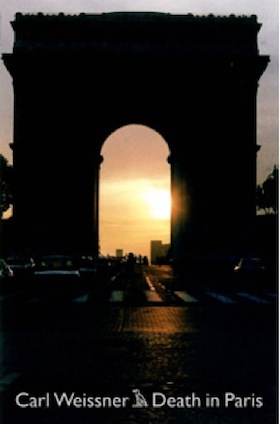
RealityStudio published Carl's second book, Death in Paris, 39 years later, posting it online in 2009. It too is written in American English, but this time the tone is coolly sardonic and deeply personal, darker and richer than The Braille Film. And very funny, sometimes hilarious. It is the work of a more mature writer. This time the word-slinging, if you will, is the least part of the story. This time the apocalypse comes wrapped in the jaded tones of a police procedural, a metafiction that brims with the blackest gallows humor. Here is how it begins:
Establishing Shot He woke at 3 AM. Dim yellow light filled the room. Smog had descended on the city, filtering the bright lights of the hotel. The city was cast in a sinister sepia, as in a 1930s gangster movie. 'I should have killed myself when it still made sense,' he thought. He closed the curtains and went back to bed.
Near-Collision in the Main Character's SubconsciousThe Hotel Bogotá, close to a hundred years old, had been kept in shape with an attitude of bored efficiency. Room service was non-existent, but there was a fat stream of brown water from every tap in the building, and the ceiling fans blew the sweat off your face in sheets. The hotel had two elevators whose cabins moved soundlessly through shafts of soot and axle-grease. In one of them, Gerald Lake rode down at 7:50 in the morning, and entered the ground floor Starbucks from the lobby.
At the far end, near the street exit, the familiar silhouette of a man in his mid-seventies made the small hairs on the back of his neck crackle with the voltage of pure hatred. He had always felt sure that he had killed his father ten years ago in Germany, by deliberately steering the car, with the old man in the passenger seat, into the concrete pillar of a bridge across Highway 3 near Cologne. He had been somewhat less than half conscious when firemen cut him out of the wreck with acetylene torches, his face swollen and rainbowed, coated in abrasions, bloody lips and cheeks flecked with tiny shards of glass. Before they could shove him into the EMS truck, he was in a deep coma. When he emerged from it after six months, his doctors showed him a letter with a photo of his father's grave somewhere in southern Germany. His stepbrother, Tony, who worked for a large software outfit down there, had made the arrangements and handled the paperwork.
Lake turned around unsteadily and crossed the diamond pattern of black and white marble tiles that had earned the Bogotá the dubious distinction of a San Francisco landmark. He pushed through the heavy slow-motion revolving door, turned left and started looking for a cab.
Posted by CW
Label: Doomsday Lit
December 7, 2007
3:12 AM
You can see that Carl, the writer, was as tough-minded as they come. But Carl, the person, glowed with warmth. He was kind, thoughtful, generous, and given to modesty. (Yes, I know, sounds like a cliché.) His erudition always amazed me, though he rarely put it on display. It only showed when the situation demanded it, and then he was scintillating. To quote Ian MacFadyen, he was "one of the great ones."
Among his lesser talents was his old musical training. Here is Carl's rusty Chopin after not playing for, oh, 50 years. "This is the schmaltzy version -- Viennese," you can hear him say in the video. Also, he combines pieces. "But what the hell." Typically careless of his ego, he let me post the video despite calling his playing "terrible." When a YouTube viewer praised his hesitations as "rubato," he gave a hearty laugh.
Ave atque vale, dear Carl. You were loved by many. Play us out.
]]> Penzel, a Berlin-based author of several books, including TraumHaft (a rock 'n' roll novel) and Rebell im Cola-Hinterland (a biography of Jorg Fauser, written with Ambros Waibel), says he met Carl when he was starting out as a journalist: "He rolled many balls in my direction, contacts, ideas, door-openers, the whole works."
This version of Penzel's obiturary restores cuts made in the published German text and adds a few enhancements. As he explains: "Nelson Algren once said, 'No book was ever worth the writing that wasn't done with the attitude that this ain't what you rung for, Jack -- but it's what you're damned well getting.' Same goes for this -- ok?"
One of the few stories he wrote in German ("Last Exit to Mannheim")* kicks off with the first-person narrator sitting at the foot of the Bay Bridge, San Francisco, on the stairway of his apartment house fire-escape, clocking the neighbor across the street with an old pair of binoculars ("used to play with Charlie Parker at the Five Spot") as he watches TV ("an old Hollywood ditty with Robert Mitchum who was once again wearing underpants way too big for him"). Just hearing the title of one of Carl Weissner's books, published years ago, makes contemporary cutting-edge writers like Mark Z. Danielewski sit up and listen -- the title in question was The Braille Film (most interesting to a guy whose House of Leaves emulates the syntax of movies and features the scribbled notes of a blind man who happens to be the only person to have watched a certain movie). This may capture it: the story of the life and impact of works by Carl Weissner.
Frankfurter Allgemeine Sonntagszeitung
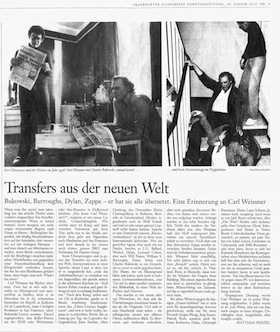 When you phoned him, you would be greeted -- for years -- by nothing but the shrill pheep of an incorrectly set fax-answer-phone-machine. When he insisted on driving you home because of atrocious rain at six in the morning -- his glasses finger-thick -- doing 18 mph on the highway, in the right lane at least -- and then when you awoke from nightmares, when letters were returned unopened, because the mailman -- working a Mannheim neighborhood of Turkish gambling parlors -- didn't see the name-tags on the door bells, which would have led him to a letter box inside Carl's apartment block across from a Women's Bookstore, then you would sometimes ask yourself: Was ist hier bloß los?
Carl Weissner translated books. While he tried pretty hard to remain in the background and unreachable, he is known to people in the weirdest hangouts -- in Calcutta just as much as in Luxemburg, at City Lights Bookstore in San Francisco, among Bukowski readers worldwide anyway. If you mentioned to him that underground poets from East Germany or ad writers or celebrity reporters in Hollywood would scream in awe, "You know Carl Weissner!?!," he would only shrug and react with a smile. Impenetrable. How does someone grow up as a child during the war, amidst the rubble, and learn to be gentle? Someone who looks and listens, who goes way beyond fine manners. A good boy at the piano who discovers jazz, then with a grant goes off to Manhattan and '68 San Francisco. And then becomes, in still grey and triste Germany, the expert for hipster slang.
His translations are actually exactly that: transfers from a different world, interpretations into a language, a country, in which -- as he put it -- "many understand 'Schriftstellertum' like an employee, right in the midst of a streamlined career -- never to wrong-foot or make a mistake, but rather to function straight and reliably."
Funeral is Feb. 10, in Mannheim. [Photo: Signe Mahler]
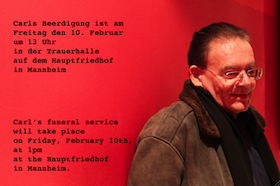 After the war, performing with and for GIs in Karlsruhe, he would play in jazz bands, gobble up special editions of the Times Literary Supplement, and wanting more from life, start to write. Letters. Up to twenty a day. To legends of the counter-culture, John Sinclair, Burroughs, Ginsberg, the dramatist Mohit Chattopadhyay in Calcutta, beatniks in Greece, Mexico; at the same time to Wolf Vostell; and as he could not afford all his own reading material, he cobbled together a magazine, in which he would print this New Internationale. Like a pretty cool agent, or rather a dealer, he would translate J.G. Ballard, the Beats, Warhol, Dylan, Leonard Cohen -- but also Will Eisner, Denton Welch, Diane Arbus, Muhammad al-Murabit -- into a German that had not existed before. The man who stayed in the background thereby kicked open a door to a library, existing invisibly and parallel to what every well-educated literary student had been completely unaware of, a door to a world of books, to grooves and a language that pulsated with life.
This he did with an active vocabulary that made some of his translations -- another silent smile here -- look even better than the originals. And because he was a pro at his craft -- never too self-assured, always with open ears, wide-awake vision, and with AFN radio playing in the background. He translated books -- and did well, not grand -- many of which got reprinted, repeatedly. Ten hours a day in the early days. The gain, in terms of merit not earnings, was that Weissner helped knock the mildew of past decades out of the German lingo. Zappa, whom he also translated, has by now had streets named after him; Dylan is touted as a contender for the Nobel Prize -- yeah, sure (so what). Weissner remained unobtrusive. Ten years ago, he quit what he called his "day job." Kept listening, looked around, and wrote. In Thailand, Paris, in Marseilles tracing Rimbaud, then back into the shadow of the Empire State Building. Finally, at the age of 70, he found a home for his own novels -- Milena-Verlag, in Vienna -- which he had nearly given up hoping for. Also his latest book, only months old, seems to be taking a whole new generation of readers on a trip.
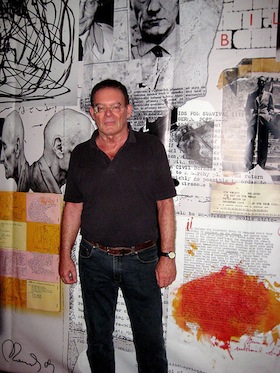 Despite all his raging against contemporary German writers whose "A-level essays" are very neatly written but god-awful to read, he never ceased to rave not only about friends like Jürgen Ploog, Jörg Fauser, and Patrick Roth, but also about Anna Katharina Hahn, Christoph Ransmayr, Marie-Luise Scherer. Yes, he was always switched-on, curious. Talking about Jack Bauer, criticizing The Wire, talking about Grindcore Metal and Schopenhauer, skaters in Venice Beach. Inscrutable. Then mumbling, en passant, a few lines by Adam Green, thoughts on cyberpunk and SMS-texted novels -- and this was years before he would go to Karstadt Mannheim to have the pre-paid card of his mobile phone recharged (by assistants who would gather around him to catch a glimpse of that darn antiquated phone), before he would exchange his fax-phone machine for a PC with access to the internet, and remain stuck to the old spelling rules.
(He insisted he would not write according to the new rules taken up by news agencies and most German media around 1998. He would not let them change his work. In other words, in some ways he was quite conservative, stubborn you could also call it, operating on principles, whatever. Or simply somebody who was clear about what he wants and what he does.)
Yeah, letting the talk do the walk, his own books capture the way he thought and talked and wrote: They brim with life, they are whole reference systems that lead to much more than what is on the page. The narrative still has traces of that first-person narrator at the foot of the Bay Bridge, waiting for City Lights' Ferlinghetti and, incidentally, Claude Pélieu, who wrapped his prose in truly cool lingo. The narrator watching what the other guy is watching, noticing and declaring what we always felt but hardly dare say. Was ist bloß los? what's the story here? One take would be to say it is like the exploding Cadillac on screen, like the labyrinth in The Braille Film: an expansion of senses and sensibilities in order to look into the world with new eyes . . . the other take somewhere between the sheer force of cascading information and the charming effect of matryoshka dolls, image within image all the way to the meltdown, where -- as in the finale of his final novel, Die Abenteuer von Trashman -- the cuts are flickering while "curls of celluloid with nothing left to see on them chirrup out of the projector."
On a Tuesday in January 2012, Carl Weissner was found dead in his flat in Mannheim. I'll bet anything that we will still get to read a hell of a lot by him -- and that the old stuff will keep rockin' for a long time. Unbeatable basically. Told in a wacko but straight manner. Like a shot, intravenously. The sorta stuff that makes you long for a reliable dealer of your choice.
*published in Gasolin 23, first issue, i.e. #2, 1973
]]> When I asked Cody Mahler to write something for me about the friend we both lost, he wrote back: "I have to sit down with Carl and discuss what he would like me to say." They must've had a great conversation, because this is what he wrote:
I CALLED HIM MISTER MOOCH
Everybody knows that he is dead except me
Why don't I know it yet?
Maybe because we were downstairs when he went to bed
We were downstairs and he went to bed because he had a sore throat
He had a sore throat and he didn't want to spread any germs
He didn't want to infect anybody
He particularly didn't want to infect Signe
Who had offered to bring him up some soup that night
When we had called him on the phone expecting to meet him
Downstairs
At the gallery
Where we were planning to join him in the festivities
No, he said he was tired
I told him a couple of funny stories on the phone
which I can't remember now
He was not too tired to laugh
He could laugh no matter how much it hurt
And there was nothing more he was waiting for
Than a chance to get a good laugh
A good innocent laugh
Or a even bitter caustic laugh at hypocrites
Who he shrugged off with fine chosen words
As fine as the cakes and cheeses and ciders and wines
He brought us
And such fine things we had for dinners that we invited him to
Or dining out in the "ghetto" as we called it
Slumming was the word we used
in his neck of the woods
I called him Mister Mooch
Which by definition is a man that mooches off people
Takes their comforts and their food
It was an intimate joke between us
He was never a mooch
He was our friend
And nothing can take that away
Signe just said I forgot something
We asked Carl once
What his favorite meal in the world was
And he told us spaghetti and meatballs
So one night
I made them
Just like my mother did
And he was about as happy
As anybody I have ever seen!
-- Cody Mahler
Here is another scribble ... I feel like poems are standing in a long line waiting ... and they don't mind the wait ... they are patient ... they chat among themselves ... they don't push to get ahead ... some poems even go for a little walk and never come back ... we find these poems sometimes staring at a river or gazing up at an old house or standing on a street they played on as a child ... sometimes we leave these poems where we find them and sometimes we drag them back into line ... in the end it does not matter what happens to poems ... they always know what is best for them ...
Yesterday after a long forced march to the chemical company Roche through the Siberia-like cold front I returned on a tram to Carl's neighborhood. I went to Sultan's grill (where we had gone on a couple of occasions with Carl) ... I devoured a Doner Kebab and then went next store to the Turkish bakery for a little treat ... I must have looked like a homeless man. The young Turkish guy handed me a sweet and when I asked him how much, he said nothing, it costs nothing ... I had to laugh. I guess in a way I was homeless. Another place or person gone that we called home. That is how it feels much of the time.
The sun stares at the cold face of a winter day
like the dead stare at the living
God prays for the dead
who pray for God
And the earth listens
And waits for some movement from below
The toilet flushes upstairs
Signe is asleep on the couch
I read poems all day
To bring back the dead
Who promised to meet me today
With word of Carl
who promised to explain to me
What happened since he died
What happened to the night
We were supposed to meet
And how will I describe it
How he came downstairs unexpectedly
And greeted us
Though he had a sore throat
How he drank a glass of red wine
How he lingered just a few moments
Before he returned upstairs
To his apartment
He excused himself
Said that he didn't have much time
But that he would come
And pay us a visit
On evenings when we can't face
What has happened to him
He will wake us gently
And laugh at the absurdity of his death
March 19 -- Cody sends an email message that Florian Gunter, a poet from East Berlin and a friend of his, has written a poem for Carl. "Be great if you could put it up on your site ..." Here it is in Cody's translation:
A Missed Chance
Carl Weissner was in town
The word that got out was that
a lot of people
would be going to the show
to hear him read
letters from Bukowski
I was broke. I didn't even
have money for the tram,
and my car hadn't sprung
to life for weeks
So I stayed home.
Had a smoke in the dark
and remembered
the letter I had written
to him almost 25 years ago,
that he never answered.
And that C.W. was the only
hero of mine
that I would like to
have talked to.
The ashes on my cigarette
had died out.
A couple of drunks
roared down below
a beer bottle
burst on the pavement
I undressed
and went to bed.
-- Florian Gunter
]]> There is nothing I cherished more than my friendship with Carl. He was my dearest, oldest friend. We didn't just go back to the '60s together, when we exchanged torrents of letters and collaborated on literary projects; we remained the warmest of friends through all the years since. I am devastated by his death. It came as a shock, and not only to me. To his son Mike, too, and to all the friends who were as devoted to Carl as I was. When I heard he had died, I cried like a child. You'd think I deserved the purple heart for breast-beating. Shit. What a spectacle. I tell myself, "Don't be sad. He would prefer a good laugh." Besides, going out the way Carl did fits the man. No fuss. No muss. No bother. Complete surprise. The angels, if there are any, simply carried him off. Looking over our recent email exchanges helped calm me down. He was in wonderful humor.
(See updates below.)
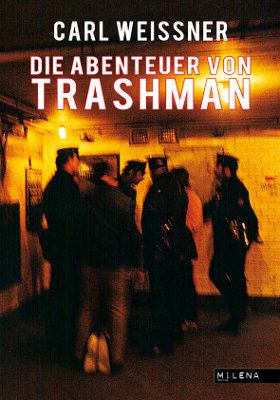 I had asked about his Rimbaud-in-Marseille novel, which he'd put on the back burner while finishing Manhattan Muffdiver and The Adventures of Trashman. He replied: "i should get into that marseille story, but I think I'll have to suffer, in situ, endless bad weather bad food bad drinks in crummy waterfront bars first. in other words, earn it." I told him about a recent trip to a shaggy little Caribbean village, which had "exceeded my expectations," and I wondered whether he was "earning it." He messaged back: "in their xmas edition, STERN gave my book five stars" -- the reference was to Trashman -- "as a result of which I get a chance to say my piece on austrian TV next week. so, I am not earning it, I'm living off yesterday's laurels." As to the Caribbean village, he said, "maybe one day we'll have a 2 week get-together there, bottle of rum and a mulligatawny soup, ploog can hop over from ft lauderdale, we'll have our own table, with a brass sign that says: The Survivors."
Phone just rang ... my daughter Olivia (who also loved Carl dearly and to whom he dedicated Muffdiver as one of the "Hermans") is about to give birth, so I must stop here. I have much more to say, but that will have to wait for now. In the meantime, please have a look at realitystudio.org's In Memory of Carl Weissner, which is largely about Carl and William Burroughs.
]]> Jan. 27 -- Signe Mähler sends this announcement: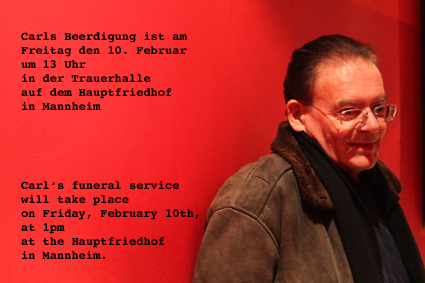
Signe was one of Carl's closest friends. He adored her and loved her work.
Jan. 28 -- As I was saying, Carl was in wonderful humor before he was so rudely interrupted. Proof? I adduce our most recent emails. Now that my newborn granddaughter is safely home, I offer them here:
from carl, January 4:
we ate an american turkey, straight from the PX, at cody's, and listened to sigur ros at max volume. it sounded, if that should be the word, like pink floyd AND edgar varèse on crack. [William Cody Maher, an American ex-pat writer living in Heidelberg, was also one of Carl's closest friends. Cody, Carl, and Signe recently did a book together, Down Southern Roads.]
 to carl, January 5:
well WELL! yesterday's laurels are thoroughly deserved. 5 stars! from STERN, no less. Hoo-haa!! they've wiped clean the curse of hitler's diaries.
re dinner at cody's, you're not deaf now, right? just bleeding from the ears.?.
turned the big 7-0 the other day. onward into oblivion!
from carl, January 7:
turning 70 - how does it feel? monstrous event, bad joke of evolution? as far as i can remember i sat thru mine on ze left cheek (helped in no small measure by incipient senility) - what truly pained me was turning 40.
what do you hear from mustill?
to carl, january 9:
one cheek or the other. it makes no diff. i'm lucky to remember what i had for dinner last nite. i did get a few huzzahs. prompted i guess by the big fat number. no complaints, but troof? it feels like shit. as for mustill, he's got the corragio. it's nearly a year since his death sentence. as chipper as he ever was, most of the time. when the pain gets really bad he takes a bigger hit of morphine. says he's turning into a regular junkie.
from carl, january 10:
good old norman. I swear I'm going to emulate him when I get hit.
Mike is for the stoic warrior stuff anyway. That plus a ton of painkiller.
"next", they say at the dept. of urology, "we'll circumcise you. and who knows? one day we'll chop the rest of it off." isn't that hilarious. always one thing or another. "Yeah", I say. "I'll be The Dickless Dude from Hell."
to carl, january 17:
did i ever point this way? talk about stoic ... and laffs, too:
MacGowran Reads Beckett
That was my last message to Carl. I never heard back. Tomorrow I will have more to say.
Jan. 30 -- "Tomorrow" came and went. I keep thinking, did I have a premonition? The reading, in MacGowran's gravelly voice, is from Malone Dies. It begins, "I shall soon be quite dead at last in spite of all."
This blogpost is still unfinished. I've been busy posting Matthias Penzel's tribute to Carl, 'Transfers From a Different World.' Please have a look at it. He tells me Milena Verlag has announced that an interview with Carl will be broadcast tomorrow night on Austrian TV. It was recorded on Jan. 14, which helps explain why Carl's last emails ceased after the 10th.
Feb. 1 -- I asked Cody to write something about the friend we lost. He wrote back that first he had to have a conversation with Carl about what to say. They must've had an interesting discussion. Cody's poem begins: "Everybody knows that he is dead except me / Why don't I know it yet?" Read all of it here.
Feb. 3 -- Carl wrote his first book, The Braille Film, in English. I published it in 1970, under the Nova Broadcast imprint. Although his native language was German, he had an incomparable ear for phrases that made his written English sing, certainly his American lingo. And he seemed to toss it off with the ease and sophistication of a Bill Evans solo. The Braille Film is prescient and panoramic, an extended cut-up riffing about a world gone mad. Here is the jazzy opening:
The passengers of this hopped up mixed media set are on a trip to the end of the nervous system, to the end of the Invisible Environment. There is no guide, no voice, no word. Walled in by oscillographs of the past the crew plot a precarious course in dead space of random topograhies. Infra-red TV screens, exposed nerve ends, phosphorescent comics, roentgen films & tapes of fictitious events, windtunnels of gossip, rigged history. LAUTLOSER FLUG DURCH VERFALLENES FLEISCH. Et pas de commissions. SAUVE QUI PEUT. The night croons in a thousand orange loudspeakers. (Invisible tracks of passengers on the run like bursting blobs of transparent jelly; windtunnels of luminous comics photographed with a 180 degree distortion lens, interrupted again & again by the white-out of exposed reel endings.) The Braille Film of Present Time unfolds in flesh-colored rushes sharp & clear as an electroshock orgasm.
RealityStudio published Carl's second book, Death in Paris, 37 years later, posting it online in 2007. It too is written in American English, but this time the tone is coolly sardonic and deeply personal, darker and richer than The Braille Film. And very funny, sometimes hilarious. It is the work of a more mature writer. This time the word-slinging, if you will, is the least part of the story. This time the apocalypse comes wrapped in the jaded tones of a police procedural, a metafiction that brims with the blackest gallows humor. Here is how it begins:
Establishing Shot He woke at 3 AM. Dim yellow light filled the room. Smog had descended on the city, filtering the bright lights of the hotel. The city was cast in a sinister sepia, as in a 1930s gangster movie. 'I should have killed myself when it still made sense,' he thought. He closed the curtains and went back to bed.
Near-Collision in the Main Character's SubconsciousThe Hotel Bogotá, close to a hundred years old, had been kept in shape with an attitude of bored efficiency. Room service was non-existent, but there was a fat stream of brown water from every tap in the building, and the ceiling fans blew the sweat off your face in sheets. The hotel had two elevators whose cabins moved soundlessly through shafts of soot and axle-grease. In one of them, Gerald Lake rode down at 7:50 in the morning, and entered the ground floor Starbucks from the lobby.
At the far end, near the street exit, the familiar silhouette of a man in his mid-seventies made the small hairs on the back of his neck crackle with the voltage of pure hatred. He had always felt sure that he had killed his father ten years ago in Germany, by deliberately steering the car, with the old man in the passenger seat, into the concrete pillar of a bridge across Highway 3 near Cologne. He had been somewhat less than half conscious when firemen cut him out of the wreck with acetylene torches, his face swollen and rainbowed, coated in abrasions, bloody lips and cheeks flecked with tiny shards of glass. Before they could shove him into the EMS truck, he was in a deep coma. When he emerged from it after six months, his doctors showed him a letter with a photo of his father's grave somewhere in southern Germany. His stepbrother, Tony, who worked for a large software outfit down there, had made the arrangements and handled the paperwork.
Lake turned around unsteadily and crossed the diamond pattern of black and white marble tiles that had earned the Bogotá the dubious distinction of a San Francisco landmark. He pushed through the heavy slow-motion revolving door, turned left and started looking for a cab.
Posted by CW
Label: Doomsday Lit
December 7, 2007
3:12 AM
You can see that Carl, the writer, was as tough-minded as they come. But Carl, the person, glowed with warmth. He was kind, thoughtful, generous, and given to modesty. (Yes, I know, sounds like a cliché.) His erudition always amazed me, though he rarely put it on display. It only showed when the situation demanded it, and then he was scintillating. To quote Ian MacFadyen, he was "one of the great ones."
Among his lesser talents was his old musical training. Here is Carl's rusty Chopin after not playing for, oh, 50 years. "This is the schmaltzy version -- Viennese," you can hear him say in the video. Also, he combines pieces. "But what the hell." Typically careless of his ego, he let me post the video despite calling his playing "terrible." When a YouTube viewer praised his hesitations as "rubato," he gave a hearty laugh.
Ave atque vale, dear Carl. You were loved by many. Play us out.
]]>Iraq is quickly slipping back into authoritarianism as its security forces abuse protesters, harass journalists, and torture detainees. Despite U.S. government assurances that it helped create a stable democracy, the reality is that it left behind a budding police state. -- Sarah Leah Whitson, Middle East and North Africa director of Human Rights Watch
I suppose that's not the same thing as the Sunni genocide or the death squad massacres hidden in plain sight or the loud whispers, which we blogged about in 2005 and 2006. But it's a reminder.
]]>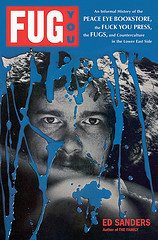 Speaking of Lower East Side legends, Ed Sanders has written a new memoir, FUG YOU {An Informal History of the Peace Eye Bookstore, the Fuck You Press, The Fugs, and Counterculture in the Lower East Side}. Just out from Da Capo Press, with a dust jacket based on an historic Life magazine cover, it's a picaresque chronicle of the 1960s filled with scrupulously documented recollections of Sanders's adventures and misadventures in poetry, politics, and rock 'n' roll.
FUG YOU reads like a nonfiction outtake from Thomas Pynchon's V. The tales Sanders tells, bizarre but true, are buttressed by illustrations and citations from a mammoth archive he compiled through the years. They include everything from mimeo magazines and antiwar flyers to FBI memos and news clippings; from poems scribbled on napkins to set lists and lead sheets; from Peace March photos and concert posters to literary relics such as the "well-scooped cold cream jar" that Allen Ginsberg used as a "cock lubricant."
A sample vignette:
I was working weekends -- Friday, Saturday, Sunday -- on the 5:00 PM to 2:00 AM shift at the cigar store where I had toiled off and on, and learned a lot about the underground world of Times Square, since 1960. It was freaky. One evening a guy who worked at the 2-for-25¢ hamburger place next door came in for cigarettes. I asked him why he was barefoot. He replied, "I have a date with a Toe Queen, and my date likes dirty feet." All that evening I wrote a series of poems depicting the life and times of "Tillie the Toe Queen" on white, elongated slats of thin cardboard from cigarette cartons. By the next weekend I had published The Toe-Queen Poems. When I read them at Le Metro, the response, in applause and overwhelming laughter, was the first I had received for anything I'd ever read in public, and I think it was an impetus to form a satiric proto-folk-rock group called The Fugs a few months later. One of the first Fugs songs, never, unfortunately, put on an album, was a ditty called "Toe Queen Love."
Although FUG YOU has no sewer-dwelling alligators hunted by a posse of misfits with shotguns, it has plenty of details that are equally preposterous and Pynchonesque. For instance, an anti-yodelling edict at the Chicago 7 trial. The presiding judge won't let Sanders demonstrate from the witness stand how well he yodels. "I was disappointed," Sanders writes, "for verily I was and am the only Beat who can yodel. However, I resisted the dramatic impulse to weep and show trembling agitation in front of the judge at this restriction on my yodeliferous genius. Why? Six-month jail term and maybe a $1,000 fine for insulting the dignity of the court. I had to get to L.A. and start investigating the Manson family." (Which he did.)
]]>-thumb-200x257-21039.jpg "'LEGENDS of the LOWER EAST SIDE'") I can't let the year end without taking note of a new coloring book -- yes, a coloring book -- titled Legends of the Lower East Side. It's a collaboration of the artists Troy Harris, Orlando Bonilla and the unstoppable documentarian Clayton Patterson. The book features their confederates in nonconformity, artistry, community activism, and "colorfulness." If the International Herbert Marcuse Society were to give a Great Refusal prize to honor colorful outsiders, Patterson should get it. Since there is no such prize, a coloring book will have to do.
I can't let the year end without taking note of a new coloring book -- yes, a coloring book -- titled Legends of the Lower East Side. It's a collaboration of the artists Troy Harris, Orlando Bonilla and the unstoppable documentarian Clayton Patterson. The book features their confederates in nonconformity, artistry, community activism, and "colorfulness." If the International Herbert Marcuse Society were to give a Great Refusal prize to honor colorful outsiders, Patterson should get it. Since there is no such prize, a coloring book will have to do.
I've written about Patterson before, the first time in connection with 326 Years of Hip, a group show of outsider artists Mary Beach, Taylor Mead, Boris Lurie, and Herbert Huncke, which Patterson produced and curated in 2005. I wrote about him again in connection with Lurie and the No!art movement. But that only scratched the surface of someone I think of as the opposite of what Marcuse called one-dimensional man.
-thumb-200x259-21041.jpg "Clayton Patterson's page in 'Legends of the Lower East Side.'") Patterson -- rightly dubbed a "docucontrarian" -- has lived a multidimensional life of exemplary defiance and commitment. His record of arrests for antagonizing authority is by itself enough to put him in a category far above extraordinary. If you asked Patterson what he's proudest of, however, he would probably point to the massive archive he has created with his partner Elsa Rensaa, who is also featured in the Legends coloring book.
Patterson -- rightly dubbed a "docucontrarian" -- has lived a multidimensional life of exemplary defiance and commitment. His record of arrests for antagonizing authority is by itself enough to put him in a category far above extraordinary. If you asked Patterson what he's proudest of, however, he would probably point to the massive archive he has created with his partner Elsa Rensaa, who is also featured in the Legends coloring book.
Their archive documents the people, culture, and history of Manhattan's Lower East Side, and captures the neighborhood's dramatic changes over the past three decades with hundreds of thousands of photographs, approximately 2,500 hours of video, and a unique collection of ephemera. Many of Patterson's projects are a direct outgrowth of the huge amount of material he has gathered as a historical legacy, including a handful of books -- Inside Out (1994), Wildstyle (2003), Captured (2005), Resistance (2007), Arabic Tattoos (2007), and the Front Door Book (2009) -- all of them dedicated in one way or other to free expression.
Here's an interview from 2010 with the man himself:
]]> And here's Elsa Rensaa, the "First Lady" of Legends of the Lower East Side:
 You can say a lot of things about Christopher Hitchens's role as a cheerleader for the war in Iraq, most of all that it stank to high heaven. Of course it's pure coincidence that he died on the same day that marked the official end of the war. But it's a fitting irony that Secretary of Defense Leon Panetta's lie to the departing troops -- "You will leave with great pride, lasting pride" -- applies to Hitchens's departure as well. All the fine principles that Hitchens stood for were tarnished by his relentless drumbeat for an unforgivable war. When they took down the American flag in Baghdad for the last time, the band played "Off We Go Into the Wild Blue Yonder." I doubt that the lyrics will be recited at Hitchens's funeral, but they would be a fitting sendoff for him, too.
Postscript: Dec. 20 -- I see that Alexander Cockborn wrote a welcome antidote to the Hitcharoma that has gripped the press.
]]>
At a glance the photo would appear to illustrate the report of Putin's claim that Secretary of State Hillary Clinton had personally spurred protesters to action after Russia's recent parliamentary elections. "She set the tone for some actors in our country and gave them a signal," the Times article quoted Putin as saying. Clinton denies the allegation, of course. She would never stick her head in the toilet, would she? What kind of signal is that? Better she should stick her finger down her throat. In fact, the photo illustrates a feature story for the Home & Garden section, Scrub the Halls, about neat freaks tidying up at home for holiday visitors. But I'm still wondering what the editor had in mind.
]]> Here's the full monty.
Albany at San Pablo & Solana (Photograph © 2011 by Richard Sargent)

One could insist that Sargent is late to the game. But it's not as if he has chosen to stand outside art history. He himself notes in a statement on the back of the calendar, "Artistic interest in decay is not new." He also points out that "the images, messages, and juxtapositions are always changing," and they offer "new meanings" to the viewer. Sargent, who is 79 and lives in Berkeley, says he was a former Navy photographer with an MFA in painting from the University of Southern California when he arrived in New York, in the 1950s, "during the prevailing reign of Abstract Expressionism." His Pop-saturated décollage billboards evoke that influence.
]]> Richmond on Barrett Ave (Photograph © 2011 by Richard Sargent)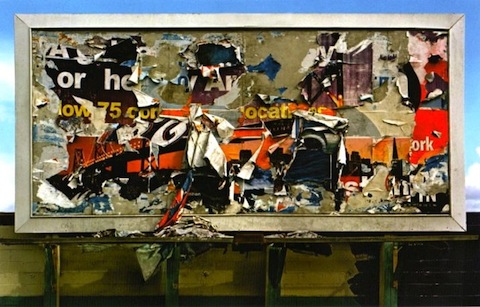
"Fifty years later," Sargent writes, "I find dripped paint, troweled impasto, and partial words peeling across disparate images in today's decaying urban billboards which I see as my 'found paintings.' They are huge, flapping in the wind, in frames." He lays claim to them, deservedly, as "my billboards."
Oakland at Broadway & E 41st (Photograph © 2011 by Richard Sargent)
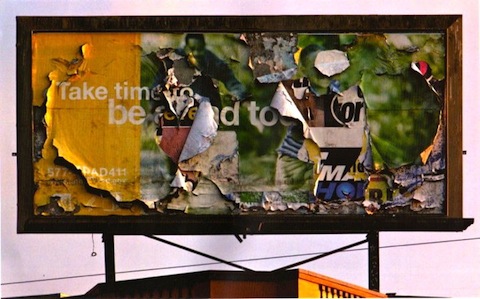
Some of his billboard photos call to mind the mid-20th century décollages of Mimmo Rotella or Wolf Vostell, others seem to echo the combine paintings of Robert Rauschenberg. But their scale and profusion speak for themselves, and it's only their perception through Sargent's camera that enables them to be seen as art. However accidental or late, he has given them aesthetic purpose.
Oakland on Foothill Blvd (Photograph © 2011 by Richard Sargent)
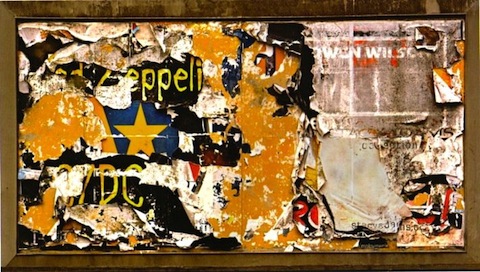
It's a matter of taste, of course, but I'm crazy about all of them.
Oakland at 23rd & E 12th (Photograph © 2011 by Richard Sargent)
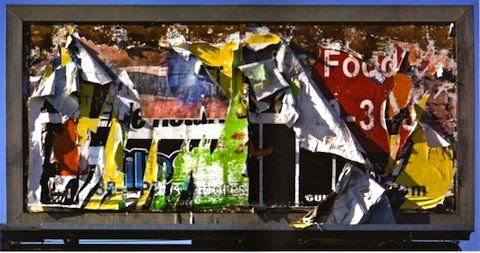
For a change of pace, how about this one.
Oakland at Market & 63rd (Photograph © 2011 by Richard Sargent)
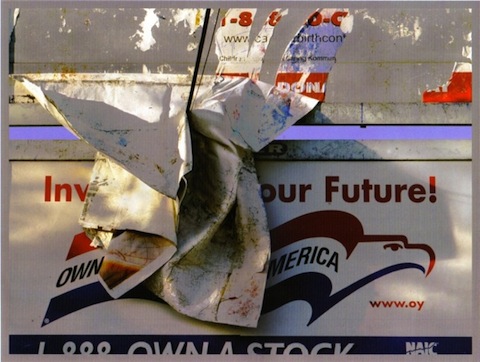
Incidental intelligence: In case anybody wants to know, all the billboard photos in the calendar were taken since 2000. Here are the dates for the ones reproduced in this blogpost: Albany at San Pablo & Solana (April 13, 2010); Richmond on Barrett Ave (2006); Oakland at Broadway & E 41st (March 7, 2010); Oakland on Foothill Blvd (2006); Oakland at 23rd & E 12th (Dec. 30, 2008); Oakland at Market & 63rd (Nov. 2, 2000).
 Sargent has served as Curator at the Long Beach Museum of Art, the Berkeley Art Center, and Dominican University's San Marco Gallery. His work has been shown at the Triangle Gallery, in San Francisco; the Giorgi Gallery, in Berkeley; North First Artspace, in San Jose; and both the Joyce Gordon Gallery and the Warehouse Gallery, in Oakland.
I'm told that the EAST BAY BILLBOARDS CALENDAR 2012 may be ordered for a flat $10 each within the U.S., including tax and shipping, by sending a check made payable to Workwomans Press, 4048 NE 58th Street, Seattle, WA 98105. Calendars will be mailed out First Class. For orders outside the U.S. the price is $15, including shipping. Alternatively, they can be purchased via Paypal, using the email GailChiarello@comcast.net to place an order.
]]>