<?xml version="1.0" encoding="utf-8"?>
<feed xmlns="http://www.w3.org/2005/Atom">
    <title>foot in mouth</title>
    <link rel="alternate" type="text/html" href="http://www.artsjournal.com/foot/" />
    <link rel="self" type="application/atom+xml" href="http://www.artsjournal.com/foot/atom.xml" />
    <id>tag:www.artsjournal.com,2008-02-19:/foot//28</id>
    <updated>2008-07-14T02:39:49Z</updated>
    <subtitle>Apollinaire Scherr talks about dance</subtitle>
    <generator uri="http://www.sixapart.com/movabletype/">Movable Type Open Source 4.1</generator>

<entry>
    <title>Apollinaire, Monday July 14</title>
    <link rel="alternate" type="text/html" href="http://www.artsjournal.com/foot/2008/07/apollinaire_monday_july_14.html" />
    <id>tag:www.artsjournal.com,2008:/foot//28.14249</id>

    <published>2008-07-14T02:38:43Z</published>
    <updated>2008-07-14T02:39:49Z</updated>

    <summary>Backsides in Jerome Robbins&apos; &quot;Goldberg Variations&quot;...</summary>
    <author>
        <name>foot in mouth</name>
        <uri>http://www.artsjournal.com/foot/</uri>
    </author>
    
        <category term="topics" scheme="http://www.sixapart.com/ns/types#category" />
    
    
    <content type="html" xml:lang="en-US" xml:base="http://www.artsjournal.com/foot/">
        <![CDATA[<a href="http://www.artsjournal.com/foot/2008/07/_i_know_foot_has.html">Backsides in Jerome Robbins' "Goldberg Variations"</a> ]]>
        
    </content>
</entry>

<entry>
    <title>Jerome Robbins&apos; &quot;Goldberg Variations,&quot; back and front</title>
    <link rel="alternate" type="text/html" href="http://www.artsjournal.com/foot/2008/07/_i_know_foot_has.html" />
    <id>tag:www.artsjournal.com,2008:/foot//28.14248</id>

    <published>2008-07-14T02:28:50Z</published>
    <updated>2008-07-20T19:51:33Z</updated>

    <summary><![CDATA[ I know, I know, Foot in Mouth has been experiencing a time warp lately. Here, for example, are some thoughts on a ballet I saw more than two weeks ago. &nbsp; In his "Goldberg Variations," to the complete Bach...]]></summary>
    <author>
        <name>foot in mouth</name>
        <uri>http://www.artsjournal.com/foot/</uri>
    </author>
    
        <category term="main" scheme="http://www.sixapart.com/ns/types#category" />
    
    
    <content type="html" xml:lang="en-US" xml:base="http://www.artsjournal.com/foot/">
        <![CDATA[

<p class="MsoNormal"><font style="font-size: 1.25em;"><i style="">I know, I know, Foot in Mouth has been experiencing a time warp lately. Here, for example, are some thoughts on a ballet I saw
more than two weeks ago. <o:p></o:p></i></font></p>

<p class="MsoNormal"><font style="font-size: 1.25em;"><o:p>&nbsp;</o:p></font></p>

<p class="MsoNormal"><font style="font-size: 1.25em;">In his "Goldberg Variations," to the complete Bach score, Jerome
Robbins concludes most of his own variations with a flock of dancers rushing in from the wings as
the ones already onstage finish up. It's a nice touch, a little joke about a tag-team
structure that works kind of like the camera in Richard Linklater's "Slacker," which
tracks one person (and story) around a corner only to take off after somebody else. Bach's variations
don't point to a theme, as in the conventional theme-and-variations
arrangement, so much as backwards and forwards to one another--and Robbins aims
to do the same. </font></p>

<p class="MsoNormal"><font style="font-size: 1.25em;">Depending on your point of view, </font><font style="font-size: 1.25em;">the result is ballet ad nauseum or ad
infinitum. Critics have been divided on this
question since the dance's debut in 1971. Arlene Croce
dubbed the New York City Ballet work "ninety minutes of hard labor"; other critics, including me, have
experienced it as waves on waves of delicious invention. When the performance
is good, each time the dancers arrive from the wings I am excited--and grateful--for more. Only the middle of "The Goldberg Variations" sags. </font></p>

<p class="MsoNormal"><font style="font-size: 1.25em;">But the piece's power to sustain attention and delight
depends on the dancers knowing how to fill the space--front <i>and</i> back. In
recognition of Bach's architectural splendor, the choreographic configurations--circles
inside of circles, folk dance lines, zigzags, and many walking formations--count
for at least as much as the individual steps. Negative space is especially
charged. In one number, a group advances from the wing upstage while another
faces them as they walk backwards into the opposite wing downstage. We
watch the fronts of one cluster and the backs of the other. The dancers may move almost
as casually as people on the street, but the courtliness of the occasion is palpable:
the regal advance, the gracious retreat, and the electricity of the space between.
</font></p>

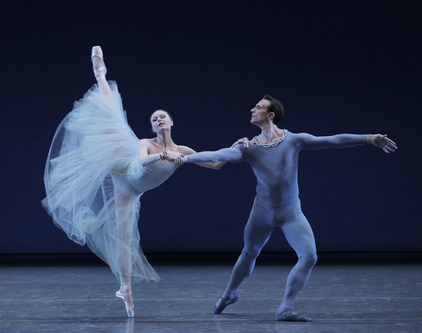
<p class="MsoNormal"><br /></p><span class="mt-enclosure mt-enclosure-image" style="display: inline;"><a href="http://www.artsjournal.com/foot/goldbergcrowd.jpg"><img alt="goldbergcrowd.jpg" src="http://www.artsjournal.com/foot/goldbergcrowd-thumb-500x322.jpg" class="mt-image-none" style="" height="322" width="500" /></a></span><p class="MsoNormal"><font style="font-size: 1.25em;"><br /></font></p><p class="MsoNormal"><font style="font-size: 1.25em;">Except for the three romantic pas de deux in the dance's second
half, the steps are plain throughout. But for plain not to devolve into meager or dull--for
the movement to animate the space as Bach has animated
time in his linking past variation to future--the dancers need to
relinquish the customary forward pitch that Balanchinean speed demands of the body
and feel<i style=""> </i>their backs from
crown to heel: the heel's pressure against the floor, the flex of the haunches,
the expansive shallow in the upper back, the tautness of the stalk of neck.
</font></p>

<p class="MsoNormal"><font style="font-size: 1.25em;">In one of the short archival videos introducing each Robbins
evening this season, we see the choreographer working with a young Damian Woetzel on
the rumba solo in "Fancy Free." At one point, the dancer goes from being curved
to the floor in profile to upright facing front. Woetzel makes
that transition like the sun rising from the ocean. Robbins tells him to unfurl
the spine like a fern in the dawning light. He wants the drama not along the horizon
but up and down. He often wants that. </font></p>

<p class="MsoNormal"><font style="font-size: 1.25em;">If the "Goldberg" dancers imagined themselves floating belly
up in cool water on a hot day, the submerged skin taking on its own temperature and character, or riding a bike fast enough to feel the breeze blowing off their backs, they'd
do better by this dance, which is only really alive when the back is. </font></p>

<p class="MsoNormal"><font style="font-size: 1.25em;"><o:p>&nbsp;</o:p></font></p>

<p class="MsoNormal"><font style="font-size: 1.25em;"><i style=""><font style="font-size: 0.8em;">The New York City
Ballet will perform "The Goldberg Variations" once more this year, on Tuesday
July 22 at the Saratoga Springs Performing Arts Center upstate. Longtime
Village Voice critic Deborah Jowitt will present a pre-performance talk at 7
pm. (Performance at 8 pm.) Visit the <a href="http://www.spac.org/calendar.php?calId=5ff14553-3ce5-102b-be03-c069cdc77f24">SPAC website</a>
for more info.</font> <o:p></o:p></i></font></p>

<p class="MsoNormal"><font style="font-size: 1.25em;"><o:p>&nbsp;</o:p></font></p>

<p class="MsoNormal"><font style="font-size: 1em;">Photo by Paul Kolnik for the New York City Ballet. </font></p>

<p class="MsoNormal"><font style="font-size: 1.25em;"><o:p>&nbsp;</o:p></font></p>

 ]]>
        
    </content>
</entry>

<entry>
    <title>Apollinaire, Saturday July 5:</title>
    <link rel="alternate" type="text/html" href="http://www.artsjournal.com/foot/2008/07/apollinaire_saturday_july_5.html" />
    <id>tag:www.artsjournal.com,2008:/foot//28.14157</id>

    <published>2008-07-05T22:25:42Z</published>
    <updated>2008-07-05T22:26:48Z</updated>

    <summary>Neil Greenberg&apos;s surface unconscious...</summary>
    <author>
        <name>foot in mouth</name>
        <uri>http://www.artsjournal.com/foot/</uri>
    </author>
    
        <category term="topics" scheme="http://www.sixapart.com/ns/types#category" />
    
    
    <content type="html" xml:lang="en-US" xml:base="http://www.artsjournal.com/foot/">
        <![CDATA[<a href="http://www.artsjournal.com/foot/2008/07/what_i_like_about_him.html">Neil Greenberg's surface unconscious</a> ]]>
        
    </content>
</entry>

<entry>
    <title>What I like about him</title>
    <link rel="alternate" type="text/html" href="http://www.artsjournal.com/foot/2008/07/what_i_like_about_him.html" />
    <id>tag:www.artsjournal.com,2008:/foot//28.14156</id>

    <published>2008-07-05T22:12:26Z</published>
    <updated>2008-07-20T20:42:23Z</updated>

    <summary> &quot;It&apos;s so internal!&quot; my friend Amanda says with admiration about Neil Greenberg&apos;s &quot;Really Queer Dance with Harps,&quot; which premiered a couple of weeks ago at Dance Theater Workshop. One move--a series of changements on half-point--reminded her of a schizophrenic...</summary>
    <author>
        <name>foot in mouth</name>
        <uri>http://www.artsjournal.com/foot/</uri>
    </author>
    
        <category term="main" scheme="http://www.sixapart.com/ns/types#category" />
    
    
    <content type="html" xml:lang="en-US" xml:base="http://www.artsjournal.com/foot/">
        <![CDATA[<p class="MsoNormal"><br /></p><span class="mt-enclosure mt-enclosure-image" style="display: inline;"><a href="http://www.artsjournal.com/foot/neilharpists.jpg"><img alt="neilharpists.jpg" src="http://www.artsjournal.com/foot/neilharpists-thumb-448x298.jpg" class="mt-image-center" style="margin: 0pt auto 20px; text-align: center; display: block;" height="298" width="448" /></a></span>

<p><font style="font-size: 1.25em;"><i style=""><o:p></o:p></i></font><br /><o:p><br /></o:p></p>

<p class="MsoNormal"><font style="font-size: 1.25em;">"It's so internal!" my friend Amanda says with admiration
about Neil Greenberg's "<em><span style="font-style: normal;">Really Queer Dance with Harps,</span></em><i style="">" <span style=""></span></i>which premiered a couple
of weeks ago at Dance Theater Workshop. One move--a series of <i style="">changements </i>on half-point--reminded her
of a schizophrenic she'd seen outside a hospital in Rome jangling his insides with
stiff little jumps. </font></p>

<p class="MsoNormal"><font style="font-size: 1.25em;">The insides of Greenberg's dancers are not at risk: they inhabit
a whorl of trunk as sturdy as a tree's. <span style="">&nbsp;</span>But
their bare galumphing feet--smacking the floor exactly as you're taught <i style="">not to </i>in ballet class--</font><font style="font-size: 1.25em;">resound with social ineptitude and a
rough flamboyance</font><font style="font-size: 1.25em;">. They call to mind Frankenstein's
monster (on a good day). <br /></font></p><p class="MsoNormal"><font style="font-size: 1.25em;">Meanwhile, the arms are socially aware--grace notes of affect, as are the flowers in the hair of boys and girls alike. Fragility
and delicacy, self-declaration and tribal identification, flutter on the
body's periphery as if the soul and its accessories were butterflies. In
one of "Really Queer Dance's" several distinct phrases, one hand grazes
the vulnerable crease in the hip where an angel forced Jacob to testify, while the other reaches overhead like a weather vane or the paw of a disco queen feeling out the
scene. </font></p>

<p class="MsoNormal"><font style="font-size: 1.25em;">Only the gaze enters the world </font><font style="font-size: 1.25em;">naked</font><font style="font-size: 1.25em;">--shed of inwardness. Or it tries to, anyway. Eyes askew in the head and head askew on the spine as
if the effort caused all sorts of distortions, the dancers peer
at the wall of darkness that separates us from them without recognition, or seduction, in
the look.</font></p>

<p class="MsoNormal"><font style="font-size: 1.25em;">You know those people who find fault with one lover after
another for years on end without it ever occurring to them that the problem
might lie with their conception of love? Well, the dance equivalent is the false notion that dance is the most unmediated of arts, the
least artful of arts, a quasi-art that delivers its truths straight. People who
insist they really do like dance, it's only a matter of finding the <i style="">right</i> dance, are often seeking <i style="">sheer physicality! sheer feeling! sheer
pleasure!</i> <span style="">&nbsp;</span>But precisely because dance
<i style="">is </i>physical, which, yes, is tangled
up in our minds with pleasure and feeling, it can't only be physical, emotional,
pleasurable, or it wouldn't be art, it would just be body, feeling, sensation. On the other hand, it has no choice but to present even introspection on the surface. All it has is surface, which does double duty as inside and out. <br /> </font></p>

<p><font style="font-size: 1.25em;">Greenberg homes in on this poignant paradox, which, he discovers, life shares with dance. His subject is invariably an inner life that we can only approach via surfaces--an inner life <i>made up</i>, in fact,<i> </i>of surfaces, the detritus of the everyday.&nbsp; </font><span style="font-size: 12pt; font-family: &quot;Plantagenet Cherokee&quot;;"> </span><br /></p><p class="MsoNormal">"<font style="font-size: 1.25em;">Really Queer Dance with Harps" may be no more inward than previous dances--as usual, each dancer is alone with others, never touching (until the goofy coda) and never acknowledging anyone in any conventional sense, and as usual the dancers share a family of gestures that means something particular to each of them. But here those family members are especially individual. (The eight highly trained, </font><font style="font-size: 1.25em;">wonderfully idiosyncratic </font><font style="font-size: 1.25em;"> dancers are Ellen Barnaby, Nicholas Duran, Johnni Durango, Christine Elmo, Paige Martin, Luke Miller, Antonio Ramos, and Colin Stilwell.) </font></p>

<p class="MsoNormal"><font style="font-size: 1.25em;">Until recently, Greenberg devised his choreography on his
own body, videotaping himself improvising, then editing what he saw for his
dancers' consumption. For "Really Queer Dance with Harps" and its companion on
the program, the equally glorious though short "Quartet with Three Gay Men," he
decided to have the dancers invent most of the phrases. The effect is to
intensify the scene's </font><font style="font-size: 1.25em;">casual-seeming, non-syncopated character. The phrases
seem more than ever like floating <i style="">idées
fixes</i>, snagging on a person like a plastic bag on a rosebush. Sometimes they become assimilated into her style of being, and
sometimes they don't. </font></p>

<p class="MsoNormal"><font style="font-size: 1.25em;">"Really Queer Dance with Harps" is low key and in no hurry. The
movement has more feeling and lusciousness than the Cunningham vocabulary it
grew out of. (At this juncture, too many of Cunningham's dancers treat steps as if
they were a task assigned them, above which they can smile at each other unbothered. Cunningham should ask them to commit <i style="">all</i> of themselves to what they're doing.)
And three golden harpists massage </font><font style="font-size: 1.25em;">Zeena Parkins' mercurial music into </font><font style="font-size: 1.25em;">their heart-shaped harps to call to mind the heart. But the dance does share Cunningham's aversion
to the conventional dramatic arc--and the present he lets you sink into and pull back
from again and again. </font></p>

<p class="MsoNormal"><font style="font-size: 1.25em;">In this, it's </font><font style="font-size: 1.25em;">like life, too.<span style="">&nbsp; </span><span style="">&nbsp;</span><br /></font></p><br /><p class="MsoNormal"><font style="font-size: 1.25em;"><i style=""><o:p>&nbsp;</o:p></i></font></p>

<p></p>

<p class="MsoNormal"><font style="font-size: 1.25em;"><i style="">For more, here's the
esteemed Roslyn Sulcas' <a href="http://www.nytimes.com/2008/06/14/arts/dance/14dtw.html">excellent review</a> for the New York Times and my friend Nancy Dalva's Danceviewtimes <a href="http://danceviewtimes.typepad.com/nancydalva/2008/06/this-weekend-in.html.">post</a>. For the full monty of previews and views, try Dance Theater Workshop's <a href="http://www.dancetheaterworkshop.org/greenberg">web site </a>(which has failed to include this blog as well as danceviewtimes, for example, on
its blog roll. Sigh. Why even have a blog roll if it's so strictly self-serving?) <span style="">&nbsp;</span><span style="">&nbsp;</span><br /></i></font></p><br /><p class="MsoNormal"><br /></p><p class="MsoNormal">Photo by Julia Cervantes for Dance Theater Workshop. <br /><font style="font-size: 1.25em;"><i style=""><o:p></o:p></i></font></p>

<p class="MsoNormal"><font style="font-size: 1.25em;"><i style=""><o:p>&nbsp;</o:p></i></font></p>

<p> </p>]]>
        
    </content>
</entry>

<entry>
    <title>GO: Neil Greenberg at Dance Theater Workshop (only through Saturday)</title>
    <link rel="alternate" type="text/html" href="http://www.artsjournal.com/foot/2008/06/go_neil_greenberg_at_dance_the.html" />
    <id>tag:www.artsjournal.com,2008:/foot//28.14003</id>

    <published>2008-06-20T03:37:57Z</published>
    <updated>2008-06-24T05:25:14Z</updated>

    <summary> I should have mentioned Neil Greenberg&apos;s show at DTW already, as I&apos;ve never seen anything by him I haven&apos;t liked, if not been deeply moved by. (I&apos;m going Friday, tonight--and may have more to say later). Thankfully, Foot in...</summary>
    <author>
        <name>foot in mouth</name>
        <uri>http://www.artsjournal.com/foot/</uri>
    </author>
    
        <category term="main" scheme="http://www.sixapart.com/ns/types#category" />
    
    
    <content type="html" xml:lang="en-US" xml:base="http://www.artsjournal.com/foot/">
        <![CDATA[

<span class="mt-enclosure mt-enclosure-image" style="display: inline;"><font style="font-size: 1.25em;"><a href="http://www.artsjournal.com/foot/harpdancegreenberg.jpg"><img alt="harpdancegreenberg.jpg" src="http://www.artsjournal.com/foot/harpdancegreenberg-thumb-400x213.jpg" class="mt-image-center" style="margin: 0pt auto 20px; text-align: center; display: block;" height="213" width="400" /></a></font></span><font style="font-size: 1.25em;"><br /></font>

<p class="MsoNormal" style=""><font style="font-size: 1.25em;">I
should have mentioned Neil Greenberg's show at DTW already, as I've never seen
anything by him I haven't liked, if not been deeply moved by. (I'm going
Friday, tonight--and may have more to say later). Thankfully, Foot in Mouth
contributor Eva Yaa Asantewaa reminded me, with this rave <a href="http://infinitebody.blogspot.com/">on her blog</a>: <o:p></o:p></font></p>

<blockquote><p class="MsoNormal"><font style="font-size: 1.25em;">Everybody's thrilled by <a href="http://www.dancetheaterworkshop.org/greenberg">and writing about</a> <b>Neil
Greenberg</b>'s new <i>Really Queer Dance with Harps</i>, and you should really
queerly or otherwise see it--especially for the radiant trio of harpists, led
by composer <b>Zeena Parkins</b>, at the golden heart of the piece. But my own
really queer<i> </i>heart has gone and continues to go out to <i>Quartet with
Three Gay Men</i>, the 2006 work danced by Greenberg, <b>Luke Miller</b>, <b>Antonio
Ramos</b> and <b>Colin Stillwell</b>. It's just--<i>hooray!</i>--11 minutes,
and some of that time is spent dancing to RuPaul's "Supermodel (You Better
Work)." Can't go wrong, in my book, with RuPaul. And it's a fantastic
dance, too, like a prism breaking Greenberg into four avatars who render his
spacious movement with luscious, queerforward simplicity. Oh, did I mention
it's only 11 minutes? Brevity, the soul of wit.<o:p></o:p></font></p></blockquote>

<p class="MsoNormal" style=""><font style="font-size: 1.25em;"><br /><b>Dance Theater Workshop</b></font>
<font style="font-size: 1.25em;">'s got <b>Dance By Neil Greenberg</b> through
Saturday. Click <a href="http://www.dancetheaterworkshop.org/greenberg">here</a> to watch a clip
of <i>Quartet with Three Gay Men (</i>it's number 4 in the slideshow).<i> </i>Also
click <a href="http://www.dancetheaterworkshop.org/greenberg">here </a>for
tickets, preview articles, more rave reviews, and <a href="http://www.artforum.com/words/id=20588">an Artforum piece by Greenberg
himself</a> that's really smart. Greenberg should be a big star; the fact that
we can see him and his incredible, eccentric dancers up close and for $25 (or
less) is amazing for us, whatever it says about the situation of the artist in
America. So, Enjoy! <o:p></o:p></font></p>

<p class="MsoNormal"><font style="font-size: 1.25em;"><o:p>&nbsp;</o:p></font></p>

<p class="MsoNormal"><font style="font-size: 1.25em;" size="-2">Photo by Erin Baiano; borrowed from <em>The New York Times.</em></font></p>]]>
        
    </content>
</entry>

<entry>
    <title>We like her, we really, really like her</title>
    <link rel="alternate" type="text/html" href="http://www.artsjournal.com/foot/2008/06/we_like_her_we_really_really_l.html" />
    <id>tag:www.artsjournal.com,2008:/foot//28.13974</id>

    <published>2008-06-18T02:46:23Z</published>
    <updated>2008-06-18T03:29:45Z</updated>

    <summary>I try not to resort too often to the common blog tactic of letting other writers do the work, but I won&apos;t be able to get anything up until next week and my colleague Joel Lobenthal, of the New York...</summary>
    <author>
        <name>foot in mouth</name>
        <uri>http://www.artsjournal.com/foot/</uri>
    </author>
    
        <category term="main" scheme="http://www.sixapart.com/ns/types#category" />
    
    
    <content type="html" xml:lang="en-US" xml:base="http://www.artsjournal.com/foot/">
        <![CDATA[I try not to resort too often to the common blog tactic of letting other writers do the work, but I won't be able to get anything up until next week and my colleague Joel Lobenthal, of the New York Sun, has written a wonderful tribute to the exceptional Wendy Whelan, of New York City Ballet.<a href="http://www.nysun.com/arts/nycbs-wendy-whelan-in-her-prime/80031/"> So I can't resist. Enjoy!&nbsp;</a><br /><br /><br /><span class="mt-enclosure mt-enclosure-image" style="display: inline;"><a href="http://www.artsjournal.com/foot/whelansotopolyphonia.jpg"><img alt="whelansotopolyphonia.jpg" src="http://www.artsjournal.com/foot/whelansotopolyphonia-thumb-250x238.jpg" class="mt-image-center" style="margin: 0pt auto 20px; text-align: center; display: block;" height="238" width="250" /></a></span>Whelan and retired principal dancer Jock Soto in Christopher Wheeldon's "Polyphonia." Photo by Paul Kolnik for New York City Ballet.<br /> <div><br /></div>]]>
        
    </content>
</entry>

<entry>
    <title>Apollinaire, Wednesday June 11:</title>
    <link rel="alternate" type="text/html" href="http://www.artsjournal.com/foot/2008/06/apollinaire_wednesday_june_11.html" />
    <id>tag:www.artsjournal.com,2008:/foot//28.13855</id>

    <published>2008-06-11T14:13:00Z</published>
    <updated>2008-06-11T14:14:44Z</updated>

    <summary>Premieres by the Bolshoi&apos;s Alexei Ratmansky, Twyla Tharp, and Michael Clark--lot o&apos; thoughts...</summary>
    <author>
        <name>foot in mouth</name>
        <uri>http://www.artsjournal.com/foot/</uri>
    </author>
    
        <category term="topics" scheme="http://www.sixapart.com/ns/types#category" />
    
    
    <content type="html" xml:lang="en-US" xml:base="http://www.artsjournal.com/foot/">
        <![CDATA[Premieres by the Bolshoi's Alexei Ratmansky, Twyla Tharp, and Michael Clark--<a href="http://www.artsjournal.com/foot/2008/06/ballet_miscellany.html">lot o' thoughts</a><br />]]>
        
    </content>
</entry>

<entry>
    <title>Ballet Miscellany</title>
    <link rel="alternate" type="text/html" href="http://www.artsjournal.com/foot/2008/06/ballet_miscellany.html" />
    <id>tag:www.artsjournal.com,2008:/foot//28.13852</id>

    <published>2008-06-11T06:37:31Z</published>
    <updated>2008-06-27T04:29:09Z</updated>

    <summary> I&apos;ve seen many exciting ballets in the last few weeks--and I knew if I didn&apos;t write about them soon (all of them), I&apos;d forget what I was thinking. So this roundup is altogether too long. In order not to...</summary>
    <author>
        <name>foot in mouth</name>
        <uri>http://www.artsjournal.com/foot/</uri>
    </author>
    
        <category term="main" scheme="http://www.sixapart.com/ns/types#category" />
    
    
    <content type="html" xml:lang="en-US" xml:base="http://www.artsjournal.com/foot/">
        <![CDATA[<p></p>

<p class="MsoNormal" style="">

</p><p class="MsoNormal" style="">

</p><p class="MsoNormal" style="">

</p><p class="MsoNormal"><font style="font-size: 1.25em;"><i>I've seen many exciting ballets in the last few
weeks--and I knew if I didn't write about them soon (all of them), I'd forget
what I was thinking. So this roundup is altogether too long. In order not to
fall into a stupor, perhaps you should read it in installments. The photos
serve to separate the parts.</i></font></p>

<p class="MsoNormal" style=""><i><span style="font-family: Perpetua;"> <u1:p></u1:p></span></i><span style="font-family: Perpetua;"><o:p></o:p></span></p>

<p><u1:p></u1:p></p><p class="MsoNormal" style=""><i><span style="font-family: Perpetua;">&nbsp;<u1:p></u1:p></span></i><span style="font-family: Perpetua;"><o:p></o:p></span></p>

<p><u1:p></u1:p></p><p class="MsoNormal" style=""><font style="font-size: 0.512em;"><i><span style="font-size: 15pt; font-family: Perpetua;"><font style="font-size: 0.8em;"><font style="font-size: 0.8em;"></font></font> <u1:p></u1:p></span></i><span style="font-family: Perpetua;"><o:p></o:p></span></font></p>

<p><font style="font-size: 0.512em;"><u1:p></u1:p></font></p><div align="left"><span class="mt-enclosure mt-enclosure-image" style="display: inline;"><font style="font-size: 0.512em;"><a href="http://www.artsjournal.com/foot/concerto%20dsch.jpg"><img alt="concerto dsch.jpg" src="http://www.artsjournal.com/foot/concerto%20dsch-thumb-400x200.jpg" class="mt-image-center" style="margin: 0pt auto 20px; text-align: center; display: block;" height="200" width="400" /></a></font></span></div><p class="MsoNormal"><font style="font-size: 0.512em;"><br /><span style="font-family: Century;"></span></font></p>

<p class="MsoNormal" style=""><font style="font-size: 1.25em;">About
Alexei Ratmansky's "Concerto DSCH," my friend Elaine exclaimed,
"It's so <i>real!</i>"</font> <o:p></o:p></p>

<u1:p></u1:p><u2:p></u2:p><u3:p></u3:p>

<p class="MsoNormal" style=""><font style="font-size: 1.25em;">&nbsp;&nbsp;&nbsp;
Of course, it's not real, it's ballet. But Ratmansky's eye for what people do
together--become voyeurs, perpetrators, flirts, attention-hoggers, rivals,
accidental lovers--is so wise and funny that he seems to have lifted scene
after scene from life and translated it more perfectly than possible with
translation into ballet. It's like when Marge and Homer Simpson become
pilgrims--exactly as they've always been except now they're on the <i>Mayflower</i>.<o:p></o:p></font></p>

<font style="font-size: 1.25em;"><u3:p></u3:p></font>

<p class="MsoNormal" style=""><font style="font-size: 1.25em;"><u1:p></u1:p>&nbsp;&nbsp;&nbsp;
At one point late in the ballet--the score is Shostakovich's urbanely witty,
then brooding, then buoyant Piano Concerto No. 2 in F major--a horde of dancers
bursts onto the stage with little flat-footed hops, and everyone laughs, not
only because the <i>boing</i> in the step is funny but because, performed <i>en
masse</i>, it answers the drama that the dancers have just intruded on. You
feel glee --and relief--to find aspects of humanity so instantly recognizable,
no matter the language they're spoken in.<o:p></o:p></font></p>

<font style="font-size: 1.25em;"><u1:p></u1:p><u2:p></u2:p><u3:p></u3:p></font>

<p class="MsoNormal" style=""><font style="font-size: 1.25em;">&nbsp;&nbsp;&nbsp;
It's tempting to compare Ratmansky to all the other choreographers I admire,
not because he's derivative--not at all--but because he ratifies ballet's
history by extending it. The choreographer whom he most reminds me of, though,
is Jerome Robbins. (I swear, I had this thought before the Robbins festival at
New York City Ballet began. Specifically, it was Ratmansky's "Bizet
Variations," with its shades of the three rival sailors in "Fancy
Free," that clinched the connection for me. That was during the BAM run
this winter of Nina Ananiashvili's State Ballet of Georgia, which commissioned
the ballet.) <o:p></o:p></font></p>

<font style="font-size: 1.25em;"><u1:p></u1:p><u2:p></u2:p><u3:p></u3:p></font>

<p class="MsoNormal" style=""><font style="font-size: 1.25em;">&nbsp;&nbsp;&nbsp;
Ratmansky also makes a real place of the stage. He also is preoccupied with the
psychology of the group and of the individual in the group; he also understands
the corps not as a corps proper but as a bunch of people, whose relation to one
another is constantly in flux. He also recognizes the punctuating power of
exits and entrances (like the last word in a sentence or in a line of poetry).
Most of all, he succeeds where Robbins desperately wanted to, but only
sometimes did: he develops a language that jettisons conventional signs (for
Robbins, the "cool" finger-snapping, the maidenly curtsying, the
folksy jigs) for what those signs originally conveyed, before they became
commonplace. Too often, Robbins got stuck in the middle, retaining the gestures
while lifting them from their social context, so they quickly devolved into
shtick. Ratmansky saves himself by inventing his own gestures. (He loves
inventing steps as only perhaps Balanchine did, and he's got a keen sense of
their evocative oomph.) Because the moves are never exactly what you'd see in
the world, they offer it with wit and insight. <o:p></o:p></font></p>

<font style="font-size: 1.25em;"><u1:p></u1:p><u2:p></u2:p><u3:p></u3:p></font>

<p class="MsoNormal" style=""><font style="font-size: 1.25em;">&nbsp;&nbsp;&nbsp;
On the same program-- it's called Here and Now--is "Rococo
Variations," Christopher Wheeldon's last ballet as the company's resident
choreographer. I dismissed it at its premiere this winter as even more
frou-frou than its Tchaikovsky score, but now, on a third viewing, it seems to
have deepened, grown full of mood. Of course I want to think Wheeldon went to
work on it, fixing the transitions so that it now feels of a piece, but
probably I'm the one who's changed. <o:p></o:p></font></p>

<font style="font-size: 1.25em;"><u3:p></u3:p></font>

<p class="MsoNormal" style=""><font style="font-size: 1.25em;"><u1:p></u1:p><u2:p></u2:p>&nbsp;&nbsp;&nbsp;
It's embarrassing to be so inconsistent. If I love a piece at first sight, I
rarely love it less on a second go, but the other way around happens too
often--especially, for some reason, with Wheeldon and Mark Morris. <o:p></o:p></font></p>

<font style="font-size: 1.25em;"><u1:p></u1:p><u2:p></u2:p><u3:p></u3:p></font>

<p class="MsoNormal" style=""><font style="font-size: 1.25em;">&nbsp;&nbsp;&nbsp;
It took two visits before I could stand Morris's "Sylvia" and
"Mozart Dances." Five for "V." (Believe me, I would have
given up by then if the dance hadn't appeared on mixed bills.) Two for
Wheeldon's "American in Paris." But I'm not sliding from admiration
to adoration here, I'm leaping from impatient dislike to swoony love--a vast
distance.&nbsp; <o:p></o:p></font></p>

<font style="font-size: 1.25em;"><u1:p></u1:p><u2:p></u2:p><u3:p></u3:p></font>

<p class="MsoNormal" style=""><font style="font-size: 1.25em;">&nbsp;&nbsp;&nbsp;
Maybe it's a musical thing. Both Wheeldon and Morris respond in detail to their
scores, and when their interpretations depart radically from my own dreamy
visualizations, I spend the first visit or two simply adjusting--reading the
words but not grasping the sentences. I'm glad to have the luxury (the free
tickets!) to come again. <o:p></o:p></font></p>

<font style="font-size: 1.25em;"><u3:p></u3:p></font>

<p class="MsoNormal" style=""><font style="font-size: 1.25em;"><i><u1:p></u1:p><u2:p></u2:p><br /></i></font></p><p class="MsoNormal" style=""><font style="font-size: 1.25em;"><i>Last
chance for "Rococo Variations" and "Concerto DSCH" this
season: Thursday, 8 pm, State Theater, Lincoln Center. Orchestra, 3<sup>rd</sup>
and 4<sup>th</sup> ring seats still available. Nycballet.com. (The program
consists of four ballets; the ones in the middle are bad, in my humble opinion.
You could take a break for dinner and come back for the Ratmansky.)&nbsp;</i></font><o:p></o:p></p>

<p class="MsoNormal" style=""><font style="font-size: 0.8em;"><i><span style="font-size: 14pt;"></span></i></font><span style="font-size: 14pt;"><o:p></o:p></span></p>

<p class="MsoNormal" style=""><i><span style="font-size: 13pt; font-family: Perpetua;"><font style="font-size: 0.8em;"><font style="font-size: 1.25em;">&nbsp;</font></font> <u1:p></u1:p></span></i><span style="font-size: 13pt; font-family: Perpetua;"><o:p></o:p></span></p>

<p><u1:p></u1:p><font style="font-size: 0.512em;"><i><span style="font-size: 15pt; font-family: Perpetua;"><font style="font-size: 0.64em;"></font></span></i></font></p><p class="MsoNormal"><font style="font-size: 0.512em;"><i style=""><span style="font-family: Century;"><span style=""> </span><o:p></o:p></span></i></font></p>

<p class="MsoNormal"><font style="font-size: 0.512em;"><span style="font-family: Century;"><o:p>&nbsp;</o:p></span></font></p>

<p></p><span class="mt-enclosure mt-enclosure-image" style="display: inline;"><font style="font-size: 0.512em;"><a href="http://www.artsjournal.com/foot/Clark_I%20Do_Stephanie%20Berger4_partnering.jpg"><img alt="Clark_I Do_Stephanie Berger4_partnering.jpg" src="http://www.artsjournal.com/foot/Clark_I%20Do_Stephanie%20Berger4_partnering-thumb-480x318.jpg" class="mt-image-none" style="" height="318" width="480" /></a></font></span><p class="MsoNormal"><font style="font-size: 0.512em;"><span style="font-family: Century;"><o:p>&nbsp;</o:p></span></font></p>

<p class="MsoNormal" style=""><font style="font-size: 1.25em;">Speaking
of being quickly dismissed--and of music revisited--British choreographer
Michael Clark didn't get many reviews for his two programs to Stravinsky
scores, presented last week at the Rose Theater as part of Lincoln Center's
Great Performers series. So it's nice that the trusty old Times sent a reviewer
to both programs--except they sent the same reviewer, Claudia La Rocco, and she
didn't like either show! (Once it was clear that Clark irritated her, it was
nuts to subject her--and us--to a second drubbing. The Times should have sent
someone else.) <o:p></o:p></font></p>

<font style="font-size: 1.25em;"><u1:p></u1:p><u2:p></u2:p></font>

<p class="MsoNormal" style=""><font style="font-size: 1.25em;">&nbsp;&nbsp;&nbsp;
Where La Rocco saw meagerness, sterility, and stale, '80s outrageousness, I
found a lot to be intrigued by. (I only saw the second program, which featured
"Mmm..." to Stravinsky's "Rite of Spring" and "I
Do"--pictured above--to "Les Noces.") But that's neither here
nor there: we're entitled to our different views. I do take issue, though, with
the bind La Rocco puts an artist in who wants to respond to dance history or
even just the music of dance history. <o:p></o:p></font></p>

<font style="font-size: 1.25em;"><u2:p></u2:p></font>

<p class="MsoNormal" style=""><font style="font-size: 1.25em;">&nbsp;&nbsp;&nbsp;
She concludes her review of "I Do" and "Mmm..." with, <o:p></o:p></font></p>

<font style="font-size: 1.25em;"><u1:p></u1:p><u2:p></u2:p></font>

<blockquote><p class="MsoNormal" style=""><font style="font-size: 1.25em;">There
are neat touches throughout the two works. But Mr. Clark is going up against
history here, and neat doesn't quite do the trick.<o:p></o:p></font></p></blockquote>

<font style="font-size: 1.25em;"><u1:p></u1:p><u2:p></u2:p></font>

<p class="MsoNormal" style=""><font style="font-size: 1.25em;">&nbsp;&nbsp;&nbsp;
If Clark had followed the usual plot line of the ballets, the result would
likely be derivative, if not hokey (see: Robbins' "Les Noces").
Instead, he acknowledges the scores' canonical status by assuming we know the
story and allowing himself to take a more oblique approach, and he's accused of
skirting the issue ("neat touches"). What, then, <i>is</i> there for
him to do? This music cries out, as it always has, to be danced to, and we
critics should be careful not to muffle that cry. <o:p></o:p></font></p>

<font style="font-size: 1.25em;"><u2:p></u2:p></font>

<p class="MsoNormal" style=""><font style="font-size: 1.25em;">&nbsp;&nbsp;&nbsp;
For what it's worth, "Mmm..." and "I Do" seemed to <i>me</i>
mainly modest and serious (albeit with kinky embroidery), intent on approaching
the music in both highly conceptual and highly kinetic and spatial terms (these
last two deliciously bound): a difficult approach, which does indeed make
success unlikely, but a worthwhile one for its being so unusual. <o:p></o:p></font></p>

<font style="font-size: 1.25em;"><u1:p></u1:p><u2:p></u2:p></font>

<p class="MsoNormal" style=""><font style="font-size: 1.25em;">&nbsp;&nbsp;&nbsp;
While the conventional response to the rhythmic bombast of "Rite" and
"Noces" is to meet it beat for beat with percussive steps, Clark
translates rhythm into an angularity of the body. The dancers move in flat,
Cunninghamesque tilts with right-angled arms. The pieces' necessary texture
comes by way of flurries of steps, turns that go against sense, torsos softly
abandoning their clear lines to gyre and implode, entrances and exits that
materialize unexpectedly (half the time through rotating mirrored panels at the
back, which open onto a cement back wall and spotlights beaming directly into
our eyes. Ingeniously creepy.). <o:p></o:p></font></p>

<font style="font-size: 1.25em;"><u1:p></u1:p><u2:p></u2:p></font>

<p class="MsoNormal" style=""><font style="font-size: 1.25em;">&nbsp;&nbsp;&nbsp;
The penchant for the planar is very British contemporary-dance-- Richard Alston
and Russell Maliphant have it, too--and Americans tend to find it a bit bland.
Our strict angles--<i>our</i> Cunningham--is Cunningham, who is more explosive,
more suddenly still, whose palette is both larger and more detailed. But the
love that the Brits have for the most basic of Cunningham shapes--as if it were
a miracle to flatten the body into an X or a Y, how much juice even in
that!--is touching and contagious. <o:p></o:p></font></p>

<font style="font-size: 1.25em;"><u1:p></u1:p><u2:p></u2:p></font>

<p class="MsoNormal" style=""><font style="font-size: 1.25em;">&nbsp;&nbsp;&nbsp;
I found the attention the Clark pieces invited was very like that of Cunningham
dances, which have no narrative or dramatic arc, either. You get absorbed in
the details and are not waiting for anything in particular. But with Clark,
anyway, the devastatingly dramatic just may occur. "I Do" ends with
the dancers in a tangle on the floor under sickly yellow light, as if they had
been downed by poison gas and curled their limbs in to die. (Ah, the spectacle
of forever after!) The bride, bedecked in what looks like a tea cozy cum dildo,
stands above the wreckage. Trauma and drama presented as incident may be at
odds with Stravinsky's "Rite" and "Noces"--all about
anticipation, both of them--but so much the better.</font></p><p class="MsoNormal" style=""><br /><font style="font-size: 1.25em;"> <o:p></o:p></font></p>

<font style="font-size: 1.25em;"><u1:p></u1:p><u2:p></u2:p><span style="font-size: 12pt; font-family: &quot;Times New Roman&quot;;"><u1:p> </u1:p></span></font>

<p><font style="font-size: 1.25em;"><i><a href="http://www.michaelclarkcompany.com/mmm.wmv">Here's a one-minute
clip </a>from "Mmm..."&nbsp; No more Michael Clark for Americans this
year, but the company will be touring the Stravinsky fare to Luxembourg,
Marseille, Suffolk, and Belfast this summer and fall. Click <a href="http://www.michaelclarkcompany.com/diary.html">here </a>for itinerary.</i></font><o:p></o:p></p>

<span style="font-size: 12pt; font-family: &quot;Times New Roman&quot;;"><u1:p></u1:p><i><br /><br /></i></span><p class="MsoNormal" style=""><font style="font-size: 0.512em;"><span style="font-size: 15pt; font-family: Perpetua;"><font style="font-size: 0.8em;"><i><font style="font-size: 0.8em;"></font> </i></font></span><span style="font-family: Perpetua;"><o:p></o:p></span></font></p>

<p></p><div align="center"><span class="mt-enclosure mt-enclosure-image" style="display: inline;"><font style="font-size: 0.512em;"><a href="http://www.artsjournal.com/foot/tharprogue.jpg"><img alt="tharprogue.jpg" src="http://www.artsjournal.com/foot/tharprogue-thumb-250x390.jpg" class="mt-image-none" style="" height="390" width="250" /></a></font></span></div><p class="MsoNormal"><font style="font-size: 0.512em;"><i><br /></i></font></p>

<p class="MsoNormal" style=""><font style="font-size: 1.25em;">Twyla
Tharp's "Rabbit and Rogue" for American Ballet Theatre is all
anticipation. You keep waiting for the cartoon roustabouts Rabbit and Rogue and
the Balanchinean corps slipping along behind them to either more fully converge
or more completely diverge--rather than this semi-demi relationship. <o:p></o:p></font></p>

<font style="font-size: 1.25em;"><u1:p></u1:p><u2:p></u2:p></font>

<p class="MsoNormal" style=""><font style="font-size: 1.25em;">&nbsp;&nbsp;&nbsp;
The premiere last week polarized critics, with more hating it than loving it. I
fell somewhere in between, struck when it was over (and it is long) by what a
feat it is to make a ballet--a real ballet, which this is, yes--without being
struck by wonder at the ballet itself. I was never bored (though I did give way
to exhaustion by the very end, having been in a state of anticipation for
nearly an hour). But finally it seemed less than the sum of its parts. <o:p></o:p></font></p>

<font style="font-size: 1.25em;"><u1:p></u1:p><u2:p></u2:p></font>

<p class="MsoNormal" style=""><font style="font-size: 1.25em;">&nbsp;&nbsp;&nbsp;
And parts "Rabbit and Rogue" certainly has. The corps is liquid and
evanescent, very much in the mode of Tharp's last ballet for American Ballet
Theatre, "The Brahms-Hayden Variations," with whatever meaning one
derives arriving via the senses. The rapscallions Rabbit and Rogue, on the
other hand, belong to the kind of cartoon world that needs a plot. I couldn't
find one, but my Artsjournal colleague Tobi Tobias could (<a href="http://www.artsjournal.com/tobias/2008/06/tharp_goes_to_hell_back_in_rab.html">hers
</a>is my favorite among the reviews I read): <o:p></o:p></font></p>

<font style="font-size: 1.25em;"><u1:p></u1:p><u2:p></u2:p></font>

<blockquote><p class="MsoNormal" style=""><font style="font-size: 1.25em;"><u1:p></u1:p>The
pair [Rabbit (Herman Cornejo) and Rogue (Ethan Steifel)] sets out to see the
world, accompanied by a colorful mix of music by the film composer Danny
Elfman. Well, a postmodern idea of the world: They visit Hell, where Gillian
Murphy and David Hallberg, alternately quarreling and making love, are the
central patrons of a with-it nightclub where the required dress is black,
skimpy and spangled. (Outfits by Norma Kamali.)<o:p></o:p></font></p><font style="font-size: 1.25em;"><u1:p></u1:p><u2:p></u2:p></font><font style="font-size: 1.25em;">Next stop is Heaven, a peaceable kingdom, all white gowns
and silver trousers, reigned over by Paloma Herrera and Gennadi Saveliev. In
this place, one might find serene compatibility, even true love, perhaps bliss.
Then the worlds commingle, as in real life.<u1:p> </u1:p></font><br style="" /><font style="font-size: 1.25em;"><u1:p></u1:p></font></blockquote>


<p class="MsoNormal"><font style="font-size: 1.25em;"><u1:p>
<!--[if !supportLineBreakNewLine]--><br style="" />
<!--[endif]--></u1:p><o:p></o:p></font></p>

<font style="font-size: 1.25em;"><u1:p></u1:p></font>

<p class="MsoNormal" style=""><font style="font-size: 1.25em;">&nbsp;&nbsp;&nbsp;
I did have the idea that our heroes existed in a different zone from everyone
else, though primary colors for R and R, with the black and white for the rest,
would have helped. But even this might not have been enough, because for the
corps to tell a story, Rabbit and Rogue need one as well, and nothing really
happens to them. (Have you ever met a cartoon character who <i>wasn't </i>defined
by action? After all, what else do they have?) Rabbit and Rogue, endearingly
danced by Cornejo and Steifel, end up seeming like filler in the neoclassical
ballet Tharp actually wanted to make. <o:p></o:p></font></p>

<font style="font-size: 1.25em;"><u1:p></u1:p><u2:p></u2:p></font>

<p class="MsoNormal" style=""><font style="font-size: 1.25em;">&nbsp;&nbsp;&nbsp;
Their antics might have at least employed cartoon rhythm. Film composer Danny
Elfman's score has been disparaged for "lacking distinction," and it <i>is
a </i>hodgepodge. But it starts out with a color and chug--one rhythmic pattern
overlapping the next--that demands to be adhered to: Elfman is as dictatorial
at the start as his hero Prokofiev. And still Tharp doesn't listen. Given how
many of her early works depend on comic timing, it's surprising to find her deaf
to it here. Perhaps she had to make the bulk of the dance before the score was
finished. <o:p></o:p></font></p>

<font style="font-size: 1.25em;"><u1:p></u1:p><u2:p></u2:p></font>

<p class="MsoNormal" style=""><font style="font-size: 1.25em;">&nbsp;&nbsp;&nbsp;
Besides the corps moving as silkily as a school of fish, the other unalloyed
pleasure is Gillian Murphy as half of a "Rag" couple with the
acclaimed David Hallberg. Tharp brings out Murphy's silent-movie-star charm;
the ballerina returns the favor by inspiring Tharp's most interesting steps. <br /><u1:p></u1:p><u2:p></u2:p><br /><u1:p></u1:p><br /></font></p><p class="MsoNormal" style=""><font style="font-size: 1.25em;"><i>After roving across Japan and Korea, "Rabbit and
Rogue" hops into Orange County in August. Click <a href="http://www.abt.org/performances/abtontour.asp">here</a> for details.</i></font>

<o:p></o:p></p>

<p class="MsoNormal" style=""><span style="font-size: 13pt; font-family: Perpetua;"><font style="font-size: 0.8em;"><i></i></font><o:p></o:p></span></p>

<p class="MsoNormal" style=""><font style="font-size: 0.512em;"><font style="font-size: 0.512em;"><span style="font-size: 15pt; font-family: Perpetua;"><font style="font-size: 0.64em;"><i></i></font></span></font><span style="font-family: Perpetua;"><o:p></o:p></span></font></p>

<p class="MsoNormal"><font style="font-size: 0.512em;"><span style="font-family: Perpetua;"><o:p>&nbsp;</o:p></span><span style="font-size: 12pt; font-family: Perpetua;"></span><br style="" /></font></p><font style="font-size: 0.64em;"><span style="font-size: 15pt; font-family: Perpetua;">

<p><!--[endif]--></p></span><u1:p></u1:p></font><p class="MsoNormal"><font style="font-size: 0.8em;">Photos in order of appearance: "Concerto DSCH" by Paul Kolnik for the New York City Ballet; Michael Clark Company in "I Do" to Stravinsky's "Les Noces" for Lincoln Center Great Performers, photo by Stephanie Berger; and "Rabbit and Rogue" by Rosalie O'Connor for American Ballet Theatre.</font><font style="font-size: 0.512em;"><br /><i style=""><span style="font-family: Century;"> <o:p></o:p></span></i></font></p>

<p class="MsoNormal"><font style="font-size: 0.512em;"><span style="font-family: Century;"><o:p>&nbsp;</o:p></span></font></p>
]]>
        <![CDATA[<p><br />
</p>
]]>
    </content>
</entry>

<entry>
    <title>Coming soon (I hope)...</title>
    <link rel="alternate" type="text/html" href="http://www.artsjournal.com/foot/2008/06/coming_soon_1.html" />
    <id>tag:www.artsjournal.com,2008:/foot//28.13822</id>

    <published>2008-06-09T15:24:25Z</published>
    <updated>2008-06-09T16:02:56Z</updated>

    <summary>To those of you who check in regularly: Thank you, I&apos;m honored. And I apologize for the lull here. I have a backlog of ballets I&apos;m eager to respond to: Alexei Ratmansky&apos;s incredible premiere for New York City Ballet; Michael...</summary>
    <author>
        <name>foot in mouth</name>
        <uri>http://www.artsjournal.com/foot/</uri>
    </author>
    
        <category term="main" scheme="http://www.sixapart.com/ns/types#category" />
    
    
    <content type="html" xml:lang="en-US" xml:base="http://www.artsjournal.com/foot/">
        <![CDATA[To those of you who check in regularly: Thank you, I'm honored. And I apologize for the lull here. <br /><br />I have a backlog of ballets I'm eager to respond to: Alexei Ratmansky's incredible premiere for New York City Ballet; Michael Clark's worthy Stravinsky nights at Lincoln Center Great Performances, too easily dismissed by the Times (the only paper to review it, I think); Tharp's admirably epic and somehow opaque "Rabbit and Rogue" for American Ballet Theatre, also given a Times beating (I detect a pattern here); and some more thoughts on Robbins--how much he tells you by his dancers' exits and entrances--as the Robbins festival at New York City Ballet continues.  But I won't let myself do any of that until I finish a pile of paying work. So, we'll see how much you care by the time I get around to it. <br /><br />In the meantime--or&nbsp; in any case--check out regular Times contributor Claudia La Rocco's omnivore blog <a href="http://blogs.wnyc.org/culturist/">The Culturist</a> on WNYC's web site: interesting stuff. <br /><br />And if you're wanting some reflections on ballet while we're in the midst of the spring season, here are a few pieces from the Foot vault: <a href="http://www.artsjournal.com/foot/2007/11/pennsylvania_ballets_romantic.html">me on "Serenade"</a> (apropos of nothing, I know); and <a href="http://www.artsjournal.com/foot/2007/07/what_american_ballet_theatre_m.html">me on what can be done about ABT's "The Sleeping Beauty." </a>Perhaps they have done it! (It's being reprised this month at the Met.) <br />]]>
        
    </content>
</entry>

<entry>
    <title>June 1, Apollinaire:</title>
    <link rel="alternate" type="text/html" href="http://www.artsjournal.com/foot/2008/06/june_1_apollinaire.html" />
    <id>tag:www.artsjournal.com,2008:/foot//28.13771</id>

    <published>2008-06-03T01:47:07Z</published>
    <updated>2008-06-03T01:49:52Z</updated>

    <summary>The memories that unwind from the ritual of cassettes in Julian Barnett&apos;s brilliant &quot;Sound Memory&quot;...</summary>
    <author>
        <name>foot in mouth</name>
        <uri>http://www.artsjournal.com/foot/</uri>
    </author>
    
        <category term="topics" scheme="http://www.sixapart.com/ns/types#category" />
    
    
    <content type="html" xml:lang="en-US" xml:base="http://www.artsjournal.com/foot/">
        <![CDATA[<a href="http://www.artsjournal.com/foot/2008/06/julian_barnetts_sound_memory_a.html">The memories that unwind from the ritual of cassettes in Julian Barnett's brilliant "Sound Memory"</a><br />]]>
        
    </content>
</entry>

<entry>
    <title>Julian Barnett&apos;s &quot;Sound Memory&quot; and other odes to retro habits at La Mama Moves </title>
    <link rel="alternate" type="text/html" href="http://www.artsjournal.com/foot/2008/06/julian_barnetts_sound_memory_a.html" />
    <id>tag:www.artsjournal.com,2008:/foot//28.13762</id>

    <published>2008-06-02T05:30:06Z</published>
    <updated>2008-06-27T03:48:49Z</updated>

    <summary> La Mama is a casual kind of place. I&apos;ve shown up to review a dance version of &quot;Medusa&quot; without anyone mentioning that there would be lots of talking--in Japanese. Or, a couple of Sundays ago, only half the advertised...</summary>
    <author>
        <name>foot in mouth</name>
        <uri>http://www.artsjournal.com/foot/</uri>
    </author>
    
        <category term="main" scheme="http://www.sixapart.com/ns/types#category" />
    
    
    <content type="html" xml:lang="en-US" xml:base="http://www.artsjournal.com/foot/">
        <![CDATA[

<p class="MsoNormal"><font style="font-size: 1.25em;"><span style="font-family: &quot;Iskoola Pota&quot;;">La Mama is a casual
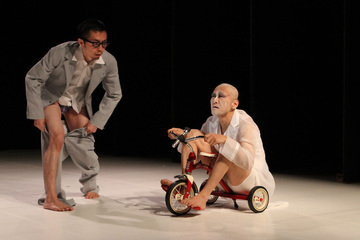
kind of place. I've shown up to review a dance version of "Medusa" without anyone
mentioning that there would be lots of talking--in Japanese. Or, a couple of Sundays
ago, only half the advertised performers actually performed. The other half had
gone the day before. <o:p></o:p></span></font></p>

<p class="MsoNormal"><font style="font-size: 1.25em;"><span style="font-family: &quot;Iskoola Pota&quot;;">This easy spirit is
perfect for the La Mama Moves festival, which just finished up (sorry!) its
glorious three weeks. The festival was experimental in the root sense: artists
goofing around.<span style="">&nbsp; </span><span style="">&nbsp;</span><o:p></o:p></span></font></p>

<p class="MsoNormal"><font style="font-size: 1.25em;"><span style="font-family: &quot;Iskoola Pota&quot;;">On the Mavericks in
Motion program on May 18, the pieces made especially for the occasion--and probably
in short time--were dopey, gross, brawling, oozy, highly allusive, and very much
of the moment. (Heather Olson's solo, excerpted from her Dance Theater Workshop
premiere in March, "Curious Awake Not Possible," was naturally more polished. I
don't know what I would have thought of the drama as a whole, but this part,
with the always-splendid Olson doing the dancing, possessed a compelling oddness
and clarity.) <o:p></o:p></span></font></p>

<p class="MsoNormal"><font style="font-size: 1.25em;"><span style="font-family: &quot;Iskoola Pota&quot;;">Aaron Draper's
"Fruitshake Polaroid" calls to mind food commercials--all of them--where food fills
in for some other appetite. A man and woman dance, romance, and stuff their
faces with Ho-Hos. <o:p></o:p></span></font></p>

<p class="MsoNormal"><font style="font-size: 1.25em;"><span style="font-family: &quot;Iskoola Pota&quot;;">You may say, okay,
I get how that's gross, oozy, and allusive, but <i style="">new</i>? The references in the other dances aren't of recent vintage, either: not the psychedelic
light shows or the grunge spirit that cinematographer Ray Roy's "Red Light
Special" brings to mind, nor the cassette tapes featured prominently in Julian Barnett's "Sound
Memory." But what <i>does</i> feel current is the very plenitude of retro allusions--the ease with which the choreographers borrow from the past.<span style="">&nbsp; </span><o:p></o:p></span></font></p>

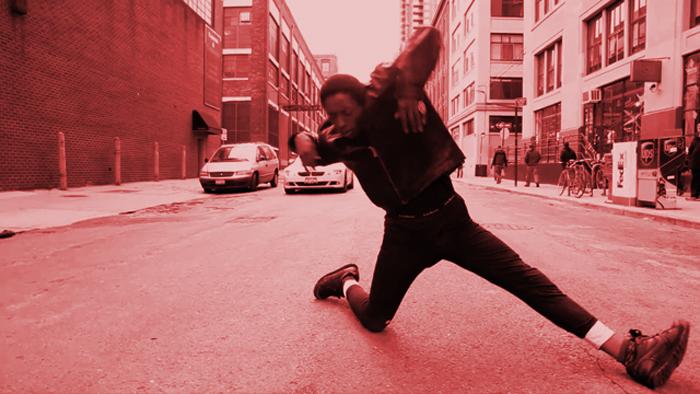
<p class="MsoNormal"><font style="font-size: 1.25em;"><span style="font-family: &quot;Iskoola Pota&quot;;">"Red Light Special"
sets the scene with a video screen behind the dancers multiplying them
tenfold in red and green as they move sluggishly in the flesh. It comes into its own when pasty-faced
Roy, in boxer shorts, and his two lady companions, in hoodies and
underpants, plunk down in a row of institutional metal folding chairs and spread
their legs, subway style. <br /></span></font></p><p class="MsoNormal"><font style="font-size: 1.25em;"><span style="font-family: &quot;Iskoola Pota&quot;;">Roy is getting off in a clammy, crackhead way on the
nearness of them, while they, looking slovenly and hung over, are maintaining a
heavy-lidded glumness, like he found them that day at the Laundromat after
someone had stolen their clothes. If the American Apparel models let some natural
light into their fluorescent cubes, it might look like this. <o:p></o:p></span></font></p>

<p class="MsoNormal"><font style="font-size: 1.25em;"><span style="font-family: &quot;Iskoola Pota&quot;;">As I've complained on Foot more than once about the lack of movement invention among
youngish choreographers, I should say that they <i>are </i>keen on the social realm. My favorite example on Sunday--the whole
year, even--was Julian Barnett's "Sound Memory (work in progress)."<span style="">&nbsp; </span><o:p></o:p></span></font></p>

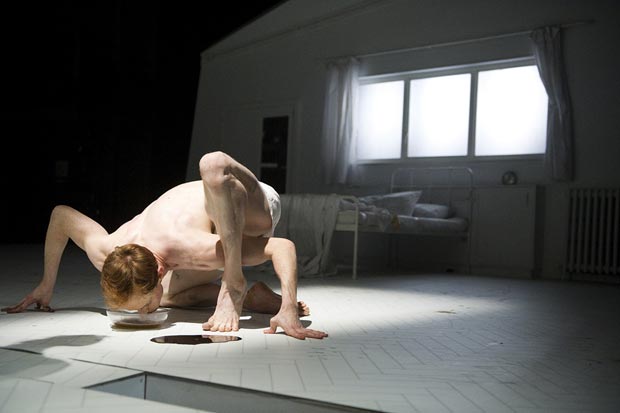
<p class="MsoNormal"><font style="font-size: 1.25em;"><span style="font-family: &quot;Iskoola Pota&quot;;"><br /></span></font></p><span class="mt-enclosure mt-enclosure-image" style="display: inline;"><font style="font-size: 1.25em;"><a href="http://www.artsjournal.com/foot/7_img1530.jpg"><img alt="7_img1530.jpg" src="http://www.artsjournal.com/foot/7_img1530-thumb-448x336.jpg" class="mt-image-none" style="" height="336" width="448" /></a></font></span><p class="MsoNormal"><font style="font-size: 1.25em;"><span style="font-family: &quot;Iskoola Pota&quot;;"><br /></span></font></p><p class="MsoNormal"><font style="font-size: 1.25em;"><span style="font-family: &quot;Iskoola Pota&quot;;"><br /></span></font></p><p class="MsoNormal"><font style="font-size: 1.25em;"><span style="font-family: &quot;Iskoola Pota&quot;;">The piece gives off
such light in its unfinished state that you worry it might lose more than it
gains by being completed. (Then--nature abhorring a vacuum--you figure out what
might be gained and stop worrying.)<o:p></o:p></span></font></p>

<p class="MsoNormal"><font style="font-size: 1.25em;"><span style="font-family: &quot;Iskoola Pota&quot;;">The dance begins in the pitch black. Someone empties a box of cassette tapes onto the floor and scoots them
one by one across the space. It turns out that cassettes dropped and scattered make
a sound so distinct that you can identify it in the dark.<span style=""> </span>"Sound&nbsp; Memory" calls up many things that have
lain in the dark. <o:p></o:p></span></font></p>

<p class="MsoNormal"><font style="font-size: 1.25em;"><span style="font-family: &quot;Iskoola Pota&quot;;">You may only remember
a song's words and tune after it begins, but you usually know in advance how it will
make you feel. It's as if the song were unwinding from you as much as from the
tape: a reverse déjà vu, the song on tape imagined while the song in
you is real. Sometimes the experience is inverted: you realize you've forgotten how
much pleasure a song has given, over and over again. For weeks or months or
years while you were thinking of other things, it held that pleasure, like someone
holding a place for you in line. <o:p></o:p></span></font></p>

<p class="MsoNormal"><font style="font-size: 1.25em;"><span style="font-family: &quot;Iskoola Pota&quot;;">That mix of certainty
and anticipation--everything will proceed in order, and you will have to, you
will get to,<span style=""> </span>take it bit by bit--is
specific to tape-playing. With an iPod or even with a record player (God
forbid!), no one ever has to wait. And with an iPod, you can choose not only a
particular tune but even randomness. (What kind of randomness is it, anyway, if
you get to choose it?) Tape-playing has us wait for what we can't quite
remember until it arrives. <o:p></o:p></span></font></p>

<p class="MsoNormal"><font style="font-size: 1.25em;"><span style="font-family: &quot;Iskoola Pota&quot;;">"Sound Memory" gets
at this boredom and relief, private memory and collective ritual, by very simple
means. Three dancers (Barnett, Patrick Ferreri, and Hanna Kivioja) take turns
picking cassettes off the floor, stuffing them into their individual boom boxes,
and dancing alone to the song. <o:p></o:p></span></font></p>

<p class="MsoNormal"><font style="font-size: 1.25em;"><span style="font-family: &quot;Iskoola Pota&quot;;">Years ago, these songs spent months in heavy rotation. Most of them are like the Counting
Crows' "Mister Jones": dumb lyrics ("...and I felt so symbolic yesterday") and a dumb yet
catchy beat. The dancer occasionally seems to be responding to the lyrics. More
often, the song is only a point of departure--departed from so long ago,
no one could possibly follow the path back. <o:p></o:p></span></font></p>

<p class="MsoNormal"><font style="font-size: 1.25em;"><span style="font-family: &quot;Iskoola Pota&quot;;">Whenever someone says
a dance is left open to our imaginations, I'm pretty sure I won't like it. Doesn't
all dance do that? So what does it mean to announce it? "Sound Memory" doesn't
leave the dance open to our imagination, it explores what an imagination does
with what gets handed to it. The encodedness of this dancing is funny and to
the point. <o:p></o:p></span></font></p>

<p class="MsoNormal"><font style="font-size: 1.25em;"><span style="font-family: &quot;Iskoola Pota&quot;;">The dances to the individual
songs could have been more distinct from person to person and song to song. My
friend Elaine hoped Barnett would deploy a quasi-Cunninghamesque method as he
proceeded: make a bunch of short dances, some of them to specific songs and
some of them randomly assigned a song. The dancers then have this enormous
repertory of dances in their heads--as we have song memories in ours--which they
call up on the instant when a tape is picked off the floor. <o:p></o:p></span></font></p>


<p class="MsoNormal"><font style="font-size: 1.25em;"><span style="font-family: &quot;Iskoola Pota&quot;;">What <i style="">was</i> amazing and rare was the texture--the
way the dance fell in and out of formality. Sometimes it was antitheatrical: the
dancer picking up a tape and plunking it in the player in a thoroughly
pedestrian way, or losing the thread of his improvisation midway and just diddling around. And
sometimes it was tightly rehearsed--the dancers tumbling over each as they progressed along a diagonal late in the piece. Usually when dances alternate back and
forth like this, it means the choreographer doesn't know what he's doing. Here,
it felt like listening to tapes: sometimes you're just listening and sometimes
you're remembering. Sometimes it's in real time and sometimes it has the smooth patina of dream-memory.<span style=""> </span>"Sound Memory (work in
progress)" is the raw and the cooked together.&nbsp; <br /></span></font></p><font style="font-size: 1.25em;"><br /></font><p class="MsoNormal"><font style="font-size: 1em;">Look for Julian Barnett's "Sound Memory" at Danspace Project at St. Mark's Church in March. <br /></font></p><p class="MsoNormal" align="center"><font style="font-size: 1.25em;"><span style="font-family: &quot;Iskoola Pota&quot;;"><o:p>******&nbsp;</o:p><br /></span></font></p><p class="MsoNormal" align="center"><font style="font-size: 1.25em;"><br /><span style="font-family: &quot;Iskoola Pota&quot;;"></span></font></p>

<p class="MsoNormal"><font style="font-size: 1.25em;"><span style="font-family: &quot;Iskoola Pota&quot;;">"Sound Memory" made me think of all sorts of mental habits that current technology has made
obsolete. <o:p></o:p></span></font></p>

<p class="MsoNormal"><font style="font-size: 1.25em;"><span style="font-family: &quot;Iskoola Pota&quot;;">When you called someone
before there were answering machines, you imagined the person
walking to the phone, which was grafted to the wall or planted on a surface. If it kept ringing--and you could let it ring for as long as you wanted--you imagined the
empty house and no one hearing the ring except maybe the dog, if he was home. And
what did it mean to <i style="">him</i>? <o:p></o:p></span></font></p>

<p class="MsoNormal"><font style="font-size: 1.25em;"><span style="font-family: &quot;Iskoola Pota&quot;;">Then there was
being called--the mystery of it. You had no idea who it might be, and you had time to
think about it. Nothing was going to happen if you didn't answer on the fourth
ring except maybe the person would hang up. There was no answering machine to make
you feel like a cheat. If you didn't want to answer, you could count the rings
and extrapolate how much this person really wanted to talk to you (or maybe your sister, mother, father, or brother.) <br /></span></font></p><p class="MsoNormal"><font style="font-size: 1.25em;"><span style="font-family: &quot;Iskoola Pota&quot;;">In the second house
I grew up in, people didn't call much, though they did come by--my mother's
friends and the enticing friends of the artist who lived in our basement.
<o:p></o:p></span></font></p>

<p class="MsoNormal"><font style="font-size: 1.25em;"><span style="font-family: &quot;Iskoola Pota&quot;;">The basement arrangement
was supposed to be temporary--the artist moved in because his girlfriend, who lived
next door, had dumped him. But he was there for years, until another girlfriend
took him in. <o:p></o:p></span></font></p>

<p class="MsoNormal"><font style="font-size: 1.25em;"><span style="font-family: &quot;Iskoola Pota&quot;;">The basement, which
mainly consisted of a carport, had no windows. When he wanted outside light, he'd
open the carport door--his front door--and hang out in the driveway, him and his
paint-speckled friends.<span style=""> </span>The subject of
his paintings, were, appropriately, cars. Big cars, little cars, red cars, blue
cars. <o:p></o:p></span></font></p>

<p class="MsoNormal"><font style="font-size: 1.25em;"><span style="font-family: &quot;Iskoola Pota&quot;;">When he got drunk,
he would call--and call and call and call and call. It was like having the troll who usually stays under the bridge move in. You could practically hear him
dialing before the ringing began. <o:p></o:p></span></font></p>

<p class="MsoNormal"><font style="font-size: 1.25em;"><span style="font-family: &quot;Iskoola Pota&quot;;">My father didn't
live with us, so he was the person I most looked forward to hearing from. For a
year after he died, when the phone would ring I'd be halfway through anticipating
it was him before I remembered it couldn't be. <br /></span></font></p><p class="MsoNormal"><font style="font-size: 1.25em;"><span style="font-family: &quot;Iskoola Pota&quot;;">Then I moved away to
college, and there was nowhere to anchor that tense, achy hope to. <br /></span></font></p><p class="MsoNormal"><font style="font-size: 1.25em;"><span style="font-family: &quot;Iskoola Pota&quot;;">The phone and the
home and the hope were of a piece for me, but I wonder whether in this evermore
portable world the imagination binds itself more and more loosely to places and things.&nbsp;</span></font></p><font style="font-size: 1.25em;"><br /></font><p class="MsoNormal"><font style="font-size: 1.25em;"><br /></font></p>]]>
        
    </content>
</entry>

<entry>
    <title>Saturday May 17, Apollinaire: </title>
    <link rel="alternate" type="text/html" href="http://www.artsjournal.com/foot/2008/05/saturday_may_17_apollinaire.html" />
    <id>tag:www.artsjournal.com,2008:/foot//28.13612</id>

    <published>2008-05-17T19:21:58Z</published>
    <updated>2008-05-17T19:24:59Z</updated>

    <summary>Eleanor Bauer&apos;s refreshing and expansive &quot;At Large&quot;...</summary>
    <author>
        <name>foot in mouth</name>
        <uri>http://www.artsjournal.com/foot/</uri>
    </author>
    
        <category term="topics" scheme="http://www.sixapart.com/ns/types#category" />
    
    
    <content type="html" xml:lang="en-US" xml:base="http://www.artsjournal.com/foot/">
        <![CDATA[Eleanor Bauer's <a href="http://www.artsjournal.com/foot/2008/05/go_eleanor_bauers_at_large.html">refreshing and expansive "At Large"</a> ]]>
        
    </content>
</entry>

<entry>
    <title>GO: Eleanor Bauer&apos;s &quot;At Large&quot;</title>
    <link rel="alternate" type="text/html" href="http://www.artsjournal.com/foot/2008/05/go_eleanor_bauers_at_large.html" />
    <id>tag:www.artsjournal.com,2008:/foot//28.13611</id>

    <published>2008-05-17T18:40:35Z</published>
    <updated>2008-06-27T03:51:56Z</updated>

    <summary> &quot;At Large&quot; is bursting with ideas, dances, experiments in approaching the audience and the world--probably too much of everything, with some of the connecting threads too thin. But how nice for a change, this rigorous excess rather than the...</summary>
    <author>
        <name>foot in mouth</name>
        <uri>http://www.artsjournal.com/foot/</uri>
    </author>
    
        <category term="main" scheme="http://www.sixapart.com/ns/types#category" />
    
    
    <content type="html" xml:lang="en-US" xml:base="http://www.artsjournal.com/foot/">
        <![CDATA[<p></p>

<p></p>


<p class="MsoNormal"><font style="font-size: 1.25em;"><span style="font-family: &quot;Iskoola Pota&quot;;">"At Large" is
bursting with ideas, dances, experiments in approaching the audience and the
world--probably too much of everything, with some of the connecting threads too
thin. But</span><span style="font-family: &quot;Iskoola Pota&quot;;"> how nice for a change, this rigorous excess rather than the usual dour
minimalism or clubby encodedness (like a party where every cluster
is a closed circle--to you, anyway, as you wander, with plastic cup of
bubbly water in hand.) Bauer
herself, who's not even 30, is the perfect exemplar of her aesthetic-- a bold,
big-boned, luscious, comic dancer, elastic in her morphing from Broadway to
hiphop to <i>bharatanatyam </i>to a modern-dance windy tangle of moves. The world is
her oyster--and she invites us in. <o:p></o:p></span></font></p>

<p class="MsoNormal"><font style="font-size: 1.25em;"><span style="font-family: &quot;Iskoola Pota&quot;;">Anyway, you only
have until tonight, Saturday, to catch it. At the Chocolate Factory Theater, 5-49 49th Ave., Long Island City, Queens.</span></font><font style="font-size: 0.8em;"><i style=""><span style="font-size: 12pt; font-family: &quot;Iskoola Pota&quot;;"> </span></i></font><font style="font-size: 1.25em;"><span style="font-family: &quot;Iskoola Pota&quot;;">Visit Dtw.org for details.&nbsp; <o:p></o:p></span></font></p>


<p class="MsoNormal"><font style="font-size: 1.25em;"><span style="font-family: &quot;Iskoola Pota&quot;;"><o:p>&nbsp;</o:p><br />One prong
of the "At Large" project--the show is only one aspect --is a lovely pocket-sized
booklet that we all get a copy of when we attend the show. A whole bunch of
dancers and choreographers respond to questions with potentially no end to answers,
such as "Why do you dance?" "Why do you make dances?" "Why do you go to see
dance?" <o:p></o:p></span></font></p>


<p class="MsoNormal"><font style="font-size: 1.25em;"><span style="font-family: &quot;Iskoola Pota&quot;;"><o:p></o:p>The answers get less interesting as they go. Almost everyone has something striking to
say about why they dance. For example: "I dance because I started dancing when I was three and it's
become a condition" and "Becoming a dancer was a way to give a body to my
life, because I was very ghostly." Fewer people get much out of watching <i style="">other people</i>
dance. Most regard it as a professional obligation. Here's a wry example: "[B]eing in the field for a long time, it's very rare but
sometimes dance performances, the performers, the dances, can....<i style="">touch me." Hee hee</i>.<i style=""> </i>I also love this response:
"I'm looking for a complexity I understand, not a complexity that I feel I
should understand and don't." Down with guilt-inducing obscurantism! <o:p></o:p></span></font></p>


<p class="MsoNormal"><font style="font-size: 1.25em;"><span style="font-family: &quot;Iskoola Pota&quot;;">Speaking of which and otherwise apropos of nothing, here
are a couple of sentences from the eminently grouchy cultural critic Theodor Adorno. The
book is his turgid yet intriguing <i style="">Aesthetic
Theory</i>. </span><span style="font-family: &quot;Iskoola Pota&quot;;">It has been lying around my apartment for a long while, and I have finally assigned myself a couple of sentences a day. </span><span style="font-family: &quot;Iskoola Pota&quot;;">Each sentence is its own puzzle--with the one preceding and following not helping much. As for these two from page 6, I know what he means...</span></font></p><blockquote><p class="MsoNormal"><font style="font-size: 1.25em;"><span style="font-family: &quot;Iskoola Pota&quot;;">The basic levels of experience that motivate art are related to those of the world from which they recoil. The unsolved
antagonism of reality <i>returns in artworks as problems of form.</i>&nbsp; [Emphasis added.]</span><span style="font-family: &quot;Iskoola Pota&quot;;"></span></font></p></blockquote>

<p> </p>]]>
        
    </content>
</entry>

<entry>
    <title>May 10, Lori Ortiz and Apollinaire:</title>
    <link rel="alternate" type="text/html" href="http://www.artsjournal.com/foot/2008/05/may_10_lori_ortiz_and_apollina.html" />
    <id>tag:www.artsjournal.com,2008:/foot//28.13525</id>

    <published>2008-05-10T15:35:51Z</published>
    <updated>2008-05-10T15:37:29Z</updated>

    <summary>war dances and the new Inertia Movement...</summary>
    <author>
        <name>foot in mouth</name>
        <uri>http://www.artsjournal.com/foot/</uri>
    </author>
    
        <category term="topics" scheme="http://www.sixapart.com/ns/types#category" />
    
    
    <content type="html" xml:lang="en-US" xml:base="http://www.artsjournal.com/foot/">
        <![CDATA[<a href="http://www.artsjournal.com/foot/2008/05/far_and_other_war_dances_this.html">war dances and the new Inertia Movement</a> ]]>
        
    </content>
</entry>

<entry>
    <title>&quot;Far,&quot; &quot;tanks under trees,&quot; other war dances, and the new Inertia Movement</title>
    <link rel="alternate" type="text/html" href="http://www.artsjournal.com/foot/2008/05/far_and_other_war_dances_this.html" />
    <id>tag:www.artsjournal.com,2008:/foot//28.13524</id>

    <published>2008-05-10T14:58:03Z</published>
    <updated>2008-06-27T03:53:15Z</updated>

    <summary><![CDATA[I received this email recommendation from freelance dance writer Lori Ortiz of&nbsp; exploredance.com and the Performance Arts Journal yesterday: &nbsp; Hi Apollinaire,&nbsp;I saw Douglas Dunn's press preview of "tanks under trees" last night. The show runs through Sunday at his...]]></summary>
    <author>
        <name>foot in mouth</name>
        <uri>http://www.artsjournal.com/foot/</uri>
    </author>
    
        <category term="main" scheme="http://www.sixapart.com/ns/types#category" />
    
    
    <content type="html" xml:lang="en-US" xml:base="http://www.artsjournal.com/foot/">
        <![CDATA[<p class="MsoNormal"><font style="font-size: 1em;"><i><font style="font-size: 1.25em;"><span style="font-family: &quot;Iskoola Pota&quot;;">I received this email recommendation from <a href="http://www.loriortiz.com/">freelance dance writer Lori Ortiz</a> of&nbsp; exploredance.com and the Performance Arts Journal yesterday: <o:p></o:p></span></font></i></font></p>

<p class="MsoNormal"><font style="font-size: 1.25em;"><span style="font-family: &quot;Iskoola Pota&quot;;"><o:p>&nbsp;</o:p></span></font></p>

<blockquote><p class="MsoNormal"><font style="font-size: 1.25em;"><span style="font-family: &quot;Iskoola Pota&quot;;">Hi Apollinaire,<o:p></o:p></span></font></p><p class="MsoNormal"><font style="font-size: 1.25em;"><span style="font-family: &quot;Iskoola Pota&quot;;"><o:p>&nbsp;</o:p>I saw Douglas
Dunn's press preview of "tanks under trees" last night. The show runs
through Sunday at his SoHo loft, which he has turned into a theater with
stadium seating. It's an opportunity to see amazingly evocative dancing by
Dunn, Liz Filbrun, Paul Singh, and Christopher Williams--dancers we can never
see enough of. Also if you haven't heard poet Anne Waldman read, there's
another must-see. She moves among the dancers and is totally invested. It's
completed by Mimi Gross's paintings--real, made with a brush-- and has live
cello and percussion. <o:p></o:p></span></font></p><p class="MsoNormal"><font style="font-size: 1.25em;"><span style="font-family: &quot;Iskoola Pota&quot;;"><o:p>&nbsp;</o:p>I am telling you
about it because it's one of only two companies I've seen this season that
directly addresses Iraq. (The other is Rebecca Kelly Ballet.) It is so
important that some artists are attentive. Although<span style="">&nbsp; </span>"tanks under trees" is mostly about
environmental doom, it ends strongly on an upbeat. The dance is loaded and
energizing. Even palliative. <o:p></o:p></span></font></p><p class="MsoNormal"><font style="font-size: 1.25em;"><span style="font-family: &quot;Iskoola Pota&quot;;"><o:p>&nbsp;</o:p>Lori<o:p></o:p></span></font></p></blockquote>


<p class="MsoNormal"><font style="font-size: 1.25em;"><span style="font-family: &quot;Iskoola Pota&quot;;"><o:p>&nbsp;</o:p></span></font></p>

<p class="MsoNormal"><font style="font-size: 1.25em;"><span style="font-family: &quot;Iskoola Pota&quot;;">Apollinaire
responds: Lori, thanks for the heads up. Yes, Douglas Dunn's dances can be wonderful--and his dancers always are. Readers, take note. <br /></span></font></p><p class="MsoNormal"><font style="font-size: 1.25em;"><span style="font-family: &quot;Iskoola Pota&quot;;">I'm
always on
the lookout for dances that address Iraq, too, directly or indirectly.
Recent ones
I've seen have included Los Angelena Victoria Marks' "Not About Iraq
Dance" at
Danspace (intermittently effective--still, worth seeing),
British-Bangladeshi Akram Khan and Belgian-Moroccan Sidi
Larbi Cherkaoui's <a href="http://www.artsjournal.com/foot/2008/04/go_akram_khan_and_sidi_larbi_c.html">astounding "zero degrees" </a>at City Center and, yesterday, French Algerian Rachid
Ouramdane's "Far...," which goes the route of most young choreographers
vis a vis the war: a lot of lying around plus some variation of shaking in place.
(Ouramdane's shaking was more fluid than most: a variation on hiphop popping and locking.)</span><br /></font></p><font style="font-size: 1em;"><br /></font><span class="mt-enclosure mt-enclosure-image" style="display: inline;"><font style="font-size: 1em;"><a href="http://www.artsjournal.com/foot/rachid.jpg"><img alt="rachid.jpg" src="http://www.artsjournal.com/foot/rachid-thumb-300x198.jpg" class="mt-image-none" style="" height="198" width="300" /></a></font></span><p class="MsoNormal"><font style="font-size: 1em;"><br /></font></p><p class="MsoNormal"><font style="font-size: 1.25em;"><span style="font-family: &quot;Iskoola Pota&quot;;">
Alastair Macaulay of the Times <a href="http://www.nytimes.com/2008/05/10/arts/dance/10rach.html?ref=dance">was very impressed</a>, but he hasn't been
here long enough to be worn out by the inertia. Inertia is the new movement, as the glossies might put it. It was
interesting for the first couple of years, but by now it would be
better to say something than to say over and over again that you are
too traumatized to say anything. When everyone's doing this, it may be
just as heartfelt as when only one person is, but it doesn't feel that
way. <br /></span></font></p><p class="MsoNormal"><font style="font-size: 1.25em;"><span style="font-family: &quot;Iskoola Pota&quot;;">"Far..." compensates for the movement cliches with its use of voice and face and web of space. The heart of
the piece is spoken testimonies--very relaxed, conversational--from the
choreographer's mother, plus other people Ouramdane's age also viewing the war through the semi-obscured lens of their parents. The Vietnam War,
as it happens, but we get the connection. <br /></span></font></p><p class="MsoNormal"><font style="font-size: 1.25em;"><span style="font-family: &quot;Iskoola Pota&quot;;">While we hear the person on tape, a
door-shaped screen at an oblique angle reveals a part of his face--like the memory we're getting only some shadowy version of. On the floor are mirrors like midnight lakes, as if we were looking
down on a map of a terrain bleached of color and light. A skein of strings only one shade lighter
than the gray ground--subtle, flickering in and out of
consciousness--webs between these dark reflective surfaces. Everything is bathed in Pierre
LeBlanc's midnight-blue light. The club music that
alternates with the speaking ricochets across the space, too. I like
Macaulay's point that the piece journeys through a collective unconscious (though I
would say it's a <i>semiconscious</i>). <br /></span></font></p><font style="font-size: 1em;">&nbsp; </font><font style="font-size: 1.25em;"><span style="font-family: &quot;Iskoola Pota&quot;;"><o:p>About war pieces or the lack thereof, Lori, </o:p>I'm surprised there aren't more movement works, given how bodily warfare is</span></font><font style="font-size: 1em;"><span style="font-family: &quot;Iskoola Pota&quot;;"></span></font><font style="font-size: 1.25em;"><span style="font-family: &quot;Iskoola Pota&quot;;">. A
choreographer could
do so much with the ducking, the scrambling, the marching, the
machismo, the
intimidating, the torturing and being tortured, the barreling around in Humvees, the being blown up. I
know, I know: someone's going to say this is a hokey idea, and
presumptuous to imitate a war we're so removed from. It doesn't have to be
hokey, though. If you unloaded the movement from its generic meanings, took it apart piece by piece to see what the movement itself said, there
might be something there. Or a choreographer could do the opposite--work with the cartoon notions of the foreigner and us the "rescuers,"&nbsp; as in </span></font><font style="font-size: 1.25em;"><span style="font-family: &quot;Iskoola Pota&quot;;">the "South Park" boys' brilliant, hilarious animated movie </span></font><font style="font-size: 1.25em;"><span style="font-family: &quot;Iskoola Pota&quot;;">"Team America." <br /><br />But choreographers would have to be interested in movement. </span></font><font style="font-size: 1.25em;"><span style="font-family: &quot;Iskoola Pota&quot;;">The current generation of experimentalists mainly isn't. </span></font><font style="font-size: 1.25em;"><span style="font-family: &quot;Iskoola Pota&quot;;">I probably would have liked "Far..." more if it hadn't reminded me that contemporary choreographers with structural or conceptual savvy invariably offer mostly muttery moves. </span></font><font style="font-size: 1.25em;"><span style="font-family: &quot;Iskoola Pota&quot;;"></span></font><font style="font-size: 1em;"><br /></font><font style="font-size: 1.25em;"><span style="font-family: &quot;Iskoola Pota&quot;;"><br />Is speaking </span></font><font style="font-size: 1.25em;"><span style="font-family: &quot;Iskoola Pota&quot;;">through movement </span></font><font style="font-size: 1.25em;"><span style="font-family: &quot;Iskoola Pota&quot;;">(about something other than one's muteness) now considered an uptight thing--the exclusive domain of nerds and dorks? </span></font><font style="font-size: 1em;"><br /><br /><br />UPDATE, Monday a.m.: Lori Ortiz and Foot contributor Eva Yaa Asantewaa offer interesting responses <a href="http://www.artsjournal.com/foot/2008/05/far_and_other_war_dances_this.html#comments">here.<br /><br /><br /></a><i>Photo of Rachid Ouramdane in "Far..." by Julien Jourdes, borrowed from the New York Times. <br /><br />When you're feeling refreshed, there's also my son of "Watermill" post, on Robbins' "Dybbuk," <a href="http://www.artsjournal.com/foot/2008/05/on_the_other_hand_dybbuk_the_f.html">here</a>.<br /></i></font>]]>
        
    </content>
</entry>

</feed>