Williams and Tsien on How Philly Barnes Will Be Different (and whether it should move)

Rendering of the planned Philly Barnes: Permanent collection galleries are the rectangle in the foreground; behind and above, the light box over a connecting courtyard; behind and wrapping around the light box, the L-shaped entry pavilion with temporary exhibition space on the right
During my recent conversation with architects Tod Williams and Billie Tsien after their successful presentation to the Philadelphia Arts Commission of their plans for the Barnes Foundation's new facility, I experienced one of those "did he really say that?" moments.
Williams told me:
We need the galleries to be in a way identical [to the originals in Merion], but we also need to lift them up. There are people---maybe you, even we [emphasis added]---who realize that there are issues with moving this collection. So when they move it, we want it to feel better and be better, and be everything we [not Dr. Barnes?] want it to be."Even we"?!?
I did my internal double-take but let it pass, because had I questioned further, I likely would have gotten one of those unwelcome, retroactive "off-the-record" requests. I later checked my tape to make sure I heard it right.
So how will the maybe-it-shouldn't-move Barnes Collection "be better"? For one thing, the layout will not be identical to that of the old Barnes, because each gallery floor will be interrupted by a classroom and an internal garden. Visitors will not move directly into the galleries, but through a large entry pavilion (behind the white light box shown in the photo above).
As for other differences, here are some excerpts from my conversation with the architects:
Williams: The lighting will be, I believe, dramatically better.Less calming is the busy-looking exterior, which Williams called "a kind of syncopation. We're trying to make the exterior a kind of cloth---a tapestry of stone and hardware [the visible steel on which the limestone panels are hung]....
Tsien: The top floor will be naturally lit. We're bringing in natural light to the galleries. I think that will be very transformative and very subtle.
Williams: I think the main gallery flooring is very badly done. I think it was handed off to a hack. There are three different stones on the main gallery floor....There's a porphyry edge that runs up....
We're hoping that the eyes will better focus on the art. I find it's hard to see the paintings because of the lighting and because of stripes on the floor. To the extent that we can make it a more calming space, we think that you'll be better able to see.
Rosenbaum: In what ways will the lighting be changed?
Williams: We will have windows that will enable you to look out. They will allow only 15 percent of the exterior light to come in. But that will emotionally connect you to the landscape that we don't see in Merion. When I go into Merion, I'm looking at the paintings but I don't feel the arboretum that I'm in. We will make you feel more that you're in a lively, changing environment that, I guess, is the way he [Albert Barnes] had to intend it, since he put it in an arboretum and put windows in [now covered over].
Rosenbaum: Natural light makes it easier to see the art, but sometimes it can also harm the art.
Tsien: We'll have very good filtering, in terms of the technology. On the top floor, there are only two galleries with skylights now, but all of the top-floor galleries will be skylighted
Williams: Most visitors don't go up to the second level. They think the first level is it. So we want to make sure the second level feels atractive. Mostly the details we're working on are to calm your experience.
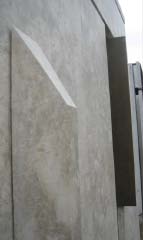
"While we had several other stones up there [on the construction site], they had no character from a distance and this has to be able to project itself. You have to be able to read it from the [Benjamin Franklin] Parkway....You'll see [on the facade] a stone that protrudes, which is our idea of a vertical bar, to give some exterior relief. And you'll also see a piece of bronze that's there as a way to catch light when the sunlight hits it."

The vertical stone bar, left; the hammered bronze fin, right
Williams responded to the complaints of some critics about the obtrusiveness of the light box by saying that it will be more subtle than it appears in the renderings. The plans submitted to the Arts Commission say that "the light canopy will have a delicate, diffused glow."
Others have criticized the placement of the entrance for the facility. It's not in the replacement for the Merion building, which faces the grand Benjamin Franklin Parkway (leading to the Philadelphia Museum of Art), but in the new pavilion behind it, steps away from the Barnes' 80-car parking lot and across from a Whole Foods store on Pennsylvania Avenue. Not long ago, this spot was the entry location for the juvenile detention facility, fronting on Pennsylvania, that formerly occupied the Barnes site.
Williams said that it would not have been possible to have the entrance on the Benjamin Franklin Parkway and keep the southern orientation of the gallery windows that Barnes and Matisse had wanted.
Others have criticized the placement of the entrance for the facility. It's not in the replacement for the Merion building, which faces the grand Benjamin Franklin Parkway (leading to the Philadelphia Museum of Art), but in the new pavilion behind it, steps away from the Barnes' 80-car parking lot and across from a Whole Foods store on Pennsylvania Avenue. Not long ago, this spot was the entry location for the juvenile detention facility, fronting on Pennsylvania, that formerly occupied the Barnes site.
Williams said that it would not have been possible to have the entrance on the Benjamin Franklin Parkway and keep the southern orientation of the gallery windows that Barnes and Matisse had wanted.
As for the more fundamental criticism---that the gallery shouldn't be moved at all---dealer and former Barnes art advisory committee member Richard Feigen (rebutted here by the Barnes' new general counsel, Brett Miller) and LA Times art critic Christopher Knight have weighed in once again, spurred by the posting (click on "Transcript of Dr. Watson's speech) of the speech delivered by Barnes chairman Bernard Watson at the Nov. 13 groundbreaking ceremony.
Like Miller, I don't agree with characterizing the transfer to Philadelphia as a "theft." I think that the Pennsylvania and Philadelphia powers-that-be understandably wanted to lure that valuable cultural resource to the big city. The Barnes board, to my mind, wrongly capitulated to that pressure. It was derelict in its own duty when it let the political and philanthropic movers-and-shakers have their way.
If it truly wanted to save the Merion Barnes, the board should have been far more proactive in taking steps (such as those that I outlined in my NY Times Op-Ed) that could have made it financially viable in the location where Barnes intended it to remain in perpetuity.
As Feigen (who had testified on the day when I attended the court hearings on whether the Barnes should be permitted to move) recently wrote in the Art Newspaper:
A small part, perhaps $25 million, of the vague financing plans, which include $107 million earmarked [but not entirely allocated] from the state capital budget for the new building, could easily provide an endowment for the Barnes in its historic location. Insufficient effort has been made to tap private sources for the old Barnes. Insufficient effort has been made to sell the redundant real estate of Barnes's valuable farm, its 19th-century American pottery collection or unrestricted paintings in the offices, which have been appraised at more than $30 million.In Knight's words:
In a nutshell he [Watson] says the board tried to keep the financially strapped Barnes intact and in place, which proved to be impossible. So, to save it they opted for the next best solution: moving.In other words, the Barnes was too big not to fail in Merion. It had to be characterized as not saveable on Latch's Lane, so that it could be transported to the Parkway. It wasn't theft; it was surrender without a struggle. It was the path of least resistance for a board that has now aligned itself with the financial and political elite---the kind of people that Albert Barnes always said he had no use for.
I don't believe it. I believe that boosting cultural tourism in Philadelphia was always the goal, and the Barnes' fabled art collection was the key. (Watson also chaired the Pennsylvania Convention Center Authority, a local tourism agency, and he once told the Inquirer the Barnes "belongs" downtown.)
With the cultural tourism goal set, moving all those paintings by Picasso, Matisse, van Gogh and the rest into the city from suburban Merion, where they couldn't be profitably maximized, was the only answer.
January 20, 2010 2:21 PM
| Permalink
|
About
CULTUREGRRL (Lee Rosenbaum) is the artworld's award-winning "best blog."

Photo © by Jill Krementz
CULTUREGRRL SPEAKS on museum issues and ethics, arts journalism.
CONTACT ME: here.
CULTUREGRRL VIDEOS
My YouTube Channel
FIND ME ON

FOLLOW ME ON
LEE ROSENBAUM I'm a veteran cultural journalist with many pieces in the New York Times, Wall Street Journal and major art magazines. I have been a cultural contributor on New York Public Radio (WNYC and WQXR) and have provided arts commentary on NPR and public radio stations in Philadelphia and Los Angeles. I am a HuffPost Arts writer. I've been profiled on the PBS NewsHour with Jim Lehrer's Art Beat and in the Chicago Reader. I've appeared as an art-market commentator on BBC-TV and have published numerous Op-Ed pieces in the New York Times and Los Angeles Times. I am author of The Complete Guide to Collecting Art (Knopf) and have lectured on cultural property issues at the New Acropolis Museum and the University of Pennsylvania, on deaccessioning at at Investigative Reporters and Editors 2011 Annual Meeting, Columbia Law School, the University of Iowa and a conference of the Museum Association of New York, on museum governance and cultural property issues at Seton Hall University, on arts blogging at American University and on Smithsonian exhibition controversies at Rutgers University.
more
CONTACT ME
Write to me here.
more
Photo © by Jill Krementz
CULTUREGRRL SPEAKS on museum issues and ethics, arts journalism.
CONTACT ME: here.
CULTUREGRRL VIDEOS
My YouTube Channel
FIND ME ON
FOLLOW ME ON
________________________
moreLEE ROSENBAUM I'm a veteran cultural journalist with many pieces in the New York Times, Wall Street Journal and major art magazines. I have been a cultural contributor on New York Public Radio (WNYC and WQXR) and have provided arts commentary on NPR and public radio stations in Philadelphia and Los Angeles. I am a HuffPost Arts writer. I've been profiled on the PBS NewsHour with Jim Lehrer's Art Beat and in the Chicago Reader. I've appeared as an art-market commentator on BBC-TV and have published numerous Op-Ed pieces in the New York Times and Los Angeles Times. I am author of The Complete Guide to Collecting Art (Knopf) and have lectured on cultural property issues at the New Acropolis Museum and the University of Pennsylvania, on deaccessioning at at Investigative Reporters and Editors 2011 Annual Meeting, Columbia Law School, the University of Iowa and a conference of the Museum Association of New York, on museum governance and cultural property issues at Seton Hall University, on arts blogging at American University and on Smithsonian exhibition controversies at Rutgers University.
more
CONTACT ME
Write to me here.
more
Blogroll
About Last Night
Art History Newsletter
Art Law Blog
Art Observed
The Art Tribune (France)
Art Unwashed (Laura Gilbert)
Artopia
bloggers@brooklynmuseum
Design Observer
A Don's Life
Edward Lifson
Exhibitionist (Boston)
Eye Level (SAAM)
HuffPost Arts
LA Observed (Los Angeles)
Looting Matters
NewYorkology--Architecture
NewYorkology--Museums
Opera Chic
Slipped Disc (Norman Lebrecht)
Slog (Seattle)
Unframed (LACMA)
Walker
AJ Blogs
AJBlogCentral | rssculture
About Last Night
Terry Teachout on the arts in New York City
Artful Manager
Andrew Taylor on the business of arts & culture
blog riley
rock culture approximately
critical difference
Laura Collins-Hughes on arts, culture and coverage
Dewey21C
Richard Kessler on arts education
diacritical
Douglas McLennan's blog
Dog Days
Dalouge Smith advocates for the Arts
Flyover
Art from the American Outback
lies like truth
Chloe Veltman on how culture will save the world
Life's a Pitch
For immediate release: the arts are marketable
Mind the Gap
No genre is the new genre
Performance Monkey
David Jays on theatre and dance
Plain English
Paul Levy measures the Angles
Real Clear Arts
Judith H. Dobrzynski on Culture
Rockwell Matters
John Rockwell on the arts
State of the Art
innovations and impediments in not-for-profit arts
Straight Up |
Jan Herman - arts, media & culture with 'tude
dance
Foot in Mouth
Apollinaire Scherr talks about dance
Seeing Things
Tobi Tobias on dance et al...
jazz
Jazz Beyond Jazz
Howard Mandel's freelance Urban Improvisation
ListenGood
Focus on New Orleans. Jazz and Other Sounds
Rifftides
Doug Ramsey on Jazz and other matters...
media
Out There
Jeff Weinstein's Cultural Mixology
Serious Popcorn
Martha Bayles on Film...
classical music
Creative Destruction
Fresh ideas on building arts communities
The Future of Classical Music?
Greg Sandow performs a book-in-progress
Overflow
Harvey Sachs on music, and various digressions
PianoMorphosis
Bruce Brubaker on all things Piano
PostClassic
Kyle Gann on music after the fact
Sandow
Greg Sandow on the future of Classical Music
Slipped Disc
Norman Lebrecht on Shifting Sound Worlds
The Unanswered Question
Joe Horowitz on music
publishing
book/daddy
Jerome Weeks on Books
Quick Study
Scott McLemee on books, ideas & trash-culture ephemera
theatre
Drama Queen
Wendy Rosenfield: covering drama, onstage and off
visual
Aesthetic Grounds
Public Art, Public Space
Another Bouncing Ball
Regina Hackett takes her Art To Go
Artopia
John Perreault's art diary
CultureGrrl
Lee Rosenbaum's Cultural Commentary