Creative Destruction: February 2011 Archives
 Recently, I have been reading Lewis Hyde's absolutely brilliant book, The Gift: How the Creative Spirit Transforms the World, and today ran across two quotes that seem to speak to the events of this week.
As we all know, this has been a period in which the Detroit Symphony Orchestra canceled the remainder of its season due to the impasse between musicians and management, and in which the House of Representatives gutted the National Endowment for the Arts as part of its version of the continuing resolution legislation necessary to avoid a government shutdown in early March.
Such moments are disconcerting, because we look for meaning as we try to frame our response. It is too big for any single one of us to handle. There is a feeling of losing direction and momentum; an interruption of life as it had been.
Perhaps that is why the quotes in this book were so powerful to me. I have been trying to make sense of these days. Why does this moment seem so threatening?
The first passage is Hyde's own quoting of Joseph Conrad, who, in writing about the role of the artist, says:
He speaks to our capacity for delight and wonder, to the sense of mystery surrounding our lives; to our sense of pity, and beauty, and pain: to the latent feeling of fellowship with all creation - to the subtle but invincible conviction of solidarity that knits together the loneliness of innumerable hearts, to the solidarity . . . which binds together all humanity - the dead to the living and the living to the unborn.
As a musician, I stopped and reflected. Those of us living today, creating at this moment, are part of the long conversation that has occupied mankind from the very beginning. Yet the events of the past week threaten that conversation in some way, and it has taken a toll on many of us who sense that this is beyond our capacity to hold back the tide. It is as if there is a fever that has to rise, to break, and, only then subside - but at what price to all of us? What will be left after this fever has passed?
I returned to the book and, a few pages later, was stunned to read this passage written by Hyde himself:
In first introducing these two Greek terms, I said that it is bios-life - individual and embodied - that dies, while zoë-life is the unbroken thread, the spirit that survives the destruction of its vessels. But here we must add that zoë-life may be lost as well when there is wholesale destruction of its vehicles. The spirit of a community or collective can be wiped out; tradition can be destroyed. We tend to think of genocide as the physical destruction of a race or group, but the term may be aptly expanded to include the obliteration of the genius of a group, the killing of its creative spirit through the destruction, debasement, or silencing of its art.... Those parts of our being that extend beyond the individual ego cannot survive unless they can be constantly articulated. And there are individuals - all of us, I would say, but men and women of spiritual and artistic temperament in particular - who cannot survive, either, unless the symbols of zoë-life circulate among us as a commonwealth.
This is the significance of this time in our lives. The fever of the moment has the capacity to destroy, debase and silence us. The vehicles of the long conversation, what Hyde calls zoë-life, are threatened. The unbroken line can be severed in the fever of fiscal "responsibility."
Unlike the purges of 1937 in the Soviet Union, this killing of the creative spirit is not driven by a Stalinesque need to instill fear in the hearts of his people. Instead, this genocide of our genius is justified by abstract numbers.
We are the victims, not of a dictator, but of arithmetic.
Such a moment demands imagination, a willingness to think anew, and the determination necessary to continue the work in the face of seemingly intractable forces.
We must steel ourselves to express what we value as a society. This moment is an aberration, and it can abate, but not if we are all silent. We must quiet our anger, but articulate our values.
There is an old saying that "Truth is the last guest that comes to the table," but, if properly invited, it does arrive at last.
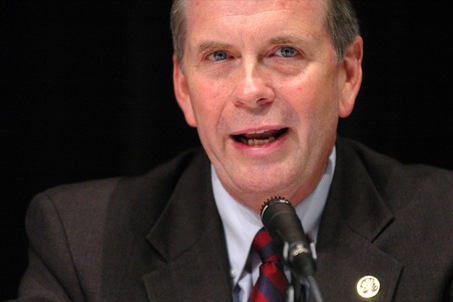
To: Tim Walberg, Congressman, 7th District, Michigan
Dear Congressman Walberg,
As you are aware, we know each other.
You are my congressman; we live in the same county, eat in the same restaurants, shop in the same stores and know the same friends. I have enjoyed having you among the members of the audience in the orchestra where I serve as Music Director. You've attended symphony fund raising events. I know your wife, and I like her. I know and admire people who supported you in your effort to get re-elected. One family, whom I dearly love, even traveled to your swearing-in ceremony.
We are not enemies, but I cannot remain silent on your recent action.
Most probably we don't share the same views on a number of subjects, but I've always thought, and I continue to think, that the primary challenge of being human is to hold to your values while not serving up disrespect to those who don't share them. Most probably you think something similar.
And so, while my letter might seem like an attack, it is not. Instead it is a letter of the strongest possible disagreement. I doubt this letter will affect your thinking. Rather, most probably it will mean that people whom I love will become silent toward me. That is the price I pay for telling you my perception of the truth.
But I can't be silent, because I believe you are wrong, and your thinking can potentially impact the whole country.
You have proposed that the National Endowment for the Arts be drastically cut. Your proposal is intended to be a part of a larger effort to slash the size of the Federal government. This comes in context of an election that brought great gains to the Republican Party. You benefited from that wave of voter discontent, and I believe you are responding to it. Showing in a tangible way that you think government is too large will surely play well to an electorate that is rattled by an economy that continues to deteriorate.
You lost your seat once, and I am sure you don't want to lose it again. You've chosen the NEA as a reasonable target. It is probably not the most important federal agency to this district, and yet, that agency has served us locally. Last year, the orchestra here received $10,000 from the NEA in support of a concert that concluded a two-year composer-in-residence project that resulted in five world premieres.That same music will soon be recorded by the London Symphony Orchestra. That project couldn't have happened without funding from a variety of sources, and the National Endowment for the Arts was one of them.
But, in truth that is not the reason to write this letter. I could not argue that the whole country should be taxed just so that our little county could benefit. Because, to do so would not adequately value what the NEA does.
The NATIONAL Endowment for the Arts is about all of us. It takes a very small token from each person and rewards the whole country with a wealth of art. It encourages small places throughout the United States, places like Lenawee County - your county - to raise their sites toward greater things. It changes the landscape of the nation in its appreciation for beauty and meaning. It is a statement of community rather than of individualism. It is a benefit to the whole.
The National Endowment for the Arts is one of the best-run agencies of the federal government. I have sat on NEA granting committees in the past and was so impressed with the professionalism of the staff, the disciplined thinking in the deliberation process, and the strict following of guidelines leading to the awarding of the grants. I was genuinely proud to serve in its behalf. I felt I had done something truly good for this country, and I left with a new appreciation of what it means to be awarded a grant by the whole nation through the agency of the National Endowment for the Arts.
I agree with you that the deficit has grown. It worries me too. There are things in this government I would choose to cut, but the NEA isn't one of them. Cutting the NEA is a statement of values, and, in my opinion, you're simply wrong on this issue.
I honestly don't know how you can sit in a concert hall full of people of such diverse backgrounds and not understand the value of the arts to a community as a whole. I can't grasp that you could not see that the entire nation is just like this county, and that it NEEDS the joy that the arts bring to all of us. Those arts have collective value. They are worthy of a very small portion of national expenditures. I'm disappointed in you, Tim.
I am sad to say that your proposal to double the proposed amount of money to be cut from the NEA in this budget is a colossal failure of vision. It does damage to all of us, and you do not represent my views as a citizen of this county, state and nation.
Sincerely,
John Thomas Dodson
Blogroll
AJ Ads
AJ Blogs
AJBlogCentral | rssculture
Terry Teachout on the arts in New York City
Andrew Taylor on the business of arts & culture
rock culture approximately
Laura Collins-Hughes on arts, culture and coverage
Richard Kessler on arts education
Douglas McLennan's blog
Dalouge Smith advocates for the Arts
Art from the American Outback
Chloe Veltman on how culture will save the world
For immediate release: the arts are marketable
No genre is the new genre
David Jays on theatre and dance
Paul Levy measures the Angles
Judith H. Dobrzynski on Culture
John Rockwell on the arts
innovations and impediments in not-for-profit arts
Jan Herman - arts, media & culture with 'tude
dance
Apollinaire Scherr talks about dance
Tobi Tobias on dance et al...
jazz
Howard Mandel's freelance Urban Improvisation
Focus on New Orleans. Jazz and Other Sounds
Doug Ramsey on Jazz and other matters...
media
Jeff Weinstein's Cultural Mixology
Martha Bayles on Film...
classical music
Fresh ideas on building arts communities
Greg Sandow performs a book-in-progress
Harvey Sachs on music, and various digressions
Bruce Brubaker on all things Piano
Kyle Gann on music after the fact
Greg Sandow on the future of Classical Music
Norman Lebrecht on Shifting Sound Worlds
Joe Horowitz on music
publishing
Jerome Weeks on Books
Scott McLemee on books, ideas & trash-culture ephemera
theatre
Wendy Rosenfield: covering drama, onstage and off
visual
Public Art, Public Space
Regina Hackett takes her Art To Go
John Perreault's art diary
Lee Rosenbaum's Cultural Commentary